Results by title
151 books match the query 'Radicalism' and 4 start with u

Unite, Proletarian Brothers!
Radicalism and Revolution in the Spanish Second RepublicMatthew Kerry
University of London Press, 2020
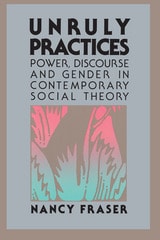
Unruly Practices
Power, Discorse, and Gender in Contemporary Social TheoryFraser, Nancy
University of Minnesota Press, 1989
University of California, Berkeley
Unruly Practices brings together a series of widely discussed essays in feminism and social theory. Read together, they constitute a sustained critical encounter with leading European and American approaches to social theory. In addition, Nancy Fraser develops a new and original socialist-feminist critical theory that overcomes many of the limitations of current alternatives. First, in a series of critical essays, she deploys philosophical and literary techniques to sort the wheat from the chaff in the work of Michel Foucault, the French deconstructionists, Richard Rorty, and Jurgen Habermas. Then, in a group of constructive essays, she incorporates their respective strengths in a new critical theory of late-capitalist political culture.
Fraser breaks new ground methodologically by integrating the previously divergent insights of poststructuralism, critical social theory, feminist theory, and pragmatism. Thematically, she deals with varied forms of dominance and subordination in modern, industrial, late-capitalist societies - especially gender dominance and subordination; state-bureaucratic forms of organization; the institutional politics of knowledge and expertise; and the structure and function of social-welfare programs. In the last section of the book, these themes are integrated in an original theory of “the politics of need interpretation.” This concept becomes the linchpin of he socialist-feminist critical theory proposed in the last chapter.
Uprooting Racism and Racists in the United States
James Boggs and Grace Lee Boggs
Disobedience Press, 2027
“Uprooting Racism and Racists in the United States” has become even more timely and instructive today than when James and Grace Lee Boggs first sounded the alarm in 1970. In this essay, the Boggses diagnose the “essential contradiction” of economic overdevelopment and political underdevelopment, tracing its path through key stages: how racism has been interwoven into U.S. economic development; a destructive national drive for economic growth at all costs; and how subsequent generations of Americans prioritize economics over principles—breeding a collective social irresponsibility that leaves us unable to act ethically in the face of pressing social challenges.
Today, the contradiction the Boggses identified has grown more entrenched—and its consequences more destructive. “Uprooting” helps explain why millions voted for Trump in 2024 despite his demonstrated corruption, why society fails to regulate the expansion of AI and data centers, why we are unable to forestall the climate changes that scientists have long warned against, why immigrants face racist vilification, and why the federal government is intent on erasing the centrality of race to the making of the country. Ultimately, “Uprooting” offers a crucial assessment of where this contradiction began, how it shapes the nation, and where we need to go.
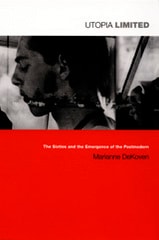
Utopia Limited
The Sixties and the Emergence of the PostmodernMarianne DeKoven
Duke University Press, 2004
DeKoven rigorously analyzes a broad array of cultural and political texts important in the sixties—from popular favorites such as William S. Burroughs’s Naked Lunch to political manifestoes including The Port Huron Statement, the founding document of SDS (Students for a Democratic Society). She examines texts that overtly discuss the conflict in Vietnam, Black Power, and second-wave feminism—including Frances FitzGerald’s Fire in the Lake, James Baldwin’s The Fire Next Time, and Shulamith Firestone’s The Dialectic of Sex; experimental pieces such as The Living Theatre’s Paradise Now; influential philosophical works including Roland Barthes’s Mythologies and Herbert Marcuse’s One-Dimensional Man; and explorations of Las Vegas, the prime location of postmodernity. Providing extensive annotated bibliographies on both the sixties and postmodernism, Utopia Limited is an invaluable resource for understanding the impact of that tumultuous decade on the present.