Results by title
31 books match the query 'Ruins'
Answering the Ruins
PoemsGregory Fraser
Northwestern University Press, 2009

April at the Ruins
Lawrence Raab
Tupelo Press, 2022
—Marina Brown, Los Angeles Review
“Every poem in April at the Ruins is a powerhouse: rich, quietly essential, profoundly lucid. Many have flavors of the best parables or folk tales, bringing us into intimate relation with mysteries and transformations abounding around and inside us…. Raab’s sense of irony is unerring. These poems prove that one of the only true forms of consolation is giving darkness its due.”
—Amy Gerstler
“[T]his collection isn’t just nostalgic. Instead, it is full of wonder. Wonder and the ability to step through wonder into a whole new place.”
—Alexis David, Compulsive Reader
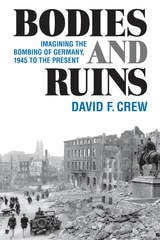
Bodies and Ruins
Imagining the Bombing of Germany, 1945 to the PresentDavid F. Crew
University of Michigan Press, 2017
Bodies and Ruins examines a range of local publications that carried photographic images of German cities destroyed in the air war, images that soon entered the visual memory of World War II. Despite its obvious importance, historians have paid very little attention to the visual representation of the bombing war. This book follows the search for what were considered to be the “right” stories and the “right” pictures of the bombing war in local publications and picture books from 1945 to the present, and is intended for historians as well as general readers interested in World War II, the Allied bombing of German cities, the Holocaust, the history of memory and photographic/visual history.
Economics After Capitalism
A Guide to the Ruins and a Road to the FutureDerek Wall
Pluto Press, 2015
Challenging the arguments for markets, mainstream economics and capitalism from Adam Smith onwards, Economics After Capitalism provides a step-by-step guide to various writers, movements and schools of thought, critical of neoliberal globalisation. These range from Keynesian-inspired reformists such as Geroge Soros and Joseph Stiglitz, critics of inequality like Thomas Piketty and Amaitya Sen, to more radical voices including Naomi Klein, Marxists such as David Harvey, anarchists, and autonomists including Toni Negri and Michael Hardt.
By providing a clear and accessible guide to the economics of anti-capitalism, Derek Wall successfully demonstrates that an open source eco-socialist alternative to rampant climate change, elite rule and financial chaos is not just necessary, but possible.
From the Ruins of Enlightenment
Beethoven and Schubert in Their SolitudeRichard Kramer
University of Chicago Press, 2023
Here is Vienna, hosting a congress in 1815 that would redraw national boundaries and reconfigure the European community for a full century. A snapshot captures two of its citizens, each seemingly oblivious to this momentous political environment: Franz Schubert, not yet twenty years old and in the midst of his most prolific year—some 140 songs, four operas, and much else; and Ludwig van Beethoven, struggling through a midlife crisis that would yield the song cycle An die ferne Geliebte, two strikingly original cello sonatas, and the two formidable sonatas for the “Hammerklavier,” opp. 101 and 106. In Richard Kramer’s compelling reading, each seemed to be composing “against”—Beethoven, against the Enlightenment; Schubert, against the looming presence of the older composer even as his own musical imagination took full flight.
From the Ruins of Enlightenment begins in 1815, with the discovery of two unique projects: Schubert’s settings of the poems of Ludwig Hölty in a fragmentary cycle and Beethoven’s engagement with a half dozen poems by Johann Gottfried Herder. From there, Kramer unearths previously undetected resonances and associations, illuminating the two composers in their “lonely and singular journeys” through the “rich solitude of their music.”
Havana beyond the Ruins
Cultural Mappings after 1989Anke Birkenmaier and Esther Whitfield, eds.
Duke University Press, 2011
Contributors
Emma Álvarez-Tabío Albo
Eric Felipe-Barkin
Anke Birkenmaier
Velia Cecilia Bobes
Mario Coyula-Cowley
Elisabeth Enenbach
Sujatha Fernandes
Jill Hamberg
Patricio del Real
Cecelia Lawless
Jacqueline Loss
Orlando Luis Pardo Lazo
Antonio José Ponte
Nicolás Quintana
Jose Quiroga
Laura Redruello
Rafael Rojas
Joseph L. Scarpaci
Esther Whitfield
Health in Ruins
The Capitalist Destruction of Medical Care at a Colombian Maternity HospitalCésar Ernesto Abadía-Barrero
Duke University Press, 2022
Hiking the Road to Ruins
Day Trips and Camping Adventures to Iron Mines, Old Military Sites, and Things Abandoned in the New York City Area ... and BeyondSteinberg, David A
Rutgers University Press, 2007
Each chapter contains detailed directions, a hand-drawn map, suggestions for the optimal time and season to visit, and GPS coordinates to specific sites. Bringing fifteen years of experience as a leader of hikes, Steinberg leaves no part of the trip unplanned. He even suggests ideal conditions for the outing. An overcast day, for instance, sets up the haunted atmosphere appropriate for visiting a water tower in Mountainside, New Jersey, that has links to a murder-suicide in the 1970s.
For less experienced hikers, the guide also includes a chapter on equipment and safety, detailed instructions on how to program a hand-held Global Positioning System receiver, and a glossary of terms.
Both a practical guide and a creative chronicle, this book is bound to please hikers and history buffs alike.
Hiking the Road to Ruins
Daytrips and Camping Adventures to Iron Mines, Old Military Sites, and Things Abandoned in the New York City Area...and BeyondSteinberg, David A
Rutgers University Press, 2015
Imperial Debris
On Ruins and RuinationAnn Laura Stoler, ed.
Duke University Press, 2013
Contributors. Ariella Azoulay, John F. Collins, Sharad Chari, E. Valentine Daniel, Gastón Gordillo, Greg Grandin, Nancy Rose Hunt, Joseph Masco, Vyjayanthi Venuturupalli Rao, Ann Laura Stoler
Lost Russia
Photographing the Ruins of Russian ArchitectureWilliam Craft Brumfield
Duke University Press, 1995
The twentieth century in Russia has been a cataclysm of rare proportions, as war, revolution, famine, and massive political terror tested the limits of human endurance. The results of this assault on Russian culture are particularly evident in ruined architectural monuments, some of which are little known even within Russia itself. Over the past four decades William Craft Brumfield, noted historian and photographer of Russian architecture, has traveled throughout Russia and photographed many of these neglected, lost buildings, poignant and haunting in their ruin. Lost Russia provides a unique view of Brumfield’s acclaimed work, which illuminates Russian culture as reflected in these remnants of its distinctive architectural traditions.
Capturing the quiet, ineffable beauty that graces these buildings, these photographs are accompanied by a text that provides not only a brief historical background for Russian architecture, but also Brumfield’s personal impressions, thoughts, and insights on the structures he views. Churches and monasteries from the fifteenth to the twentieth century as well as abandoned, ruined manor houses are shown—ravaged by time, willful neglect, and cultural vandalism. Brumfield also illustrates examples of recent local initiatives to preserve cultural landmarks from steady decline and destruction.
Concluding with photographs of the remarkable log architecture found in Russia’s far north, Lost Russia is a book for all those concerned with the nation’s cultural legacy, history, and architecture, and with historic and cultural preservation generally. It will also interest those who appreciate the fine art of exceptional photography.
Ruins and Rivals
The Making of Southwest ArchaeologyJames E. Snead
University of Arizona Press, 2001
William P. Clements Center for Southwest Studies, Southern Methodist University
Ruins are as central to the image of the American Southwest as are its mountains and deserts, and antiquity is a key element of modern southwestern heritage. Yet prior to the mid-nineteenth century this rich legacy was largely unknown to the outside world. While military expeditions first brought word of enigmatic relics to the eastern United States, the new intellectual frontier was seized by archaeologists, who used the results of their southwestern explorations to build a foundation for the scientific study of the American past.
In Ruins and Rivals, James Snead helps us understand the historical development of archaeology in the Southwest from the 1890s to the 1920s and its relationship with the popular conception of the region. He examines two major research traditions: expeditions dispatched from the major eastern museums and those supported by archaeological societies based in the Southwest itself. By comparing the projects of New York's American Museum of Natural History with those of the Southwest Museum in Los Angeles and the Santa Fe-based School of American Archaeology, he illustrates the way that competition for status and prestige shaped the way that archaeological remains were explored and interpreted. The decades-long competition between institutions and their advocates ultimately created an agenda for Southwest archaeology that has survived into modern times.
Snead takes us back to the days when the field was populated by relic hunters and eastern "museum men" who formed uneasy alliances among themselves and with western boosters who used archaeology to advance their own causes. Richard Wetherill, Frederic Ward Putnam, Charles Lummis, and other colorful characters all promoted their own archaeological endeavors before an audience that included wealthy patrons, museum administrators, and other cultural figures. The resulting competition between scholarly and public interests shifted among museum halls, legislative chambers, and the drawing rooms of Victorian America but always returned to the enigmatic ruins of Chaco Canyon, Bandelier, and Mesa Verde.
Ruins and Rivals contains a wealth of anecdotal material that conveys the flavor of digs and discoveries, scholars and scoundrels, tracing the origins of everything from national monuments to "Santa Fe Style." It rekindles the excitement of discovery, illustrating the role that archaeology played in creating the southwestern "past" and how that image of antiquity continues to exert its influence today.
Ruins of Modernity
Julia Hell and Andreas Schönle, eds.
Duke University Press, 2009
Several contributors discuss ideas about ruins developed by philosophers such as Immanuel Kant, Georg Simmel, and Walter Benjamin. One contributor examines how W. G. Sebald’s novel The Rings of Saturn betrays the ruins erased or forgotten in the Hegelian philosophy of history. Another analyzes the repressed specter of being bombed out of existence that underpins post-Second World War modernist architecture, especially Le Corbusier’s plans for Paris. Still another compares the ways that formerly dominant white populations relate to urban-industrial ruins in Detroit and to colonial ruins in Namibia. Other topics include atomic ruins at a Nevada test site, the connection between the cinema and ruins, the various narratives that have accrued around the Inca ruin of Vilcashuamán, Tolstoy’s response in War and Peace to the destruction of Moscow in the fire of 1812, the Nazis’ obsession with imperial ruins, and the emergence in Mumbai of a new “kinetic city” on what some might consider the ruins of a modernist city. By focusing on the concept of ruin, this collection sheds new light on modernity and its vast ramifications and complexities.
Contributors. Kerstin Barndt, Jon Beasley-Murray, Russell A. Berman, Jonathan Bolton, Svetlana Boym, Amir Eshel, Julia Hell, Daniel Herwitz, Andreas Huyssen, Rahul Mehrotra, Johannes von Moltke, Vladimir Paperny, Helen Petrovsky, Todd Presner, Helmut Puff, Alexander Regier, Eric Rentschler, Lucia Saks, Andreas Schönle, Tatiana Smoliarova, George Steinmetz, Jonathan Veitch, Gustavo Verdesio, Anthony Vidler
Ruins of the Past
The Use and Perception of Abandoned Structures in the Maya LowlandsTravis W. Stanton
University Press of Colorado, 2008
Ruins, Caves, Gods, and Incense Burners
Northern Lacandon Maya Myths and RitualsDidier Boremanse
University of Utah Press, 2019
Their cult of incense burners, based on the veneration of Maya ruins and funerary caves and the deities these effigy censers represented, remained free of any Christian influence. Some ceremonies were vestiges of more complex rituals believed to date back to pre-Columbian times. In this volume, Didier Boremanse explores Lacandon beliefs and traditions he observed during the many months of fieldwork he did, spanning four decades.
Throughout the book Boremanse makes Lacandon values and worldviews accessible to readers from western cultures. Rituals are described and explained with extracts of the celebrants’ prayers that were tape-recorded, transcribed, and translated. Other elements of religious oral tradition are included, including incantations, chants, and the myths and beliefs that sustain the rites. Boremanse also discusses how larger social change influences religious change, both through economic means and outside influences. Most of the myths retold in this book have never been published in English. Photographs show rites that are no longer performed and shrines that no longer exist.
Ruins
Classical Theater and Broken MemoryOdai Johnson
University of Michigan Press, 2018
Much of the theater of antiquity is marked by erasures: missing origins, broken genres, fragments of plays, ruins of architecture, absented gods, remains of older practices imperfectly buried and ghosting through the civic productions that replaced them. Ruins: Classical Theater and Broken Memory traces the remains, the remembering, and the forgetting of performance traditions of classical theater. The book argues that it is only when we look back over the accumulation of small evidence over a thousand-year sweep of classical theater that the remarkable and unequaled endurance of the tradition emerges. In the absence of more evidence, Odai Johnson turns instead to the absence itself, pressing its most legible gaps into a narrative about scars, vanishings, erasures, and silence: all the breakages that constitute the ruins of antiquity.
In ten wide-ranging case studies, theater history and performance theory are brought together to examine the texts, artifacts, and icons left behind, reading them in fresh ways to offer an elegantly written, extended meditation on “how the aesthetic of ruins offered a model for an ideal that dislodged and ultimately stood in for the historic.”
Sovereignty in Ruins
A Politics of CrisisGeorge Edmondson and Kalus Mladek, editors
Duke University Press, 2017
Contributors. Judith Butler, George Edmondson, Roberto Esposito, Carlo Galli, Klaus Mladek, Alberto Moreiras, Andrew Norris, Eric L. Santner, Adam Sitze, Carsten Strathausen, Rei Terada, Cary Wolfe
Strolling in the Ruins
The Caribbean's Non-sovereign Modern in the Early Twentieth CenturyFaith Smith
Duke University Press, 2023
Survival City
Adventures among the Ruins of Atomic AmericaTom Vanderbilt
University of Chicago Press, 2002
On the road to Survival City, Tom Vanderbilt maps the visible and invisible legacies of the cold war, exhuming the blueprints for the apocalypse we once envisioned and chronicling a time when we all lived at ground zero. In this road trip among ruined missile silos, atomic storage bunkers, and secret test sites, a lost battleground emerges amid the architecture of the 1950s, accompanied by Walter Cotten’s stunning photographs. Survival City looks deep into the national soul, unearthing the dreams and fears that drove us during the latter half of the twentieth century.
“A crucial and dazzling book, masterful, and for me at least, intoxicating.”—Dave Eggers
“A genuinely engaging book, perhaps because [Vanderbilt] is skillful at conveying his own sense of engagement to the reader.”—Los Angeles Times
“A retracing of Dr. Strangelove as ordinary life.”—Greil Marcus, Bookforum

The Choral Turn
Performing the Chorus in the Ruins of DemocracyAmy Holzapfel
University of Michigan Press, 2027
The Choral Turn: Performing the Chorus in the Ruins of Democracy examines the recent resurgence of the chorus—a hallmark of ancient Greek tragedy—across contemporary Western theatre, performance, and activism, arguing that this “choral turn” is inseparable from anxieties about the decline of liberal democracy. Drawing on classical studies, theatre and performance studies, and political philosophy, Holzapfel coins the term “choraperformativity” to describe performances that mobilize the formal and collective conventions of the chorus to contest or reshape dominant political narratives. The Choral Turn uses case studies—plays about war and catastrophe featuring Greek-like choruses, refugee performers theatrically reenacting their own displacement, environmental protesters staging collective mourning for a dying planet—to show how groups use choral performance to demand recognition and assert the need for change. Rather than treating the chorus as inherently progressive, the study asks hard questions about who gets included in these choral communities and who gets left out, offering a nuanced, timely look at collective action on stage and in the streets.
The Conquest of Ruins
The Third Reich and the Fall of RomeJulia Hell
University of Chicago Press, 2019
Hell examines centuries of European empire-building—from Charles V in the sixteenth century and Napoleon’s campaigns of the late seventeenth and early eighteenth centuries to the atrocities of Mussolini and the Third Reich in the 1930s and ’40s—and sees a similar fascination with recreating the Roman past in the contemporary image. In every case—particularly that of the Nazi regime—the ruins of Rome seem to represent a mystery to be solved: how could an empire so powerful be brought so low? Hell argues that this fascination with the ruins of greatness expresses a need on the part of would-be conquerors to find something to ward off a similar demise for their particular empire.
The Orchard in the Ruins
Cloning Oranges and Cultivating Whiteness in America and the Global SouthTiago Saraiva
University of Chicago Press, 2026
Ingeniously connects the history of citrus cultivation to the production and maintenance of whiteness in sites around the world.
In The Orchard in the Ruins, acclaimed historian Tiago Saraiva illuminates the global impact of cloning Californian oranges, a practice that emerged in the aftermath of the great depression of the 1890s. Cloning promised control, uniformity, and resistance to an array of environmental and economic threats. But Californian orchards—white-owned but tended by workers of Chinese, Japanese, Mexican, or Indigenous origin—were also places where plantations and race intertwined. Agricultural anxieties about strains of oranges and their value, Saraiva shows, formed a continuum with anxieties about vanishing whiteness.
The Orchard in the Ruins connects Californian history to other sites of citrus cultivation: South Africa, where concerns about white poverty grew during the early twentieth century; Mandatory Palestine, where orchards were key to Zionist undertakings; colonial Algeria, where French settlers transformed the landscape with European farming techniques; and Brazil, where orchards were cultivated post-abolition. Drawing on local histories as well as the works of John Dewey, J. M. Coetzee, Edward Said, Frantz Fanon, and artist Tarsila do Amaral, Saraiva shows that in each place, orchards grew in the wake of specific historical crises. Orange cultivation was a transnational project in cultivating whiteness, one in which studies of fruits, buds, rootstocks, fungi, and viruses became race-making experiments.
A must-read for anyone interested in the history of science, technology, agriculture, and race, The Orchard in the Ruins reveals a troubled account of science-led attempts to remedy crumbling worlds.
The Past in Ruins
Tradition and the Critique of ModernityDavid Gross
University of Massachusetts Press, 1992
What is the fate of tradition in the modern world? Once a viral source of social cohesion and continuity, many traditions in the West today seem to have been undermined or to have disappeared altogether. Some observers regard this erosion of past values and practices as a disaster, the root cause of contemporary spiritual and social decay. Others see the same phenomenon as emancipatory, making possible new ways of living and new modes of cultural expression.
The Past in Ruins engages and extends this debate beyond these two perspectives. Neither a nostalgic lament for a “world we have lost” nor a celebration of the decline of tradition, the book offers a description of what has disappeared and why, an appraisal of what has survived and how, and a discussion of what to do with tradition now that it no longer serves the integrative function it once did.
In David Gross’s view, the collapse of tradition, though real, can easily be exaggerated. Many traditions have survived at the margins of social life; others have been reconstituted in new forms, or have persisted as “fragments” or “residues.” Yet, though vestiges of tradition remain, they have come to represent something strange or “other.” According to Gross, it is precisely this quality of otherness that makes tradition especially valuable, for today tradition can do what it has rarely done before. It can disturb and unsettle, it can force us to rethink the “givens” of modern life, and it can reconnect us with many of the past’s “lost” or undeveloped possibilities.
The Ruins of Allegory
Paradise Lost and the Metamorphosis of Epic ConventionCatherine Gimelli Martin
Duke University Press, 1998
Martin shows how Paradise Lost, written at the threshold of the enormous imaginative shift that accompanied the Protestant, scientific, and political revolutions of the seventeenth century, conforms to a prophetic baroque model of allegory similar to that outlined by Walter Benjamin. As she demonstrates, Milton’s experimentation with baroque forms radically reformulates classical epic, medieval romance, and Spenserian allegory to allow for both a naturalistic, empirically responsible understanding of the universe and for an infinite and incomprehensible God. In this way, the resulting poetic world of Paradise Lost is like Milton’s God, an allegorical “ruin” in which the divine is preserved but at the price of a loss of certainty. Also, as Martin suggests, the poem affirmatively anticipates modernity by placing the chief hope of human progress in the fully self-authored subject.
Maintaining a dialogue with a critical tradition that extends from Johnson and Coleridge to the best contemporary Milton scholarship, Martin sets Paradise Lost in both the early modern and the postmodern worlds. Ruins of Allegory will greatly interest all Milton scholars, as well as students of literary criticism and early modern studies.
The Ruins of Ani
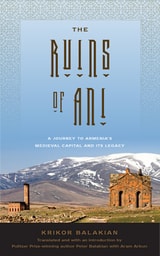
A Journey to Armenia's Medieval Capital and its LegacyKrikor Balakian
Rutgers University Press, 2019
From the tenth to the thirteenth centuries, the city of Ani was the jewel of the Armenian kingdom, renowned far and wide for its magnificent buildings. Known as the city of 1001 churches, Ani was a center for artistic innovation, and its architecture is a potential missing link between Byzantine and Gothic styles. By the fifteenth century, Ani was virtually abandoned, its stunning buildings left to crumble. Yet its ruins have remained a symbol of cultural accomplishment that looms large in the Armenian imagination.
The Ruins of Ani is a unique combination of history, art criticism, and travel memoir that takes readers on a thousand-year journey in search of past splendors. Today, Ani is a popular tourist site in Turkey, but the city has been falsified in its presentation by the Turkish government in order to erase Armenian history in the wake of the Armenian Genocide. This timely publication also raises questions about the preservation of major historic monuments in the face of post atrocity campaigns of cultural erasure.
Originally written by young priest Krikor Balakian in 1910, just a few years before the Armenian genocide, this book offers a powerful and poignant counterpart to Balakian’s acclaimed genocide memoir Armenian Golgotha. This new translation by the author’s great-nephew, Pulitzer Prize-winning poet Peter Balakian, eloquently renders the book’s vivid descriptions and lyrical prose into English. Including a new introduction that explores Ani’s continued relevance in the twenty-first century, The Ruins of Ani will give readers a new appreciation for this lost city’s status as a pinnacle of both Armenian civilization and human achievement.
The Ruins of the New Argentina
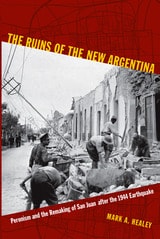
Peronism and the Remaking of San Juan after the 1944 EarthquakeMark A. Healey
Duke University Press, 2011
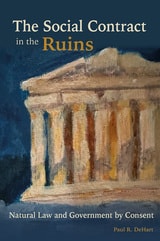
The Social Contract in the Ruins
Natural Law and Government by ConsentPaul R. DeHart
University of Missouri Press, 2024
Most scholars who write on social contract and classical natural law perceive an irreconcilable tension between them. Social contract theory is widely considered the political-theoretic concomitant of modern philosophy. Against the regnant view, The Social Contract in the Ruins, argues that all attempts to ground political authority and obligation in agreement alone are logically self-defeating. Political authority and obligation require an antecedent moral ground. But this moral ground cannot be constructed by human agreement or created by sheer will—human or divine. All accounts of morality as constructed or made collapse into self-referential incoherence. Only an uncreated, real good can coherently ground political authority and obligation or the proposition that rightful government depends on the consent of the governed. Government by consent requires classical natural law for its very coherence.
Thinking in the Ruins
Wittgenstein and Santayana on ContingencyMichael P. Hodges
Vanderbilt University Press, 2000
Santayana is often regarded as an aesthetician and metaphysician, but Wittgenstein's work is usually seen as antithetical to the philosophical approaches favored by Santayana. In this insightful new study, Michael Hodges and John Lachs argue that behind the striking differences in philosophical style and vocabulary there is a surprising agreement in position. The similarities have largely gone unnoticed because of their divergent styles, different metaphilosophies, and separate spheres of influence. Hodges and Lachs show that Santayana's and Wittgenstein's works express their philosophical responses to contingency. Surprisingly, both thinkers turn to the integrity of human practices to establish a viable philosophical understanding of the human condition.
Both of these important twentieth-century philosophers formed their mature views at a time when the comfortable certainties of Western civilization were crumbling all around them. What they say is similar at least in part because they wished to resist the spread of ruin by relying on the calm sanity of our linguistic and other practices. According to both, it is not living human knowledge but a mistaken philosophical tradition that demands foundations and thus creates intellectual homelessness and displacement. Both thought that, to get our house in order, we have to rethink our social, religious, philosophical, and moral practices outside the context of the search for certainty. This insight and the projects that flowed from it define their philosophical kinship.
Thinking in the Ruins will enhance our understanding of these monumental thinkers' intellectual accomplishments and show how each influenced subsequent American philosophers. The book also serves as a call to philosophers to look beyond traditional classifications to the substance of philosophical thought.
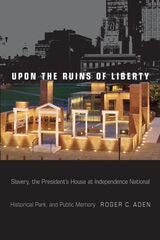
Upon the Ruins of Liberty
Slavery, the President's House at Independence National Historical Park, and Public MemoryRoger C. Aden
Temple University Press, 2014
In Upon the Ruins of Liberty, Roger Aden offers a compelling account that explores the development of this important historic site and how history, space, and public memory intersected with contemporary racial politics. Aden constructs this engrossing tale by drawing on archival material and interviews with principal figures in the controversy-including historian Ed Lawler, site activist Michael Coard, and site designer Emanuel Kelly.
Upon the Ruins of Liberty chronicles the politically-charged efforts to create a fitting tribute to the place where George Washington (and later, John Adams) shaped the presidency while denying freedom to the nine enslaved Africans in his household. From design to execution, the plans prompted advocates to embrace stories informed by race, and address difficulties that included how to handle the results of the site excavation. As such, this landmark project raised concerns and provided lessons about the role of public memory and how places are made to shape the nation's identity.
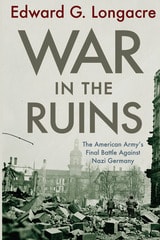
War in the Ruins
The American Army's Final Battle Against Nazi GermanyEdward G. Longacre
Westholme Publishing, 2010
The Last Major Combat for American Troops in Germany During the Final Days of World War II
By April 1945, the last German counteroffensive in the west had been defeated, the vaunted Siegfried Line was no more, the Rhine River had been crossed, and major German cities were being bombed relentlessly. The war in Europe appeared to be in its final stages. As American and British armies overran central Germany, the Russians were smashing their way from the east toward Berlin. Optimism reigned up and down the Allied lines. But as the American Army’s 100th Infantry Division pushed along the west bank of the Neckar River across from bomb-shattered Heilbronn, resistance unexpectedly stiffened. In that 700-year-old city, a major industrial and communications center still operating for the benefit of the Nazi war machine, Hitler’s subordinates had battened down for a last-ditch stand. For sheer ferocity, it would exceed anything the now-battle-hardened Americans had experienced. Here, American troops faced a grueling campaign of house-to-house fighting, with Hitler Youth, Volkssturm militia, and an SS division attempting to stop the American advance at this critical sector of the European theater. Having been repeatedly targeted by Alllied aircraft, the city resembled a vast, Hellish ruin, and as American soldiers inched their way forward, they encountered booby traps, withering sniper fire, deadly Panzerfaust rounds, and a fanatical enemy. The nine-day battle for Heilbronn would be the last major combat for American troops in Europe. Within three weeks of their securing the city, Hitler would be dead and Germany defeated.
In War in the Ruins: The American Army’s Final Battle Against Nazi Germany, Edward G. Longacre recounts this neglected but essential chapter in the history of World War II, describing the 100th Division’s swift but grueling advance through the Vosges Mountains, their Rhine River crossing, the assault on the historic Maginot Line, and the ominous approach to Heilbronn. The author then describes the entire bitter battle and its aftermath, using private letters, journals, German and American action reports, and other primary source material, to establish War in the Ruins as an essential volume in the history of World War II in Europe.
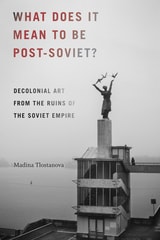
What Does It Mean to Be Post-Soviet?
Decolonial Art from the Ruins of the Soviet EmpireMadina Tiostanova
Duke University Press, 2018