Results by title
939 books match the query 'Religious aspects' and 14 start with u
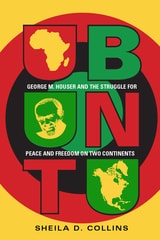
Ubuntu
George M. Houser and the Struggle for Peace and Freedom on Two ContinentsSheila D. Collins
Ohio University Press, 2020
This remarkable biography features a white American pacifist minister whose tireless work for justice and human rights helped reshape Black civil rights in the U.S. and Africa.
George M. Houser (1916–2015) was one of the most important civil rights and antiwar activists of the twentieth century. A conscientious objector during World War II, in 1942 Houser cofounded and led the Congress of Racial Equality (CORE), whose embrace of nonviolent protest strategies and tactics characterized the modern American Civil Rights Movement. Beginning in the 1950s, Houser played a critical role in pan-Africanist anticolonial movements, and his more than thirty-year dedication to the cause of human rights and self-determination helped prepare the ground for the toppling of the South African apartheid regime.
Throughout his life, Houser shunned publicity, preferring to let his actions speak his faith. Sheila Collins’s well-researched biography recounts the events that informed Houser’s life of activism—from his childhood experiences as the son of missionaries in the Philippines to his early grounding in the Social Gospel and the teachings of Mohandas Gandhi. In light of the corruption the U.S. and the world face today, Houser’s story of faith and decisive action for human rights and social justice is one for our time.
Un Catecismo para los Negocios
Andrew V. Abela
Catholic University of America Press, 2016

Unbridled
Studying Religion in PerformanceWilliam Robert
University of Chicago Press, 2022
In Unbridled, William Robert uses Equus, Peter Shaffer’s enigmatic play about a boy passionately devoted to horses, to think differently about religion. For several years, Robert has used Equus to introduce students to the study of religion, provoking them to conceive of religion in unfamiliar, even uncomfortable ways. In Unbridled, he is inviting readers to do the same.
A play like Equus tangles together text, performance, practice, embodiment, and reception. Studying a play involves us in playing different roles, as ourselves and others, and those roles, as well as the imaginative work they require, are critical to the study of religion. By approaching Equus with the reader, turning the play around and upside-down, Unbridled transforms standard approaches to the study of religion, engaging with themes including ritual, sacrifice, worship, power, desire, violence, and sexuality, as well as thinkers including Judith Butler, Sigmund Freud, Karl Marx, Friedrich Nietzsche, and Jonathan Z. Smith. As Unbridled shows, the way themes and theories play out in Equus challenges us to reimagine the study of religion through open questions, contrasting perspectives, and alternative modes of interpretation and appreciation.

Understanding Al Qaeda
Changing War and Global PoliticsMohammad-Mahmoud Ould Mohamedou
Pluto Press, 2011
This book controversially argues that Al Qaeda has clear aims, and that the only way to defeat it is to engage with its arguments in a serious way.
Since the publication of the first edition in 2006, Mohamedou has brought the text right up-to-date. Starting with Al Qaeda's creation almost twenty years ago, and sketching its global mutation, Mohamedou explains that there is a cogent strategy to Al Qaeda's actions. He shows that the 'war on terror' is failing, only serving to recruit more terrorists to Al Qaeda's cause. He also puts forward a case for how the international community can best respond.
Arguing that it is dangerous to dismiss Al Qaeda as illogical and irrational, this incisive and original book is important for policy-makers and ideal for undergraduates in international relations, Middle East studies and peace/conflict studies.
Understanding Wisdom
Sources & Science Spiritual PrinciplesWarren, Jr. Brown
Templeton Press, 2000
Understanding and Teaching Religion in US History
Edited by Karen J. Johnson and Jonathan M. Yeager
University of Wisconsin Press, 2024
This book offers a breadth of voices and approaches to teaching this crucial part of US history. Religion can be a delicate topic, especially in public education, and many students and teachers bring strongly held views and identities to their understanding of the past. The editors and contributors aim to help the reader see religion in fresh ways, to present sources and perspectives that may be unfamiliar, and to suggest practical interventions in the classroom that teachers can use immediately.
Uneasy in Babylon
Southern Baptist Conservatives and American CultureBarry Hankins
University of Alabama Press, 2002
The definitive account of how conservative Southern Baptists came to dominate the nation's largest Protestant denomination
In 1979 a group of conservative members of the Southern Baptists Convention (SBC) initiated a campaign to reshape the denomination’s seminaries and organizations by installing new conservative leaders who made belief in the inerrancy of the Bible a condition of service. They succeeded. This book is a definitive account of that takeover.
Barry Hankins argues that the conservatives sought control of the SBC not or not only to secure the denomination's orthodoxy but to mobilize Southern Baptists for a war against secular culture. The best explanation of the beliefs and behavior of Southern Baptist conservatives, Hankins concludes, lies in their adoption of the culture war model of American society. Believing that "American culture has turned hostile to traditional forms of faith,” they sought to deploy the Southern Baptist Convention in a "full-scale culture war" against secularism in the United States. Hankins traces the roots of this movement to the ideas of such post-WWII northern evangelicals as Carl F. H. Henry and Francis Schaeffer. Henry and Schaeffer viewed America's secular culture as hostile to Christianity and called on evangelicals to develop a robust Christian opposition to secular culture. As the nation’s largest Protestant denomination, SBC positions on divisive cultural issues like abortion have remade the American political landscape, most notably in the reversal of Roe v. Wade.
Hankins also argues, however, that Southern Baptist conservatives sought more than orthodox adherence to Biblical inerrancy. They also sought an identity that was authentically Baptist and Southern. Hankin’s excellent and prescient work will fascinate readers interested in contemporary American religion, culture, and public policy, as well as in the American South.
Unquiet Americans
U.S. Catholics, Moral Truth, and the Preservation of Civil LibertiesGerard V. Bradley
St. Augustine's Press, 2013
Before the Second Vatican Council, America’s Catholics operated largely as a coherent voting bloc, usually in connection with the Democratic Party. Their episcopal leaders generally spoke for Catholics in political matters; at least, where America’s bishops asserted themselves in public affairs there was little audible dissent from the faithful.
More than occasionally, the immigrant Church’s eagerness to demonstrate its patriotic bona fides furthered its tendency to speak with one voice about national matters, and in line with the broader societal consensus. And, notwithstanding the considerable conflict which Catholics encountered, and generated, in American political life, there was before the Council broad agreement in American culture about the centrality of Biblical morality to the success of Americans’ experiment with republican government.
In other words: before the Council, American Catholics’ relationship to the political common good was mediated, somewhat uncritical, and insulated from conflict (both within and without the Church) over such fundamental matters as protection of innocent life, marriage and family life, and (to a lesser extent) religious liberty.
This has all changed since the mid-1960s. For the first time in the Church’s pilgrimage on these shores, controversial questions about the basic moral requirements of the political common good are front and center for America’s Catholics. These questions require Catholics to confront matters which heretofore they either took for granted, read off from the background culture, or which they left to the bishops to handle. But the Council Fathers rightly recognized that Jesus calls upon a formed and informed laity to act as leaven in the public realm, to bring Gospel values to the temporal sphere. In this book of essays touching upon Catholic social doctrine, the truth about human equality and political liberty, and religious faith as it bears upon public life and the public engagement of lay Catholics, Gerard Bradley supplies indispensable aid to those seeking to answer Jesus’ call.
Unreconciled
From Racial Reconciliation to Racial Justice in Christian EvangelicalismAndrea Smith
Duke University Press, 2019

Unsecular Media
MAKING NEWS OF RELIGION IN AMERICAMark Silk
University of Illinois Press, 1995
Mark Silk's book is the first to offer a comprehensive description and analysis of how American news media cover religion.
Unseen Art
Making, Vision, and Power in Ancient MesoamericaClaudia Brittenham
University of Texas Press, 2023
In Unseen Art, Claudia Brittenham unravels one of the most puzzling phenomena in Mesoamerican art history: why many of the objects that we view in museums today were once so difficult to see. She examines the importance that ancient Mesoamerican people assigned to the process of making and enlivening the things we now call art, as well as Mesoamerican understandings of sight as an especially godlike and elite power, in order to trace a gradual evolution in the uses of secrecy and concealment, from a communal practice that fostered social memory to a tool of imperial power.
Addressing some of the most charismatic of all Mesoamerican sculptures, such as Olmec buried offerings, Maya lintels, and carvings on the undersides of Aztec sculptures, Brittenham shows that the creation of unseen art has important implications both for understanding status in ancient Mesoamerica and for analyzing art in the present. Spanning nearly three thousand years of the Indigenous art of Mexico, Guatemala, Honduras, and Belize, Unseen Art connects the dots between vision, power, and inequality, providing a critical perspective on our own way of looking.
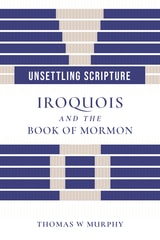
Unsettling Scripture
Iroquois and the Book of MormonThomas W Murphy
University of Utah Press, 2025
In Unsettling Scripture: Iroquois and the Book of Mormon, anthropologist Thomas W Murphy delves into the visions of Seneca prophet Handsome Lake, the epic narratives of the Iroquois Confederacy, and the origin story of the Book of Mormon, revealing surprising parallels between Indigenous and Mormon traditions.
Through ethnohistorical research and decolonizing methodologies, Murphy reexamines how both communities understand their origins, faith, and prophecy. From Handsome Lake’s revelations to Joseph Smith’s seer stone, from ancient sibling rivalries to the Great Peace, this book unsettles traditional narratives while opening new conversations on scripture, identity, and cultural exchange. Drawing from living Indigenous voices, Unsettling Scripture challenges readers to rethink sacred texts and the histories they tell.

Unveiling Traditions
Postcolonial Islam in a Polycentric WorldAnouar Majid
Duke University Press, 2000
Majid moves beyond Edward Said’s unmasking of orientalism in the West to examine the intellectual assumptions that have prevented a more nuanced understanding of Islam’s legacies. In addition to questioning the pervasive logic that assumes the “naturalness” of European social and political organizations, he argues that it is capitalism that has intensified cultural misunderstanding and created global tensions. Besides examining the resiliency of orientalism, the author critically examines the ideologies of nationalism and colonialist categories that have redefined the identity of Muslims (especially Arabs and Africans) in the modern age and totally remapped their cultural geographies. Majid is aware of the need for Muslims to rethink their own assumptions. Addressing the crisis in Arab-Muslim thought caused by a desire to simultaneously “catch up” with the West and also preserve Muslim cultural authenticity, he challenges Arab and Muslim intellectuals to imagine a post-capitalist, post-Eurocentric future. Critical of Islamic patriarchal practices and capitalist hegemony, Majid contends that Muslim feminists have come closest to theorizing a notion of emancipation that rescues Islam from patriarchal domination and resists Eurocentric prejudices.
Majid’s timely appeal for a progressive, multicultural dialogue that would pave the way to a polycentric world will interest students and scholars of postcolonial, cultural, Islamic, and Marxist studies.
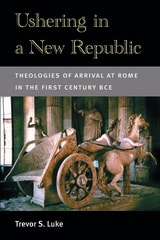
Ushering in a New Republic
Theologies of Arrival at Rome in the First Century BCETrevor S. Luke
University of Michigan Press, 2014