Results by title
857 books match the query 'Schools' and 20 start with u

U.S. Engineering in a Global Economy
Edited by Richard B. Freeman and Hal Salzman
University of Chicago Press, 2018
The volume provides insights on engineering education, practice, and careers that can inform educational institutions, funding agencies, and policy makers about the challenges facing the United States in developing its engineering workforce in the global economy.
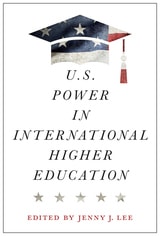
U.S. Power in International Higher Education
Jenny J. Lee
Rutgers University Press, 2021
U.S. Power in International Higher Education explores how internationalization in higher education is not just an educational endeavor, but also a geopolitical one. By centering and making explicit the role of power, the book demonstrates the United States’s advantage in international education as well as the changing geopolitical realities that will shape the field in the future. The chapter authors are leading critical scholars of international higher education, with diverse scholarly ties and professional experiences within the country and abroad. Taken together, the chapters provide broad trends as well as in-depth accounts about how power is evident across a range of key international activities. This book is intended for higher education scholars and practitioners with the aim of raising greater awareness on the unequal power dynamics in internationalization activities and for the purposes of promoting more just practices in higher education globally.
UW Struggle
When a State Attacks Its UniversityChuck Rybak
University of Minnesota Press, 2017
A Wisconsin story that serves as a national warning
UW Struggle provides an on-the-ground view of the smoldering attack on public higher education in Wisconsin. Chuck Rybak, who works in the University of Wisconsin System, provides important glimpses into the personal lives of those affected, the dismantling of tenure protections, the diminishment of shared governance, and how faculty remain the scapegoat for all of the university’s problems. This is a chronicle of failed leadership and what actions, if any, can protect this vital American institution.
Under New Management
Universities, Administrative Labor, and the Professional TurnAuthored by Randy Martin
Temple University Press, 2012
Faculty members who care about the institutions of higher education where they work are often at odds with university management. In his forceful book, Under New Management, Randy Martin takes a novel, evenhanded approach to this gulf between professors, who feel a loss of autonomy, and administrators.
Martin imagines a political future for academic labor based on a critical understanding of the administrative work that faculty already undertake. He considers the differences between self-rule and specialized expertise and provides a case study of a New York City public school to show how kids and families respond to the demands of managerial productivity that is part of preparing students for college. Under New Management also considers changes faced by students, faculty, and administrators in light of this reworked social compact of professionals.

Understanding Virtual Universities
Roy Rada
Intellect Books, 2013
• distance learning for individual students
• groups in classrooms - focusing on interactive technology
• the university as a whole
• emerging market forces in Higher Education and training for industry
Unlike competing books that focus on specific aspects of the subject, Understanding Virtual Universities combines managerial, social and technical issues, to provide a comprehensive approach to Information Technology for Higher Education.
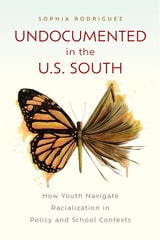
Undocumented in the U.S. South
How Youth Navigate Racialization in Policy and School ContextsSophia Rodriguez
Rutgers University Press, 2025
Unequal Choices
How Social Class Shapes Where High-Achieving Students Apply to CollegeYang Va Lor
Rutgers University Press, 2023
Unequal City
Race, Schools, and Perceptions of InjusticeCarla Shedd is assistant professor of sociology and African American studies at Columbia University.
Russell Sage Foundation, 2015
Shedd draws from an array of data and in-depth interviews with Chicago youth to offer new insight into this understudied group. Focusing on four public high schools with differing student bodies, Shedd reveals how the predominantly low-income African American students at one school encounter obstacles their more affluent, white counterparts on the other side of the city do not face. Teens often travel long distances to attend school which, due to Chicago’s segregated and highly unequal neighborhoods, can involve crossing class, race, and gang lines. As Shedd explains, the disadvantaged teens who traverse these boundaries daily develop a keen “perception of injustice,” or the recognition that their economic and educational opportunities are restricted by their place in the social hierarchy.
Adolescents’ worldviews are also influenced by encounters with law enforcement while traveling to school and during school hours. Shedd tracks the rise of metal detectors, surveillance cameras, and pat-downs at certain Chicago schools. Along with police procedures like stop-and-frisk, these prison-like practices lead to distrust of authority and feelings of powerlessness among the adolescents who experience mistreatment either firsthand or vicariously. Shedd finds that the racial composition of the student body profoundly shapes students’ perceptions of injustice. The more diverse a school is, the more likely its students of color will recognize whether they are subject to discriminatory treatment. By contrast, African American and Hispanic youth whose schools and neighborhoods are both highly segregated and highly policed are less likely to understand their individual and group disadvantage due to their lack of exposure to youth of differing backgrounds.
Unequal Higher Education
Wealth, Status, and Student OpportunityBarrett J. Taylor
Rutgers University Press, 2019
Ungrading
Why Rating Students Undermines Learning (and What to Do Instead)Susan D. Blum
West Virginia University Press, 2020
The moment is right for critical reflection on what has been assumed to be a core part of schooling. In Ungrading, fifteen educators write about their diverse experiences going gradeless. Some contributors are new to the practice and some have been engaging in it for decades. Some are in humanities and social sciences, some in STEM fields. Some are in higher education, but some are the K–12 pioneers who led the way. Based on rigorous and replicated research, this is the first book to show why and how faculty who wish to focus on learning, rather than sorting or judging, might proceed. It includes honest reflection on what makes ungrading challenging, and testimonials about what makes it transformative.
CONTRIBUTORS:
Aaron Blackwelder
Susan D. Blum
Arthur Chiaravalli
Gary Chu
Cathy N. Davidson
Laura Gibbs
Christina Katopodis
Joy Kirr
Alfie Kohn
Christopher Riesbeck
Starr Sackstein
Marcus Schultz-Bergin
Clarissa Sorensen-Unruh
Jesse Stommel
John Warner
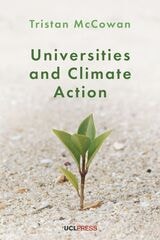
Universities and Climate Action
Tristan McCowan
University College London, 2025
As the climate crisis intensifies, universities stand at a crossroads—both as contributors to ecological challenges and as agents of change. Universities and Climate Action presents a novel framework for understanding how higher education institutions can engage meaningfully with climate issues across teaching, research, governance, and community outreach. Tristan McCowan investigates the tensions between academia’s historical complicity in environmental exploitation and its immense potential in driving sustainable transformation.
This work offers a holistic perspective on how universities influence climate change at local and global levels, underscoring both the barriers to action and the pathways to meaningful change. With examples from institutions worldwide, McCowan demonstrates how universities can embed climate responsibility into curricula, shift research priorities, and foster climate-conscious campus operations. By synthesizing diverse approaches and offering practical principles for reform, Universities and Climate Action is a vital blueprint for academics and university leaders seeking to reorient higher education toward a just and sustainable future.
Universities and Reflexive Modernity
Institutional Ambiguities and Unintended ConsequencesLazar Vlasceanu
Central European University Press, 2010
A book about the challenges and uncertainties facing today's university, a chronicle of recent and current changes in higher education in the world. There are many questions today that are sufficiently open to doubt and profoundly related to new developments, to justify our starting new enquiries, here and now, by looking freshly and more closely at the actual configurations and at their historical grounds, for providing the new standard account of the university today.
Vlasceanu discusses the inherent contradiction between academia on the one hand, and expectations and regulations of the market on the other. Analyses demographic and other statistical characteristics of today's higher education. Examines the financial basis of universities in various countries, and describes current governance models. Finally the author sets up a new typology of universities.

Universities and the Future of America
Derek Bok
Duke University Press, 1990
“If universities are so important to society and if ours are so superior, one might have thought that America would be flourishing in comparison to other industrialized countries of the world. Yet this is plainly not the case. . . . Our economic position in the world has deteriorated [and] we have climbed to the top, or near the top, of all advanced countries in the percentage of population who live in poverty, commit crimes, become addicted to drugs, have illegitimate children, or are classified as functionally illiterate.” In light of these results, “it is fair to ask whether our universities are doing all they can and should to help America surmount the obstacles that sap our economic strength and blight the lives of millions of our people.”
Having posed this question, Derek Bok reviews what science can do to bring about greater productivity, what professional schools can do to improve the effectiveness of corporations, government, and public education, and what all parts of the university are doing to help students acquire higher levels of ethical and social responsibility. He concludes that Universities are contributing much less than the should to help the nation address its most urgent social problems. “A century after the death of Cardinal Newman, many university officials and faculty members continue to feel ambivalent about deliberate efforts to address practical problems of society. And though competition drives university leaders and their faculties to unremitting effort, what competition rewards is chiefly success in fields that command academic prestige rather than success in responding to important social needs.”
Bok urges academic leaders, trustees, foundations, and government agencies to work together to help universities realign their priorities “so that they will be ready to make their full contribution when the nation turns its attention again to the broad agenda of reform. . . . Observing our difficulties competing abroad, our millions of people in poverty, our drug-ridden communities, our disintegrating families, our ineffective schools, those who help to shape our universities have reason to ask whether they too have any time to lose.”
Universities in the Age of Corporate Science
The UC Berkeley-Novartis ControversyAlan P. Rudy, Dawn Coppin, Jason Konefal, Bradley T. Shaw, Toby Ten Eyck, Craig Harris and Lawrence Busch
Temple University Press, 2007

Unsettled Belonging
Educating Palestinian American Youth after 9/11Thea Renda Abu El-Haj
University of Chicago Press, 2015
Abu El-Haj explores the school as the primary site where young people from immigrant communities encounter the central discourses about what it means to be American. She illustrates the complex ways social identities are bound up with questions of belonging and citizenship, and she details the processes through which immigrant youth are racialized via everyday nationalistic practices. Finally, she raises a series of crucial questions about how we educate for active citizenship in contemporary times, when more and more people’s lives are shaped within transnational contexts. A compelling account of post-9/11 immigrant life, Unsettled Belonging is a steadfast look at the disjunctures of modern citizenship.
Unsportsmanlike Conduct
Exploiting College AthletesWalter Byers
University of Michigan Press, 1997

Untold Stories
Tyler Clementi's Death and Crisis Leadership in Higher EducationJudy Farmer Jarvis
Rutgers University Press, 2027
Untold Stories: Tyler Clementi’s Death and Crisis Leadership in Higher Education delves into the well-known but poorly understood death of gay first-year Rutgers student Tyler Clementi in 2010 and explains how social identities shaped the responses to his tragic death, the media firestorm, Rutgers University’s actions, and the legacy of his life and death. It offers insights for higher education crisis responders and anyone who wants to learn more about this well-known but poorly understood case.

Unwell Writing Centers
Searching for Wellness in Neoliberal Educational Institutions and Beyondby Genie Nicole Giaim, foreword by Elizabeth Boquet
Utah State University Press, 2022
The book is broken into sections based on journeying: searching for wellness, finding wellness, and imagining a “well” future that includes a sustainable model of writing center work. Each chapter begins with a personal narrative about wellness issues in writing centers, including the author’s experiences in and responses to local emergencies. She shares findings from a longitudinal assessment study on non-institutional interventions in writing centers and provides resources for administrators to create more ethical "well" writing centers. The book also includes an appendix of training documents, emergency planning documents, and several wellness-specific interventions developed from anti-racist, anti-neoliberal, and organizational theories.
Establishing the need for a field-specific response to the austerity-minded eruption of wellness-focused interventions in higher education, Unwell Writing Centers is a critical text for graduate students and new directors that can easily be applied in workplaces in and outside of higher education.

Urology at Michigan
The Origin Story: Emergence of a Medical Subspecialty and Its Deployment at University of MichiganDavid A. Bloom
Michigan Publishing Services, 2021
This book describes the emergence of a small but essential medical specialty, urology, at one of the first American public institutions of higher education, the University of Michigan. Urology at Michigan: The Origin Story, a microcosm of the modern world of healthcare specialization, entwines many stories beginning with its earliest roots, diagnostic uroscopy and the primitive interventions of catheterization and lithotomy. The Hippocratic Oath forbade its generalist healers from only three practices – abortion, euthanasia, and lithotomy, relegating the last to specialists “in that art,” namely itinerant lithotomists of whom little record remains. Over two and a half millennia since Hippocrates, catheterization, lithotomy, and genitourinary surgery in general advanced only modestly until products of the industrial revolution and scientific inquiry provided the tools and knowledge that accelerated the ancient genitourinary work into a new discipline of urology around the fin de siècle of the 19th century, just as the University of Michigan concurrently was joining the top rank of higher education.
The University of Michigan in the early 20th century was nearly a century old and contained a medical school and wholly-owned University Hospital, the first of that genre. Ann Arbor was a propitious place for modern urology to take hold when Hugh Cabot brought not just the new terminology, but also the complete triple mission with urologic education and research embedded in a milieu of world-class clinical care. Cabot arrived in Ann Arbor from Boston in the autumn of 1919, imbued with more than two years’ service in WWI with the British Expeditionary Forces on the Western Front, and he became Dean of the Medical School in 1921. Cabot expanded the full-time salary model in the medical school, supervised construction of Ann Arbor’s 4th iteration of the University Hospital, but its first state-of the art facility. He created a multi-specialty academic group practice and assembled a great faculty with future leaders in surgery including Frederick Coller, Max Peet, Carl Badgley, and John Alexander. Cabot’s first trainees to become urologists were Charles Huggins, a future Nobel Laureate, and Reed Nesbit who rose to the top ranks of academic and organizational urology and made Ann Arbor an international clinical and educational destination. This book tells the story of urology at Michigan amidst the larger stories of the roots of genitourinary surgery, the formation of the University of Michigan and its Medical School, and the inevitable tensions of balancing the triple mission of medical academia: education and investigation within a milieu of the essential transaction of excellent clinical care.
Using Servant Leadership
How to Reframe the Core Functions of Higher EducationLetizia, Angelo J.
Rutgers University Press, 2018