Results by title
216 books match the query 'Social' and 4 start with u
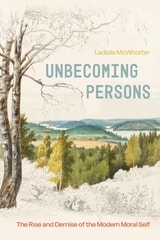
Unbecoming Persons
The Rise and Demise of the Modern Moral SelfLadelle McWhorter
University of Chicago Press, 2025
In the face of ecological crisis, economic injustice, and political violence, the moral demands of being a good person are almost too much to bear. In Unbecoming Persons, Ladelle McWhorter argues that this strain is by design. Our ideas about personhood, she shows, emerged to sustain centuries of colonialism, slavery, and environmental destruction. We must look elsewhere to find our way out.
This history raises a hard question: Should we be persons at all, or might we live a good life without the constraints of individualism or the illusion of autonomy? In seeking an answer, McWhorter pushes back on the notion of our own personhood—our obsession with identity, self-improvement, and salvation—in search of a better way to live together in this world. Although she finds no easy answers, McWhorter ultimately proposes a new ethics that rejects both self-interest and self-sacrifice and embraces perpetual dependence, community, and the Earth
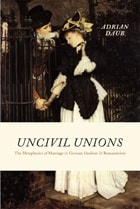
Uncivil Unions
The Metaphysics of Marriage in German Idealism and RomanticismAdrian Daub
University of Chicago Press, 2012
“What a strange invention marriage is!” wrote Kierkegaard. “Is it the expression of that inexplicable erotic sentiment, that concordant elective affinity of souls, or is it a duty or a partnership . . . or is it a little of all that?”
Like Kierkegaard a few decades later, many of Germany’s most influential thinkers at the turn of the eighteenth century wondered about the nature of marriage but rejected the easy answers provided by biology and theology. In Uncivil Unions, Adrian Daub presents a truly interdisciplinary look at the story of a generation of philosophers, poets, and intellectuals who turned away from theology, reason, common sense, and empirical observation to provide a purely metaphysical justification of marriage.
Through close readings of philosophers like Fichte and Schlegel, and novelists like Sophie Mereau and Jean Paul, Daub charts the development of this new concept of marriage with an insightful blend of philosophy, cultural studies, and theory. The author delves deeply into the lives and work of the romantic and idealist poets and thinkers whose beliefs about marriage continue to shape ideas about gender, marriage, and sex to the present day.
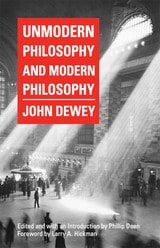
Unmodern Philosophy and Modern Philosophy
John Dewey, Edited by Phillip Deen, Foreword by Larry A. Hickman
Southern Illinois University Press, 2012
800x600Normal0falsefalsefalseEN-USX-NONEX-NONEMicrosoftInternetExplorer4
In 1947 America’s premier philosopher, educator, and public intellectual John Dewey purportedly lost his last manuscript on modern philosophy in the back of a taxicab. Now, sixty-five years later, Dewey’s fresh and unpretentious take on the history and theory of knowledge is finally available. Editor Phillip Deen has taken on the task of editing Dewey’s unfinished work, carefully compiling the fragments and multiple drafts of each chapter that he discovered in the folders of the Dewey Papers at the Special Collections Research Center at Southern Illinois University Carbondale. He has used Dewey’s last known outline for the manuscript, aiming to create a finished product that faithfully represents Dewey’s original intent. An introduction and editor’s notes by Deen and a foreword by Larry A. Hickman, director of the Center for Dewey Studies, frame this previously lost work.
In Unmodern Philosophy and Modern Philosophy, Dewey argues that modern philosophy is anything but; instead, it retains the baggage of outdated and misguided philosophical traditions and dualisms carried forward from Greek and medieval traditions. Drawing on cultural anthropology, Dewey moves past the philosophical themes of the past, instead proposing a functional model of humanity as emotional, inquiring, purposive organisms embedded in a natural and cultural environment.
Dewey begins by tracing the problematic history of philosophy, demonstrating how, from the time of the Greeks to the Empiricists and Rationalists, the subject has been mired in the search for immutable absolutes outside human experience and has relied on dualisms between mind and body, theory and practice, and the material and the ideal, ultimately dividing humanity from nature. The result, he posits, is the epistemological problem of how it is possible to have knowledge at all. In the second half of the volume, Dewey roots philosophy in the conflicting beliefs and cultural tensions of the human condition, maintaining that these issues are much more pertinent to philosophy and knowledge than the sharp dichotomies of the past and abstract questions of the body and mind. Ultimately, Dewey argues that the mind is not separate from the world, criticizes the denigration of practice in the name of theory, addresses the dualism between matter and ideals, and questions why the human and the natural were ever separated in philosophy. The result is a deeper understanding of the relationship among the scientific, the moral, and the aesthetic.
More than just historically significant in its rediscovery, Unmodern Philosophy and Modern Philosophy provides an intriguing critique of the history of modern thought and a positive account of John Dewey’s naturalized theory of knowing. This volume marks a significant contribution to the history of American thought and finally resolves one of the mysteries of pragmatic philosophy.
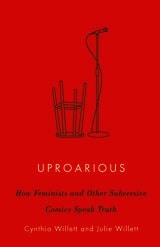
Uproarious
How Feminists and Other Subversive Comics Speak TruthCynthia Willett
University of Minnesota Press, 2019
Humor is often dismissed as cruel ridicule or harmless fun. But what if laughter is a vital force to channel rage against patriarchy, Islamophobia, or mass incarceration? To create moments of empathy and dialogue between Black Lives Matter and the police? These and other such questions are at the heart of this powerful reassessment of humor. Placing theorists in conversation with comedians, Uproarious offers a full-frontal approach to the very foundation of comedy and its profound political impact.
Here Cynthia Willett and Julie Willett address the four major theories of humor—superiority, relief, incongruity, and social play—through the lens of feminist and game-changing comics such as Wanda Sykes, Margaret Cho, Hannah Gadsby, Hari Kondabolu, and Tig Notaro. They take a radical and holistic approach to the understanding of humor, particularly of humor deployed by those from groups long relegated to the margins, and propose a powerful new understanding of humor as a force that can engender politically progressive social movements. Drawing on a range of cross-disciplinary sources, from philosophies and histories of humor to the psychology and physiology of laughter to animal studies, Uproarious offers a richer understanding of the political and cathartic potential of humor.
A major new contribution to a wider dialogue on comedy, Uproarious grounds for us explorations of outsider humor and our golden age of feminist comics—showing that when women, prisoners, even animals, laugh back, comedy along with belly laughs forge new identities and alter the political climate.