Results by title
333 books match the query 'Television' and 6 start with u
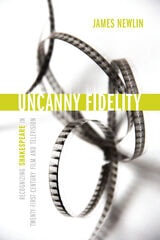
Uncanny Fidelity
Recognizing Shakespeare in Twenty-First-Century Film and TelevisionJames Newlin
University of Alabama Press, 2024
How the study of Shakespeare’s legacy, specifically in film and television, can radically challenge what we consider to be authentically Shakespearean
In the field of adaptation studies today, the idea of reading an adapted text as “faithful” or “unfaithful” to its original source strikes many scholars as too simplistic, too conservative, and too moralizing. In Uncanny Fidelity: Recognizing Shakespeare in Twenty-First Century Film and Television, James Newlin challenges these critical orthodoxies. Instead, recognizing how a film or television series closely recalls Shakespeare’s drama encourages an interrogation of what we consider to be “Shakespeare” in the first place.
Drawing upon Sigmund Freud’s model of the uncanny—the sudden sensation of peculiar, discomforting familiarity—this book focuses on films and television series that were not marketed as adaptations of Shakespeare. Yet these works unexpectedly invoke lost, even troubling aspects of Shakespeare’s original playtexts, their performance history, or their reception. Broadening the scope of fidelity readings beyond familiar concerns like plot and language, Newlin demonstrates how the study of Shakespeare’s afterlife can clarify both the historical context of his drama and its relevance for the current political moment. Engaging contemporary debates in literary and psychoanalytic theory, this book features provocative close readings of The Tempest, Othello, and The Winter’s Tale alongside recent films and television series, from art-house movies such as The Master and Manchester by the Sea to the cult favorites Brigsby Bear and Vice Principals. These works conjure widely overlooked qualities of Shakespeare’s drama by recalling the casting practices or the generic contexts of the early modern stage or by making a meaningful intervention in the plays’ critical reception. Closely examining these surprisingly faithful adaptations of Shakespeare’s drama helps us to articulate the original experience of the early modern stage and better consider its resonance in the present.
This book will benefit students and scholars of Shakespeare on film and psychoanalytic theory. Yet Uncanny Fidelity will also be of interest to scholars of performance history, source studies, and early modern discourses of race and gender—as well as anyone interested in the unexpected connections between canonical literature and contemporary culture. By examining adaptation as an instance of uncanny return, Newlin demonstrates how the study of Shakespeare’s afterlife can radically challenge what we consider to be authentically Shakespearean.
Uncomfortable Television
Hunter Hargraves
Duke University Press, 2023
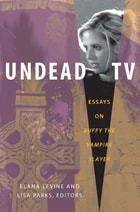
Undead TV
Essays on Buffy the Vampire SlayerElana Levine and Lisa Parks, eds.
Duke University Press, 2007
In Undead TV, media studies scholars tackle the Buffy phenomenon and its many afterlives in popular culture, the television industry, the Internet, and academic criticism. Contributors engage with critical issues such as stardom, gender identity, spectatorship, fandom, and intertextuality. Collectively, they reveal how a vampire television series set in a sunny California suburb managed to provide some of the most biting social commentaries on the air while exposing the darker side of American life. By offering detailed engagements with Sarah Michelle Gellar’s celebrity image, science-fiction fanzines, international and “youth” audiences, Buffy tie-in books, and Angel’s body, Undead TV shows how this prime-time drama became a prominent marker of industrial, social, and cultural change.
Contributors. Ian Calcutt, Cynthia Fuchs, Amelie Hastie, Annette Hill, Mary Celeste Kearney, Elana Levine, Allison McCracken, Jason Middleton, Susan Murray, Lisa Parks
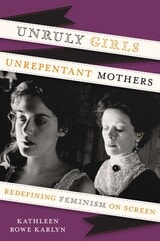
Unruly Girls, Unrepentant Mothers
Redefining Feminism on ScreenBy Kathleen Rowe Karlyn
University of Texas Press, 2010
Since the 1990s, when Reviving Ophelia became a best seller and "Girl Power" a familiar anthem, girls have assumed new visibility in the culture. Yet in asserting their new power, young women have redefined femininity in ways that have often mystified their mothers. They have also largely disavowed feminism, even though their new influence is a likely legacy of feminism's Second Wave. At the same time, popular culture has persisted in idealizing, demonizing, or simply erasing mothers, rarely depicting them in strong and loving relationships with their daughters.
Unruly Girls, Unrepentant Mothers, a companion to Kathleen Rowe Karlyn's groundbreaking work, The Unruly Woman, studies the ways popular culture and current debates within and about feminism inform each other. Surveying a range of films and television shows that have defined girls in the postfeminist era—from Titanic and My So-Called Life to Scream and The Devil Wears Prada, and from Love and Basketball to Ugly Betty—Karlyn explores the ways class, race, and generational conflicts have shaped both Girl Culture and feminism's Third Wave. Tying feminism's internal conflicts to negative attitudes toward mothers in the social world, she asks whether today's seemingly materialistic and apolitical girls, inspired by such real and fictional figures as the Spice Girls and Buffy the Vampire Slayer, have turned their backs on the feminism of their mothers or are redefining unruliness for a new age.
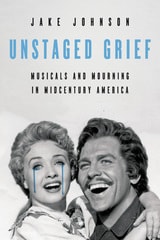
Unstaged Grief
Musicals and Mourning in Midcentury AmericaJake Johnson
University of Illinois Press, 2025
Often dismissed as escapism, screen musicals of the 1960s in fact tapped into unspoken sadness about an America that was slipping away. Jake Johnson delves into film and television musicals of the era to examine their place in networks of grieving in America, for America, and about America.
The Golden Age of musical theater ended just as Elisabeth Kübler-Ross’s On Death and Dying debuted, and Johnson uses Kübler-Ross’s five stages to frame the intertwining of musicals and grief. He analyzes films like Seven Brides for Seven Brothers and State Fair alongside paintings, poetry, and other images and texts to reveal how the musical theater engine built in the first half of the century broke down just as a new language emerged to describe the melancholy felt by people facing the end of the world they had known.
Nuanced and original, Unstaged Grief plumbs the grief, loss, and hope behind the Technicolor spectacle and rousing showstoppers.
Unwatchable
Baer, Nicholas
Rutgers University Press, 2019
With over 50 original essays by leading scholars, artists, critics, and curators, this is the first book to trace the “unwatchable” across our contemporary media environment, in which viewers encounter difficult content on various screens and platforms. Appealing to a broad academic and general readership, the volume offers multidisciplinary approaches to the vast array of troubling images that circulate in global visual culture.