Results by title
98 books match the query 'Urban renewal' and 2 start with u
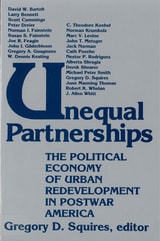
Unequal Partnerships
The Political Economy of Urban Redevelopment in Postwar AmericaEdited by Gregory Squires
Rutgers University Press, 1989
Unequal Partnerships explores urban development in American cities since World War II. Gregory D. Squires and other contributors examine what has long been a highly inequitable and destructive process of urban development. They look at the political and social assumptions and interests shaping redevelopment, the social and economic costs of development for the vast majority of urban residents, and alternative approaches emerging.The book begins with an overview of the ideological forces that have shaped urban economic development in the United States from the urban renewal days of the 1950s and 1960s through the celebration of public-private partnerships in the 1980s. Subsequent chapters examine specific cities in light of the consequences of development initiatives. These cities include those in declining rustbelt regions that are struggling with the consequences of deindustrialization (Boston, New York, Philadelphia, Pittsburgh, Cleveland, Detroit, Chicago, and Milwaukee), as well as growing cities in the sunbelt (Louisville, New Orleans, Houston, and Sacramento). The book concludes with a discussion of promising policy alternatives.
[more]
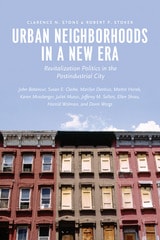
Urban Neighborhoods in a New Era
Revitalization Politics in the Postindustrial CityClarence N. Stone and Robert P. Stoker
University of Chicago Press, 2015
For decades, North American cities racked by deindustrialization and population loss have followed one primary path in their attempts at revitalization: a focus on economic growth in downtown and business areas. Neighborhoods, meanwhile, have often been left severely underserved. There are, however, signs of change. This collection of studies by a distinguished group of political scientists and urban planning scholars offers a rich analysis of the scope, potential, and ramifications of a shift still in progress. Focusing on neighborhoods in six cities—Baltimore, Chicago, Denver, Los Angeles, Phoenix, and Toronto—the authors show how key players, including politicians and philanthropic organizations, are beginning to see economic growth and neighborhood improvement as complementary goals. The heads of universities and hospitals in central locations also find themselves facing newly defined realities, adding to the fluidity of a new political landscape even as structural inequalities exert a continuing influence.
While not denying the hurdles that community revitalization still faces, the contributors ultimately put forth a strong case that a more hospitable local milieu can be created for making neighborhood policy. In examining the course of experiences from an earlier period of redevelopment to the present postindustrial city, this book opens a window on a complex process of political change and possibility for reform.
While not denying the hurdles that community revitalization still faces, the contributors ultimately put forth a strong case that a more hospitable local milieu can be created for making neighborhood policy. In examining the course of experiences from an earlier period of redevelopment to the present postindustrial city, this book opens a window on a complex process of political change and possibility for reform.
[more]