644 books match the query 'Wars & Conflicts' and 9 start with u
cover of Ukraine's Patronal Democracy and the Russian Invasion: The Russia-Ukraine War, Volume One

Ukraine's Patronal Democracy and the Russian Invasion

The Russia-Ukraine War, Volume One

Bálint Madlovics

Central European University Press, 2023

The Russian invasion of Ukraine in 2022 jeopardizes the country's independence and its chances for Western-style development. However, the heroic attitude of the Ukrainian people, combined with a solidifying national identity, makes the domestic foundations for a western turn stronger than ever. After the invasion, building strong foundations of liberal democracy will be a top priority. In addition to alleviating immediate problems, the country must also address its post-communist legacy and address the constraints of patronalism.

The authors of this edited volume, leading Ukrainian scholars supplemented by colleagues from Hungary, examine the chances of an anti-patronal transformation after the war. The book provides an overview of the development of Ukraine's political-economic system: color revolutions in 2004 and 2014 brought democratic transformation, but no change in the patronage system The result was patronal regime cycles instead of the emergence of a Western-type liberal democracy in the country. Building on the conceptual framework of the editors' The Anatomy of Post-Communist Regimes (CEU Press, 2020), the 12 chapters examine the impact of the war on patronal democracy, the relational economy, clientelist society, and the international environment in which Ukraine operates.

This collection is complemented by the book entitled Russia. Imperial Endeavor and Geopolitical Consequences.
[more]
cover of Understanding and Teaching the Vietnam War

Understanding and Teaching the Vietnam War

Edited by John Day Tully, Matthew Masur, and Brad Austin

University of Wisconsin Press, 2013

Just as the Vietnam War presented the United States with a series of challenges, it presents a unique challenge to teachers at all levels. The war had a deep and lasting impact on American culture, politics, and foreign policy. Still fraught with controversy, this crucial chapter of the American experience is as rich in teachable moments as it is riddled with potential pitfalls—especially for students a generation or more removed from the events themselves.
            Addressing this challenge, Understanding and Teaching the Vietnam War offers a wealth of resources for teachers at the secondary and university levels. An introductory section features essays by eminent Vietnam War scholars George Herring and Marilyn Young, who reflect on teaching developments since their first pioneering classes on the Vietnam War in the early 1970s. A methods section includes essays that address specific methods and materials and discuss the use of music and film, the White House tapes, oral histories, the Internet, and other multimedia to infuse fresh and innovative dimensions to teaching the war. A topical section offers essays that highlight creative and effective ways to teach important topics, drawing on recently available primary sources and exploring the war's most critical aspects—the Cold War, decolonization, Vietnamese perspectives, the French in Vietnam, the role of the Hmong, and the Tet Offensive. Every essay in the volume offers classroom-tested pedagogical strategies and detailed practical advice.
            Taken as a whole, Understanding and Teaching the Vietnam War will help teachers at all levels navigate through cultural touchstones, myths, political debates, and the myriad trouble spots enmeshed within the national memory of one of the most significant moments in American history.

Honorable Mention, Franklin Buchanan Prize for Curricular Materials, Association for Asian Studies and the Committee for Teaching about Asia
[more]
cover of Undertones of War

Undertones of War

Edmund Blunden

University of Chicago Press, 2007

“I took my road with no little pride of fear; one morning I feared very sharply, as I saw what looked like a rising shroud over a wooden cross in the clustering mist. Horror! But on a closer study I realized that the apparition was only a flannel gas helmet. . . . What an age since 1914!”

In Undertones of War, one of the finest autobiographies to come out of World War I, the acclaimed poet Edmund Blunden records his devastating experiences in combat. After enlisting at the age of twenty, he took part in the disastrous battles at the Somme, Ypres, and Passchendaele, describing them as “murder, not only to the troops but to their singing faiths and hopes.”

All the horrors of trench warfare, all the absurdity and feeble attempts to make sense of the fighting, all the strangeness of observing war as a writer—of being simultaneously soldier and poet—pervade Blunden’s memoir. In steely-eyed prose as richly allusive as any poetry, he tells of the endurance and despair found among the men of his battalion, including the harrowing acts of bravery that won him the Military Cross.

Now back in print for American readers, the volume includes a selection of Blunden’s war poems that unflinchingly juxtapose death in the trenches with the beauty of Flanders’s fields. Undertones of War deserves a place on anyone’s bookshelf between Siegfried Sassoon’s poetry and Robert Graves’s Goodbye to All That.
[more]
cover of Unfriendly Fire: A Mother's Memoir

Unfriendly Fire

A Mother's Memoir

Peg Mullen

University of Iowa Press, 1995

In 1968 Michael Mullen, a graduate student in biochemistry, was drafted; in 1969 he was sent to Vietnam as a foot soldier in Colonel Norman Schwarzkopf's Charlie Company; and in 1970 he was killed by the same “friendly fire” that destroyed thousands of other lives during the Vietnam War.

Back home on the family farm in Iowa, his parents made his death a crusade to awaken all parents to the insanity of war. C. D. B. Bryan's Friendly Fire and the TV movie of the same name documented these dramatic years, and Peg Mullen became a national symbol of grassroots activism. Now Peg Mullen shifts from symbol to reality as she tells her story in print for the first time.

Outspoken, fearless, and wickedly humorous, Peg Mullen had a duel mission in the years after Michael's death: to penetrate the lies and evasions behind the artillery misfire that killed her oldest son and to publicize the senseless horror of the Vietnam War. Unfriendly Fire draws on the many letters sent to the Mullens after Michael's death; in addition, Michael's own bitter, weary letters home are reprinted. In these the voices of parents, brothers, sisters, comrades, teachers, and Michael himself echo Peg Mullen's call for truth and peace.
[more]
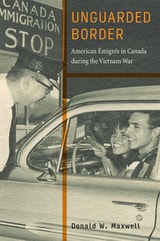
cover of Unguarded Border: American Émigrés in Canada during the Vietnam War

Unguarded Border

American Émigrés in Canada during the Vietnam War

Donald W. Maxwell

Rutgers University Press, 2023

The United States is accustomed to accepting waves of migrants who are fleeing oppressive conditions and political persecution in their home countries. But in the 1960s and 1970s, the flow of migration reversed as over fifty thousand Americans fled across the border to Canada to resist military service during the Vietnam War or to escape their homeland’s hawkish society. 
 
Unguarded Border tells their stories and, in the process, describes a migrant experience that does not fit the usual paradigms. Rather than treating these American refugees as unwelcome foreigners, Canada embraced them, refusing to extradite draft resisters or military deserters and not even requiring passports for the border crossing. And instead of forming close-knit migrant communities, most of these émigrés sought to integrate themselves within Canadian society. 
 
Historian Donald W. Maxwell explores how these Americans in exile forged cosmopolitan identities, coming to regard themselves as global citizens, a status complicated by the Canadian government’s attempts to claim them and the U.S. government’s eventual efforts to reclaim them. Unguarded Border offers a new perspective on a movement that permanently changed perceptions of compulsory military service, migration, and national identity. 
 
[more]
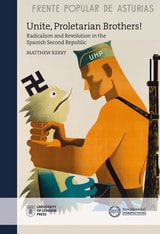
cover of Unite, Proletarian Brothers!: Radicalism and Revolution in the Spanish Second Republic

Unite, Proletarian Brothers!

Radicalism and Revolution in the Spanish Second Republic

Matthew Kerry

University of London Press, 2020
In October 1934, the northern Spanish region of Asturias was the scene of one of the most important outbursts of revolution in Europe. Thousands of left-wing militants took up arms and fought the Spanish army in the streets of Oviedo, while in the rear-guard committees proclaimed a revolutionary dawn. After two weeks, however, the insurrection was crushed, and the ensuing widespread repression was central to the polarization and fragmentation of Spanish politics prior to the Civil War (1936–39). Weaving together a range of everyday disputes and arenas of conflict, from tenant activism to strikes, boycotts to political violence, Unite, Proletarian Brothers! reveals how local cleavages and conflicts operating within the context of the Spanish Second Republic (1931–36) and interwar Europe explain the origins, development and consequences of the Asturian October. The book sheds new light on the long-debated process of “radicalization” during the Second Republic, as well as the wider questions of protest, revolutionary politics, and social and political conflict in inter-war Europe.
[more]
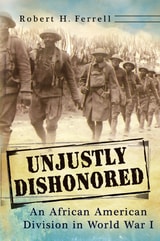
cover of Unjustly Dishonored: An African American Division in World War I

Unjustly Dishonored

An African American Division in World War I

Robert H. Ferrell

University of Missouri Press, 2026
For nearly one hundred years, the 92nd Division of the U.S. Army in World War I has been remembered as a military failure. The division should have been historically significant. It was the only African American division of the American Expeditionary Forces in France. Comprised of nearly twenty-eight thousand black soldiers, it fought in two sectors of the great battle of the Meuse-Argonne, the largest and most costly battle in all of U.S. history. Unfortunately, when part of the 368th Infantry Regiment collapsed in the battle’s first days, the entire division received a blow to its reputation from which it never recovered.      
 
In Unjustly Dishonored: An African American Division in World War I, Robert H. Ferrell challenges long-held assumptions and asserts that the 92nd, in fact, performed quite well militarily. His investigation was made possible by the recent recovery of a wealth of records by the National Archives. The retrieval of lost documents allowed access to hundreds of pages of interviews, mostly from the 92nd Division’s officers, that had never before been considered. In addition, the book uses the Army’s personal records from the Army War College, including the newly discovered report on the 92nd’s field artillery brigade by the enthusiastic commanding general.
 
In the first of its sectors, the Argonne, the 92nd took its objective. Its engineer regiment was a large success, and when its artillery brigade got into action, it so pleased its general that he could not praise it enough. In the attack of General John J. Pershing’s Second Army during the last days of the war, the 92nd captured the Bois Frehaut, the best performance of any division of the Second Army.
 
This book is the first full-length account of the actual accomplishments of the 92nd Division. By framing the military outfit’s reputation against cultural context, historical accounts, and social stigmas, the author proves that the 92nd Division did not fail and made a valuable contribution to history that should, and now finally can, be acknowledged. Unjustly Dishonored fills a void in the scholarship on African American military history and World War I studies.
[more]
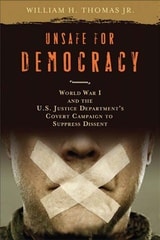
cover of Unsafe for Democracy: World War I and the U.S. Justice Department's Covert Campaign to Suppress Dissent

Unsafe for Democracy

World War I and the U.S. Justice Department's Covert Campaign to Suppress Dissent

William H. Thomas Jr.

University of Wisconsin Press, 2009

During the First World War it was the task of the U.S. Department of Justice, using the newly passed Espionage Act and its later Sedition Act amendment, to prosecute and convict those who opposed America’s entry into the conflict. In Unsafe for Democracy, historian William H. Thomas Jr. shows that the Justice Department did not stop at this official charge but went much further—paying cautionary visits to suspected dissenters, pressuring them to express support of the war effort, or intimidating them into silence. At times going undercover, investigators tried to elicit the unguarded comments of individuals believed to be a threat to the prevailing social order.
In this massive yet largely secret campaign, agents cast their net wide, targeting isolationists, pacifists, immigrants, socialists, labor organizers, African Americans, and clergymen. The unemployed, the mentally ill, college students, schoolteachers, even schoolchildren, all might come under scrutiny, often in the context of the most trivial and benign activities of daily life.
            Delving into numerous reports by Justice Department detectives, Thomas documents how, in case after case, they used threats and warnings to frighten war critics and silence dissent. This early government crusade for wartime ideological conformity, Thomas argues, marks one of the more dubious achievements of the Progressive Era—and a development that resonates in the present day.

Best Books for Special Interests, selected by the American Association of School Librarians

“Recommended for all libraries.”—Frederic Krome, Library Journal
[more]
cover of Utah and the Great War: The Beehive State and the World War I Experience

Utah and the Great War

The Beehive State and the World War I Experience

Edited by Allan Kent Powell

University of Utah Press, 2016

Copublished with the Utah State Historical Society. Affiliated with the Utah Division of State History, Utah Department of Heritage & Arts.

In time for the centennial of the United States’s entry into World War I, this collection of seventeen essays explores the war experience in Utah through multiple perspectives, from those of soldiers, nurses and ambulance drivers who experienced the horror of the conflict firsthand to those on the home front who were transformed by the war. Citizens supported the war financially, through service on councils of defense, with victory gardens, and by other means. Some of Utah’s Native Americans and at least one Episcopal bishop resisted the war. The terrible 1918–1919 flu pandemic impacted Utah and killed more victims around the world than those who died on the battlefields. There was a Red Scare and fight over United States participation in a League of Nations. These topics and more are explored, helping us understand the nature and complexity of the conflict and its impact on Utahns. 

[more]