173 books match the query 'Women in literature' and 2 start with u
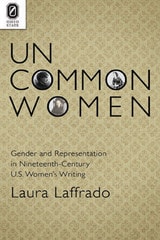
cover of Uncommon Women: Gender and Representation in Nineteenth-Century U.S. Women's Writing

Uncommon Women

Gender and Representation in Nineteenth-Century U.S. Women's Writing

Laura Laffrado

The Ohio State University Press, 2009
Uncommon Women discusses provocative, highly readable, nineteenth-century American texts that complicate notions of self-writing and female agency. This feminist study considers the generic forms, language, and illustrations of a group of complex and often daring texts, including Sarah Kemble Knight’s unconventional travel Journal (1825); Fanny Fern’s controversial newspaper essays (1851–72); Civil War nurse Louisa May Alcott’s Hospital Sketches (1863); and cross-dressed soldier’s S. Emma E. Edmonds’s Nurseand Spy in the Union Army (1865), along with later women’s war reminiscences. The study concludes with a fresh reading of neglected aspects of Harriet Jacobs’s Incidents in the Life of a Slave Girl (1861), the primary Black female autobiographical text of the century, which fundamentally displays what whiteness enabled.
 
Uncommon Women reveals attempts of white middle-class women to both violate and align themselves with gendered assumptions. In doing so, it makes visible the ways in which these texts disputed restrictive female constructions, tested boundaries of race and class, and anticipated reaction to their disruptive discourses. The resulting conflicted self-representations illuminate the vexed contours of women’s autobiography.
This study’s findings make plain the impact of white/male discourses of gender on women’s self-narrativeand illustrate how unconventional women were pressured to embrace domesticity, heterosexuality, marriage, motherhood, and political passivity.
 
 
[more]
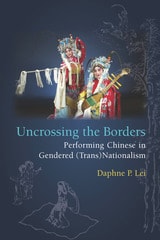
cover of Uncrossing the Borders: Performing Chinese in Gendered (Trans)Nationalism

Uncrossing the Borders

Performing Chinese in Gendered (Trans)Nationalism

Daphne P. Lei

University of Michigan Press, 2019

Over many centuries, women on the Chinese stage committed suicide in beautiful and pathetic ways just before crossing the border for an interracial marriage. Uncrossing the Borders asks why this theatrical trope has remained so powerful and attractive. The book analyzes how national, cultural, and ethnic borders are inevitably gendered and incite violence against women in the name of the nation. The book surveys two millennia of historical, literary, dramatic texts, and sociopolitical references to reveal that this type of drama was especially popular when China was under foreign rule, such as in the Yuan (Mongol) and Qing (Manchu) dynasties, and when Chinese male literati felt desperate about their economic and political future, due to the dysfunctional imperial examination system. Daphne P. Lei covers border-crossing Chinese drama in major theatrical genres such as zaju and chuanqi, regional drama such as jingju (Beijing opera) and yueju (Cantonese opera), and modernized operatic and musical forms of such stories today.

[more]