Results by title
4413 books match the query 'Anthropology' and 70 start with u
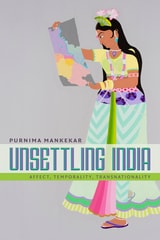
Unsettling India
Affect, Temporality, TransnationalityPurnima Mankekar
Duke University Press, 2015
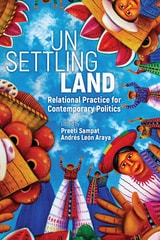
Unsettling Land
Relational Practice for Contemporary PoliticsPreeti Sampat
University Press of Colorado, 2026
Unsettling Land brings together anthropologists and geographers examining land relations across South Asia, the Americas, Northeast Africa, Eastern Europe, and Oceania to show how land’s forms, affordances, and meanings shift across diverse historical contexts and uses. Land is not a fixed, passive surface or static resource but a dynamic entity with agency that is shaped by social, historical, and material relations. As such, land is crucial to understanding contemporary political challenges around climate change, capitalism, and conflict.
Unsettling Land offers vital conceptual and methodological tools that challenge the familiar sociomaterial binaries centered on nature/culture, Indigenous/capitalist, and land/water dichotomies. Scholars make land sensible across its diverse relational forms and by placing it at the center of contemporary politics. Land’s relationalities manifest in animal sanctuaries, wetlands, plantations, forests, conflict zones, urban settlements, and in extractive, infrastructural, and national frontiers. They emerge as identities mobilized through historical, social, and institutional relations of power, and through relationships tied to financialization, assetization, rentierism, and extractivism.
Accessible and theoretically ambitious, Unsettling Land investigates new and old political projects based on questions of care, solidarity, identity, rights, and power across the world. It is essential reading for students and scholars of anthropology, geography, political ecology and economy, and environmental, development, Indigenous, urban, and agrarian studies, as well as readers interested in climate justice and the future of land politics worldwide.
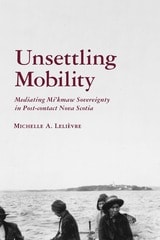
Unsettling Mobility
Mediating Mi’kmaw Sovereignty in Post-contact Nova ScotiaMichelle A. Lelièvre
University of Arizona Press, 2017
Since contact, attempts by institutions such as the British Crown and the Catholic Church to assimilate indigenous peoples have served to mark those people as “Other” than the settler majority. In Unsettling Mobility, Michelle A. Lelièvre examines how mobility has complicated, disrupted, and—at times—served this contradiction at the core of the settler colonial project.
Drawing on archaeological, ethnographic, and archival fieldwork conducted with the Pictou Landing First Nation—one of thirteen Mi’kmaw communities in Nova Scotia—Lelièvre argues that, for the British Crown and the Catholic Church, mobility has been required not only for the settlement of the colony but also for the management and conversion of the Mi’kmaq. For the Mi’kmaq, their continued mobility has served as a demonstration of sovereignty over their ancestral lands and waters despite the encroachment of European settlers.
Unsettling Mobility demonstrates the need for an anthropological theory of mobility that considers not only how people move from one place to another but also the values associated with such movements, and the sensual perceptions experienced by moving subjects. Unsettling Mobility argues that anthropologists, indigenous scholars, and policy makers must imagine settlement beyond sedentism. Rather, both mobile and sedentary practices, the narratives associated with those practices, and the embodied experiences of them contribute to how people make places—in other words, to how they settle.
Unsettling Mobility arrives at a moment when indigenous peoples in North America are increasingly using movement as a form of protest in ways that not only assert their political subjectivity but also remake the nature of that subjectivity.
Unsettling Queer Anthropology
Foundations, Reorientations, and DeparturesMargot Weiss, editor
Duke University Press, 2024
Contributors. Jafari Sinclair Allen, Tom Boellstorff, Erin L. Durban, Elijah Adiv Edelman, Lyndon K. Gill, K. Marshall Green, Brian A. Horton, Nikki Lane, Martin F. Manalansan IV, Shaka McGlotten, Scott L. Morgensen, Kwame Otu, Juno Salazar Parreñas, Lucinda Ramberg, Sima Shakhsari, Savannah Shange, Anne Spice, Margot Weiss, Ara Wilson

Unsettling Scripture
Iroquois and the Book of MormonThomas W Murphy
University of Utah Press, 2025
In Unsettling Scripture: Iroquois and the Book of Mormon, anthropologist Thomas W Murphy delves into the visions of Seneca prophet Handsome Lake, the epic narratives of the Iroquois Confederacy, and the origin story of the Book of Mormon, revealing surprising parallels between Indigenous and Mormon traditions.
Through ethnohistorical research and decolonizing methodologies, Murphy reexamines how both communities understand their origins, faith, and prophecy. From Handsome Lake’s revelations to Joseph Smith’s seer stone, from ancient sibling rivalries to the Great Peace, this book unsettles traditional narratives while opening new conversations on scripture, identity, and cultural exchange. Drawing from living Indigenous voices, Unsettling Scripture challenges readers to rethink sacred texts and the histories they tell.
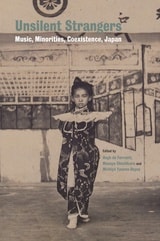
Unsilent Strangers
Music, Minorities, Co-existence, JapanEdited by Hugh de Ferranti, Michiyo Yoneno-Reyes, and Masaya Shishikura
National University of Singapore Press, 2023
This collection of essays on the music of migrant minorities in and from Japan examines the central role music plays in the ongoing adjustment, conciliation, and transformation of newcomers and “hosts” alike. It is the first academic text to address musical activities across a range of migrant groups in Japan––particularly those of Tokyo and its neighboring areas and the first to juxtapose such communities with those of Japanese emigrants as ethnic minorities elsewhere. It presents both archival and fieldwork-based case studies that highlight music in the dynamics of encounter and attempted identity-making, under a unifying framework of migration.
The 2019 introduction of a new “Specified Skilled Worker” visa category marked the beginning of Japan’s “new immigration era,” led by the slogan of tabunka kyosei, or “multicultural coexistence.” The contributors to this volume analyze the concept itself and the many problems around realizing this ideal through ethnographic accounts of current minorities, including South Indians, Brazilians, Nepalis, Filipinos, Iranians, and Ainu domestic migrants. This volume will be of interest to ethnomusicologists, students of the cultures of migrant communities, and those engaged with cultural change and diversity in Japan and East Asia.
Untaming the Frontier in Anthropology, Archaeology, and History
Edited by Bradley J. Parker and Lars Rodseth
University of Arizona Press, 2005
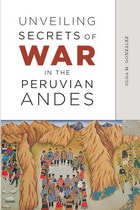
Unveiling Secrets of War in the Peruvian Andes
Olga M. González
University of Chicago Press, 2011
The Maoist guerrilla group Shining Path launched its violent campaign against the government in Peru’s Ayacucho region in 1980. When the military and counterinsurgency police forces were dispatched to oppose the insurrection, the violence quickly escalated. The peasant community of Sarhua was at the epicenter of the conflict, and this small village is the focus of Unveiling Secrets of War in the Peruvian Andes. There, nearly a decade after the event, Olga M. González follows the tangled thread of a public secret: the disappearance of Narciso Huicho, the man blamed for plunging Sarhua into a conflict that would sunder the community for years.
Drawing on extensive fieldwork and a novel use of a cycle of paintings, González examines the relationship between secrecy and memory. Her attention to the gaps and silences within both the Sarhuinos’ oral histories and the paintings reveals the pervasive reality of secrecy for people who have endured episodes of intense violence. González conveys how public secrets turn the process of unmasking into a complex mode of truth telling. Ultimately, public secrecy is an intricate way of “remembering to forget” that establishes a normative truth that makes life livable in the aftermath of a civil war.
Unwrapping the Sacred Bundle
Reflections on the Disciplining of AnthropologyDaniel A. Segal and Sylvia J. Yanagisako, eds.
Duke University Press, 2005
The essayists consider the complex state of anthropology, its relation to other disciplines and the public sphere beyond academia, the significance of the convergence of linguistic and cultural anthropology, and whether or not anthropology is the best home for archaeology. While the contributors are not in full agreement with one another, they all critique “official” definitions of anthropology as having a fixed, four-field core. The editors are keenly aware that anthropology is too protean to be remade along the lines of any master plan, and this volume does not offer one. It does open discussions of anthropology’s institutional structure to all possible outcomes, including the refashioning of the discipline as it now exists.
Contributors. James Clifford, Ian Hodder, Rena Lederman, Daniel A. Segal, Michael Silverstein, Sylvia J. Yanagisako
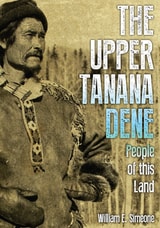
Upper Tanana Dene
People of This Landby William E. Simeone
University of Alaska Press, 2022
As young Dene migrate to towns and cities far from their homeland on the upper Tanana River of east central Alaska, they may never learn what it was like living from the land. In these interviews elders express concern that young Dene are becoming ignorant of the traditions that made their ancestors disciplined and strong enough to withstand the rigors of life on the land. The old life was taxing and made demands on the body and soul, and the struggle to achieve security placed a premium on knowledge, endurance, and constant effort. Modern conveniences have made life easier, but elders believe their knowledge is still vital to the survival of future generations.
With text in both Dene and English, The Upper Tanana Dene is a link to Dene experiences, lives, and understanding of the world and is meant for those interested in Dene heritage, as well as students and scholars of cultural and ethnic studies and history.
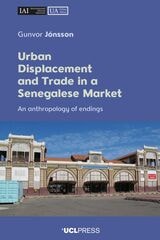
Urban Displacement and Trade in a Senegalese Market
An Anthropology of EndingsGunvor Jónsson
University College London, 2024
The Malian market at the terminus in Dakar was bulldozed in 2009 and, following the privatization of the railway, passenger services in Senegal soon ceased altogether. The consequences were felt especially by women traders who had traveled the line since its inauguration, making the terminus in Dakar the center of a thriving network of traders and migrants. To examine the fates of those whose livelihoods were destroyed or disrupted, Gunvor Jónsson spent a year with the women evicted from the terminus. Urban Displacement and Trade in a Senegalese Market explores what happens at the end of urban displacement, when people find themselves scattered in sometimes unfamiliar surroundings, trying to pick up the pieces and create something meaningful.
In this book, Jónsson argues that rupture and ensuing displacement do not produce a clean slate where identities, networks, and histories must be produced from scratch. When evicted, traders and their markets do not simply vanish into thin air. The book examines not only what is lost but what emerges when a dense node, such as the terminus, is dissolved and fragmented. The ethnography of the traders reveals that the aftermath of eviction in cities may lead to diasporic forms of consciousness and identity formations. Displacement, whether on a local or global scale, demands difficult adjustments, and people’s capacities to adapt to new circumstances and environments vary. This book uncovers the different capacities and variations in traders’ reactions to displacement.
Urban Dwellings, Haitian Citizenships
Housing, Memory, and Daily Life in HaitiVincent Joos
Rutgers University Press, 2022
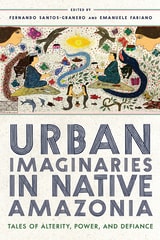
Urban Imaginaries in Native Amazonia
Tales of Alterity, Power, and DefianceFernando Santos-Granero
University of Arizona Press, 2023
Featuring analysis from historical, ethnological, and philosophical perspectives, contributors seek to explain the imaginaries’ widespread diffusion, as well as their influence in present-day migration and urbanization. Above all, it underscores how these urban imaginaries allow Indigenous Amazonians to express their concerns about power, alterity, domination, and defiance.
Contributors
Natalia Buitron
Philippe Erikson
Emanuele Fabiano
Fabiana Maizza
Daniela Peluso
Fernando Santos-Granero
Pirjo Kristiina Virtanen
Robin M. Wright
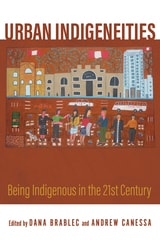
Urban Indigeneities
Being Indigenous in the Twenty-First CenturyDana Brablec
University of Arizona Press, 2023
Today a majority of Indigenous peoples live in urban areas: they are builders and cleaners, teachers and lawyers, market women and masons, living in towns and cities surrounded by the people and pollution that characterize life for most individuals in the twenty-first century. Despite this basic fact, the vast majority of studies on Indigenous peoples concentrate solely on rural Indigenous populations.
Aiming to highlight these often-overlooked communities, this is the first book to look at urban Indigenous peoples globally and present the urban Indigenous experience—not as the exception but as the norm. The contributing essays draw on a wide range of disciplines, including sociology, anthropology, architecture, land economy, and area studies, and are written by both Indigenous and non-Indigenous scholars. The analysis looks at Indigenous people across the world and draws on examples not usually considered within the study of indigeneity, such as Fiji, Japan, and Russia.
Indigeneity is often seen as being “authentic” when it is practiced in remote rural areas, but these essays show that a vigorous, vibrant, and meaningful indigeneity can be created in urban spaces too. The book challenges many of the imaginaries and tropes of what constitutes “the Indigenous” and offers perspectives and tools to understand a contemporary Indigenous urban reality. As such, it is a must-read for anyone interested in the real lives of Indigenous people today.
Contributors
Aiko Ikemura Amaral
Chris Andersen
Giuliana Borea
Dana Brablec
Andrew Canessa
Sandra del Valle Casals
Stanislav Saas Ksenofontov
Daniela Peluso
Andrey Petrov
Marya Rozanova-Smith
Kate Stevens
Kanako Uzawa
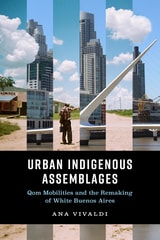
Urban Indigenous Assemblages
Qom Mobilities and the Remaking of White Buenos AiresAna Vivaldi
Vanderbilt University Press, 2025
Over the past two decades, Latin American politicians and activists have reckoned with their nations’ histories of racism, forced displacement of native peoples, and inequality by acknowledging Indigenous communities as peoples preexisting the modern states. In Argentina—a nation long fixated on presenting itself as “white” and “European”—this shift has been dramatic. After decades of erasure and racism toward Indigenous peoples, Argentinian civil society is identifying Indigenous groups as not just an element from the past, but as nations central to the country’s culturally plural and multiracial identity.
In Urban Indigenous Assemblages, Ana Vivaldi considers how Argentina’s urban Indigenous population fits into this recent political and social movement. To do this, she focuses on how the Qom Indigenous people—whose traditional territories are in northern Argentina—have moved to Buenos Aires, made homes in shantytowns alongside other migrants, and remade urban space by building Indigenous lives in the city. Starting from a Qom barrio in Greater Buenos Aires, Vivaldi traces how Qom peoples’ travels to rural communities and movement across the city create complex networks and produce an urban life always in connection to other places. She argues that urban racialized indigeneities represent sites of contradictory relations visible and invisible to state actors and hypervisible to development agencies, as the Qom are expected to prove their authenticity and remove themselves from important relationships with nonwhite neighbors to access rights and recognition.
Based on eighteen months of fieldwork, this book analyzes the historical process that created the barrio: the constant remaking of this Indigenous space in interaction with state institutions and NGOs, the links between the barrio and northern Argentina through travels “far out” to rural communities in the Chaco, and the expansion of “Indigenous territories” beyond bounded location.
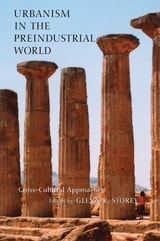
Urbanism in the Preindustrial World
Cross-Cultural ApproachesEdited by Glenn R. Storey
University of Alabama Press, 2006
This work employs a subset of preindustrial cities on many continents to answer questions archaeologists grapple with concerning the populating and growth of cities before industrialization. It further explores how scholars differently conceive and execute their research on the population of cities. The subject cities are in Greece, Mesoamerica, the Andes, Italy, Egypt, Africa, United States, Denmark, and China. This broad sample provides a useful framework for answers to such questions as “Why did people agglomerate into cities?” and “What population size and what age of endurance constitute a city?”
The study covers more than population magnitude and population makeup, the two major frameworks of urban demography. The contributors combine their archaeological and historical expertise to reveal commonalities, as well as theoretical extrapolations and methodological approaches, at work here and outside the sample.
Urbanism in the Preindustrial World is a unique study revealing the variety of factors involved in the coalescing and dispersal of populations in preindustrial times.
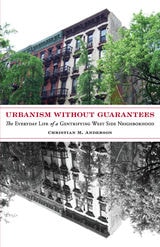
Urbanism without Guarantees
The Everyday Life of a Gentrifying West Side NeighborhoodChristian M. Anderson
University of Minnesota Press, 2020
A unique more-than-capitalist take on urban dynamics
Vigilante action. Renegades. Human intrigue and the future at stake in New York City. In Urbanism without Guarantees, Christian M. Anderson offers a new perspective on urban dynamics and urban structural inequality based on an intimate ethnography of on-the-ground gentrification.
The book is centered on ethnographic work undertaken on a single street in Clinton/Hell’s Kitchen in New York City—once a site of disinvestment, but now rapidly gentrifying. Anderson examines the everyday strategies of residents to preserve the quality of life of their neighborhood and to define and maintain their values of urban living—from picking up litter and reporting minor concerns on the 311 hotline to hiring a private security firm to monitor the local public park. Anderson demonstrates how processes such as investment and gentrification are constructed out of the collective actions of ordinary people, and challenges prevalent understandings of how place-based civic actions connect with dominant forms of political economy and repressive governance in urban space.
Examining how residents are pulled into these systems of gentrification, Anderson proposes new ways to think and act critically and organize for transformation of a place—in actions that local residents can start to do wherever they are.

Us and Them
The Science of IdentityDavid Berreby
University of Chicago Press, 2008
In this award-winning book, David Berreby describes how twenty-first-century science is addressing these age-old questions. Ably linking neuroscience, social psychology, anthropology, and other fields, Us and Them investigates humanity’s “tribal mind” and how this alters our thoughts, affects our health, and is manipulated for good and ill. From the medical effects of stress to the rhetoric of politics, our perceptions of group identity affect every part of our lives. Science, Berreby argues, shows how this part of human nature is both unexpectedly important and surprisingly misunderstood.
Humans need our tribal sense—it tells us who we are, how we should behave, and links us to others as well as the past and future. Some condemn this instinct, while others celebrate it. Berreby offers in Us and Them a third alternative: how we can accept and understand our inescapable tribal mind.
“[A] brave book. . . . Berreby’s quest is to understand what he sees as a fundamental human urge to classify and identify with ‘human kinds.’”—Henry Gee, Scientific American
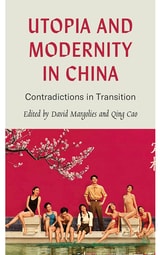
Utopia and Modernity in China
Contradictions in TransitionDavid Margolies
Pluto Press, 2022
Utopia and Modernity in China examines the conflicts inherent in China's attempt to achieve a 'utopia' by advancing production and technology. Through the lenses of literature, arts, law, the press and the environment, the contributors interrogate the contradictions of modernization in Chinese society and its fundamental challenges.
By unpicking both China's vision of utopia and its realities and the increasing tension between traditional Chinese values and those of the West, this book offers a unique insight into the cultural forces that are part of reshaping today's China.
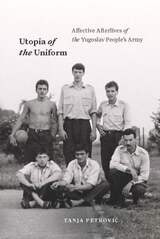
Utopia of the Uniform
Affective Afterlives of the Yugoslav People's ArmyTanja Petrovic
Duke University Press, 2024