Results by title
8128 books match the query 'Literary Criticism' and 105 start with u

Unfastened
Globality and Asian North American NarrativesEleanor Ty
University of Minnesota Press, 2010
Unfolding the City
Women Write the City in Latin AmericaAnne Lambright
University of Minnesota Press, 2007
Unfurl
Survivals, Sorrows, and DreamingEli Clare
Duke University Press, 2025
Unguessed Kinships
Naturalism and the Geography of Hope in Cormac McCarthySteven Frye
University of Alabama Press, 2023
Literary naturalism at play in one of America’s most visionary novelists: Cormac McCarthy
It took six novels and nearly thirty years for Cormac McCarthy to find commercial success with the National Book Award–winning All the Pretty Horses, followed by major prizes, more best sellers, and Hollywood adaptations of his work. Those successes, though, have obscured McCarthy’s commitment to an older form of literary expression: naturalism.
It is hardly a secret that McCarthy’s work tends to darker themes: violence, brutality, the cruel indifference of nature, themes which would not be out of place in the writing of Jack London or Stephen Crane. But literary naturalism is more than the oversimplified Darwinism that many think of. Nature may be red in tooth and claw, and humans are part of nature, but the humanity depicted in naturalist literature is capable of love, selflessness, and spirituality, as well.
In Unguessed Kinships, Steven Frye illuminates all these dimensions of McCarthy’s work. In his novels and plays, McCarthy engages both explicitly and obliquely with the project of manifest destiny, in the western drama Blood Meridian, the Tennessee Valley Authority-era Tennessee novels, and the atomic frontier of Alamogordo in Cities of the Plain. McCarthy’s concerns are deeply religious and philosophical, drawing on ancient Greek philosophy, Gnosticism, and Nietzsche, among other sources. Frye argues for McCarthy not merely as a naturalist writer but as a naturalist in the most expansive sense. Unguessed Kinships includes biographical and historical context in each chapter, widening the appeal of the text to not just naturalists or McCarthy scholars but anyone studying the literature of the South or the West.

Universal Grammar and Narrative Form
David Herman
Duke University Press, 1995
Following an extensive historical overview of theories about universal grammar, Herman examines Joyce’s Ulysses, Kafka’s The Trial, and Woolf’s Between the Acts as case studies of modernist literary narratives that encode grammatical principles which were (re)fashioned in logic, linguistics, and philosophy during the same period. Herman then uses the interpretation of universal grammar developed via these modernist texts to explore later twentieth-century cultural phenomena. The problem of citation in the discourses of postmodernism, for example, is discussed with reference to syntactic theory. An analysis of Peter Greenaway’s The Cook, The Thief, His Wife, and Her Lover raises the question of cinematic meaning and draws on semantic theory. In each case, Herman shows how postmodern narratives encode ideas at work in current theories about the nature and function of language.
Outlining new directions for the study of language in literature, Universal Grammar and Narrative Form provides a wealth of information about key literary, linguistic, and philosophical trends in the twentieth century.
Universes without Us
Posthuman Cosmologies in American LiteratureMatthew A. Taylor
University of Minnesota Press, 2013
During the nineteenth and early twentieth centuries, a wide variety of American writers proposed the existence of energies connecting human beings to cosmic processes. From varying points of view—scientific, philosophical, religious, and literary—they suggested that such energies would eventually result in the perfection of individual and collective bodies, assuming that assimilation into larger networks of being meant the expansion of humanity’s powers and potentialities—a belief that continues to inform much posthumanist theory today.
Universes without Us explores a lesser-known countertradition in American literature. As Matthew A. Taylor’s incisive readings reveal, the heterodox cosmologies of Edgar Allan Poe, Henry Adams, Charles Chesnutt, and Zora Neale Hurston reject the anthropocentric fantasy that sees the universe as a kind of reservoir of self-realization. For these authors, the world can be made neither “other” nor “mirror.” Instead, humans are enmeshed with “alien” processes that are both constitutive and destructive of “us.” By envisioning universes no longer our own, these cosmologies picture a form of interconnectedness that denies any human ability to master it.
Universes without Us demonstrates how the questions, possibilities, and dangers raised by the posthuman appeared nearly two centuries ago. Taylor finds in these works an untimely engagement with posthumanism, particularly in their imagining of universes in which humans are only one category of heterogeneous thing in a vast array of species, objects, and forces. He shows how posthumanist theory can illuminate American literary texts and how those texts might, in turn, prompt a reassessment of posthumanist theory. By understanding the posthuman as a materialist cosmology rather than a technological innovation, Taylor extends the range of thinkers who can be included in contemporary conversations about the posthuman.
Unlawful Violence
Mexican Law and Cultural ProductionRebecca Janzen
Vanderbilt University Press, 2022
The abundance of laws and constitutional amendments that have cropped up in response are mirrored in Mexico's fragmented cultural production of the same period. Contemporary Mexican literature grapples with this splintered reality through non-linear stories from multiple perspectives, often told through shifts in time. The novels, such as Jorge Volpi's Una novela criminal [A Novel Crime] (2018) and Julián Herbert's La casa del dolor ajeno [The House of the Pain of Others] (2015) take multiple perspectives and follow non-linear plotlines; other examples, such as the very short stories in ¡Basta! 100 mujeres contra la violencia de género [Enough! 100 Women against Gender-Based Violence] (2013), present perspectives from multiple authors.
Few scholars compare cultural production and legal texts in situations like Mexico, where extreme violence coexists with a high number of human rights laws. Unlawful Violence measures fictional accounts of human rights against new laws that include constitutional amendments to reform legal proceedings, laws that protect children, laws that condemn violence against women, and laws that protect migrants and Indigenous peoples. It also explores debates about these laws in the Mexican house of representatives and senate, as well as interactions between the law and the Mexican public.
Unnatural Ecopoetics
Unlikely Spaces in Contemporary PoetrySarah Nolan
University of Nevada Press, 2017
By approaching environments in a new way, Nolan closes this gap and recognizes how contemporary poets employ self-reflexive commentary and formal experimentation in order to create new natural/cultural environments on the page. She proposes a radical new direction for ecopoetics and deploys it in relation to four major American poets. Working from literal to textual spaces through the contemporary poetry of A.R. Ammons’s Garbage, Lyn Hejinian’s My Life, Susan Howe’s The Midnight, and Kenneth Goldsmith’s Seven American Deaths and Disasters, the book presents applications of unnatural ecopoetics in poetic environments, ones that do not engage with traditional ideas of nature and would otherwise remain outside the scope of ecocritical and ecopoetic studies.
Nolan proposes a new practical approach for reading poetic language. Ecocriticism is a very fluid and evolving discipline, and Nolan’s pioneering new book pushes the boundaries of second-wave ecopoetics—the fundamental issue being what is nature/natural, and how does poetic language, particularly self-conscious contemporary poetic agency, contribute to and complicate that question.
Unnatural Narrative
Theory, History, and PracticeBrian Richardson
The Ohio State University Press, 2015
Applying these theoretical insights, Richardson also provides a compelling alternative view of the history of narrative. He traces a genealogy of unnatural narratives from ancient Greek and Sanskrit works through medieval and renaissance fiction to eighteenth-century and romantic fiction. The study continues through the twentieth century, discussing the unnatural elements of Ulysses and other early twentieth-century texts, and engages with contemporary fiction by offering an alternative account of postmodernism. Unnatural Narrative makes an essential intervention in narrative theory and an important contribution to the history of the novel.
Unnatural Narratology
Extensions, Revisions, and ChallengesEdited by Jan Alber and Brian Richardson
The Ohio State University Press, 2020
Unoriginal Genius
Poetry by Other Means in the New CenturyMarjorie Perloff
University of Chicago Press, 2010
What is the place of individual genius in a global world of hyper-information— a world in which, as Walter Benjamin predicted more than seventy years ago, everyone is potentially an author? For poets in such a climate, "originality" begins to take a back seat to what can be done with other people’s words—framing, citing, recycling, and otherwise mediating available words and sentences, and sometimes entire texts. Marjorie Perloff here explores this intriguing development in contemporary poetry: the embrace of "unoriginal" writing. Paradoxically, she argues, such citational and often constraint-based poetry is more accessible and, in a sense, "personal" than was the hermetic poetry of the 1980s and 90s.
Perloff traces this poetics of "unoriginal genius" from its paradigmatic work, Benjamin’s encyclopedic Arcades Project, a book largely made up of citations. She discusses the processes of choice, framing, and reconfiguration in the work of Brazilian Concretism and Oulipo, both movements now understood as precursors of such hybrid citational texts as Charles Bernstein’s opera libretto Shadowtime and Susan Howe’s documentary lyric sequence The Midnight. Perloff also finds that the new syncretism extends to language: for example, to the French-Norwegian Caroline Bergvall writing in English and the Japanese Yoko Tawada, in German. Unoriginal Genius concludes with a discussion of Kenneth Goldsmith’s conceptualist book Traffic—a seemingly "pure’" radio transcript of one holiday weekend’s worth of traffic reports. In these instances and many others, Perloff shows us "poetry by other means" of great ingenuity, wit, and complexity.
Unorthodox Beauty
Russian Modernism and Its New Religious AestheticMartha M. F. Kelly
Northwestern University Press, 2016
Unorthodox Beauty shows how Russian poets of the early twentieth century consciously adapted Russian Orthodox culture in order to create a distinctly religious modernism. Martha M. F. Kelly contends that, beyond mere themes, these writers developed an entire poetics that drew on liturgical tradition. Specifically, Russian Orthodoxy held out the possibility of unifying spirit and matter, as well as a host of other dichotomies—subject and object, empirical and irrational, noumena and phenomena. The artist could produce a work of transformative and regenerative power. Using a range of crossdisciplinary tools, Kelly reads key works by Blok, Kuzmin, Akhmatova, and Pasternak in ways that illustrate how profoundly religious traditions and ideas shaped Russian modernist literature.
Unquiet Tropes
Form, Race, and Asian American LiteratureElda E Tsou
Temple University Press, 2015
In Unquiet Tropes, Tsou reconceptualizes the literature as a set of highly particular classical rhetorical tropes including antanaclasis, rhetorical question, apophasis, catachresis, and allegory. Looking at five canonical works—Aiiieeeee!, No-No Boy, China Men, Blu’s Hanging, and Native Speaker—Tsou shows how these texts use figurative means to confront the problem of race. She also explores how traces of Asian American history live on through these figures.
Each case study in Unquiet Tropes considers a different scenario—defiance, coercion, necessity, error, and deceit—to show how literary representation from the 1950s through 1997 has responded to a specific political condition.
Unraveling the Real
The Fantastic in Spanish-American FiccionesAuthored by Cynthia Duncan
Temple University Press, 2010
In literary and cinematic fictions, the fantastic blurs the lines between reality and fantasy. Lacking a consensus on definition, critics often describe the fantastic as supernatural, or similar to, but quite different from fantasy, science fiction, and magical realism.
In Unraveling the Real Cynthia Duncan provides a new theoretical framework for discussing how the fantastic explores both metaphysical and socially relevant themes in Spanish American fictions. Duncan deftly shows how authors and artists have used this literary genre to convey marginalized voices as well as critique colonialism, racism, sexism, and classism. Selecting examples from the works of such noted writers as Jorge Luis Borges, Julio Cortázar, and Carlos Fuentes, among others, she shows how capacious the concept is, and why it eludes standard definition.
Challenging the notion that the fantastic is escapist in nature, Unraveling the Real shows how the fantastic has been politically engaged throughout the twentieth century, often questioning what is real or unreal. Presenting a mirror image of reality, the fantastic does not promoting a utopian parallel universe but rather challenges the way we think about the world around us and the cultural legacy of colonialism.
Unrequited Conquests
Love and Empire in the Colonial AmericasRoland Greene
University of Chicago Press, 2000
European encounters with the Americas awakened many forms of desire, which pervaded the writings of explorers like Columbus and his contemporaries. These experiences in turn shaped colonial society in Brazil, Peru, and elsewhere. The New World, while it could be explored, conquered, and exploited, could never really be "known"—leaving Europe's desire continually unrequited and the project of empire unfulfilled.
Using numerous poetic examples and extensive historical documentation, Unrequited Conquests rewrites the relations between the Renaissance and colonial Latin America and between poetry and history.
Unsettled Solidarities
Asian and Indigenous Cross-Representations in the AméricasQuynh Nhu Le
Temple University Press, 2019
Unsettled Solidarities examines contemporary Asian and Indigenous cross-representations within different settler states in the Américas. Quynh Nhu Le looks at literary works by both groups alongside public apologies, interviews, and hemispheric race theories to trace cross-community tensions and possibilities for solidarities amidst the uneven imposition of racialization and settler colonization.
Contrasting texts such as Maxine Hong Kingston’s China Men with Gerald Vizenor’s Hiroshima Bugi, and Karen Tei Yamashita’s Through the Arc of the Rain Forest with Leslie Marmon Silko’s Almanac of the Dead, among others, Le reveals how settler colonialism persists through the liberal ideological structuring or incorporation of critical and political resistance. She illuminates the tense collisions of Asian and Indigenous movements from the heroic/warrior traditions, reparations and redress, and transnational/cross-racial mobilization against global capital to mixed-race narratives.
Reading these tensions as formed through the unstable grammatical and emotional economies of liberalism, Le frames settler colonialism as a process that is invoked and yet ruptured by Asian and Indigenous peoples. In analyzing Asian/Indigenous crossings in the United States, Canada, Mexico, and Brazil, Unsettled Solidarities conveys the logics and instabilities that connect these settler empires.
Unsettled Subjects
Restoring Feminist Politics to Poststructuralist CritiqueSusan Lurie
Duke University Press, 1997
In her analysis, Lurie traces each author’s strategies for revealing and challenging the ways that patriarchal gender ideology profits from what is always plural and contested female subjectivity. Only such an inquiry, Lurie demonstrates, can explain the impasses that have steered poststructuralist feminism away from gender as a category of analysis and can point toward the models necessary for a more complete feminist critique of patriarchal power.
Unsettled
The Culture of Mobility and the Working Poor in Early Modern EnglandPatricia Fumerton
University of Chicago Press, 2006
Migrants made up a growing class of workers in late sixteenth- and seventeenth- century England. In fact, by 1650, half of England’s rural population consisted of homeless and itinerant laborers. Unsettled is an ambitious attempt to reconstruct the everyday lives of these dispossessed people. Patricia Fumerton offers an expansive portrait of unsettledness in early modern England that includes the homeless and housed alike.
Fumerton begins by building on recent studies of vagrancy, poverty, and servants, placing all in the light of a new domestic economy of mobility. She then looks at representations of the vagrant in a variety of pamphlets and literature of the period. Since seamen were a particularly large and prominent class of mobile wage-laborers in the seventeenth century, Fumerton turns to seamen generally and to an individual poor seaman as a case study of the unsettled subject: Edward Barlow (b. 1642) provides a rare opportunity to see how the laboring poor fashioned themselves, for he authored a journal of over 225,000 words and 147 pages of drawings. Barlow’s journal, studied extensively here for the first time, vividly charts what he himself termed his “unsettled mind” and the perpetual anxieties of England’s working and wayfaring poor. Ultimately, Fumerton explores representations of seamen as unsettled in the broadside ballads of Barlow’s time.
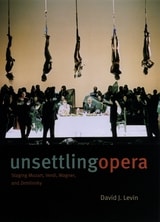
Unsettling Opera
Staging Mozart, Verdi, Wagner, and ZemlinskyDavid J. Levin
University of Chicago Press, 2007
What happens when operas that are comfortably ensconced in the canon are thoroughly rethought and radically recast on stage? What does a staging do to our understanding of an opera, and of opera generally? While a stage production can disrupt a work that was thought to be established, David J. Levin here argues that the genre of opera is itself unsettled, and that the performance of operas, at its best, clarifies this condition by bringing opera’s restlessness and volatility to life.
Unsettling Opera explores a variety of fields, considering questions of operatic textuality, dramaturgical practice, and performance theory. Levin opens with a brief history of opera production, opera studies, and dramatic composition, and goes on to consider in detail various productions of the works of Wagner, Mozart, Verdi, and Alexander Zemlinsky. Ultimately, the book seeks to initiate a dialogue between scholars of music, literature, and performance by addressing questions raised in each field in a manner that influences them all.
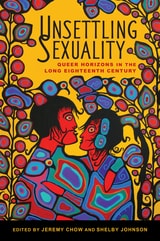
Unsettling Sexuality
Queer Horizons in the Long Eighteenth CenturyJeremy Chow
University of Delaware Press, 2025
This book is also freely available online as an open access digital edition on Manifold, here: https://openpub.udel.edu/projects/unsettling-sexuality.
Unsettling Sexuality: Queer Horizons in the Long Eighteenth Century challenges the traditional ways that scholarship has approached sexuality, gender nonconformity, and sex (as well as its absence) in the long eighteenth century. Drawing from recent and emerging criticisms in Middle Eastern and Asian studies, Black studies, and Native American and Indigenous studies, the collected authors perform intersectional queer readings, reimagine queer historiographic methods, and spearhead new citational models that can invigorate the field. Contributors read with and against diverse European, transatlantic, and global archives to explore mutually informative frameworks of gender, sexuality, race, indigeneity, ability, and class. In charting multidirectional queer horizons, this collection locates new prospective desires and intimacies in the literature, culture, and media of the period to imagine new directions and simultaneously unsettle eighteenth-century studies.
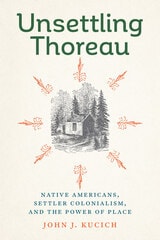
Unsettling Thoreau
Native Americans, Settler Colonialism, and the Power of PlaceJohn J. Kucich
University of Massachusetts Press, 2024
A CHOICE 2025 Outstanding Academic Title
Finalist for the 2025 New England Society Book Awards
Henry David Thoreau’s life-long fascination with Native Americans is widely known and a recurring topic of interest, and it is also a source of modern debate. This is a figure who both had a deep interest in Native American history and culture and was seen by many of his contemporaries, including Ralph Waldo Emerson and Nathaniel Hawthorne, as “more like an Indian” than his white neighbors. At the same time, Thoreau did little to protest the systematic dispossession of Indigenous people across the country in his lifetime. John J. Kucich charges into this contradiction, considering how Thoreau could demonstrate deep respect for Native American beliefs on one hand and remain largely silent about their genocide, actively happening throughout his life, on the other. Thoreau’s long study of Native peoples, as reflected in so much of his writing, allowed him to glimpse an Indigenous worldview, but it never fully freed him from the blind spots of settler colonialism.
Drawing on Indigenous studies and critiques of settler colonialism, as well as new materialist approaches that illustrate Thoreau’s radical reimagining of the relationship between humans and the natural world, Unsettling Thoreau explores the stakes of Thoreau’s effort to live mindfully and ethically in place when living alongside, or replacing marginalized peoples. By examining the whole scope of his writings, including the unpublished Indian Notebooks, and placing them alongside Native writers and communities in and beyond New England, this book gauges Thoreau’s effort to use Indigenous knowledge to reimagine a settler colonial world, without removing him from its trappings.
Unsettling
Jews, Whiteness, and Incest in American Popular CultureEli Bromberg
Rutgers University Press, 2021
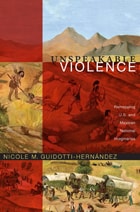
Unspeakable Violence
Remapping U.S. and Mexican National ImaginariesNicole M. Guidotti-Hernández
Duke University Press, 2011
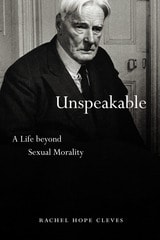
Unspeakable
A Life beyond Sexual MoralityRachel Hope Cleves
University of Chicago Press, 2020
Unspeakable approaches Douglas as neither monster nor literary hero, but as a man who participated in an exploitative sexual subculture that was tolerated in ways we may find hard to understand. Using letters, diaries, memoirs, police records, novels, and photographs—including sources by the children Douglas encountered—Cleves identifies the cultural practices that structured pedophilic behaviors in England, Italy, and other places Douglas favored. Her book delineates how approaches to adult-child sex have changed over time and offers insight into how society can confront similar scandals today, celebrity and otherwise.
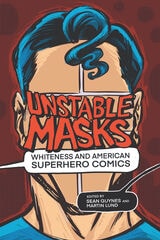
Unstable Masks
Whiteness and American Superhero ComicsEdited by Sean Guynes and Martin Lund
The Ohio State University Press, 2020
In Unstable Masks: Whiteness and American Superhero Comics, Sean Guynes and Martin Lund bring together a series of essays that contextualize the histories and stakes of whiteness studies, superhero comics, and superhero studies for academics, fans, and media-makers alike. The volume illustrates how the American comic book superhero is fundamentally a figure of white power and white supremacy and ultimately calls for diversity in superhero comics as well as a democratized media culture.
Contributors not only examine superhero narratives but also delve into the production, distribution, audience, and reception of those narratives, highlighting the imbrication of forces that have helped to create, normalize, question, and sometimes even subvert American beliefs about whiteness and race. Unstable Masks considers the co-constitutive nature of identity, representation, narrative, production and consumption, and historical and cultural contexts in forging the stereotypes that decide who gets to be a superhero and who gets to be American on the four-color pages of comic books.
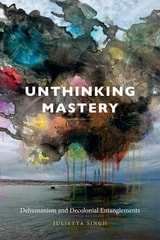
Unthinking Mastery
Dehumanism and Decolonial EntanglementsJulietta Singh
Duke University Press, 2018
Unthought
The Power of the Cognitive NonconsciousN. Katherine Hayles
University of Chicago Press, 2017
Marshalling fresh insights from neuroscience, cognitive science, cognitive biology, and literature, Hayles expands our understanding of cognition and demonstrates that it involves more than consciousness alone. Cognition, as Hayles defines it, is applicable not only to nonconscious processes in humans but to all forms of life, including unicellular organisms and plants. Startlingly, she also shows that cognition operates in the sophisticated information-processing abilities of technical systems: when humans and cognitive technical systems interact, they form “cognitive assemblages”—as found in urban traffic control, drones, and the trading algorithms of finance capital, for instance—and these assemblages are transforming life on earth. The result is what Hayles calls a “planetary cognitive ecology,” which includes both human and technical actors and which poses urgent questions to humanists and social scientists alike.
At a time when scientific and technological advances are bringing far-reaching aspects of cognition into the public eye, Unthought reflects deeply on our contemporary situation and moves us toward a more sustainable and flourishing environment for all beings.
Until Choice Do Us Part
Marriage Reform in the Progressive EraClare Virginia Eby
University of Chicago Press, 2013
For centuries, people have been thinking and writing—and fiercely debating—about the meaning of marriage. Just a hundred years ago, Progressive era reformers embraced marriage not as a time-honored repository for conservative values, but as a tool for social change.
In Until Choice Do Us Part, Clare Virginia Eby offers a new account of marriage as it appeared in fiction, journalism, legal decisions, scholarly work, and private correspondence at the turn into the twentieth century. She begins with reformers like sexologist Havelock Ellis, anthropologist Elsie Clews Parsons, and feminist Charlotte Perkins Gilman, who argued that spouses should be “class equals” joined by private affection, not public sanction. Then Eby guides us through the stories of three literary couples—Upton and Meta Fuller Sinclair, Theodore and Sara White Dreiser, and Neith Boyce and Hutchins Hapgood—who sought to reform marriage in their lives and in their writings, with mixed results. With this focus on the intimate side of married life, Eby views a historical moment that changed the nature of American marriage—and that continues to shape marital norms today.
Untimely Interventions
AIDS Writing, Testimonial, and the Rhetoric of HauntingRoss Chambers
University of Michigan Press, 2004
Ross Chambers argues that culture produces itself as civilized by denying the forms of collective violence and other traumatic experience that it cannot control. In the context of such denial, personal accounts of collective disaster can function as a form of counter-denial. By investigating a range of writing on AIDS, the First World War, and the Holocaust, Chambers shows how such writing produces a rhetorical effect of haunting, as it seeks to describe the reality of those experiences culture renders unspeakable.
Ross Chambers is Professor of Romance Languages at the University of Michigan. His other books includeFacing It: AIDS Diaries and the Death of the Author.
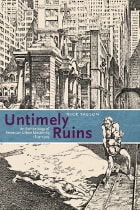
Untimely Ruins
An Archaeology of American Urban Modernity, 1819-1919Nick Yablon
University of Chicago Press, 2009
American ruins have become increasingly prominent, whether in discussions of “urban blight” and home foreclosures, in commemorations of 9/11, or in postapocalyptic movies. In this highly original book, Nick Yablon argues that the association between American cities and ruins dates back to a much earlier period in the nation’s history. Recovering numerous scenes of urban desolation—from failed banks, abandoned towns, and dilapidated tenements to the crumbling skyscrapers and bridges envisioned in science fiction and cartoons—Untimely Ruins challenges the myth that ruins were absent or insignificant objects in nineteenth-century America.
The first book to document an American cult of the ruin, Untimely Ruins traces its deviations as well as derivations from European conventions. Unlike classical and Gothic ruins, which decayed gracefully over centuries and inspired philosophical meditations about the fate of civilizations, America’s ruins were often “untimely,” appearing unpredictably and disappearing before they could accrue an aura of age. As modern ruins of steel and iron, they stimulated critical reflections about contemporary cities, and the unfamiliar kinds of experience they enabled. Unearthing evocative sources everywhere from the archives of amateur photographers to the contents of time-capsules, Untimely Ruins exposes crucial debates about the economic, technological, and cultural transformations known as urban modernity. The result is a fascinating cultural history that uncovers fresh perspectives on the American city.
Untimely Women
Radically Recasting Feminist Rhetorical HistoryJason Barrett-Fox
The Ohio State University Press, 2022
Untimely Women recovers the work of three early-twentieth-century working women, none of whom history has understood as feminists or rhetors: cinema icon and memoirist, Mae West; silent film screenwriter and novelist, Anita Loos; and journalist and mega-publisher, Marcet Haldeman-Julius. While contemporary scholarship tends to highlight and recover women who most resemble academic feminists in their uses of propositional rhetoric, Jason Barrett-Fox uses what he terms a medio-materialist historiography to emphasize the different kinds of political and ontological gender-power that emerged from the inscriptional strategies these women employed to navigate and critique male gatekeepers––from movie stars to directors to editors to abusive husbands.
In recasting the work of West, Loos, and Haldeman-Julius in this way, Barrett-Fox reveals the material and ontological ramifications of their forms of invention, particularly their ability to tell trauma in ways that reach beyond their time to raise the consciousness of audiences unavailable to them in their lifetimes. Untimely Women thus accomplishes important historical and rhetorical work that not only brings together feminist historiography, rhetorical materialism, and posthumanism but also redefines what counts as feminist rhetoric.
Untwisting the Serpent
Modernism in Music, Literature, and Other ArtsDaniel Albright
University of Chicago Press, 2000
Focusing on collaborations with a musical component, Albright views these works as either figures of dissonance that try to retain the distinctness of their various media (e.g. Guillaume Apollinaire's Les Mamelles de Tirésias) or figures of consonance that try to lose themselves in some total effect (e.g. Arnold Schoenberg's Erwartung). In so doing he offers a fresh picture of Modernism, and provides a compelling model for the analysis of all artistic collaborations.
Untwisting the Serpent is the recipient of the 2001 Susanne M. Glasscock Humanities Book Prize for Interdisciplinary Scholarship of the Center for Humanities Research at Texas A&M University.
Untying Things Together
Philosophy, Literature, and a Life in TheoryEric L. Santner
University of Chicago Press, 2022
In 1905, Freud published his Three Essays on the Theory of Sexuality, the book that established the core psychoanalytic thesis that sexuality is central to formations of the unconscious. With this book, Eric L. Santner inverts Freud’s title to take up the sexuality of theory—or, more exactly, the modes of enjoyment to be found in the kinds of critical thinking that, since the 1960s, have laid claim to that ancient word, “theory.” Santner unfolds his argument by tracking his own relationship with this tradition and the ways his intellectual and spiritual development has been informed by it.
Untying Things Together is both an intellectual history of major theoretical paradigms and a call for their reexamination and renewal. Revisiting many of the topics he has addressed in previous work, Santner proposes a new way of conceptualizing the eros of thinking, attuned to how our minds and bodies individually and collectively incorporate or “encyst” on a void at the heart of things. Rather than proposing a “return to theory,” Santner’s book simply employs theory as a way of further “(un)tying together” the resources of philosophy, art and literature, theology, psychoanalysis, political thought, and more.
Unveiling Desire
Fallen Women in Literature, Culture, and Films of the EastDas, Devaleena
Rutgers University Press, 2018
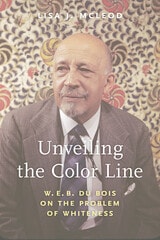
Unveiling the Color Line
W. E. B. Du Bois on the Problem of WhitenessLisa J. McLeod
University of Massachusetts Press, 2024
In The Souls of Black Folk, W. E. B. Du Bois brilliantly details the African American experience. Yet the renowned sociologist was also an astute chronicler of white people, particularly their racism. As Unveiling the Color Line demonstrates, Du Bois’s trenchant analysis of whiteness and white supremacy began in his earliest work—his 1890 speech on Jefferson Davis—and continued in every major book he published in his more than sixty-year career, up to The Black Flame Trilogy.
Lisa J. McLeod traces the development of Du Bois’s conception of whiteness, and the racism inherent to it, as an all-encompassing problem, whether predicated on ignorance, moral failure, or the inability to recognize the humanity in other people. In clear, elegant prose, McLeod investigates Du Bois’s complex and nuanced thinking, putting his insights into dialogue with contemporary racial theorists to demonstrate his continuing value to present-day critical thought and activism.

Unweaving The Odyssey
Barbara Köhler’s Niemands FrauRebecca May Johnson
University of London Press, 2019
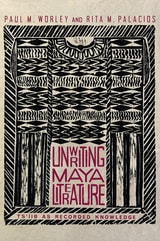
Unwriting Maya Literature
Ts'íib as Recorded KnowledgePaul M. Worley and Rita M. Palacios
University of Arizona Press, 2019
As ts’íib refers to a broad range of artistic production from painted codices and textiles to works composed in Latin script, as well as plastic arts, the authors argue that texts by contemporary Maya writers must be read as dialoguing with a multimodal Indigenous understanding of text. In other words, ts’íib is an alternative to understanding “writing” that does not stand in opposition to but rather fully encompasses alphabetic writing, placing it alongside and in dialogue with a number of other forms of recorded knowledge. This shift in focus allows for a critical reexamination of the role that weaving and bodily performance play in these literatures, as well as for a nuanced understanding of how Maya writers articulate decolonial Maya aesthetics in their works.
Unwriting Maya Literature places contemporary Maya literatures within a context that is situated in Indigenous ways of knowing and being. Through ts’íib, the authors propose an alternative to traditional analysis of Maya cultural production that allows critics, students, and admirers to respectfully interact with the texts and their authors. Unwriting Maya Literature offers critical praxis for understanding Mesoamerican works that encompass non-Western ways of reading and creating texts.
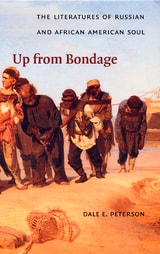
Up from Bondage
The Literatures of Russian and African American SoulDale E. Peterson
Duke University Press, 2000
Illuminating a remarkably widespread cross-pollination between the two cultural and intellectual traditions, Dale E. Peterson frames much of his argument around W. E. B. DuBois’s concept of “double-consciousness,” wherein members of an oppressed section of society view themselves simultaneously through their own self-awareness and through the internalized standards of the dominant culture. He shows how the writings of Dostoevsky, Hurston, Chesnutt, Turgenev, Ellison, Wright, Gorky, and Naylor—texts that enacted and described this sense of double awareness—were used both to perform and to contest the established genres of Western literacy. Woven through Peterson’s textual analyses is his consideration of cultural hybridism and its effects: The writers he examines find multiple ways to testify to and challenge the symptoms of postcolonial trauma. After discussing the strong and significant affinity expressed by contemporary African American cultural theorists for the dialogic thought of Russian linguist Mikhail Bakhtin, Peterson argues that a fuller appreciation of the historic connection between the two cultures will enrich the complicated meanings of being black or Russian in a world that has traditionally avoided acknowledging pluralistic standards of civilization and cultural excellence.
This investigation of comparable moments in the development of Russian and African American ethnic self-consciousness will be valuable to students and scholars of comparative literature, philosophy, cultural theory, ethnicity, linguistics, and postcolonialism, in addition to Slavic and African American studies.
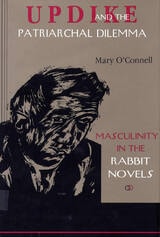
Updike and the Patriarchal Dilemma
Masculinity in the Rabbit NovelsMary O'Connell
Southern Illinois University Press, 1996
Mary O’Connell examines the role of socially constructed masculinity in John Updike’s Rabbit tetralogy—Rabbit Run, Rabbit Redux, Rabbit Is Rich, and Rabbit at Rest—which comprises the longest and most comprehensive representation of masculinity in American literature and places Updike firmly with the precursors of the contemporary movement among men to reevaluate their cultural inheritance.
A disturbing element exists, O’Connell determines, in both the texts of the Rabbit novels and in the critical community that examines them. In the novels, O’Connell finds substantial evidence to demonstrate patterns of psychological and physical abuse toward women, citing as the culminating example the mounting toll of literally or metaphorically dead women in the texts. Critics who characterize Updike as a nonviolent writer who strangely overlooks Rabbit’s repressive and violent behaviors avoid a discomforting but crucial aspect of Updike’s portrait.
Because the critical verdict of nonviolence in Updike’s novels contrasts sharply with the string of female corpses, O’Connell deems that something within the text or culture—or both—is seriously amiss.
Although she examines negative aspects of Rabbit’s behavior, O’Connell avoids the oversimplification of labeling Updike a misogynist. Instead, she looks closely at the forces shaping Rabbit’s gender identity as well as at the ways he experiences masculinity and the ways his gender identity affects his personal and spiritual development, his relationships, and, ultimately, his society. She shows how Updike challenges stereotypical masculinity, revealing its limitations and proscriptions as the source of much unhappiness for both men and women. Further, she substantiates the relation between gender, form, structure, perspective, and language use in the novels, alerting the reader to the ambivalence arising from the male author’s examination of masculinity.
O’Connell maintains that Updike does more than write Rabbit as a stereotypical male; he instead explores in depth his character’s habitually flawed ways of seeing and responding to the world. As she discusses these issues, O’Connell uses the term patriarchy in its broadest sense to refer to the practice of centralizing the male and marginalizing the female in all areas of human life. Patriarchal ideology—the assumptions, values, ideas, and patterns of thought that perpetuate the arrangement—is written as hidden text, permeating every aspect of culture, particularly language, from which it spreads to other signifying systems.
Contrary to conventional critical wisdom, Updike is not a straightforward writer; the Rabbit novels create meaning by challenging, undermining, and qualifying their own explicit content. Updike claims that his novels are "moral debates with the reader," and according to O’Connell, the resisting reader, active and skeptical, is the one most likely to discover what Rabbit conceals and to register the nuances of layered discourse.
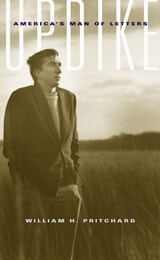
Updike
America's Man of LettersWilliam H. Pritchard
University of Massachusetts Press, 2005
Ups and Downs of Life in the Indies
P. A. Daum
University of Massachusetts Press, 1987

Urania
A RomanceGiulia Bigolina
University of Chicago Press, 2004
The first known prose romance written by a woman in Italian, Bigolina's Urania centers on the monomaniacal love of a female character falling into melancholy when her beloved leaves her for a more beautiful woman. A tale that includes many of the conventions that would later become standards of the genre—cross-dressing, travel, epic skirmishes, and daring deeds—Urania also contains the earliest treatise on the worth of women.
Also included in this volume, the novella Giulia Camposampiero is the only extant part of a probable longer narrative written in the style of the Decameron. While employing some of those same gender and role reversals as Urania, including the privileging of heroic constancy in both men and women, it chronicles the tribulations that a couple undergoes until their secret marriage is publicly recognized.
Urban Chroniclers in Modern Latin America
The Shared Intimacy of Everyday LifeBy Viviane Mahieux
University of Texas Press, 2011
An unstructured genre that blends high aesthetic standards with nonfiction commentary, the journalistic crónica, or chronicle, has played a vital role in Latin American urban life since the nineteenth century. Drawing on extensive archival research, Viviane Mahieux delivers new testimony on how chroniclers engaged with modernity in Mexico City, Buenos Aires, and São Paulo during the 1920s and 1930s, a time when avant-garde movements transformed writers' and readers' conceptions of literature. Urban Chroniclers in Modern Latin America: The Shared Intimacy of Everyday Life examines the work of extraordinary raconteurs Salvador Novo, Cube Bonifant, Roberto Arlt, Alfonsina Storni, and Mário de Andrade, restoring the original newspaper contexts in which their articles first emerged.
Each of these writers guided their readers through a constantly changing cityscape and advised them on matters of cultural taste, using their ties to journalism and their participation in urban practice to share accessible wisdom and establish their role as intellectual arbiters. The intimate ties they developed with their audience fostered a permeable concept of literature that would pave the way for overtly politically engaged chroniclers of the 1960s and 1970s. Providing comparative analysis as well as reflection on the evolution of this important genre, Urban Chroniclers in Modern Latin America is the first systematic study of the Latin American writers who forged a new reading public in the early twentieth century.
Urban Fantasy
Exploring Modernity through MagicStefan Ekman
Lever Press, 2024
Winner of the 2025 Mythopoeic Scholarship Award in Myth & Fantasy Studies
- Finalist of the Locus Awards Non-Fiction Category
- Finalist of the British Science Fiction Association Best Non-Fiction Award
Urban fantasy, the genre of fantastic literature in which magic and monsters meet modern society, is fairly young but has old roots. Stefan Ekman’s book, Urban Fantasy: Exploring Modernity through Magic, examines the genre in depth, including its inherent social commentary, its historical development, and its interplay between modernity and the fantastic.
The author draws on a wide range of urban fantasy texts from five decades, combining detailed analysis of dozens of novels and other media with broad discussions to provide a comprehensive understanding of the genre across three sections. The first section presents an overview of what the genre looks like today—both in terms of its common traits and its variety of settings—and how it has developed over time, including the history of urban fantasy scholarship. The second section examines urban fantasy’s core concern with the unseen, for example through a focus on unseen individuals overlooked by society or hiding within it, and on ignored urban spaces or labyrinthine undergrounds. The third section addresses how urban fantasy explores the relationship between the supernatural and modernity. Ekman offers readings of fiction by Ben Aaronovitch, Lauren Beukes, P. Djelí Clark, Charles de Lint, Neil Gaiman, Max Gladstone, Kim Harrison, N.K. Jemisin, and Megan Lindholm, among others.
Urban Fantasy will appeal to teachers and students of the fantastic as well as to urban fantasy enthusiasts and literary scholars. Ekman illuminates the genre’s evolution and defining traits, inviting readers to rethink urban fantasy as a creative tool for using magic to explore modernity.
Urban Horror
Neoliberal Post-Socialism and the Limits of VisibilityErin Y. Huang
Duke University Press, 2020

Urban Microcosms 1789-1940
Edited by Margit Dirscherl and Astrid Köhler
University of London Press, 2019
Urban Pastoral
Natural Currents in the New York SchoolTimothy Gray
University of Iowa Press, 2010
Were the urbane, avant-garde poets of the New York School secretly nature lovers like Edward Abbey, Wendell Berry, and Annie Dillard? In Urban Pastoral, Timothy Gray urges us to reconsider our long-held appraisals of Frank O’Hara, John Ashbery, Barbara Guest, and their peers as celebrants of cosmopolitan culture and to think of their more pastoral impulses. As Gray argues, flowers are more beautiful in the New York School’s garden of verse because no one expects them to bloom there.
Along with the poets whose careers he chronicles, Gray shows us that startlingly new approaches to New York City art and literature emerge when natural and artificial elements collide kaleidoscopically, as when O’Hara likens blinking stars to a hairnet, when painter Jane Freilicher places a jar of irises in her studio window to mirror purple plumes rising from Consolidated Edison smokestacks, or when poet Kathleen Norris equates rooftop water towers with grain silos as she plans her escape route to the Great Plains.
The New York School poets and their coterie have become a staple of poetics, literary criticism and biography, cultural studies, and art criticism, but Urban Pastoral is the first study of the original New York School poets to offer sustained discussion of the pastoral and natural imagery within the work of these renowned “city poets” and also consider poets from the second generation of the New York School—Diane di Prima, Jim Carroll, and Kathleen Norris.
Moving beyond the traditional boundaries of literary criticism to embrace the creative spirit of New York poets and artists, Gray’s accessible, lively, and blithely experimental book will shape future discussions of contemporary urban literature and literary nature writing, offering new evidence of avant-garde poetry’s role within those realms.
Urban Underworlds
A Geography of Twentieth-Century American Literature and CultureHeise, Thomas
Rutgers University Press, 2010
The quarantining of minority cultures helped to promote white, middle-class privilege. Following a diverse array of literary figures who differ with the assessment of the underworld as the space of the monstrous Other, Heise contends that it is a place where besieged and neglected communities are actively trying to take possession of their own neighborhoods.
Urbanist Desire
Queer and Trans Survival in the CityDavy Knittle
University of Minnesota Press, 2026
How writers and artists have used city planning strategies to push back against harm
Black queer feminist thinker Audre Lorde famously declared that “the master’s tools will never dismantle the master’s house.” This language is normally understood as a metaphor, but as author Davy Knittle argues in this provocative book, queer and trans activists have long used the tools of city planning and urban design to create written and visual art that critiques those in power and offers points of resilience to their own communities.
A close look at the ways queer and trans writers and artists resisted predatory redevelopment in New York City from 1950 to 2020, Urbanist Desire draws on the work of James Schuyler, June Jordan, David Wojnarowicz, Julian Talamantez Brolaski, and Zeyn Joukhadar, exploring how they intervened in major political flashpoints like the War on Poverty, the AIDS-era housing crisis, and gentrification in Brooklyn and Queens. Presenting a new cultural history of New York City, Knittle explains how urban change and the more-than-human life of cities have been foundational concerns for queer and trans cultural production since the 1950s.
Ending with analysis of the 2022 speculative novel Everything for Everyone: An Oral History of the New York Commune, 2052–2072, Urbanist Desire looks to the past to imagine a better future for New York City and for all marginalized people. Knittle demonstrates how to move past a recuperative response to harm and toward one that can change the structure of society by documenting how queer and trans activists have engaged the strategies of planning and design to address spatial, social, and economic inequality.
Retail e-book files for this title are screen-reader friendly with images accompanied by short alt text and/or extended descriptions.
Useful Knowledge
The Victorians, Morality, and the March of IntellectAlan Rauch
Duke University Press, 2001
Rauch discusses both the influence and the ideology of knowledge in terms of how it affected nineteenth-century anxieties about moral responsibility and religious beliefs. Drawing on a wide array of literary, scientific, and popular works of the period, the book focusses on the growing importance of scientific knowledge and its impact on Victorian culture. From discussions of Jane Webb Loudon’s The Mummy! and Mary Shelley’s Frankenstein, to Charlotte Brontë’s The Professor, Charles Kingsley’s Alton Locke, and George Eliot’s Mill on the Floss, Rauch paints a fascinating picture of nineteenth-century culture and addresses issues related to the proliferation of knowledge and the moral issues of this time period. Useful Knowledge touches on social and cultural anxieties that offer both historical and contemporary insights on our ongoing preoccupation with knowledge.
Useful Knowledge will appeal to readers interested in nineteenth century history, literature, culture, the mediation of knowledge, and the history of science.