Results by title
8642 books match the query '20th century' and 125 start with u
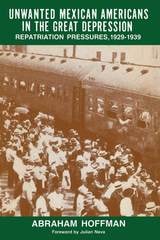
Unwanted Mexican Americans in the Great Depression
Repatriation Pressures, 1929–1939Abraham Hoffman; Foreword by Julian Nava
University of Arizona Press, 1973
Prior to 1931, many Mexican Americans left the United States voluntarily, prompted by homesickness, unemployment, and the Mexican government’s offer of free small land parcels. As the Great Depression deepened, repatriation pressures increased. Anglo groups lobbied for laws that excluded aliens from jobs and welfare benefits. Many businessmen, government officials, and social workers believed that removing Mexican Americans would open up jobs for U.S. citizens and alleviate some of the burden placed on relief agencies.
The Department of Labor’s federal deportation drive, launched in 1931, created an atmosphere of fear and tension in Mexican American communities. Immigration agents conducted surprise searches for people who had entered the country illegally, and Mexicans who had crossed the border before restrictive legislation was passed became prime targets of the deportation campaign.
Welfare agencies throughout the United States organized repatriation programs. The Los Angeles County Welfare Bureau, with the most extensive program, was responsible for the removal of more than thirteen thousand Mexican Americans. A few well-publicized deportations had frightened Mexicans who were unsure of their immigration status. Many chose repatriation over possible deportation.
Using much archival material and many previously unpublished government documents, Hoffman focuses on the repatriation experience in Los Angeles. The city’s large Mexican American population provides an excellent case study of the entire movement. He also surveys the process of Mexican repatriation throughout the entire United States.

Unwilling Germans
The Goldhagen DebateRobert R. Shandley
University of Minnesota Press, 1998
A comprehensive overview of the controversy surrounding Hitler’s Willing Executioners.
Few if any books of the past fifty years have moved a broad section of the German public to think about their country’s Nazi past as has Daniel Jonah Goldhagen’s Hitler’s Willing Executioners. The main argument of his book is that Germans committed the unthinkable acts of the Holocaust not because they were forced to but out of a deeply held conviction that killing Jews was morally just. Unwilling Germans? traces the intense and varied reception of a book that has created more heated debate than any other treatment of Germany’s genocidal past.
When Goldhagen’s book first appeared, it was almost universally dismissed by journalists and historians alike. However, following a book tour in Germany, Goldhagen started winning over many of his ardent detractors and finding a young, receptive audience. Although German scholars reacted to Goldhagen and his argument with outrage and dismissal, ironically the German public was mesmerized by both the book and Goldhagen himself.Unwilling Germans? reprints articles that originally appeared in German newspapers, the popular press, and journals, as well as offering original essays. Among the writers whose work is represented are historians, journalists, political scientists, and literary critics, including Jürgen Habermas and Klaus Theweleit. The book traces the initial reactions in Germany to the debate surrounding the U.S. publication of the book, the subsequent reviews and reactions upon the publication of the German translation, and recent commentary by Goldhagen and the American historian Christopher Browning. A unique and fascinating collection, Unwilling Germans? will help to sort out the confusing nature of the response to the “Goldhagen Debate,” and shed light on both Germany’s continuing process of coming to terms with its Nazi past and the resonances of that debate in the United States.ISBN 0-8166-3100-X Cloth $44.95xxISBN 0-8166-3101-8 Paper $17.95224 pages 5 7/8 x 9 JuneTranslation inquiries: University of Minnesota Press
Up Against the Real
Black Mask from Art to ActionNadja Millner-Larsen
University of Chicago Press, 2023
With Up Against the Real, Nadja Millner-Larsen offers the first comprehensive study of the group Black Mask and its acrimonious relationship to the New York art world of the 1960s. Cited as pioneers of now-common protest aesthetics, the group’s members employed incendiary modes of direct action against racism, colonialism, and the museum system. They shut down the Museum of Modern Art, fired blanks during a poetry reading, stormed the Pentagon in an antiwar protest, sprayed cow’s blood at the secretary of state, and dumped garbage into the fountain at Lincoln Center. Black Mask published a Dadaist broadside until 1968, when it changed its name to Up Against the Wall Motherfucker (after line in a poem by Amiri Baraka) and came to classify itself as “a street gang with analysis.” American activist Abbie Hoffman described the group as “the middle-class nightmare . . . an anti-media phenomenon simply because their name could not be printed.”
Up Against the Real examines how and why the group ultimately rejected art in favor of what its members deemed “real” political action. Exploring this notorious example of cultural activism that rose from the ruins of the avant-garde, Millner-Larsen makes a critical intervention in our understanding of political art.
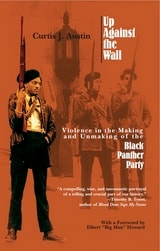
Up Against the Wall
Violence in the Making and Unmaking of the Black Panther PartyCurtis J. Austin
University of Arkansas Press, 2008
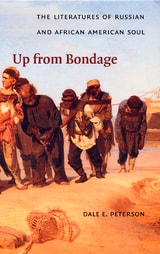
Up from Bondage
The Literatures of Russian and African American SoulDale E. Peterson
Duke University Press, 2000
Illuminating a remarkably widespread cross-pollination between the two cultural and intellectual traditions, Dale E. Peterson frames much of his argument around W. E. B. DuBois’s concept of “double-consciousness,” wherein members of an oppressed section of society view themselves simultaneously through their own self-awareness and through the internalized standards of the dominant culture. He shows how the writings of Dostoevsky, Hurston, Chesnutt, Turgenev, Ellison, Wright, Gorky, and Naylor—texts that enacted and described this sense of double awareness—were used both to perform and to contest the established genres of Western literacy. Woven through Peterson’s textual analyses is his consideration of cultural hybridism and its effects: The writers he examines find multiple ways to testify to and challenge the symptoms of postcolonial trauma. After discussing the strong and significant affinity expressed by contemporary African American cultural theorists for the dialogic thought of Russian linguist Mikhail Bakhtin, Peterson argues that a fuller appreciation of the historic connection between the two cultures will enrich the complicated meanings of being black or Russian in a world that has traditionally avoided acknowledging pluralistic standards of civilization and cultural excellence.
This investigation of comparable moments in the development of Russian and African American ethnic self-consciousness will be valuable to students and scholars of comparative literature, philosophy, cultural theory, ethnicity, linguistics, and postcolonialism, in addition to Slavic and African American studies.

Updike
America's Man of LettersWilliam H. Pritchard
University of Massachusetts Press, 2005
Uplift Cinema
The Emergence of African American Film and the Possibility of Black ModernityAllyson Nadia Field
Duke University Press, 2015
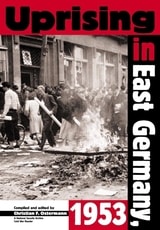
Uprising in East Germany, 1953
The Cold War, the German Question, and the First Major Upheaval behind the Iron CurtainThe National Security Archive Ostermann
Central European University Press, 2001
This volume is the second in the series Cold War Documentary Readers, a project of the US National Security Archive and the Cold War International History Project.
The volume is the first documented account of this early Cold War crisis from both sides of the Iron Curtain. Based on the recent unprecedented access to the once-closed archives of several member states of the Warsaw Pact, this collection of primary-source documents presents one of the most notorious events of post-war European history in a highly readable format.
Previously unreleased Kremlin records, once highly classified American documents, materials from the Soviet Foreign Ministry, and transcripts of internal East German Communist Party Politburo meetings in the days leading to the uprising in the German Democratic Republic (GDR) are among the highlights of this sensational documentary.
In this volume, as in the previous one in the series, each part is preceded by a detailed introductory essay to provide the necessary historical and political context. The individual documents are introduced by short headnotes summarizing the contents and orienting the reader. A chronology, glossary and bibliography offer further background information.
Uprising
How Women Used the US West to Win the Right to VoteTiffany Lewis
Michigan State University Press, 2021
Uprooted
Race, Public Housing, and the Archaeology of Four Lost New Orleans NeighborhoodsD. Ryan Gray
University of Alabama Press, 2020
The archaeology of four New Orleans neighborhoods that were replaced by public housing projects
Uprooted: Race, Public Housing, and the Archaeology of Four Lost New Orleans Neighborhoods uses archaeological research on four neighborhoods that were razed during the construction of public housing in World War II–era New Orleans. Although each of these neighborhoods was identified as a “slum” historically, the material record challenges the simplicity of this designation. D. Ryan Gray provides evidence of the inventiveness of former residents who were marginalized by class, color, or gender and whose everyday strategies of survival, subsistence, and spirituality challenged the city’s developing racial and social hierarchies.
These neighborhoods initially appear to have been quite distinct, ranging from the working-class Irish Channel, to the relatively affluent Creole of Color–dominated Lafitte area, to the former location of Storyville, the city’s experiment in semilegal prostitution. Archaeological and historical investigations suggest that race was the crucial factor in the areas’ selection for clearance. Each neighborhood manifested a particular perceived racial disorder, where race intersected with ethnicity, class, or gender in ways that defied the norms of Jim Crow segregation.
Gray’s research makes use of both primary documents—including census records, city directories, and even the brothel advertising guides called “Blue Books”—and archaeological data to examine what this entailed at a variety of scales, reconstructing narratives of the households and communities affected by clearance. Public housing, both in New Orleans and elsewhere, imposed a new kind of control on urban life that had the effect of making cities both more segregated and less equal. The story of the neighborhoods that were destroyed provides a reminder that their erasure was not an inevitable outcome, and that a more equitable and just city is still possible today. A critical examination of the rise of public housing helps inform the ongoing debates over its demise, especially in light of the changing face of post-Katrina New Orleans.
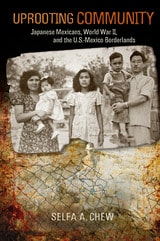
Uprooting Community
Japanese Mexicans, World War II, and the U.S.-Mexico BorderlandsSelfa A. Chew
University of Arizona Press, 2015
In Uprooting Community, Selfa A. Chew examines the lived experience of Japanese Mexicans in the U.S.-Mexico borderlands during World War II. Studying the collaboration of Latin American nation-states with the U.S. government, Chew illuminates the efforts to detain, deport, and confine Japanese residents and Japanese-descent citizens of Latin American countries during World War II. These narratives challenge the notion that Japanese Mexicans enjoyed the protection of the Mexican government during the war and refute the mistaken idea that Japanese immigrants and their descendants were not subjected to internment in Mexico during this period. Through her research, Chew provides evidence that, despite the principles of racial democracy espoused by the Mexican elite, Japanese Mexicans were in fact victims of racial prejudice bolstered by the political alliances between the United States and Mexico.
The treatment of the ethnic Japanese in Mexico was even harsher than what Japanese immigrants and their children in the United States endured during the war, according to Chew. She argues that the number of persons affected during World War II extended beyond the first-generation Japanese immigrants “handled” by the Mexican government during this period, noting instead that the entire multiethnic social fabric of the borderlands was reconfigured by the absence of Japanese Mexicans.
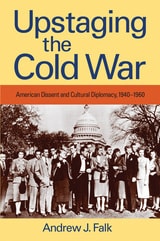
Upstaging the Cold War
American Dissent and Cultural Diplomacy, 1940-1960Andrew J. Falk
University of Massachusetts Press, 2010
Traditional interpretations of the 1950s have emphasized how American anti-communists deployed censorship and the blacklist to silence dissent, particularly in the realm of foreign policy. Yet those efforts at repression did not always succeed. Throughout the early years of the Cold War, a significant number of writers and performers continued to express controversial views about international relations in Hollywood films, through the new medium of television, on the Broadway stage, and from behind the scenes.
By promoting superpower cooperation, decolonization, nuclear disarmament, and other taboo causes, dissident artists such as Lillian Hellman, Arthur Miller, Rod Serling, Dalton Trumbo, Reginald Rose, and Paddy Chayefsky managed both to stretch the boundaries of Cold War ideology and to undermine some of its basic assumptions. Working at times under assumed names and in some cases outside the United States, they took on the role of informal diplomats who competed with Washington in representing America to the world.
Ironically, the dissidents' international appeal eventually persuaded the U.S. foreign policy establishment that their unconventional views could be an asset in the Cold War contest for “hearts and minds,” and their artistic work an effective means to sell American values and culture abroad. By the end of the 1950s, the Eisenhower administration not only appropriated the work of these talented artists but enlisted some of them to serve as official voices of Cold War cultural diplomacy.
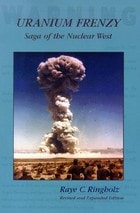
Uranium Frenzy
Saga of the Nuclear WestRaye C. Ringholz
Utah State University Press, 2002
The uranium boom is only part of the larger story of atomic weapons testing and its impact in the western United States. Nuclear explosions at the Nevada Test Site not only spurred uranium mining, they also had a disastrous impact on many Americans: downwinders in the eastward path of radiation clouds, military observers and guinea pigs in exposed positions, and Navajo and other uranium mill workers all became victims, as deaths from cancer and other radiation-caused diseases reached much higher than normal rates among them. Tons of radioactive waste left by mines, mills, and the nuclear industry and how to dispose of them are other nagging legacies of the nuclear era. Recent decades have brought multiple attempts by victims to obtain compensation from the federal government and other legal battles over disposal of nuclear waste. When courts refused to grant relief to downwinders and others, Congress eventually interceded and legislated compensation for a limited number of victims able to meet strict criteria, but did not adequately fund the program. Recently, Congress attempted to fix this shortfall, but in the meantime many downwinders and others holding compensation IOUs had died. Congressional and other efforts to dispose of waste have lately focused on Nevada and Utah, two states all too familiar with nuclear issues and reluctant to take on further radioactive burdens.
Uranium Matters
Central European Uranium in International Politics, 19001960Rainer Karlsch
Central European University Press, 2008
Urban Chroniclers in Modern Latin America
The Shared Intimacy of Everyday LifeBy Viviane Mahieux
University of Texas Press, 2011
An unstructured genre that blends high aesthetic standards with nonfiction commentary, the journalistic crónica, or chronicle, has played a vital role in Latin American urban life since the nineteenth century. Drawing on extensive archival research, Viviane Mahieux delivers new testimony on how chroniclers engaged with modernity in Mexico City, Buenos Aires, and São Paulo during the 1920s and 1930s, a time when avant-garde movements transformed writers' and readers' conceptions of literature. Urban Chroniclers in Modern Latin America: The Shared Intimacy of Everyday Life examines the work of extraordinary raconteurs Salvador Novo, Cube Bonifant, Roberto Arlt, Alfonsina Storni, and Mário de Andrade, restoring the original newspaper contexts in which their articles first emerged.
Each of these writers guided their readers through a constantly changing cityscape and advised them on matters of cultural taste, using their ties to journalism and their participation in urban practice to share accessible wisdom and establish their role as intellectual arbiters. The intimate ties they developed with their audience fostered a permeable concept of literature that would pave the way for overtly politically engaged chroniclers of the 1960s and 1970s. Providing comparative analysis as well as reflection on the evolution of this important genre, Urban Chroniclers in Modern Latin America is the first systematic study of the Latin American writers who forged a new reading public in the early twentieth century.
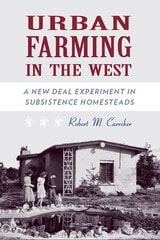
Urban Farming in the West
A New Deal Experiment in Subsistence HomesteadsRobert Carriker
University of Arizona Press, 2010
Robert Carriker examines for the first time the intricate histories of these subsistence homestead projects, which have long been buried in bureaucratic records and clouded by misunderstanding, showing that in many ways they were among the agency’s most successful efforts. He provides case studies of the projects, rescuing their obscure histories using archival documents and rare photographs. He also reveals the machinations of civic groups and private citizens across the West who jockeyed for access to the funds being allotted for New Deal community building.
By describing what took place on these western homesteads, Carriker shows that the DSH’s agenda was not as far-fetched as some have reported. The tendency to condemn the Division and its projects, he argues, has failed to appreciate the good that came from some of the individual homestead communities—particularly those in the Far West.
Although overshadowed by the larger undertakings of the New Deal, some of these western communities remain thriving neighborhoods—living legacies to FDR’s efforts that show how the country once chose to deal with economic hardship. Too often the DSH is noted for its failures; Carriker’s study shows that its western homesteads were instead qualified accomplishments.
Urban Leviathan
Mexico City in the Twentieth CenturyDiane E. Davis
Temple University Press, 1994
Why, Diane Davis asks, has Mexico City, once known as the city of palaces, turned into a sea of people, poverty, and pollution? Through historical analysis of Mexico City, Davis identifies political actors responsible for the uncontrolled industrialization of Mexico's economic and social center, its capital city. This narrative biography takes a perspective rarely found in studies of third-world urban development: Davis demonstrates how and why local politics can run counter to rational politics, yet become enmeshed, spawning ineffective policies that are detrimental to the city and the nation.
The competing social and economic demand of the working poor and middle classes and the desires of Mexico's ruling Partido Revolucionario Institutional (PRI) have led to gravely diminished services, exorbitant infrastructural expenditures, and counter-productive use of geographic space. Though Mexico City's urban transport system has evolved over the past seven decades from trolley to bus to METRO (subway), it fails to meet the needs of the population, despite its costliness, and is indicative of the city's disastrous and ill-directed overdevelopment. Examining the political forces behind the thwarted attempts to provide transportation in the downtown and sprawling outer residential areas, Davis analyzes the maneuverings of local and national politicians, foreign investors, middle classes, agency bureaucrats, and various factions of the PRI.
Looking to Mexico's future, Davis concludes that growing popular dissatisfaction and frequent urban protests demanding both democratic reform and administrative autonomy in the capital city suggest an unstable future for corporatist politics and the PRI's centralized one-party government.
Urban Lowlands
A History of Neighborhoods, Poverty, and PlanningSteven T. Moga
University of Chicago Press, 2020
In Urban Lowlands, Steven T. Moga looks closely at the Harlem Flats in New York City, Black Bottom in Nashville, Swede Hollow in Saint Paul, and the Flats in Los Angeles, to interrogate the connections between a city’s actual landscape and the poverty and social problems that are often concentrated at its literal lowest points. Taking an interdisciplinary perspective on the history of US urban development from the nineteenth to the mid-twentieth century, Moga reveals patterns of inequitable land use, economic dispossession, and social discrimination against immigrants and minorities. In attending to the landscapes of neighborhoods typically considered slums, Moga shows how physical and policy-driven containment has shaped the lives of the urban poor, while wealth and access to resources have been historically concentrated in elevated areas—truly “the heights.” Moga’s innovative framework expands our understanding of how planning and economic segregation alike have molded the American city.
Urban Lowlands
A History of Neighborhoods, Poverty, and PlanningSteven T. Moga
University of Chicago Press, 2020
Interrogates the connections between a city’s physical landscape and the poverty and social problems that are often concentrated at its literal lowest points.
In Urban Lowlands, Steven T. Moga looks closely at the Harlem Flats in New York City, Black Bottom in Nashville, Swede Hollow in Saint Paul, and the Flats in Los Angeles, to interrogate the connections between a city’s actual landscape and the poverty and social problems that are often concentrated at its literal lowest points. Taking an interdisciplinary perspective on the history of US urban development from the nineteenth to the mid-twentieth century, Moga reveals patterns of inequitable land use, economic dispossession, and social discrimination against immigrants and minorities. In attending to the landscapes of neighborhoods typically considered slums, Moga shows how physical and policy-driven containment has shaped the lives of the urban poor, while wealth and access to resources have been historically concentrated in elevated areas—truly “the heights.” Moga’s innovative framework expands our understanding of how planning and economic segregation alike have molded the American city.
Urban Pastoral
Natural Currents in the New York SchoolTimothy Gray
University of Iowa Press, 2010
Were the urbane, avant-garde poets of the New York School secretly nature lovers like Edward Abbey, Wendell Berry, and Annie Dillard? In Urban Pastoral, Timothy Gray urges us to reconsider our long-held appraisals of Frank O’Hara, John Ashbery, Barbara Guest, and their peers as celebrants of cosmopolitan culture and to think of their more pastoral impulses. As Gray argues, flowers are more beautiful in the New York School’s garden of verse because no one expects them to bloom there.
Along with the poets whose careers he chronicles, Gray shows us that startlingly new approaches to New York City art and literature emerge when natural and artificial elements collide kaleidoscopically, as when O’Hara likens blinking stars to a hairnet, when painter Jane Freilicher places a jar of irises in her studio window to mirror purple plumes rising from Consolidated Edison smokestacks, or when poet Kathleen Norris equates rooftop water towers with grain silos as she plans her escape route to the Great Plains.
The New York School poets and their coterie have become a staple of poetics, literary criticism and biography, cultural studies, and art criticism, but Urban Pastoral is the first study of the original New York School poets to offer sustained discussion of the pastoral and natural imagery within the work of these renowned “city poets” and also consider poets from the second generation of the New York School—Diane di Prima, Jim Carroll, and Kathleen Norris.
Moving beyond the traditional boundaries of literary criticism to embrace the creative spirit of New York poets and artists, Gray’s accessible, lively, and blithely experimental book will shape future discussions of contemporary urban literature and literary nature writing, offering new evidence of avant-garde poetry’s role within those realms.

Urban Policy In 20th Century
Hirsch, Arnold
Rutgers University Press, 1992
The recent riots in Los Angeles brought the urban crisis back to the center of public policy debates in Washington, D.C., and in urban areas throughout the United States. The contributors to this volume examine the major policy issues--race, housing, transportation, poverty, the changing environment, the effects of the global economy--confronting contemporary American cities.
Raymond A. Mohl begins with an extended discussion of the origins, evolution, and current state of Federal involvement in urban centers. Michael B. Katz follows with an insightful look at poverty in turn-of-the-century New York and the attempts to ameliorate the desperate plight of the poor during this period of rapid economic growth. Arnold R. Hirsch, Mohl, and David R. Goldfield then pursue different facets of the racial dilemma confronting American cities. Hirsch discusses historical dimensions of residential segregation and public policy, while Mohl uses Overtown, Miami, as a case study of the social impact of the construction of interstate highways in urban communities. David Goldfield explores the political ramifications and incongruities of contemporary urban race relations.
Finally, Carl Abbott and Sam Bass Warner, Jr., examine the impact of global economic developments and the environmental implications of past policy choices. Collectively, the authors show us where we have been, some of the needs that must be addressed, and the urban policy alternatives we face.
Urban Saniscapes
Slums, Housing and Everyday Sanitation in Accra and Nairobi, 1908–1963Waseem-Ahmed Bin-Kasim
Michigan State University Press, 2025
Urban Underworlds
A Geography of Twentieth-Century American Literature and CultureHeise, Thomas
Rutgers University Press, 2010
The quarantining of minority cultures helped to promote white, middle-class privilege. Following a diverse array of literary figures who differ with the assessment of the underworld as the space of the monstrous Other, Heise contends that it is a place where besieged and neglected communities are actively trying to take possession of their own neighborhoods.
Utah in the Twentieth Century
Brian Q. Cannon and Jessie Embry
Utah State University Press, 2009
The twentieth century could easily be Utah's most interesting and complex. Utah in the Twentieth Century chronicles the social and cultural transitions of the time, offering a well-rounded perspective on the development and change the Beehive State went through during this period.
It was an era complicated by the push of economic development and pull of traditional culture, demand for natural resources from a fragile and scenic environment, questions of who governs and how, who gets a vote, and who controls what on contested public lands, during which outside trade and a tourist economy increasingly challenged and fed an insular society. Activists left and right declaimed constitutional liberties while Utah's Native Americans become the last enfranchised in the nation. Proud contributions to national wars contrasted with denial of deep dependence on federal money; the skepticism of provocative writers, boosters eager for growth; and reflexive patriotism somehow bonded to ingrained distrust of federal government.
A valuable resource for students and teachers, this work is also fruitful reading for anyone who desires to know more about key themes of Utah’s history in the twentieth century.
Utopias Of Otherness
Nationhood And Subjectivity In Portugal And BrazilFernando Arenas
University of Minnesota Press, 2003
Forges a new understanding of how these two Lusophone nations are connected
The closely entwined histories of Portugal and Brazil remain key references for understanding developments—past and present—in either country. Accordingly, Fernando Arenas considers Portugal and Brazil in relation to one another in this exploration of changing definitions of nationhood, subjectivity, and utopias in both cultures. Examining the two nations’s shared language and histories as well as their cultural, social, and political points of divergence, Arenas pursues these definitive changes through the realms of literature, intellectual thought, popular culture, and political discourse.
Both Brazil and Portugal are subject to the economic, political, and cultural forces of postmodern globalization. Arenas analyzes responses to these trends in contemporary writers including José Saramago, Caio Fernando Abreu, Maria Isabel Barreno, Vergílio Ferreira, Clarice Lispector, and Maria Gabriela Llansol. Ultimately, Utopias of Otherness shows how these writers have redefined the concept of nationhood, not only through their investment in utopian or emancipatory causes such as Marxist revolution, women’s liberation, or sexual revolution, but also by shifting their attention to alternative modes of conceiving the ethical and political realms.