Results by title
60 books match the query '1882-1941' and 5 start with v
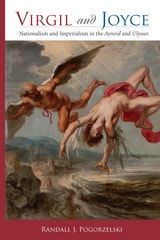
Virgil and Joyce
Nationalism and Imperialism in the <i>Aeneid</i> and <i>Ulysses</i>Randall J. Pogorzelski
University of Wisconsin Press, 2016
James Joyce’s Ulysses is a modern version of Homer’s Odyssey, but Joyce—who was a better scholar of Latin than of Greek—also was deeply influenced by the Aeneid, Virgil’s epic poem about the journey of Aeneas and the foundation of Rome.
Joyce wrote Ulysses during the Irish War of Independence, when militants, politicians, and intellectuals were attempting to create a new Irish nation. Virgil wrote the Aeneid when, in the wake of decades of civil war, Augustus was founding what we now call the Roman Empire. Randall Pogorzelski applies modern theories of nationalism, intertextuality, and reception studies to illuminate how both writers confronted issues of nationalism, colonialism, political violence, and freedom during times of crisis.
Joyce wrote Ulysses during the Irish War of Independence, when militants, politicians, and intellectuals were attempting to create a new Irish nation. Virgil wrote the Aeneid when, in the wake of decades of civil war, Augustus was founding what we now call the Roman Empire. Randall Pogorzelski applies modern theories of nationalism, intertextuality, and reception studies to illuminate how both writers confronted issues of nationalism, colonialism, political violence, and freedom during times of crisis.
[more]

Virginia Woolf Icon
Brenda R. Silver
University of Chicago Press, 1999
This is a book about "Virginia Woolf": the face that sells more postcards than any other at Britain's National Portrait Gallery, the name that Edward Albee's play linked with fear, the cultural icon so rich in meanings that it has been used to market everything from the New York Review of Books to Bass Ale. Brenda Silver analyzes Virginia Woolf's surprising visibility in both high and popular culture, showing how her image and authority have been claimed or challenged in debates about art, politics, anger, sexuality, gender, class, the canon, feminism, race, and fashion.
From Virginia Woolf's 1937 appearance on the cover of Time magazine to her current roles in theater, film, and television, Silver traces the often contradictory representations and the responses they provoke, highlighting the recurring motifs that associate Virginia Woolf with fear. By looking more closely at who is afraid and the contexts in which she is perceived to be frightening, Silver illustrates how Virginia Woolf has become the site of conflicts about cultural boundaries and legitimacy that continue to rage today.
From Virginia Woolf's 1937 appearance on the cover of Time magazine to her current roles in theater, film, and television, Silver traces the often contradictory representations and the responses they provoke, highlighting the recurring motifs that associate Virginia Woolf with fear. By looking more closely at who is afraid and the contexts in which she is perceived to be frightening, Silver illustrates how Virginia Woolf has become the site of conflicts about cultural boundaries and legitimacy that continue to rage today.
[more]
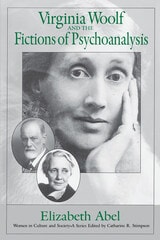
Virginia Woolf and the Fictions of Psychoanalysis
Elizabeth Abel
University of Chicago Press, 1989
"A stunning, brilliant, absolutely compelling reading of Woolf through the lens of Kleinian and Freudian psychoanalytic debates about the primacy of maternality and paternality in the construction of consciousness, gender, politics, and the past, and of psychoanalysis through the lens of Woolf's novels and essays. In addition to transforming our understanding of Woolf, this book radically expands our understanding of the historicity and contingent construction of psychoanalytic theory and our vision of the potential of psychoanalytic feminism."—Nancy J. Chodorow, University of California at Berkeley
"Virginia Woolf and the Fictions of Psychoanalysis brings Woolf's extraordinary craftsmanship back into view; the book combines powerful claims about sexual politics and intellectual history with the sort of meticulous, imaginative close reading that leaves us, simply, seeing much more in Woolf's words than we did before. It is the most exciting book on Woolf to come along in some time."—Lisa Ruddick, Modern Philology
"Virginia Woolf and the Fictions of Psychoanalysis brings Woolf's extraordinary craftsmanship back into view; the book combines powerful claims about sexual politics and intellectual history with the sort of meticulous, imaginative close reading that leaves us, simply, seeing much more in Woolf's words than we did before. It is the most exciting book on Woolf to come along in some time."—Lisa Ruddick, Modern Philology
[more]
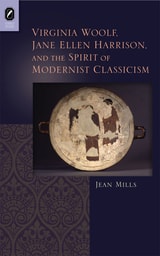
Virginia Woolf, Jane Ellen Harrison, and the Spirit of Modernist Classicism
Jean Mills
The Ohio State University Press, 2014
In a work that re-investigates archival materials and deploys an innovative theoretical framework, Jean Mills explores the intellectual and political relationship between Virginia Woolf and the Cambridge classicist Jane Ellen Harrison. Virginia Woolf, Jane Ellen Harrison, and the Spirit of Modernist Classicism discovers an intimate connection crucial to Woolf’s professional identity and intellectual and artistic development in Harrison’s controversial, feminist interpretations of Greek mythology. Mills argues that cross-reading Jane Harrison and Virginia Woolf exposes a distinctive relationship between two women intellectuals, one that does not rehearse the linearity of influence but instead demonstrates the intricacy of intertextuality—an active and transformative use of one body of writing by another writer—that makes of Virginia Woolf’s modernism a specifically feminist amplification. This cross-reading reveals a dimension of modernism that has been overlooked or minimized: Mills demonstrates that the questions preoccupying Harrison also resonated with Woolf, who adapted Harrison’s ideas to her own intellectual, political, and literary pursuits.
To an extent, Virginia Woolf, Jane Ellen Harrison, and the Spirit of Modernist Classicism participates in an act of classical recovery. It is an effort to revive and reclaim Harrison’s work and to illustrate the degree to which her cultural, political, and scholastic example informed one of the major modernist voices of the twentieth century.
To an extent, Virginia Woolf, Jane Ellen Harrison, and the Spirit of Modernist Classicism participates in an act of classical recovery. It is an effort to revive and reclaim Harrison’s work and to illustrate the degree to which her cultural, political, and scholastic example informed one of the major modernist voices of the twentieth century.
[more]
Virginia Woolf’s Mythic Method
Amy C. Smith
The Ohio State University Press, 2022
In Virginia Woolf’s Mythic Method, Amy C. Smith reinvigorates scholarly analysis of myth in Virginia Woolf’s fiction by examining how Woolf engaged social and political issues in her work. Through close readings of Mrs. Dalloway, To the Lighthouse, and Between the Acts, Smith argues that Woolf develops a paratactic method of alluding to Greek myth that is shaped by the style of archaic oral literature and her intersectional feminist insights. By revising such famously paradoxical figures as the Great Goddess, the Eleusinian deities, Dionysus, Odysseus, and the Sirens, Woolf illustrates the links between epistemological and metaphysical assumptions and war, empire, patriarchy, capitalism, and fascism. At the same time, her use of parataxis to invoke ancient myth unsettles authorial control and empowers readers to participate in making meaning out of her juxtaposed fragments. In contrast to T. S. Eliot’s more prominent mythic method, which seeks to control the anarchy of modern life, Woolf’s paratactic method envisions more livable forms of sociality by destabilizing meaning in her novels, an agenda that aligns better with our contemporary understandings of modernism.
[more]