Results by title
87 books match the query 'AIDS (Disease)' and 3 start with v

Victory Deferred
How AIDS Changed Gay Life in AmericaJohn-Manuel Andriote
University of Chicago Press, 1999
John-Manuel Andriote chronicles the impact of the disease from the coming-out revelry of the 1970s to the post-AIDS gay community of the 1990s, showing how it has changed both individual lives and national organizations. He tells the truly remarkable story of how a health crisis pushed a disjointed jumble of local activists to become a nationally visible and politically powerful civil rights movement, a full-fledged minority group challenging the authority of some of the nation's most powerful institutions. Based on hundreds of interviews with those at the forefront of the medical, political, and cultural
responses to the disease, Victory Deferred artfully blends personal narratives with institutional histories and organizational politics to show how AIDS forced gay men from their closets and ghettos into the hallways of power to lobby and into the streets to protest.
Andriote, who has been at the center of national advocacy and AIDS politics in Washington, is judicious without being uncritical, and his account of the political maturation of the gay community is one of the most stirring civil rights stories of our time.
Victory Deferred draws on hundreds of original interviews, including first-hand accounts from: Virginia Apuzzo, Reverend Carl Bean, Marcus Conant, M.D., John D'Emilio, Anthony Fauci, M.D, Fenton Johnson, Larry Kramer, Lawrence D. Mass, M.D., Armistead Maupin, Walt Odets, Torie Osborn, Eric Rofes, Urvashi Vaid, Timothy Westmoreland, and Reggie Williams.
"[Victory Deferred] is a richly textured account of the rise of the AIDS sector, that though detailed and comprehensive, reads quickly. The thematic organization of the book works especially well. The clear chronology of the events reveals how competing models of service delivery, treatment activism and private-public cooperation were subsumed into a national AIDS movement. The book should prove excellent for teaching or recreational reading."—Jose Gabilondo, Washington Post
"[A] fine history of the epidemic. . . . Andriote shines with chapters on less-covered but no less important subjects, including the multibillion-dollar 'AIDS industry' and private fund-raising groups. He brings together in one place many facts and figures heretofore unsynthesized."—Joe R. Neel, Boston Globe
"While many books have explored aspects of the impact of AIDS, Victory Deferred is among the most comprehensive. Andriote's adroit integration of the personal and the historical results is an illustrative, analytical account of the disease and its impact on the gay civil-rights movement. His depiction of the poignant struggles, heroic responses and resultant social and political gains emanating from AIDS is a perceptive document for our time—relevant to all readers, regardless of their sexual orientation."—John R. Killacky, Minneapolis Star Tribune
"[A] well-researched and nuanced portrait of the many lives on which this grave disease has wrought both destruction and transformation."—Publishers Weekly
"Andriote combines broad strokes and telling details in this engaging history of the complicated war against both disease and bigotry."—Library Journal
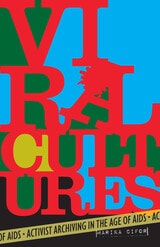
Viral Cultures
Activist Archiving in the Age of AIDSMarika Cifor
University of Minnesota Press, 2022
Delves deep into the archives that keep the history and work of AIDS activism alive
Serving as a vital supplement to the existing scholarship on AIDS activism of the 1980s and 1990s, ViralCultures is the first book to critically examine the archives that have helped preserve and create the legacy of those radical activities. Marika Cifor charts the efforts activists, archivists, and curators have made to document the work of AIDS activism in the United States and the infrastructure developed to maintain it, safeguarding the material for future generations to remember these social movements and to revitalize the epidemic’s past in order to remake the present and future of AIDS.
Drawing on large institutional archives such as the New York Public Library, as well as those developed by small, community-based organizations, this work of archival ethnography details how contemporary activists, artists, and curators use these records to build on the cultural legacy of AIDS activism to challenge the conditions of injustice that continue to undergird current AIDS crises. Cifor analyzes the various power structures through which these archives are mediated, demonstrating how ideology shapes the nature of archival material and how it is accessed and used. Positioning vital nostalgia as both a critical faculty and a generative practice, this book explores the act of saving this activist past and reanimating it in the digital age.
While many books, popular films, and major exhibitions have contributed to a necessary awareness of HIV and AIDS activism, Viral Cultures provides a crucial missing link by highlighting the powerful role of archives in making those cultural moments possible.

Viral Frictions
Global Health and the Persistence of HIV Stigma in KenyaElizabeth J. Pfeiffer
Rutgers University Press, 2022