313 books match the query 'Administration' and 2 start with v
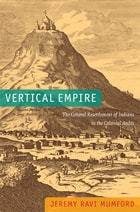
cover of Vertical Empire: The General Resettlement of Indians in the Colonial Andes

Vertical Empire

The General Resettlement of Indians in the Colonial Andes

Jeremy Ravi Mumford

Duke University Press, 2012
In 1569 the Spanish viceroy Francisco de Toledo ordered more than one million native people of the central Andes to move to newly founded Spanish-style towns called reducciones. This campaign, known as the General Resettlement of Indians, represented a turning point in the history of European colonialism: a state forcing an entire conquered society to change its way of life overnight. But while this radical restructuring destroyed certain aspects of indigenous society, Jeremy Ravi Mumford's Vertical Empire reveals the ways that it preserved others. The campaign drew on colonial ethnographic inquiries into indigenous culture and strengthened the place of native lords in colonial society. In the end, rather than destroying the web of Andean communities, the General Resettlement added another layer to indigenous culture, a culture that the Spaniards glimpsed and that Andeans defended fiercely.
[more]
cover of Visible Histories, Disappearing Women: Producing Muslim Womanhood in Late Colonial Bengal

Visible Histories, Disappearing Women

Producing Muslim Womanhood in Late Colonial Bengal

Mahua Sarkar

Duke University Press, 2008

In Visible Histories, Disappearing Women, Mahua Sarkar examines how Muslim women in colonial Bengal came to be more marginalized than Hindu women in nationalist discourse and subsequent historical accounts. She also considers how their near-invisibility except as victims has underpinned the construction of the ideal citizen-subject in late colonial India. Through critical engagements with significant feminist and postcolonial scholarship, Sarkar maps out when and where Muslim women enter into the written history of colonial Bengal. She argues that the nation-centeredness of history as a discipline and the intellectual politics of liberal feminism have together contributed to the production of Muslim women as the oppressed, mute, and invisible “other” of the normative modern Indian subject.

Drawing on extensive archival research and oral histories of Muslim women who lived in Calcutta and Dhaka in the first half of the twentieth century, Sarkar traces Muslim women as they surface and disappear in colonial, Hindu nationalist, and liberal Muslim writings, as well as in the memories of Muslim women themselves. The oral accounts provide both a rich source of information about the social fabric of urban Bengal during the final years of colonial rule and a glimpse of the kind of negotiations with stereotypes that even relatively privileged, middle-class Muslim women are still frequently obliged to make in India today. Sarkar concludes with some reflections on the complex links between past constructions of Muslim women, current representations, and the violence against them in contemporary India.

[more]