Results by title
1563 books match the query 'African American & Black Studies' and 4 start with v
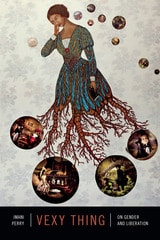
Vexy Thing
On Gender and LiberationImani Perry
Duke University Press, 2018
Even as feminism has become increasingly central to our ideas about institutions, relationships, and everyday life, the term used to diagnose the problem—“patriarchy”—is used so loosely that it has lost its meaning. In Vexy Thing Imani Perry resurrects patriarchy as a target of critique, recentering it to contemporary discussions of feminism through a social and literary analysis of cultural artifacts from the Enlightenment to the present. Drawing on a rich array of sources—from nineteenth-century slavery court cases and historical vignettes to writings by Toni Morrison and Audre Lorde and art by Kara Walker and Wangechi Mutu—Perry shows how the figure of the patriarch emerged as part and parcel of modernity, the nation-state, the Industrial Revolution, and globalization. She also outlines how digital media and technology, neoliberalism, and the security state continue to prop up patriarchy. By exploring the past and present of patriarchy in the world we have inherited and are building for the future, Perry exposes its mechanisms of domination as a necessary precursor to dismantling it.
[more]
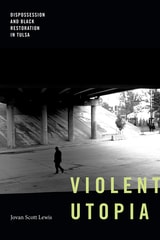
Violent Utopia
Dispossession and Black Restoration in TulsaJovan Scott Lewis
Duke University Press, 2022
In Violent Utopia Jovan Scott Lewis retells the history and afterlife of the 1921 Tulsa race massacre, from the post-Reconstruction migration of Black people to Oklahoma Indian Territory to contemporary efforts to rebuild Black prosperity. He focuses on how the massacre in Tulsa’s Greenwood neighborhood—colloquially known as Black Wall Street—curtailed the freedom built there. Rather than framing the massacre as a one-off event, Lewis places it in a larger historical and social context of widespread patterns of anti-Black racism, segregation, and dispossession in Tulsa and beyond. He shows how the processes that led to the massacre, subsequent urban renewal, and intergenerational poverty shored up by nonprofits constitute a form of continuous slow violence. Now, in their attempts to redevelop resources for self-determination, Black Tulsans must reconcile a double inheritance: the massacre’s violence and the historical freedom and prosperity that Greenwood represented. Their future is tied to their geography, which is the foundation from which they will repair and fulfill Greenwood’s promise.
[more]
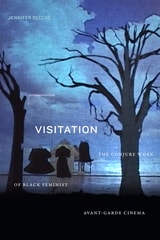
Visitation
The Conjure Work of Black Feminist Avant-Garde CinemaJennifer DeClue
Duke University Press, 2022
In Visitation, Jennifer DeClue shows how Black feminist avant-garde filmmakers draw from historical archives in order to visualize and reckon with violence suffered by Black women in the United States. DeClue argues that these filmmakers—including Kara Walker, Kara Lynch, Tourmaline, and Ja’Tovia Gary—create spaces of mourning and reckoning rather than voyeurism and pornotropy. Through their use of editing, performance, and cinematic experimentation, these filmmakers intervene in the production of Blackness and activate new ways of seeing Black women and telling their stories. Theorizing these films as a form of conjure work, DeClue shows how these filmmakers raise the specters of Black women from the past and invite them to reveal history from their point of view. In so doing, Black feminist avant-garde filmmakers channel spirits that haunt archives and create cinematic arenas for witnessing Black women battling for survival during pivotal and exceedingly violent moments in US history.
Duke University Press Scholars of Color First Book Award recipient
Duke University Press Scholars of Color First Book Award recipient
[more]
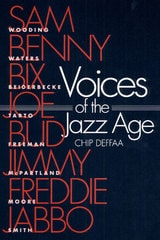
Voices of the Jazz Age
Profiles of Eight Vintage JazzmenChip Deffaa
University of Illinois Press, 1990
In Voices of the Jazz Age, Chip Deffaa interviews eight musicians who rose to popularity during the 1920s. Sam Wooding, Benny Waters, Bix Beiderbecke, Joe Tarto, Bud Freeman, Jimmy McPartland, Freddie Moore, Jabbo Smith bring the Jazz Age back to life with vivid memories, amazing stories, and their own larger-than-life personalities. Deffaa draws out their glory days in the Twenties but also invites them to share the stories of their long lives in music, often in obscurity, but in many cases still working and gigging well into their eighties.
[more]