Results by title
977 books match the query 'American literature' and 15 start with v

Value and Vision in American Literature
Essays in Honor of Ray Lewis WhiteJoseph Candido
Ohio University Press, 1999
Through their various (and sometimes contrasting) critical points of view, these essays call attention to ideas or connections that demand a reappraisal of conventional attitudes or ingrained responses. Ranging in focus from the period of the mid-nineteenth century to the present day, they treat indisputably canonical figures such as Hawthorne, Faulkner, James, Hemingway, Cather, Bellow, Porter, Welty, and Warren in the same breath and often refreshingly on the same terms with Wallace Stegner, Cormac McCarthy, Dunstan Thompson, neglected Civil War poets, and the New Formalist critics of the last ten years.
In celebration and in reflection of the important critical contribution Ray Lewis White has made to the study of American literature, these writers, each a noted scholar in the field of literary studies, present a picture of American literature that manages to value the past at the same time that it asks us to envision that past anew.
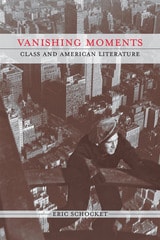
Vanishing Moments
Class and American LiteratureEric Schocket
University of Michigan Press, 2010
Schocket offers careful readings of works by Herman Melville, Rebecca Harding Davis, William Dean Howells, Jack London, T. S. Eliot, Gertrude Stein, Muriel Rukeyser, and Langston Hughes, among others, and explores how these authors worked to try to heal the rift between the classes. He considers the challenges writers faced before the Civil War in developing a language of class amidst the predominant concerns about race and slavery; how early literary realists dealt with the threat of class insurrection; how writers at the turn of the century attempted to span the divide between the classes by going undercover as workers; how early modernists used working-class characters and idioms to shape their aesthetic experiments; and how leftists in the 1930s struggled to develop an adequate model to connect class and literature. Vanishing Moments’ unique combination of a broad historical scope and in-depth readings makes it an essential book for scholars and students of American literature and culture, as well as for political scientists, economists, and humanists.
“An important book containing many brilliant arguments—hard-hitting and original. Schocket demonstrates a sophisticated acquaintance with issues within the working-class studies movement.”
--Barbara Foley, Rutgers University
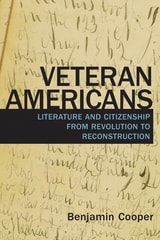
Veteran Americans
Literature and Citizenship from Revolution to ReconstructionBenjamin Cooper
University of Massachusetts Press, 2018
“I may dare to speak, and I intend to speak and write what I think,” wrote a New York volunteer serving in the Mexican War in 1848. Such sentiments of resistance and confrontation run throughout the literature produced by veteran Americans in the nineteenth century—from prisoner-of-war narratives and memoirs to periodicals, adventure pamphlets, and novels. Military men and women were active participants in early American print culture, yet they struggled against civilian prejudice about their character, against shifting collective memories that removed military experience from the nation's self-definition, and against a variety of headwinds in the uneven development of antebellum print culture.
In this new literary history of early American veterans, Benjamin Cooper reveals how soldiers and sailors from the Revolutionary War through the Civil War demanded, through their writing, that their value as American citizens and authors be recognized. Relying on an archive of largely understudied veteran authors, Cooper situates their perspective against a civilian monopoly in defining American citizenship and literature that endures to this day.
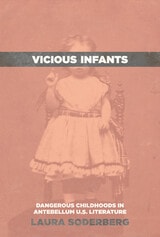
Vicious Infants
Dangerous Childhoods in Antebellum U.S. LiteratureLaura Soderberg
University of Massachusetts Press, 2021
Vicious Infants offers a counterhistory of literary childhood as both perceived social threat and site of resistance, revealing that many children were not only cut off from family and society, they were also preemptively excluded from the rewards of citizenship and adulthood. Turning to prison documents, medical journals, overlooked periodical fiction, and literary works from William Apess, Harriet Wilson, Herman Melville, Susan Paul, and Harriet Beecher Stowe, Laura Soderberg recovers alternate narratives of childhood and provides an important window into the cultural links between race, reproduction, and childhood in the antebellum period.

Vietnam Anthology
American War LiteratureNancy Anisfield
University of Wisconsin Press, 1987
Novel excerpts include: Robert Stone’s Dog Soldiers, David Halberstam’s One Very Hot Day, and Jeff Danziger’s Lieutenant Kitt. Short stories include Asa Baber’s “The Ambush,” Tobias Wolff’s “Wingfield,” and Tim O’Brien’s “The Things They Carried.” Drama excerpts include David Rabe’s Streamers and Lanford Wilson’s The 5th of July. Poets include: Denise Levertov, Jan Barry, E. D. Ehrhart, Basil T. Paquet, Stephen Sossaman, Bryan Alec Floyd, Bruce Weigl, and Trang Thi Nga.
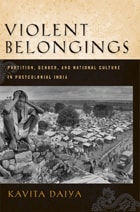
Violent Belongings
Partition, Gender, and National Culture in Postcolonial IndiaKavita Daiya
Temple University Press, 2008
In addition to challenging the official narratives of independence and Partition, these narratives challenge our contemporary understanding of gender and ethnicity in history and politics. Violent Belongings argues that both male and female bodies, and heterosexual coupledom, became symbols of the nation in public life. In the newly independent Indian nation both men and women were transformed into ideal citizens or troubling bodies, immigrants or refugees, depending on whether they were ethnically Hindu, Muslim, Jewish or Sikh. The divisions set in motion during Partition continue into our own time and account for ethnic violence in South Asia.
Virtual Americas
Transnational Fictions and the Transatlantic ImaginaryPaul Giles
Duke University Press, 2002
Throughout Virtual Americas Giles focuses on specific examples of transatlantic cultural interactions such as Frederick Douglass’s experiences and reputation in England; Herman Melville’s satirizing fictions of U.S. and British nationalism; and Vladimir Nabokov’s critique of European high culture and American popular culture in Lolita. He also reverses his perspective, looking at the representation of San Francisco in the work of British-born poet Thom Gunn and Sylvia Plath’s poetic responses to England. Giles develops his theory about the need to defamiliarize the study of American literature by considering the cultural legacy of Surrealism as an alternative genealogy for American Studies and by examining the transatlantic dimensions of writers such as Henry James and Robert Frost in the context of Surrealism.
Virtual Modernism
Writing and Technology in the Progressive EraKatherine Biers
University of Minnesota Press, 2013
In Virtual Modernism, Katherine Biers offers a fresh view of the emergence of American literary modernism from the eruption of popular culture in the early twentieth century. Employing dynamic readings of the works of Stephen Crane, Henry James, James Weldon Johnson, Djuna Barnes, and Gertrude Stein, she argues that American modernist writers developed a “poetics of the virtual” in response to the rise of mass communications technologies before World War I. These authors’ modernist formal experimentation was provoked by the immediate, individualistic pleasures and thrills of mass culture. But they also retained a faith in the representational power of language—and the worth of common experience—more characteristic of realism and naturalism. In competition with new media experiences such as movies and recorded music, they simultaneously rejected and embraced modernity.
Biers establishes the virtual poetics of these five writers as part of a larger “virtual turn” in the United States, when a fascination with the writings of Henri Bergson, William James, and vitalist philosophy—and the idea of virtual experience—swept the nation. Virtual Modernism contends that a turn to the virtual experience of language was a way for each of these authors to carve out a value for the literary, both with and against the growth of mass entertainments. This technologically inspired reengagement with experience was formative for American modernism.
Situated at the crossing points of literary criticism, philosophy, media studies, and history, Virtual Modernism provides an examination of Progressive Era preoccupations with the cognitive and corporeal effects of new media technologies that traces an important genealogy of present-day concerns with virtuality.
Visions and Divisions
American Immigration Literature, 1870-1930Prchal, Timothy
Rutgers University Press, 2008
From these debates came such novels as Willa Cather’s My Ántonia and Upton Sinclair’s The Jungle. Henry James, Charlotte Perkins Gilman, and Carl Sandburg added to the diversity of viewpoints of native born Americans while equally divergent immigrant perspectives were represented by writers such as Anzia Yezierska, Kahlil Gibran, and Claude McKay. This anthology presents the writing of these authors, among others less well known, to show the many ways literature participated in shaping the face of immigration. The volume also includes an introduction, annotations, a timeline, and historical documents that contextualize the literature.
Visions of Global America and the Future of Critical Reading
Daniel T. O’Hara
The Ohio State University Press, 2009
Visions of War
World War II in Popular Literature and CultureM. Paul Holsinger
University of Wisconsin Press, 1992
Vitality Politics
Health, Debility, and the Limits of Black EmancipationStephen Knadler
University of Michigan Press, 2019
Voicing America
Language, Literary Form, and the Origins of the United StatesChristopher Looby
University of Chicago Press, 1996
Vulgar Genres
Gay Pornographic Writing and Contemporary FictionSteven Ruszczycky
University of Chicago Press, 2021
Long fixated on visual forms, the field of porn studies is overdue for a book-length study of gay pornographic writing. Steven Ruszczycky delivers with an impressively researched work on the ways gay pornographic writing emerged as a distinct genre in the 1960s and went on to shape queer male subjectivity well into the new millennium.
Ranging over four decades, Ruszczycky draws on a large archive of pulp novels and short fiction, lifestyle magazines and journals, reviews, editorial statements, and correspondence. He puts these materials in conversation with works by a number of contemporary writers, including William Carney, Dennis Cooper, Samuel Delany, John Rechy, and Matthew Stadler. While focused on the years 1966 to 2005, Vulgar Genres reveals that the history of gay pornographic writing during this period informs much of what has happened online over the past twenty years, from cruising to the production of digital pornographic texts. The result is a milestone in porn studies and an important contribution to the history of gay life.
Vulnerable Constitutions
Queerness, Disability, and the Remaking of American ManhoodCynthia Barounis
Temple University Press, 2019
Amputation need not always signify castration; indeed, in Jack London’s fiction, losing a limb becomes part of a process through which queerly gendered men become properly masculinized. In her astute book, Vulnerable Constitutions, Cynthia Barounis explores the way American writers have fashioned alternative—even resistant—epistemologies of queerness, disability, and masculinity. She seeks to understand the way perverse sexuality, physical damage, and bodily contamination have stimulated—rather than created a crisis for—masculine characters in twentieth- and early twenty-first-century literature.
Barounis introduces the concept of “anti-prophylactic citizenship”—a mode of political belonging characterized by vulnerability, receptivity, and risk—to examine counternarratives of American masculinity. Investigating the work of authors including London, William Faulkner, James Baldwin, and Eli Clare, she presents an evolving narrative of medicalized sexuality and anti-prophylactic masculinity. Her literary readings interweave queer theory, disability studies, and the history of medicine to demonstrate how evolving scientific conversations around deviant genders and sexualities gave rise to a new model of national belonging—ultimately rewriting the story of American masculinity as a story of queer-crip rebellion.