Results by title
5550 books match the query 'Biography & Autobiography' and 45 start with v
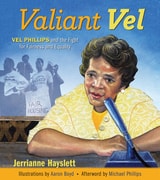
Valiant Vel
Vel Phillips and the Fight for Fairness and EqualityJerrianne Hayslett
Wisconsin Historical Society Press, 2025
An illustrated biography of groundbreaking civil rights activist Vel Phillips for young readers
Fair housing advocate, civil rights champion, and civic leader Vel Phillips spent her life breaking barriers and fighting for justice for all people. As the first Black woman on the Milwaukee Common Council, Wisconsin’s first Black judge, and the first Black woman to win statewide office when she was elected secretary of state of Wisconsin, Phillips left a lasting legacy that has inspired generations to continue the fight for justice and equality.
Valiant Vel depicts Phillips’s captivating story for young readers in middle and high school—from her childhood experiences facing racial discrimination, to achieving her dream of becoming a lawyer, to her long career in politics and civil rights. In the 1960s, Phillips spearheaded a campaign to advocate for fair housing in Milwaukee, joining forces with the NAACP Youth Council and marching alongside other activists in the face of violent opposition. In 1968, Phillips’s persistence paid off when the Milwaukee Common Council passed a fair housing ordinance.
Beautifully illustrated with historic photographs and original artwork by Milwaukee artist Aaron Boyd, Valiant Vel makes an excellent addition to young readers’ bookshelves at school and at home. With an afterword by Phillips’s son, Michael, a glossary of terms, and sources for further research, this book provides a thorough look at an inspirational activist who dedicated her life to making the world a better place.

Van Wyck Brooks - American Writers 71
University of Minnesota Pamphlets on American WritersWilliam Wasserstrom
University of Minnesota Press, 1968
Van Wyck Brooks - American Writers 71 was first published in 1968. Minnesota Archive Editions uses digital technology to make long-unavailable books once again accessible, and are published unaltered from the original University of Minnesota Press editions.
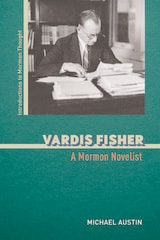
Vardis Fisher
A Mormon NovelistMichael Austin
University of Illinois Press, 2021
Engrossing and enlightening, Vardis Fisher illuminates the acclaimed author's impact on Mormon culture, American letters, and the literary tradition of the American West.
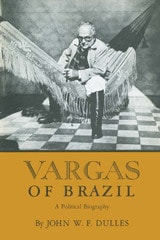
Vargas of Brazil
A Political BiographyBy John W. F. Dulles
University of Texas Press, 1967
The dominant public figure in Brazil from 1930 until 1954 was a highly contradictory and controversial personality. Getúlio Vargas, from the pampas of the southern frontier state of Rio Grande do Sul, became the dictator who ruled without ever forgetting the lower classes.
Vargas was a consummate artist at politics. He climbed the political ladder through seats in the state and national legislatures to the post of federal Finance Minister and to the governorship of Rio Grande do Sul. His career then took him to the National Palace as Provisional President and as Constitutional President, and later as the dictator of his "New State." After his deposition in 1945 and a period of semiretirement, his continuing widespread popularity resulted in his successful come-back campaign in 1950 for the Presidency on the Labor Party ticket.
Vargas' contributions to Brazilian political and economic life were many and important. Taking advantage of the power which his political magic provided him, he brought Brazil from a loose confederacy of semifeudal states to a strongly centralized nation. He was a great eclectic, welding into his social, political, and economic policies what he found good in various programs. He was also a great opportunist in the sense that he adroitly took advantage of conditions and circumstances to effect his ends. He was intimately related to the revolutionary changes in Brazilian life after 1930.
Vargas, "Father of the Brazilians," attributed achievements such as these to power in his own hands. His foes, however, still feared the political wizard, and they cheered the military when it deposed him. After his return, "on the arms of the people," Vargas saw that the armed forces were determined to repeat history, and in 1954 he chose another path—suicide.
All of these exciting events are related in John W. F. Dulles's Vargas of Brazil: A Political Biography. Despite its emphasis on Vargas the politician and statesman, the reader comes to know Vargas the man.
For this portrait of Vargas and of Brazil the author has drawn much material from State Department papers in the National Archives and from other public sources, and from interviews with numerous persons who were participants in the events he describes or observers of them. The result is an interesting, revealing, valid account of an important people. Many illustrations supplement the text.
Vasari on Theatre
Thomas A. Pallen
Southern Illinois University Press, 1999
In the process of creating the massive work that eventually became Lives of the Most Eminent Painters, Sculptors, and Architects, painter and scholar Giorgio Vasari (1511–1574) spent much of the mid-sixteenth century traveling throughout Italy, meeting Renaissance artists and writing about their lives and works.
From this imposing source, Thomas A. Pallen has created a compendium of theatrical references augmented by related modern Italian scholarship. Vasari's Lives—daunting because of its sheer magnitude—has remained relatively obscure to English-speaking theatre historians. To introduce the numerous scenographic references of this great work to the English-speaking audience, Pallen provides new translations of all relevant passages, as well as a table of cross-references to the principal editions of Vasari in both English and Italian. And because Vasari often omitted important information, Pallen annotates the text, providing important names, places, and historical background.
Essentially, Pallen divides Vasari's work into four categories: triumphs and pageantry, ingegni for mystery plays and festivals, theatrical scenery, and miscellanea and lacunae. Although triumphs and pageantry were not directly theatrical, they were executed by many of the same artists who worked on theatrical productions and either used or introduced many Renaissance Italian theatrical techniques. The works described here range from tableaux vivants and other forms of street decoration to fireworks displays.
While Vasari did not personally know the work of either Filippo Brunelleschi or Francesco d'Angelo (called Cecca), he discusses their inventions for staging mystery plays and street festivals; indeed, Pallen shows how the work of these two artists paved the way for all later Renaissance scenography.
Pallen then deals with Vasari's references to and descriptions of the theatrical scenery and lighting effects of his time and the artists who created them. In accordance with the schema developed by Elena Povoledo, Pallen leads the reader through the evolution of scenographic thought and practice from the elementary work of Girolamo Genga to the advanced settings created by Vasari himself.
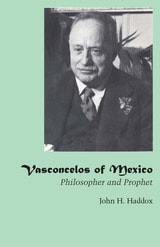
Vasconcelos of Mexico
Philosopher and ProphetBy John H. Haddox
University of Texas Press, 1967
José Vasconcelos—lawyer, politician, writer, educator, philosopher, prophet, and mystic—was one of the most influential and controversial figures in the intellectual life of twentieth-century Mexico.
Vasconcelos was driven by the desire to gain a complete and comprehensive vision of reality, employing his own aesthetic-emotive method and a poetic mode of expression. The complex philosophical system that resulted is what he called “aesthetic monism.” But this is only one side of the man. Vasconcelos was also vitally interested in both the proximate realities and remote possibilities of Mexico, in the character of the “cosmic race” of his homeland, and in the relations between his own country and the others of this hemisphere.
Soon after Vasconcelos’s death in 1959, Eduardo García Máynez spoke of him, in a moving tribute, as “without question the most inspiring intellectual and human figure that Mexico has produced.” Unhappily—and perhaps disgracefully—he has remained almost unknown outside the Spanish-speaking world. Histories of Mexico published in English usually give passing mention to his role as Minister of Public Education or his unsuccessful campaign for the presidency, but his aesthetic system and his socio-political ideas have been ignored by philosophers in the United States.
Here, for the first time, is a unified, inclusive, and occasionally critical presentation of the entire range of Vasconcelos’s thought, from his metaphysics and theory of knowledge through his aesthetics and ethics to his social and political philosophy. It is enriched by an appendix in which the most significant passages from Vasconcelos’s own philosophical writings are presented in English translations.
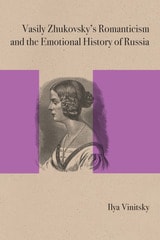
Vasily Zhukovsky's Romanticism and the Emotional History of Russia
Ilya Vinitsky
Northwestern University Press, 2015
The first major study in English of Vasily Zhukovsky (1783–1852)—poet, translator of German romantic verse, and mentor of Pushkin—this book brings overdue attention to an important figure in Russian literary and cultural history. Vinitsky’s “psychological biography” argues that Zhukovsky very consciously set out to create for himself an emotional life reflecting his unique brand of romanticism, different from what we associate with Pushkin or poets such as Byron or Wordsworth. For Zhukovsky, ideal love was harmonious, built on a mystical foundation of spiritual kinship. Vinitsky shows how Zhukovksy played a pivotal role in the evolution of ideas central to Russia’s literary and cultural identity from the end of the eighteenth century into the decades following the Napoleonic Wars.
Veeck As In Wreck
The Autobiography of Bill VeeckBill Veeck with Ed Linn
University of Chicago Press, 2001
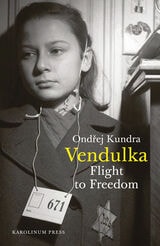
Vendulka
Flight to FreedomOndrej Kundra
Karolinum Press, 2021
Famed Czech photographer Jan Lukas snapped an offhand portrait of twelve-year-old Vendulka Vogl in March 1943. A friend of the Vogls, Lukas was saying goodbye to the family, who were soon to leave Prague for a concentration camp. The photograph almost didn’t see the light of day—Lukas knew that if the Nazis found it on him, he could wind up in the camps as well—but the image was eventually developed and came to symbolize the Holocaust and humanize its victims. Seventy years after this famous picture was taken, investigative journalist Ondřej Kundra discovered that, despite all odds, Vendulka Vogl had survived the camps of Terezín, Auschwitz, and Christianstadt, and was in fact still alive and living in the United States. Kundra persuaded her to tell the remarkable story surrounding the photograph: her survival, her later decision to flee the Communist regime for America, and how she later reconnected with Jan Lukas, maintaining a lifelong friendship.
Vogl’s thrillingly moving story, Kundra’s sharp and engaging writing, and Lukas’s striking photography all combine to make Vendulka an inspiring investigation into the horrors of totalitarianism and the redemptive beauty of friendship.
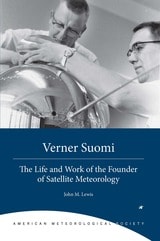
Verner Suomi
The Life and Work of the Founder of Satellite MeteorologyJohn M. Lewis et al.
American Meteorological Society, 2018
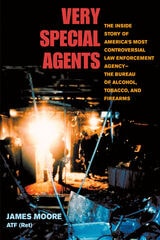
Very Special Agents
The Inside Story of America's Most Controversial Law Enforcement Agency--The Bureau of Alcohol, Tobacco, and FirearmsJames Moore, ATF (Ret.)
University of Illinois Press, 1997
Moore's personal, from-the-hip history spans the long-running war against dons and drug dealers and covers agents' daring infiltration of the Ku Klux Klan, Hell's Angels, and other violent groups. He reveals the cutting-edge forensics work that helped crack the World Trade Center and Oklahoma City bombings and also provides an insider account of the raid on the Branch Davidians at Waco. Finally, Moore discusses the ATF's rivalry with the FBI and the political power games that impede the government's ability to fight crime.
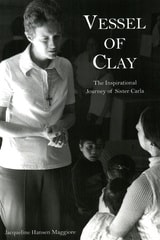
Vessel of Clay
The Inspirational Journey of Sister CarlaJacqueline Hansen Maggiore
University of Scranton Press, 2010
Jacqueline Hansen Maggiore presents in this volume the biography of her lifelong friend Carol Piette, known throughout Chile and El Salvador as Sister Carla. Drawing from the memories of those who knew her and excerpts from her letters and diaries, Vessel of Clay chronicles Sister Carla’s extraordinary life, highlighting her dedication to the poor of Latin America but also revealing her struggles with self-doubt and emotional frailty. Vessel of Clay will appeal to both lay and religious readers interested in peace and social justice, spiritual formation and development, women’s issues, liberation theology, and mission service.
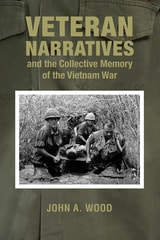
Veteran Narratives and the Collective Memory of the Vietnam War
John A. Wood
Ohio University Press, 2016
In the decades since the Vietnam War, veteran memoirs have influenced Americans’ understanding of the conflict. Yet few historians or literary scholars have scrutinized how the genre has shaped the nation’s collective memory of the war and its aftermath. Instead, veterans’ accounts are mined for colorful quotes and then dropped from public discourse; are accepted as factual sources with little attention to how memory, no matter how authentic, can diverge from events; or are not contextualized in terms of the race, gender, or class of the narrators.
Veteran Narratives and the Collective Memory of the Vietnam War is a landmark study of the cultural heritage of the war in Vietnam as presented through the experience of its American participants. Crossing disciplinary borders in ways rarely attempted by historians, John A. Wood unearths truths embedded in the memoirists’ treatments of combat, the Vietnamese people, race relations in the United States military, male-female relationships in the war zone, and veterans’ postwar troubles. He also examines the publishing industry’s influence on collective memory, discussing, for example, the tendency of publishers and reviewers to privilege memoirs critical of the war. Veteran Narratives is a significant and original addition to the literature on Vietnam veterans and the conflict as a whole.
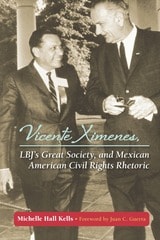
Vicente Ximenes, LBJ's Great Society, and Mexican American Civil Rights Rhetoric
Michelle Hall Kells, with a foreword by Juan C. Guerra
Southern Illinois University Press, 2018
Kells draws on Ximenes’s extensive archive of speeches, reports, articles, and oral interviews to present the activist’s rhetorical history. After a discussion of Ximenes’s early life, the author focuses on his career as an activist, examining Ximenes’s leadership in several key civil rights events, including the historic 1967 White House Cabinet Committee Hearings on Mexican American Affairs. Also highlighted is his role in advancing Mexican Americans and Latinos from social marginalization to greater representation in national politics.
This book shows us a remarkable man who dedicated the majority of his life to public service, using rhetoric to mobilize activists for change to secure civil rights advances for his fellow Mexican Americans.
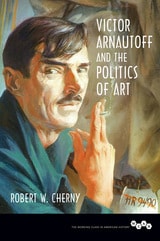
Victor Arnautoff and the Politics of Art
Robert W. Cherny
University of Illinois Press, 2017
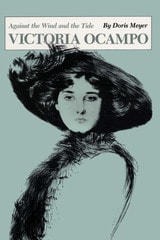
Victoria Ocampo
Against the Wind and the TideBy Doris Meyer
University of Texas Press, 1989
The "first lady of Argentine letters," Victoria Ocampo is best known as the architect of cultural bridges between the American and European continents and as the founder and director of Sur, an influential South American literary review and publishing house.
In this first biographical study in English of "la superbe Argentine," originally published in 1979, Doris Meyer considers Victoria Ocampo's role in introducing European and North American writers and artists to the South American public—through the pages of her review, through translations of their work, and through lecture tours and recitations. She examines Ocampo's personal relationships with some of the most illustrious writers and thinkers of this century—including José Ortega y Gasset, Rabindranath Tagore, Count Hermann Keyserling, Virginia Woolf, Adrienne Monnier, Vita Sackville-West, Gabriela Mistral, and many others. And she portrays an extraordinary woman who rebelled against the strictures of family and social class to become a leading personality in the fight for women's rights in Argentina and, later, a steadfast opponent of the Perón regime, for which she was sent to jail in 1953.
Fifteen of Victoria Ocampo's essays, selected from her more than ten volumes of prose and translated by Doris Meyer, complement the biographical study.
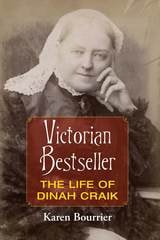
Victorian Bestseller
The Life of Dinah CraikKaren Bourrier
University of Michigan Press, 2019
Victorian Bestseller is the first book to relate the story of Dinah Craik’s remarkable life. Combining extensive archival work with theoretical work in disability studies and the professionalization of women’s authorship, Karen Bourrier engagingly traces the contours of this author’s life. Craik, who wrote extensively about disability in her work, was no stranger to it in her personal and professional life, marked by experiences of mental and physical disability, and the ebb and flow of health. Following scholarship in the ethics of care and disability studies, the book posits Craik as an interdependent subject, placing her within a network of writers, publishers, editors and artists, friends, and family members. Victorian Bestseller also traces the conditions in the material history of the book that allowed Victorian women writers’ careers to flourish. In doing so, the biography connects corporeality, gender, and the material history of the book to the professionalization of Victorian women’s authorship.
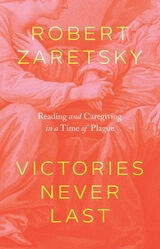
Victories Never Last
Reading and Caregiving in a Time of PlagueRobert Zaretsky
University of Chicago Press, 2022
In any time of disruption or grief, many of us seek guidance in the work of great writers who endured similar circumstances. During the first year of the COVID-19 pandemic, historian and biographer Robert Zaretsky did the same while also working as a volunteer in a nursing home in south Texas. In Victories Never Last Zaretsky weaves his reflections on the pandemic siege of his nursing home with the testimony of six writers on their own times of plague: Thucydides, Marcus Aurelius, Michel de Montaigne, Daniel Defoe, Mary Shelley, and Albert Camus, whose novel The Plague provides the title of this book.
Zaretsky delves into these writers to uncover lessons that can provide deeper insight into our pandemic era. At the same time, he goes beyond the literature to invoke his own experience of the tragedy that enveloped his Texas nursing home, one which first took the form of chronic loneliness and then, inevitably, the deaths of many residents whom we come to know through Zaretsky’s stories. In doing so, Zaretsky shows the power of great literature to connect directly to one’s own life in a different moment and time.
For all of us still struggling to comprehend this pandemic and its toll, Zaretsky serves as a thoughtful and down-to-earth guide to the many ways we can come to know and make peace with human suffering.
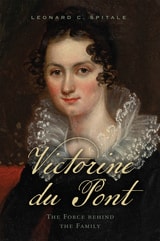
Victorine du Pont
The Force behind the FamilyLeonard C. Spitale
University of Delaware Press, 2023
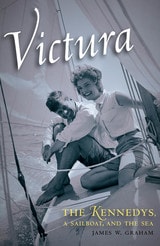
Victura
The Kennedys, a Sailboat, and the SeaJames W. Graham
University Press of New England, 2015
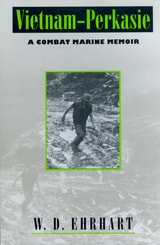
Vietnam-Perkasie
W. D. Ehrhart
University of Massachusetts Press, 1995
In 1982, John Newman, curator of the Vietnam War Literature Collection at Colorado State University, said of W.D. Ehrhart: “As a poet and editor, Bill Ehrhart is clearly one of the major figures in Vietnam War literature.” This autobiographical account of the war, the author's first extended prose work, demonstrates Ehrhart's abilities as a writer of prose as well. Vietnam–Perkasie is grim, comical, disturbing, and accurate. The presentation is novelistic—truly, a “page-turner”—but the events are all real, the atmosphere intensely evocative.
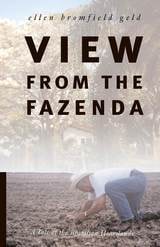
View from the Fazenda
A Tale of the Brazilian HeartlandsEllen Bromfield Geld
Ohio University Press, 2012
“I imagine everyone has a center of gravity,” says Ellen Bromfield Geld. “Something which binds one to the earth and gives sense and direction to what one does.” For Ellen, this center is a writing table before a window that looks out upon groves of pecan trees and mahogany-colored cattle in seas of grass. The place is Fazenda Pau D’Alho, Brazil, where she and her husband, Carson, have lived and farmed since 1961.
Healing the ravaged coffee plantation, rearing five children, exploring the outposts, the Gelds have created a dynamic yet peaceful life far from Ellen’s native Ohio. Their practice of sustainable agriculture, and Ellen’s plea for the preservation of Brazil’s remaining wilderness areas, reflect the legacy of her father, the novelist and farm visionary Louis Bromfield. Their shared vision is crystallized in her account of a cattle drive across the Pantanal, the vast flood plain on Brazil’s side of the Paraguay River. She describes a two-hundred year symbiosis between ranchers and a fragile ecosystem that is being threatened by development.
View from the Fazenda is distilled from fifty years of living in Brazil, weaving daily life on the farm into her quest to understand a nation. It portrays a true melting pot of people who—as conquerers, immigrants, or slaves, their blood and history mingled with those of native Indians—have created the character of Brazil. This huge, diverse county, living in several eras at the same time, is ever changing through its people’s amazing ability to “find a way.”
Ellen Bromfield Geld evokes the land and people of Brazil and offers readers an invigorating glimpse into a soulful life. “It seems to me that being a bit of a poet is perhaps the only way one can survive as a farmer,” she explains. “For in the end, more than anything, farming is a way of life you either love or become bitter enduring.”
Vigil
Alan Shapiro
University of Chicago Press, 1997
In Vigil, Shapiro chronicles with heart-wrenching lyricism the final four weeks of Beth's life in a hospice, attended by her parents, brothers, husband, daughter and friends. One by one, as loved ones arrive to visit Beth, Shapiro reveals fragments of their personal history, bringing to life a troubled and poignant past. A visit from their brother David triggers the memory of a searing betrayal—the parents disowned Beth after learning from David that she was secretly dating a black man; a visit from the parents recalls their bitter quarrels over Beth's radical politics; a visit from Beth's black husband brings the painful memory of their wedding and her parents' refusal to attend. These recollections and feelings that surface with each visit evoke the unresolved, deeply disturbing issues that kept the Shapiro family estranged for so long, making the reconciliation that Beth's death brings to her family all the more extraordinary.
Shapiro gives an unconventionally honest account of our responses—horror, relief, impatience, exhaustion, exhilaration, projection, fear, self-criticism, and a sense of fulfillment—in the presence of the dying. Concluding with a selection of moving poems, Shapiro affirms the astonishing link between creativity and healing, and provides a coda to the whole experience. The price of human connection may be great, but human connection, in the end, has the power to redeem even the most painful of human experiences.
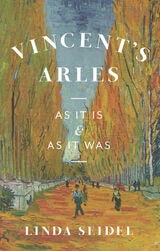
Vincent's Arles
As It Is and as It WasLinda Seidel
University of Chicago Press, 2023
Once admired as “a little Rome” on the banks of the Rhône, the town of Arles in the south of France had been a place of significance long before the painter Vincent van Gogh arrived in February of 1888. Aware of Arles’s history as a haven for poets, van Gogh spent an intense fifteen months there, scouring the city’s streets and surroundings in search of subjects to paint when he wasn’t thinking about other places or lamenting his woeful circumstances.
In Vincent’s Arles, Linda Seidel serves as a guide to the mysterious and culturally rich town of Arles, taking us to the places immortalized by van Gogh and cherished by innumerable visitors and pilgrims. Drawing on her extensive expertise on the region and the medieval world, Seidel presents Arles then and now as seen by a walker, visiting sites old and new. Roman, Romanesque, and contemporary structures come alive with the help of the letters the artist wrote while in Arles. The result is the perfect blend of history, art, and travel, a chance to visit a lost past and its lingering, often beautiful, traces in the present.
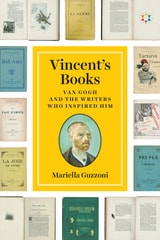
Vincent's Books
Van Gogh and the Writers Who Inspired HimMariella Guzzoni
University of Chicago Press, 2020
One of the most famous artists in history, Vincent van Gogh (1853–1890) was also a man with another powerful passion—for books. An insatiable reader, Van Gogh spent his life hungrily consuming as many books as he could. He read, reread, and copied out books in Dutch, English, and French. He knew many passages by heart from works by Dickens, Zola, Shakespeare, and Maupassant, among many others. As he wrote to his brother, Theo, in one of their hundreds of letters: “I have a more or less irresistible passion for books.”
In Vincent’s Books, Mariella Guzzoni explores Van Gogh’s life as a voracious bookworm, noting what he read, what he wrote about, and how his love of reading influenced his art. She walks us through his life, chapter by chapter: from the religious aspirations of his early adulthood, to his decision to be a painter, to the end of his tragically short life. He moved from Holland to Paris to Provence; at each moment, ideas he encountered in books defined and guided his thoughts and his worldview. Van Gogh wrote with eloquence and insight about what he was reading in his letters to Theo, referring to at least two hundred authors. Books and readers are frequent subjects of his paintings, and Guzzoni highlights over one hundred of these works, such as Still Life with Bible in the Van Gogh Museum and his vivid paintings of l’Arlesienne.
A gorgeously illustrated biography that will appeal to any booklover, Vincent’s Books takes us on a fresh, fascinating journey through the pages of a beloved artist’s life.
Explore Van Gogh’s musings on his favorite writers, including
Thomas à Kempis, Charles Blanc, Honoré de Balzac, Edmond and Jules de Goncourt, Guy de Maupassant, Charles Dickens, Erckmann-Chatrian, Homer, Victor Hugo, Pierre Loti, Jules Michelet, William Shakespeare, Harriet Beecher Stowe, Émile Zola
Vinegar Pie and Chicken Bread
A Woman's Diary of Life in the Rural South, 1890–1891Margeret Bolsterli
University of Arkansas Press, 1982
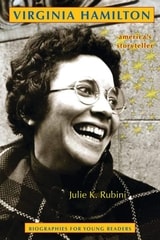
Virginia Hamilton
America’s StorytellerJulie K. Rubini
Ohio University Press, 2017
A Bank Street College of Education Best Children’s Book of 2018 (Outstanding Merit selection) • Finalist, 2018 Ohioana Book Award
Long before she wrote The House of Dies Drear, M. C. Higgins, the Great, and many other children’s classics, Virginia Hamilton grew up among her extended family near Yellow Springs, Ohio, where her grandfather had been brought as a baby through the Underground Railroad. The family stories she heard as a child fueled her imagination, and the freedom to roam the farms and woods nearby trained her to be a great observer. In all, Hamilton wrote forty-one books, each driven by a focus on “the known, the remembered, and the imagined”—particularly within the lives of African Americans.
Over her thirty-five-year career, Hamilton received every major award for children’s literature. This new biography gives us the whole story of Virginia’s creative genius, her passion for nurturing young readers, and her clever way of crafting stories they’d love.
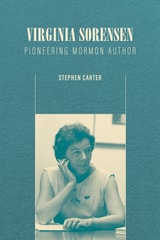
Virginia Sorensen
Pioneering Mormon AuthorStephen Carter
Signature Books, 2023
Who is Virginia Sorensen? How did a girl who grew up in a tiny Utah town in the 1920s become a globetrotting, award-winning author? And why has she been forgotten?
Though she wrote them four generations ago, Sorensen’s novels are more urgent today than ever, addressing issues both Mormons and former Mormons grapple with. Her body of work is a treasure trove of insight, compassion, and storytelling waiting to be rediscovered.
Virginia's Apple
Collected MemoirsJudith Barrington
Oregon State University Press, 2024
Virginia’s Apple is a collection of fourteen literary memoirs that explore pivotal episodes across poet and writer Judith Barrington’s life. Artfully crafted, each one stands alone yet they are linked—characters reappear and, taken together, they create a larger narrative.
The content is wide-ranging: the early days of the Second Wave of feminism—the exhilaration, the wildness, the love affairs, the surprises, and the self-invention, as well as the confusion and conflicts of those heady times; navigating a sometimes precarious existence as an out lesbian long before it was commonplace; leaving England and becoming an American citizen; finding a life partner; and growing old with an inherited disability. The author’s friendship with the distinguished poet Adrienne Rich is the subject of one story. In another, there’s an appearance by the notorious murderer, Lord Lucan, whose wife was a chance acquaintance.
These stories are laced with humor and joy, while pulsing below the surface is the slow unfolding of delayed grief over her parents’ drowning when she was nineteen, revealing how such a loss can shape a life.
Vita Mea
The Autobiography of Sir Herbert J.C. GriersonCairns Craig
Aberdeen University Press, 2015
Vittorio Orlando
ItalySpencer Di Scala
Haus Publishing, 2009
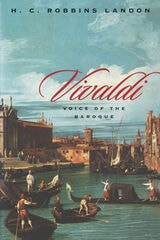
Vivaldi
Voice of the BaroqueH. C. Robbins Landon
University of Chicago Press, 1996
Very little has been written on Vivaldi for the nonspecialist, especially in English. Landon rediscovers the composer in this accessible and musically informed biography while presenting documentation of the musician's life discovered after the Baroque revival in the 1930s. This book includes illustrations of eighteenth-century Venice and several newly translated letters, thoroughly evoking the style of the time and revealing some of the more personal aspects of Vivaldi's life.
"Belongs on the shelf of every serious music student."—Kirkus
"Gives a good feel for Vivaldi's life and times . . . and describes particularly well how Vivaldi has been revived."—Booklist
"Robbins Landon is marvelously entertaining, extravagantly learned."—The Independent
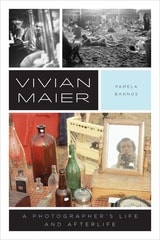
Vivian Maier
A Photographer’s Life and AfterlifePamela Bannos
University of Chicago Press, 2017
But, as Pamela Bannos reveals in this meticulous and passionate biography, this story of the nanny savant has blinded us to Maier’s true achievements, as well as her intentions. Most important, Bannos argues, Maier was not a nanny who moonlighted as a photographer; she was a photographer who supported herself as a nanny. In Vivian Maier: A Photographer’s Life and Afterlife, Bannos contrasts Maier’s life with the mythology that strangers—mostly the men who have profited from her work—have created around her absence. Bannos shows that Maier was extremely conscientious about how her work was developed, printed, and cropped, even though she also made a clear choice never to display it. She places Maier’s fierce passion for privacy alongside the recent spread of her work around the world, and she explains Maier’s careful adjustments of photographic technique, while explaining how the photographs have been misconstrued or misidentified. As well, Bannos uncovers new information about Maier’s immediate family, including her difficult brother, Karl—relatives that once had been thought not to exist.
This authoritative and engrossing biography shows that the real story of Vivian Maier, a true visionary artist, is even more compelling than the myth.
Vladimir Nabokov - American Writers 96
University of Minnesota Pamphlets on American WritersJulian Moynahan
University of Minnesota Press, 1971
Vladimir Nabokov - American Writers 96 was first published in 1971. Minnesota Archive Editions uses digital technology to make long-unavailable books once again accessible, and are published unaltered from the original University of Minnesota Press editions.
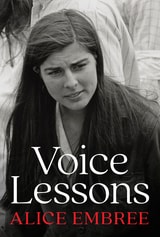
Voice Lessons
By Alice Embree
University of Texas Press, 2021
Voice Lessons explores the rich personal and political terrain of Alice Embree, a 1960s activist and convert to the women’s liberation movement of the 1970s, bringing a woman’s perspective to a transformational time in US history. This riveting memoir traces the author’s roots in segregated Austin and her participation in efforts to integrate the University of Texas. It follows her antiwar activism from a vigil in front of President Lyndon Johnson’s ranch in 1965 to a massive protest after the shootings at Kent State in 1970. Embree’s activism brought her and the Students for a Democratic Society into conflict with Frank Erwin, the powerful chairman of the UT Board of Regents, and inspired a campus free speech movement. She recounts her experiences living in New York during the tumultuous years of 1968 and 1969, including the Columbia University strike and the Woodstock music festival. She also tells about protesting at the Chicago Democratic Convention, her interactions with Yippies and poets, and her travels to Chile, Cuba, and Mexico. Embree highlights the radical roots of the women’s liberation movement in Austin and the audacious women’s community that challenged gender roles, fought for reproductive justice, and inspired a lifetime of activism.

Voice, Silence and Gender in South Africa's Anti-Apartheid Struggle
The Shadow of a Young WomanRachel E. Johnson
University of London Press, 2025
Who spoke about the liberation struggle whilst it was ongoing? When did they speak and how? And what effects do the gendered history of speech and silence within anti-apartheid politics continue to have upon our knowledge of the past? Arguing that she is emblematic of the way gendered narratives of the struggle have been made, this book listens for the voice and silence of Masabata Loate and her contemporaries within political trials; newspapers; photography; human rights reportage; creative fiction, drama, poetry and song; autobiography and memoir; and oral histories. The result is an unconventional biography that sees this young woman as a shadow within the story of South Africa’s anti-apartheid liberation struggle.
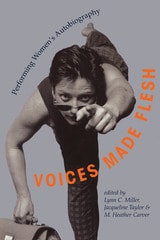
Voices Made Flesh
Performing Women'S AutobiographyLynn C. Miller
University of Wisconsin Press, 2003
Fourteen bold, dynamic, and daring women take the stage in this collection of women's lives and stories. Individually and collectively, these writers and performers speak the unspoken and perform the heretofore unperformed.
The first section includes scripts and essays about performances of the lives of Gertrude Stein, Georgia O'Keeffe, Mary Church Terrell, Charlotte Cushman, Anaïs Nin, Calamity Jane, and Mary Martin. The essays consider intriguing interpretive issues that arise when a woman performer represents another woman's life. In the second section, seven performers—Tami Spry, Jacqueline Taylor, Linda Park-Fuller, Joni Jones, Terri Galloway, Linda M. Montano, and Laila Farah—tell their own stories. Ranging from narrrative lectures (sometimes aided by slides and props) to theatrical performances, their works wrest comic and dramatic meaning from a world too often chaotic and painful. Their performances engage issues of sexual orientation, ethnicity, race, loss of parent, disability, life and death, and war and peace. The volume as a whole highlights issues of representation, identity, and staging in autobiographical performance. It examines the links among theory and criticism of women's autobiography, feminist performance theory, and performance practice.
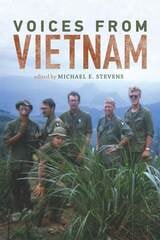
Voices from Vietnam
Michael E. Stevens
Wisconsin Historical Society Press, 1996
An unforgettable collection of 174 letters and diary entries written by 92 wisconsin men and women who served in Vietnam. Includes a journal kept by Menasha native Frederic Flom on cigarette wrappers during his final 16 days of captivity — the only known diary smuggled out by a Vietnam prisoner of war.
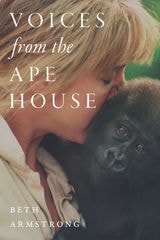
Voices from the Ape House
Beth Armstrong
The Ohio State University Press, 2020
Through anecdotal stories, readers get a glimpse into the fascinating lives of gorillas—the familiar gentleness of mothers and fathers toward their infants, power plays and social climbing, the unruly nature of teenagers, the capacity for humor, and the shared sadness by group members as they mourn the death of one of their own. In the end, Armstrong’s conflict with captivity and her lifelong fondness for these animals helped shape a zoo program dedicated to gorilla conservation.

Voices from the Gulag
Aleksandr Solzhenitsyn
Northwestern University Press, 2010
After the publication in 1962 of One Day in the Life of Ivan Denisovich, Aleksandr Solzhenitsyn began receiving, and would continue to receive throughout his life, testimonies from fellow survivors of the gulag. Originally selected by Solzhenitsyn, the memoirs in this volume are an important addition to the literature of the Soviet gulag. Written by men from a wide variety of occupations and social classes, the writing in Voices from the Gulag lends a voice to the many ordinary people—including a circus performer, a teenage boy, and a Red Army soldier—whom a brutal system attempted to erase from memory.

Voices of the Jazz Age
Profiles of Eight Vintage JazzmenChip Deffaa
University of Illinois Press, 1990
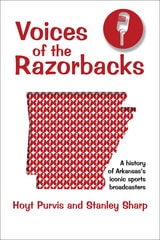
Voices of the Razorbacks
A History of Arkansas's Iconic Sports BroadcastersHoyt Purvis
Butler Center for Arkansas Studies, 2013
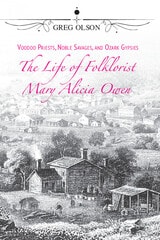
Voodoo Priests, Noble Savages, and Ozark Gypsies
The Life of Folklorist Mary Alicia OwenGreg Olson
University of Missouri Press, 2025
Folklorist Wayland Hand once called Mary Alicia Owen “the most famous American Woman Folklorist of her time.” Drawing on primary sources, such as maps, census records, court documents, personal letters and periodicals, and the scholarship of others who have analyzed various components of Owen’s multifaceted career, historian Greg Olson offers the most complete account of her life and work to date. He also offers a critical look at some of the short stories Owen penned, sometimes under the name Julia Scott, and discusses how the experience she gained as a fiction writer helped lead her to a successful career in folklore.
Olson analyzes many of the nineteenth-century theories, stereotypes, and popular beliefs that influenced the work of Owen and many of her peers. By taking a cross-disciplinary look at her works of fiction, poetry, folklore, history, and anthropology, this volume sheds new light on elements of Owen’s career that have not previously been discussed in print. Examples of the romance stories that Owen wrote for popular magazines in the 1880’s are identified and examined in the context of the time in which Owen wrote them.
This groundbreaking biography shows that Owen was more than just a folklorist—she was a nineteenth-century woman of many contradictions. She was an independent woman of many interests who possessed a keen intellect and a genuine interest in people and their stories. Specialists in folklore, anthropology, women’s studies, local and regional history, and Missouriana will find much to like in this thoroughly researched study.
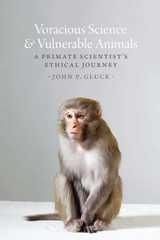
Voracious Science and Vulnerable Animals
A Primate Scientist's Ethical JourneyJohn P. Gluck
University of Chicago Press, 2016
Gluck begins by taking us inside the laboratory of Harry F. Harlow at the University of Wisconsin, where Gluck worked as a graduate student in the 1960s. Harlow’s primate lab became famous for his behavioral experiments in maternal deprivation and social isolation of rhesus macaques. Though trained as a behavioral scientist, Gluck finds himself unable to overlook the intense psychological and physical damage these experiments wrought on the macaques. Gluck’s sobering and moving account reveals how in this and other labs, including his own, he came to grapple with the uncomfortable justifications that many researchers were offering for their work. As his sense of conflict grows, we’re right alongside him, developing a deep empathy for the often smart and always vulnerable animals used for these experiments.
At a time of unprecedented recognition of the intellectual cognition and emotional intelligence of animals, Voracious Science and Vulnerable Animals is a powerful appeal for our respect and compassion for those creatures who have unwillingly dedicated their lives to science. Through the words of someone who has inflicted pain in the name of science and come to abhor it, it’s important to know what has led this far to progress and where further inroads in animal research ethics are needed.
Voyage to the Island
Raija Nieminen
Gallaudet University Press, 2014