Results by title
1566 books match the query 'Christianity' and 10 start with v

Vardis Fisher
A Mormon NovelistMichael Austin
University of Illinois Press, 2021
Engrossing and enlightening, Vardis Fisher illuminates the acclaimed author's impact on Mormon culture, American letters, and the literary tradition of the American West.
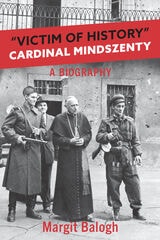
Victim of History
Cardinal Mindszenty, a biographyMargit Balogh
Catholic University of America Press, 2022
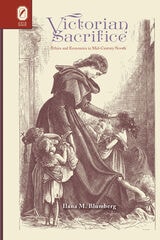
Victorian Sacrifice
Ilana M. Blumberg
The Ohio State University Press, 2013
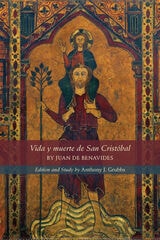
Vida y muerte de San Cristóbal
Juan de Benavides
Arizona Center for Medieval and Renaissance Studies, 2020
As the patron of travelers, Saint Christopher inspired one of the most popular cults in the medieval era, which spread across Europe and especially the Iberian Peninsula. Artistic renderings of the saint were found near the doors of most Spanish Gothic churches, and paratheatrical representations of Saint Christopher were also commonplace in religious processions. His conversion and martyrdom were often staged between the fifteenth and early eighteenth centuries.
In the theater, Juan de Benavides’s Vida y muerte de San Cristóbal is one of two known comedias dealing with the saint, but it was heavily censored after its premiere. The immense popularity of St. Christopher and other primitive saints first drew the attention of the Council of Trent in the mid-1500s, when the Catholic Church attempted to suppress the influence of the earlier saints due to their fantastical nature. The stories of these saints were censored, rewritten or even omitted in the post-Tridentine martyrologies. This publication is the first critical edition of the only extant copy of Benavides’s playscript. The circumstances surrounding Benavides’s play continue a dialogue about such important topics as censorship and the influence of the church over artistic production.
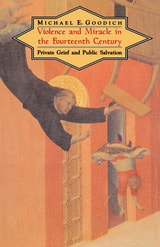
Violence and Miracle in the Fourteenth Century
Private Grief and Public SalvationMichael E. Goodich
University of Chicago Press, 1995
Rescue miracles offer a wide range of voices rarely heard in medieval history, from women and children to peasants and urban artisans. They tell of salvation not just from the ravages of nature and war, but from the vagaries of a violent society—crime, unfair judicial practices, domestic squabbles, and communal or factional conflict. The stories speak to a collapse of confidence in decaying institutions, from the law to the market to feudal authority. Particularly, the miraculous escapes documented during the Hundred Years' War, the Italian communal wars, and other conflicts are vivid testimony to the end of aristocratic warfare and the growing victimization of noncombatants.
Miracles, Goodich finds, represent the transcendent and unifying force of faith in a time of widespread distress and the hopeless conditions endured by the common people of the Middle Ages. Just as the lives of the saints, once dismissed as church propaganda, have become valuable to historians, so have rescue miracles, as evidence of an underlying medieval mentalite. This work expands our knowledge of that state of mind and the grim conditions that colored and shaped it.
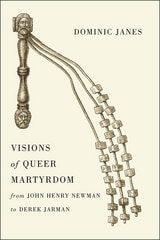
Visions of Queer Martyrdom from John Henry Newman to Derek Jarman
Dominic Janes
University of Chicago Press, 2015
Janes finds the beginnings of queer martyrdom in the nineteenth-century Church of England and the controversies over Cardinal John Henry Newman’s sexuality. He then considers how liturgical expression of queer desire in the Victorian Eucharist provided inspiration for artists looking to communicate their own feelings of sexual deviance. After looking at Victorian monasteries as queer families, he analyzes how the Biblical story of David and Jonathan could be used to create forms of same-sex partnerships. Finally, he delves into how artists and writers employed ecclesiastical material culture to further queer self-expression, concluding with studies of Oscar Wilde and Derek Jarman that illustrate both the limitations and ongoing significance of Christianity as an inspiration for expressions of homoerotic desire.
Providing historical context to help us reevaluate the current furor over homosexuality in the Church, this fascinating book brings to light the myriad ways that modern churches and openly gay men and women can learn from the wealth of each other’s cultural and spiritual experience.
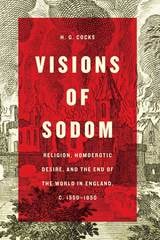
Visions of Sodom
Religion, Homoerotic Desire, and the End of the World in England, c. 1550-1850H. G. Cocks
University of Chicago Press, 2017
In Visions of Sodom, H. G. Cocks examines the many different ways in which the story of Sodom’s destruction provided a template for understanding homoerotic desire and behaviour in Britain between the Reformation and the nineteenth century. Sodom was not only a marker of sexual sins, but also the epitome of false—usually Catholic—religion, an exemplar of the iniquitous city, a foreshadowing of the world’s fiery end, an epitome of divine and earthly punishment, and an actual place that could be searched for and discovered. Visions of Sodom investigates each of these ways of reading Sodom’s annihilation in the three hundred years after the Reformation. The centrality of scripture to Protestant faith meant that Sodom’s demise provided a powerful origin myth of homoerotic desire and sexual excess, one that persisted across centuries, and retains an apocalyptic echo in the religious fundamentalism of our own time.
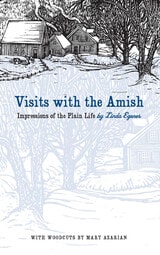
Visits with the Amish
Impressions of the Plain LifeLinda Egenes
University of Iowa Press, 2000
Who are the “plain people,” the men and women who till their fields with horse and plow, travel by horse and buggy, live without electricity and telephones, and practice “help thy neighbor” in daily life? Linda Egenes visited with her Old Order Amish neighbors in southeast Iowa for thirteen years before writing this informative and companionable introduction to their lifeways.
Drawn to their slower pace of life and their resistance to the lures of a consumer society, Egenes found a warm welcome among the Amish, and in return she has given us an equally warm perspective on Amish family life as she experienced it. The Amish value harmony in family life above all, and Egenes found an abundance of harmony as she savored homemade ice cream in a kitchen where the refrigerator ran on kerosene, learned to milk a two-bucket cow, helped cook dinner for nine in a summer kitchen, spent the day in a one-room schoolhouse, and sang “The Hymn of Praise” in its original German at Sunday service.
Whether quilting at a weekly sewing circle above the Stringtown Grocery, playing Dutch Blitz and Dare Base with schoolchildren, learning the intricacies of harness making, or mulching strawberries in a huge garden, Egenes was treated with the kindness, respect, and dignity that exemplify the strong community ties of the Amish. Her engaging account of her visits with the Amish, beautifully illustrated with woodcuts by Caldecott Medal winner Mary Azarian, reveals the serene and peaceful ways of a plain people whose lives are anything but plain.
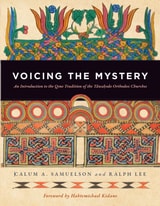
Voicing the Mystery
An Introduction to the Q?ne Tradition of the Täwa??do Orthodox ChurchesCalum A. Samuelson and Ralph Lee
Bridwell Press, 2026
This volume presents a new study of Qǝne, the extemporaneous sacred oral poetry of the Ethiopian and Eritrean Täwaḥǝdo churches. It discusses the technique of “Wax and Gold” used to compose Qǝne through which poets construct multilayered meaning using complex grammatical structures, polysemous vocabulary, and oblique allusions to texts and customs. The Introduction outlines the history of the Qǝne tradition, its liturgical function, and the challenges involved in understanding its multiple layers of meaning, and it provides a detailed account of the translation method developed for this study.
Aimed at both scholars of the Täwaḥǝdo tradition and a wider audience, this book exposes readers to an ancient poetic practice previously inaccessible without a comprehensive knowledge of Gǝʿǝz. The book introduces the new approach of Integrative Translation: each poem is presented through paired Plain and Poetic translations, enabling readers to perceive the branching meanings of the original Gǝʿǝz text and the diverse connections they evoke. A selection of fifteen qǝne poems is included, drawn from published collections compiled by notable traditional scholars of the churches, each featuring the Gǝʿǝz text and paired translations on facing pages.
Extensive annotations guide readers through the interpretive world in which Qǝne is composed, tracing the scriptural, liturgical, exegetical, hagiographical, and cultural sources that shape the tradition and illuminate the multiple meanings embedded in each poem. A Glossary also explains key terms and concepts. This is the first volume to make the Qǝne tradition accessible in English while preserving the distinctive multilayered character of the poetry.
Von Balthasar & the Option for the Poor
Theodramatics in the Light of Liberation TheologyTodd Walatka
Catholic University of America Press, 2017