Results by title
1882 books match the query 'Criticism and interpretation' and 23 start with v
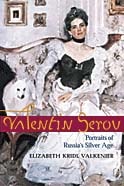
Valentin Serov
Portraits of Russia's Silver AgeElizabeth Valkenier
Northwestern University Press, 2001
Elizabeth Kridl Valkenier weds art criticism to social history in her study of Serov. She casts the artist's work against the Gilden Age of turn-of-the-century Russia, an era when money and consumption abounded and revolutionary change was taking place at all levels of society. Painting prominent people of the day in business, government, the nobility, and the arts, Serov created a gallery of Russia's important figures--figures seen with a sharp eye and painted with subtle irony.
Vampires, Mummies and Liberals
Bram Stoker and the Politics of Popular FictionDavid Glover
Duke University Press, 1996
Glover’s efforts reveal a writer who was more wide-ranging and politically engaged than his current reputation suggests. An Irish Protestant and nationalist, Stoker nonetheless drew his political inspiration from English liberalism at a time of impending crisis, and the tradition’s contradictions and uncertainties haunt his work. At the heart of Stoker’s writing Glover exposes a preoccupation with those sciences and pseudo-sciences—from physiognomy and phrenology to eugenics and sexology—that seemed to cast doubt on the liberal faith in progress. He argues that Dracula should be read as a text torn between the stances of the colonizer and the colonized, unable to accept or reject the racialized images of backwardness that dogged debates about Irish nationhood. As it tracks the phantasmatic form given to questions of character and individuality, race and production, sexuality and gender, across the body of Stoker’s writing, Vampires, Mummies, and Liberals draws a fascinating portrait of an extraordinary transitional figure.
Combining psychoanalysis and cultural theory with detailed historical research, this book will be of interest to scholars of Victorian and Irish fiction and to those concerned with cultural studies and popular culture.
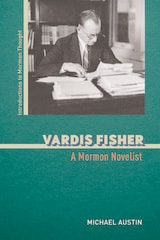
Vardis Fisher
A Mormon NovelistMichael Austin
University of Illinois Press, 2021
Engrossing and enlightening, Vardis Fisher illuminates the acclaimed author's impact on Mormon culture, American letters, and the literary tradition of the American West.
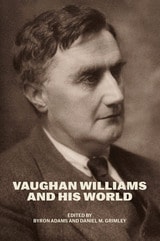
Vaughan Williams and His World
Edited by Byron Adams and Daniel M. Grimley
University of Chicago Press, 2023
Ralph Vaughan Williams (1872–1958) was one of the most innovative and creative figures in twentieth-century music, whose symphonies stand alongside those of Sibelius, Nielsen, Shostakovich, and Roussel. After his death, shifting priorities in the music world led to a period of critical neglect. What could not have been foreseen is that by the second decade of the twenty-first century, a handful of Vaughan Williams’s scores would attain immense popularity worldwide. Yet the present renown of these pieces has led to misapprehension about the nature of Vaughan Williams’s cultural nationalism and a distorted view of his international cultural and musical significance.
Vaughan Williams and His World traces the composer’s stylistic and aesthetic development in a broadly chronological fashion, reappraising Vaughan Williams’s music composed during and after the Second World War and affirming his status as an artist whose leftist political convictions pervaded his life and music. This volume reclaims Vaughan Williams’s deeply held progressive ethical and democratic convictions while celebrating his achievements as a composer.
Vermeer and the Invention of Seeing
Bryan Jay Wolf
University of Chicago Press, 2001
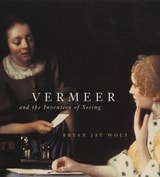
The result is a Vermeer we have not seen before: a painter whose serene spaces and calm subjects incorporate within themselves, however obliquely, the world's troubles. Vermeer abandons what his predecessors had labored so carefully to achieve: legible spaces, a world of moral clarity defined by the pressure of a hand against a table, or the scatter of light across a bare wall. Instead Vermeer complicated Dutch domestic art and invented what has puzzled and captivated his admirers ever since: the odd daubs of white pigment, scattered across the plane of the canvas; patches of blurred surface, contradicting the painting's illusionism without explanation; and the querulous silence that endows his women with secrets they dare not reveal.
This beautifully illustrated book situates Vermeer in relation to his predecessors and contemporaries, and it demonstrates how powerfully he wrestled with questions of gender, class, and representation. By rethinking Vermeer's achievement in relation to the early modern world that gave him birth, Wolf takes northern Renaissance and early modern studies in new directions.
Vernon Lee
Aesthetics, History, and the Victorian Female IntellectualChrista Zorn
Ohio University Press, 2003
The subject of renewed interest among literary and cultural scholars, Vernon Lee wrote more than forty books, in a broad range of genres, including fiction, history, aesthetics, and travel literature. Early on, Lee established her reputation as a public critic whose unconventional viewpoints stood out among those of her contemporaries.
To feminist and cultural critics, she is a fascinating model of the independent female intellectual who, as Desmond MacCarthy once put it, provides a rare combination of intellectual curiosity and imaginative sensibility.
A startlingly original critical study, Vernon Lee adds new dimensions to the legacy of this woman of letters whose career spans the transition from the late Victorian to the modernist period. Zorn draws on archival materials to discuss Lee’s work in terms of British aestheticism and in the context of the Western European history of ideas.
Zorn contends that Lee’s fiction and nonfiction represent a literary position that bridges and surpasses both the Victorian sage and the modernist aesthetic critic.
Through Professor Zorn’s approach, which combines theoretical framings of texts in terms of recent feminist and cultural criticism with passages of close reading, Vernon Lee emerges as an influential figure in late-nineteenth-century British and continental European thinking on history, art, culture, and gender.
Victor Arnautoff and the Politics of Art
Robert W. Cherny
University of Illinois Press, 2017
Victorian Lessons in Empathy and Difference
Rebecca N. Mitchell
The Ohio State University Press, 2011
Victorian Women Writers, Radical Grandmothers, and the Gendering of God
Gail Turley Houston
The Ohio State University Press, 2013
Victorian and Modern Poetics
Carol T. Christ
University of Chicago Press, 1984
Violence in the Films of Alfred Hitchcock
A Study in MimesisDavid Humbert
Michigan State University Press, 2017
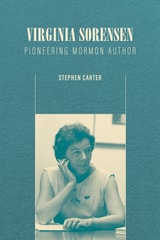
Virginia Sorensen
Pioneering Mormon AuthorStephen Carter
Signature Books, 2023
Who is Virginia Sorensen? How did a girl who grew up in a tiny Utah town in the 1920s become a globetrotting, award-winning author? And why has she been forgotten?
Though she wrote them four generations ago, Sorensen’s novels are more urgent today than ever, addressing issues both Mormons and former Mormons grapple with. Her body of work is a treasure trove of insight, compassion, and storytelling waiting to be rediscovered.

Virginia Woolf Icon
Brenda R. Silver
University of Chicago Press, 1999
From Virginia Woolf's 1937 appearance on the cover of Time magazine to her current roles in theater, film, and television, Silver traces the often contradictory representations and the responses they provoke, highlighting the recurring motifs that associate Virginia Woolf with fear. By looking more closely at who is afraid and the contexts in which she is perceived to be frightening, Silver illustrates how Virginia Woolf has become the site of conflicts about cultural boundaries and legitimacy that continue to rage today.
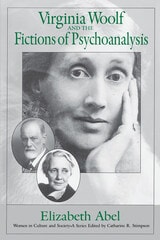
Virginia Woolf and the Fictions of Psychoanalysis
Elizabeth Abel
University of Chicago Press, 1989
"Virginia Woolf and the Fictions of Psychoanalysis brings Woolf's extraordinary craftsmanship back into view; the book combines powerful claims about sexual politics and intellectual history with the sort of meticulous, imaginative close reading that leaves us, simply, seeing much more in Woolf's words than we did before. It is the most exciting book on Woolf to come along in some time."—Lisa Ruddick, Modern Philology
Virginia Woolf’s Mythic Method
Amy C. Smith
The Ohio State University Press, 2022
Vision and Stagecraft in Sophocles
David Seale
University of Chicago Press, 1982
Visionary of the Word
Melville and ReligionEdited by Jonathan A. Cook and Brian Yothers
Northwestern University Press, 2017
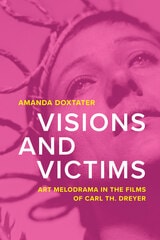
Visions and Victims
Art Melodrama in the Films of Carl Th. DreyerAmanda Doxtater
University of Wisconsin Press, 2024
Amanda Doxtater offers a necessary corrective to this narrative of his bifurcated career. Close readings of Dreyer’s Nordisk films alongside his mature work reveal a stylistic throughline Doxtater terms “art melodrama,” a form combining the ambiguity, stylization, and consciousness of art cinema with the heightened emotional expressivity and dramatic embodiments characteristic of melodrama. She argues that Dreyer’s major artistic concerns known from his later work—pathos, authenticity, the embodiment of psychological duress, and so on—find their first expression in his Nordisk melodramas, complicating our understanding not only of his later films but also of his early works, and even our understanding of the melodramatic mode in general. Indeed, extending well beyond the career of a singular director, this book challenges assumptions about the relationship between “low-brow” melodrama and “high-brow” art cinema.
Visions of Global America and the Future of Critical Reading
Daniel T. O’Hara
The Ohio State University Press, 2009
Vladimir Nabokov and the Art of Moral Acts
Dana Dragunoiu
Northwestern University Press, 2022
This book shows how ethics and aesthetics interact in the works of one of the most celebrated literary stylists of the twentieth century: the Russian American novelist Vladimir Nabokov. Dana Dragunoiu reads Nabokov’s fictional worlds as battlegrounds between an autonomous will and heteronomous passions, demonstrating Nabokov’s insistence that genuinely moral acts occur when the will triumphs over the passions by answering the call of duty.
Dragunoiu puts Nabokov’s novels into dialogue with the work of writers such as Alexander Pushkin, William Shakespeare, Leo Tolstoy, and Marcel Proust; with Kantian moral philosophy; with the institution of the modern duel of honor; and with the European traditions of chivalric literature that Nabokov studied as an undergraduate at Cambridge University. This configuration of literary influences and philosophical contexts allows Dragunoiu to advance an original and provocative argument about the formation, career, and legacies of an author who viewed moral activity as an art, and for whom artistic and moral acts served as testaments to the freedom of the will.

Vladimir Nabokov and the Poetics of Liberalism
Dana Dragunoiu
Northwestern University Press, 2011
Showing the particular influence of the thought of Kant and Berkeley, she focuses on what she calls Nabokov’s “most deceptively apolitical novels”: The Gift, Lolita, Pale Fire, and Ada. In bringing to them a more extensive context than previous Nabokov scholars, Dragunoiu argues that their treatment of various moral and political subjects can be more clearly understood in the light of ideas inherited by Nabokov from his father and his father’s generation.
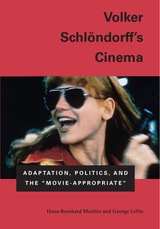
Volker Schlondorff's Cinema
Adaptation, Politics, and the "Movie-Appropriate"Hans-Bernhard Moeller and George Lellis
Southern Illinois University Press, 2002
Volker Schlöndorff’s Cinema: Adaptation, Politics and the “Movie-Appropriate”examines the work of major postwar Germandirector Volker Schlöndorff in historical, economic, and artistic contexts. Incorporating a film-by-film, twenty-eight chapter study, Hans-Bernhard Moeller & George Lellis reveal a complexity and formalambitiousness of Schlöndorff that is comparable to that found in Wenders, Herzog, andFassbinder. In spite of Schlöndorff’s successes with films like The Lost Honor ofKatharina Blum and The Tin Drum, as well as his acclaimed work in the U.S. with Death of a Salesman, Gathering of Old Men and The Handmaid’s Tale, this is the first in-depthcritical study of the filmmaker’s career.
In the context of film and television history, this book relates Schlöndorff’s oeuvre to the New German Cinema, to his formative years as a student and production assistant in France, and to his roots in the Weimar cinema’s tradition. It reveals how Schlöndorff entered into the German film production system in the 1960s, how he came to rely on German public television in the 1970s, and then moved to the international and American financing in the 1980s, attempting to redevelop the Babelsberg studios in a 1990s post-Wall Germany while continuing to make his own films into the 21st century. The book captures how Schlöndorff’s nearly half century of ongoing creativity and productivity ties together.
The authors analyze the artistry of each Schlöndorff movie arguing that his output as a whole embodies a provocative and sometimes contradictory set of balances. Schlöndorff combines commercial interest with significant artistic ambition, blends the kinesthetic pleasures of moving images with the seriousness of fine literature, links the intensity of individualized personal experience to an awareness of broader political issues, and represents a specifically German sensibility even as he reaches out to the international audiences.
The authors demonstrate the cyclical recurrence in his cinema of certain themes (individual and collective rebellion, fascist suppression, masochistic love), narrative patterns (the Western, the thriller, the subjective mood piece), and stylistic approaches (Brechtian Verfremdung, the creation of careful leitmotif structures, the use of the grotesque). In over thirty years of filmmaking, Schlöndorff has produced a remarkable unified body of work that deserves the attention of a book-length study. Authors Hans-Bernhard Moeller and George Lellis offer the first such study of its kind.
Volker Schlöndorff’s Cinema: Adaptation, Politics, and the “Movie-Appropriate” features forty-one illustrations.
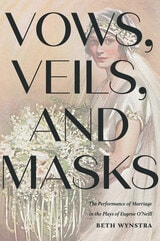
Vows, Veils, and Masks
The Performance of Marriage in the Plays of Eugene O'NeillBeth Wynstra
University of Iowa Press, 2023
Weaving in artifacts like advice columns, advertisements, theatrical reviews, and even the lived experiences of the actors who brought O’Neill’s wife characters to life, Beth Wynstra points to new ways of seeing and empathizing with those who are betrothed and new possibilities for reading marriage in literary and dramatic works. She suggests that the various ways women were, and still are, expected to divert from their true ambitions, desires, and selves in the service of appropriate wifely behavior is a detrimental performance and one at the crux of O’Neill’s marital tragedies. This book invites more inclusive and nuanced ways of thinking about the choices married characters must make and the roles they play, both on and off the stage.