Results by title
3369 books match the query 'Cultural & Social' and 40 start with v

Valuing Deaf Worlds in Urban India
Michele Friedner
Rutgers University Press, 2015
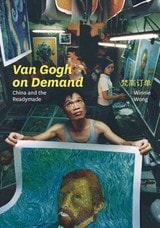
Van Gogh on Demand
China and the ReadymadeWinnie Won Yin Wong
University of Chicago Press, 2014

Vaqueros, Cowboys, and Buckaroos
By Lawrence Clayton, Jim Hoy, and Jerald Underwood
University of Texas Press, 2001
Herding cattle from horseback has been a tradition in northern Mexico and the American West since the Spanish colonial era. The first mounted herders were the Mexican vaqueros, expert horsemen who developed the skills to work cattle in the brush country and deserts of the Southwestern borderlands. From them, Texas cowboys learned the trade, evolving their own unique culture that spread across the Southwest and Great Plains. The buckaroos of the Great Basin west of the Rockies trace their origin to the vaqueros, with influence along the way from the cowboys, though they, too, have ways and customs distinctly their own.
In this book, three long-time students of the American West describe the history, working practices, and folk culture of vaqueros, cowboys, and buckaroos. They draw on historical records, contemporary interviews, and numerous photographs to show what makes each group of mounted herders distinctive in terms of working methods, gear, dress, customs, and speech. They also highlight the many common traits of all three groups.
This comparative look at vaqueros, cowboys, and buckaroos brings the mythical image of the American cowboy into focus and detail and honors the regional and national variations. It will be an essential resource for anyone who would know or portray the cowboy—readers, writers, songwriters, and actors among them.

Varieties of Muslim Experience
Encounters with Arab Political and Cultural LifeLawrence Rosen
University of Chicago Press, 2008
In Varieties of Muslim Experience, anthropologist Lawrence Rosen explores aspects of Arab Muslim life that are, at first glance, perplexing to Westerners. He ranges over such diverse topics as why Arabs eschew portraiture, why a Muslim scientist might be attracted to fundamentalism, and why the Prophet must be protected from blasphemous cartoons. What connects these seemingly disparate features of Arab social, political, and cultural life? Rosen argues that the common thread is the importance Arabs place on the negotiation of interpersonal relationships—a link that helps to explain actions as seemingly unfathomable as suicide bombing and as elusive as Quranic interpretation.
Written with eloquence and a deep knowledge of the entire spectrum of Muslim experience, Rosen’s book will interest not only anthropologists and Islamicists but anyone invested in better understanding the Arab world.
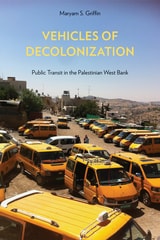
Vehicles of Decolonization
Public Transit in the Palestinian West BankMaryam S. Griffin
Temple University Press, 2022
Examining the border-enclosure strategy Israel uses to impose Palestinian im/mobilization, Maryam Griffin considers the ways public transportation in the Palestinian West Bank is a constant site of social struggle. Her illuminating book, Vehicles of Decolonization, studies collective movement, resistance, and everyday life in the West Bank to show how Palestinians assert a kind of Indigenous self-determination over mobility that Israeli settler colonialism seeks to undermine.
Having immersed herself in a year of fieldwork, Griffin maps multiple engagements with the flexible bus, shared van, and private taxi services to demonstrate that the politics of mobility are shaped by ongoing settler colonialism and Indigenous struggle. Griffin uses critical border studies to look at the contested nature of mobility at the sites of transit, where Palestinians practice self-determination through routine participation, spectacular political organizing and demonstration, and artistic renderings.
Featuring a variety of street images, Vehicles of Decolonization shows that multiple registers of people power work in concert not only to resist settler colonial logics but to reinhabit the land through the practice and preservation of alternative relations of mobility.
Veins of Devotion
Blood Donation and Religious Experience in North IndiaCopeman, Jacob
Rutgers University Press, 2008
Veins of Devotion details recent collaborations between guru-led devotional movements and public health campaigns to encourage voluntary blood donation in northern India. Focusing primarily on Delhi, Jacob Copeman carefully situates the practice within the context of religious gift-giving, sacrifice, caste, kinship, and nationalism. The book analyzes the operations of several high-profile religious orders that organize large-scale public blood-giving events and argues that blood donation has become a site not only of frenetic competition between different devotional movements, but also of intense spiritual creativity.
Despite tensions between blood banks and these religious groups, their collaboration is a remarkable success storyùthe nation's blood supply is replenished while blood donors discover new devotional possibilities.
Download open access ebook here.

Venda Children's Songs
A Study in Ethnomusicological AnalysisJohn Blacking
University of Chicago Press, 1995
Venda Children's Songs presents a detailed analysis of both the music and the cultural significance of children's songs among the Venda. Among its many original contributions is the identifying of the role of melody in generating rhythm, something that distinguishes this form of music from that of Venda adults as well as from other genres of African music in general.
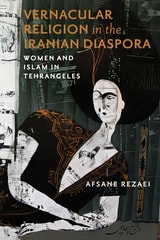
Vernacular Religion in the Iranian Diaspora
Women and Islam in TehrangelesAfsane Rezaei
University of Wisconsin Press, 2026
With nearly half a million Iranian Americans living in and around Los Angeles, Southern California is home to more Iranians than anywhere outside Iran itself. Although many community members identify as secular, stereotypes characterize Iranian Americans, like other populations from Muslim-majority countries, as pejoratively religious and culturally suspect. For Iranian American women who do practice Islam, navigating their religious, ethnic, and political identities, on both personal and communal levels, is complex and fraught, influenced not only by racialized discourses but also by intra-community narratives that equate Islamic practice with the authoritarian state in Iran.
Folklorist Afsane Rezaei applies theories of vernacular religion to explore how these women shape their religious identities in this particularly delicate diasporic context, how they engage with external imaginaries in their practices and narratives, and how they develop a sense of agency over their religious identification. For many, Islamic religiosity in the diaspora is an integrated and embodied aspect of folklife, closely tied to the sense of self, social networks, and communal identity, and is negotiated and reimagined in everyday, improvised, and sometimes contradictory ways. Rezaei’s detailed, respectful ethnography reaches beyond the binary of piety and resistance and offers new and nuanced understandings of Iranian American lived religion.
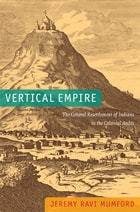
Vertical Empire
The General Resettlement of Indians in the Colonial AndesJeremy Ravi Mumford
Duke University Press, 2012
Viapolitics
Borders, Migration, and the Power of LocomotionWilliam Walters, Charles Heller, and Lorenzo Pezzani, editors
Duke University Press, 2021
Contributors. Ethan Blue, Maribel Casas-Cortes, Julie Y. Chu, Sebastian Cobarrubias, Glenda Garelli, Charles Heller, Sabine Hess, Bernd Kasparek, Clara Lecadet, Johan Lindquist, Renisa Mawani, Lorenzo Pezzani, Ranabir Samaddar, Amaha Senu, Martina Tazzioli, William Walters

Vicious Games
Capitalism and GamblingRebecca Cassidy
Pluto Press, 2020
Vicious Games is based on field research with the people who produce, shape and consume gambling. Rebecca Cassidy explores the gambling industry's affinity with capitalism and the free market and how the UK has led the way in exporting 'light touch' regulation and 'responsible gambling' around the world. She reveals how the industry extracts wealth from some of our poorest communities, and examines the adverse health effects on those battling gambling addiction.
The gambling industry has become increasingly profitable and influential, emboldened by thirty years of supportive government policies and boosted by unnatural profits. Through an anthropological excavation, Vicious Games opens up this process, with the intention of creating alternative, more equitable futures.

Victims and Warriors
Violence, History, and Memory in AmazoniaCasey High
University of Illinois Press, 2015
Victims and Warriors examines contemporary violence in the context of political and economic processes that transcend local events. Casey High explores how popular imagery of Amazonian violence has become part of Waorani social memory in oral histories, folklore performances, and indigenous political activism. As Amazonian forms of social memory merge with constructions of masculinity and other intercultural processes, the Waorani absorb missionaries, oil development, and logging depredations into their legacy of revenge killings and narratives of victimhood. High shows that these memories of past violence form sites of negotiation and cultural innovation, and thus violence comes to constitute a central part of Amazonian sociality, identity, and memory.
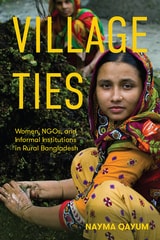
Village Ties
Women, NGOs, and Informal Institutions in Rural BangladeshNayma Qayum
Rutgers University Press, 2022

Village and Family in Contemporary China
William L. Parish and Martin King Whyte
University of Chicago Press, 1978

Vinegar Pie and Chicken Bread
A Woman's Diary of Life in the Rural South, 1890–1891Margeret Bolsterli
University of Arkansas Press, 1982

Violence and Activism at the Border
Gender, Fear, and Everyday Life in Ciudad JuarezBy Kathleen Staudt
University of Texas Press, 2008
Between 1993 and 2003, more than 370 girls and women were murdered and their often-mutilated bodies dumped outside Ciudad Juárez in Chihuahua, Mexico. The murders have continued at a rate of approximately thirty per year, yet law enforcement officials have made no breakthroughs in finding the perpetrator(s). Drawing on in-depth surveys, workshops, and interviews of Juárez women and border activists, Violence and Activism at the Border provides crucial links between these disturbing crimes and a broader history of violence against women in Mexico. In addition, the ways in which local feminist activists used the Juárez murders to create international publicity and expose police impunity provides a unique case study of social movements in the borderlands, especially as statistics reveal that the rates of femicide in Juárez are actually similar to other regions of Mexico.
Also examining how non-governmental organizations have responded in the face of Mexican law enforcement's "normalization" of domestic violence, Staudt's study is a landmark development in the realm of global human rights.
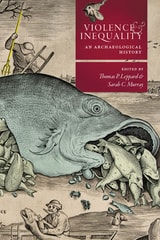
Violence and Inequality
An Archaeological HistoryThomas P. Leppard
University Press of Colorado, 2023
The assumption that violence and its threat buttressed elite social control is now challenged from various perspectives. This volume incorporates new models of the relationship between violence and social inequalities into the archaeology of social complexity, building more complicated and nuanced understandings of how different modes of social violence can militate different types of social constitution. Contributions from a variety of methodological angles—such as the bioarchaeology of health and trauma and radiogenic isotope studies and the aesthetics of violence—use a comparative perspective, drawing on data from the Southwestern US, Bronze Age China, early dynastic Egypt, ancient Mesopotamia, Roman Britain, and the Andes.
Violence and Inequality offers an original and deep history of violence and inequality. Understanding the long-term intersection of violence and inequality and how they support or erode one another is of intrinsic importance, making this work significant to the study of archaeology, economic history, and collective action.

Violence in a Time of Liberation
Murder and Ethnicity at a South African Gold Mine, 1994Donald L. Donham
Duke University Press, 2011

Violence, the Sacred, and Things Hidden
A Discussion with René Girard at Esprit (1973)René Girard
Michigan State University Press, 2022
Violent Democracies in Latin America
Enrique Desmond Arias and Daniel M. Goldstein, eds.
Duke University Press, 2010
The contributors—anthropologists, political scientists, sociologists, and historians—explore how individuals and institutions in Latin American democracies, from the rural regions of Colombia and the Dominican Republic to the urban centers of Brazil and Mexico, use violence to impose and contest notions of order, rights, citizenship, and justice. They describe the lived realities of citizens and reveal the historical foundations of the violence that Latin America suffers today. One contributor examines the tightly woven relationship between violent individuals and state officials in Colombia, while another contextualizes violence in Rio de Janeiro within the transnational political economy of drug trafficking. By advancing the discussion of democratic Latin American regimes beyond the usual binary of success and failure, this collection suggests more sophisticated ways of understanding the challenges posed by violence, and of developing new frameworks for guaranteeing human rights in Latin America.
Contributors: Enrique Desmond Arias, Javier Auyero, Lilian Bobea, Diane E. Davis, Robert Gay, Daniel M. Goldstein, Mary Roldán, Todd Landman, Ruth Stanley, María Clemencia Ramírez

Violent Intimacies
The Trans Everyday and the Making of an Urban WorldAsli Zengin
Duke University Press, 2024
Violent Utopia
Dispossession and Black Restoration in TulsaJovan Scott Lewis
Duke University Press, 2022
Viral Economies
Bird Flu Experiments in VietnamNatalie Porter
University of Chicago Press, 2019
In Viral Economies, Natalie Porter draws from long-term research on bird flu in Vietnam to chart the pathways of scientists, NGO workers, state veterinarians, and poultry farmers as they define and address pandemic risks. Porter argues that as global health programs expand their purview to include life and livestock, they weigh the interests of public health against those of commercial agriculture, rural tradition, and scientific innovation. Porter challenges human-centered analyses of pandemics and shows how dynamic and often dangerous human-animal relations take on global significance as poultry and their pathogens travel through global livestock economies and transnational health networks. Viral Economies urges readers to think critically about the ideas, relationships, and practices that produce our everyday commodities, and that shape how we determine the value of life—both human and nonhuman.
Viral Frictions
Global Health and the Persistence of HIV Stigma in KenyaElizabeth J. Pfeiffer
Rutgers University Press, 2022
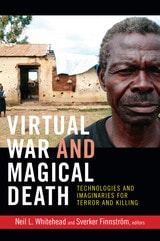
Virtual War and Magical Death
Technologies and Imaginaries for Terror and KillingNeil L. Whitehead and Sverker Finnström, eds.
Duke University Press, 2013
Another significant focus of the collection is the U.S. military's exploitation of ethnographic research, particularly through its controversial Human Terrain Systems (HTS) Program, which embeds anthropologists as cultural experts in military units. Several pieces address the ethical dilemmas that HTS and other counterinsurgency projects pose for anthropologists. Other essays reveal the relatively small scale of those programs in relation to the military's broader use of, and ambitions for, social scientific data.
Contributors. Robertson Allen, Brian Ferguson, Sverker Finnström, Roberto J. González, David H. Price, Antonius Robben, Victoria Sanford, Jeffrey Sluka, Koen Stroeken, Matthew Sumera, Neil L. Whitehead
Virulent Zones
Animal Disease and Global Health at China's Pandemic EpicenterLyle Fearnley
Duke University Press, 2020
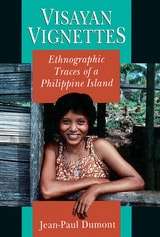
Visayan Vignettes
Ethnographic Traces of a Philippine IslandJean-Paul Dumont
University of Chicago Press, 1992
"This book is an interestingly complex ethnography that approaches the self-critical dialectical ethnography called for two decades ago....It is a welcome contribution to postmodernist theory and to the ethnography of the Visayas."—Ronald Provencher, Journal of Asian Studies
Visions of Transformation
Hegemony, Plurinationality, and Revolution in BoliviaAaron Augsburger
University of Arizona Press, 2025
On a wave of revolutionary upheaval in the early twenty-first century, Evo Morales was swept into state power as Bolivia’s first Indigenous president with a mandate to radically transform the country. The ensuing period, known simply as “el proceso de cambio” (the process of change), has been a tension-filled and contradictory process involving progressive transformations, ambiguous continuities, and outright revolutionary failures. Importantly, the contradictions have been just as much ideological as they are material.
By examining and illuminating the contrasting logics underlying opposing theories of revolutionary change, Visions of Transformation provides an analytical framework through which to understand and interpret the central conflicts and contradictions of Bolivia under Evo Morales and the Movimiento al Socialismo.
Based on nearly two years of immersive fieldwork, Visions of Transformation explores the relation between theoretical production and political practice. Through the contrasting perspectives of hegemony and plurinationality, the book analyzes three specific conjunctural moments—a proposed highway through the TIPNIS, a conflict over representation of the highland Indigenous movement organization CONAMAQ, and the struggle for Indigenous autonomy—to shed light on the primary economic, social, political, and theoretical tensions at the heart of Bolivia’s proceso de cambio.

Visions of the East
Orientalism in FilmBernstein, Matthew
Rutgers University Press, 1997
The Sheik. Pépé le Moko. Casablanca. Aladdin. Some of the most popular and frequently discussed titles in movie history are imbued with orientalism, the politically-charged way in which western artists have represented gender, race, and ethnicity in the cultures of North Africa and Asia. This is the first anthology to address and highlight orientalism in film from pre-cinema fascinations with Egyptian culture through the "Whole New World" of Aladdin. Eleven illuminating and well-illustrated essays utilize the insights of interdisciplinary cultural studies, psychoanalysis, feminism, and genre criticism. Other films discussed includeThe Letter, Caesar and Cleopatra, Lawrence of Arabia, Indochine, and several films of France's cinéma colonial.

Visual Cultures
Edited by James Elkins
Intellect Books, 2010
Visual Cultures is the first study of the place of visuality and literacy in specific nations around the world, featuring authoritative, insightful essays on the value accorded to the visual and the verbal in Japan, Poland, China, Russia, Ireland, and Slovenia.
Focusing on the national instead of the global, distinguished art critic James Elkins offers a critique of general histories of visuality, such as those of Martin Jay or Jean Baudrillard, as well as a critique of local histories of visuality, as in Third Text and other postcolonial studies. The content is not only analytic, but also historical, tracing changes in the significance of visual and verbal literacy in each nation. Visual Cultures also explores questions of national identity and the many issues Elkins raises suggest a wealth of promising avenues for future research.

Visual Encounters in the Study of Rural Childhoods
Mandrona, April R.
Rutgers University Press, 2018
Visualising Facebook
A Comparative PerspectiveDaniel Miller and Jolynna Sinanan
University College London, 2017
Visualizing Secularism and Religion
Egypt, Lebanon, Turkey, IndiaAlev Cinar, Srirupa Roy and Maha Yahya, Editors
University of Michigan Press, 2012
Over the past two decades secular polities across the globe have witnessed an increasing turn to religion-based political movements, such as the rise of political Islam and Hindu nationalism, which have been fueling new and alternative notions of nationhood and national ideologies. The rise of such movements has initiated widespread debates over the meaning, efficacy, and normative worth of secularism. Visualizing Secularism and Religion examines the constitutive role of religion in the formation of secular-national public spheres in the Middle East and South Asia, arguing that in order to establish secularism as the dominant national ideology of countries such as Turkey, Lebanon, and India, the discourses, practices, and institutions of secular nation-building include rather than exclude religion as a presence within the public sphere. The contributors examine three fields---urban space and architecture, media, and public rituals such as parades, processions, and commemorative festivals---with a view to exploring how the relation between secularism, religion, and nationalism is displayed and performed. This approach demands a reconceptualization of secularism as an array of contextually specific practices, ideologies, subjectivities, and "performances" rather than as simply an abstract legal bundle of rights and policies.
Vital Decomposition
Soil Practitioners and Life PoliticsKristina M. Lyons
Duke University Press, 2020
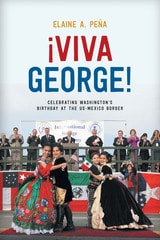
Viva George!
Celebrating Washington's Birthday at the US-Mexico BorderBy Elaine A. Peña
University of Texas Press, 2020
For 120 years, residents of the cross-border community of Laredo/Nuevo Laredo have celebrated George Washington's birthday together, and this account reveals the essential political work of a time-honored civic tradition.
Since 1898, residents of Laredo, Texas, and Nuevo Laredo, Tamaulipas, have reached across the US-Mexico border to celebrate George Washington's birthday. The celebration can last a whole month, with parade goers reveling in American and Mexican symbols; George Washington saluting; and “Pocahontas” riding on horseback. An international bridge ceremony, the heart and soul of the festivities, features children from both sides of the border marching toward each other to link the cities with an embrace. ¡Viva George! offers an ethnography and a history of this celebration, which emerges as both symbol and substance of cross-border community life. Anthropologist and Laredo native Elaine A. Peña shows how generations of border officials, civil society organizers, and everyday people have used the bridge ritual to protect shared economic and security interests as well as negotiate tensions amid natural disasters, drug-war violence, and immigration debates. Drawing on previously unknown sources and extensive fieldwork, Peña finds that border enactments like Washington's birthday are more than goodwill gestures. From the Rio Grande to the 38th Parallel, they do the meaningful political work that partisan polemics cannot.
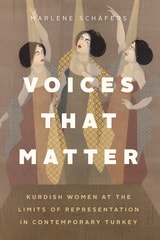
Voices That Matter
Kurdish Women at the Limits of Representation in Contemporary TurkeyMarlene Schäfers
University of Chicago Press, 2023
A fine-grained ethnography exploring the sociopolitical power of Kurdish women’s voices in contemporary Turkey.
“Raise your voice!” and “Speak up!” are familiar refrains that assume, all too easily, that gaining voice will lead to empowerment, healing, and inclusion for marginalized subjects. Marlene Schäfers’s Voices That Matter reveals where such assumptions fall short, demonstrating that “raising one’s voice” is no straightforward path to emancipation but fraught with anxieties, dilemmas, and contradictions. In its attention to the voice as form, this book examines not only what voices say but also how they do so, focusing on Kurdish contexts where oral genres have a long, rich legacy. Examining the social labor that voices carry out as they sound, speak, and resonate, Schäfers shows that where new vocal practices arise, they produce new selves and practices of social relations. In Turkey, recent decades have seen Kurdish voices gain increasing moral and political value as metaphors of representation and resistance. Women’s voices, in particular, are understood as potent means to withstand patriarchal restrictions and political oppression. By ethnographically tracing the transformations in how Kurdish women relate to and employ their voices as a result of these shifts, Schäfers illustrates how contemporary politics foster not only new hopes and desires but also create novel vulnerabilities as they valorize, elicit, and discipline voice in the name of empowerment and liberation.
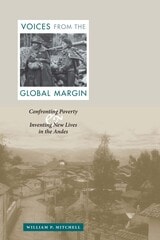
Voices from the Global Margin
Confronting Poverty and Inventing New Lives in the AndesBy William P. Mitchell
University of Texas Press, 2006
2007 — LASA Peru Flora Tristán Book Prize from the Peru Section – Latin American Studies Association
Voices from the Global Margin looks behind the generalities of debates about globalization to explore the personal impact of global forces on the Peruvian poor. In this highly readable ethnography, William Mitchell draws on the narratives of people he has known for forty years, offering deep insight into how they have coped with extreme poverty and rapid population growth—and their creation of new lives and customs in the process. In their own passionate words they describe their struggles to make ends meet, many abandoning rural homes for marginal wages in Lima and the United States. They chronicle their terror during the Shining Path guerrilla war and the government's violent military response. Mitchell's long experience as an anthropologist living with the people he writes about allows him to put the stories in context, helping readers understand the impact of the larger world on individuals and their communities. His book reckons up the human costs of the global economy, urging us to work toward a more just world.
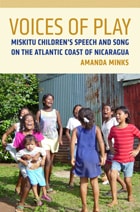
Voices of Play
Miskitu Children's Speech and Song on the Atlantic Coast of NicaraguaAmanda Minks
University of Arizona Press, 2013
Corn Island is historically home to Afro-Caribbean Creole people, but increasing numbers of Miskitu people began moving there from the mainland during the Contra War, and many Spanish-speaking mestizos from western Nicaragua have also settled there. Miskitu kids on Corn Island often gain some competence speaking Miskitu, Spanish, and Kriol English. As the children of migrants and the first generation of their families to grow up with television, they develop creative forms of expression that combine languages and genres, shaping intercultural senses of belonging.
Voices of Play is the first ethnography to focus on the interaction between music and language in children’s discourse. Minks skillfully weaves together Latin American, North American, and European theories of culture and communication, creating a transdisciplinary dialogue that moves across intellectual geographies. Her analysis shows how music and language involve a wide range of communicative resources that create new forms of belonging and enable dialogue across differences. Miskitu children’s voices reveal the intertwining of speech and song, the emergence of “self” and “other,” and the centrality of aesthetics to social struggle.

Voluminous States
Sovereignty, Materiality, and the Territorial ImaginationFranck Billé
Duke University Press, 2020
Contributors. Debbora Battaglia, Franck Billé, Wayne Chambliss, Jason Cons, Hilary Cunningham (Scharper), Klaus Dodds, Elizabeth Cullen Dunn, Gastón Gordillo, Sarah Green, Tina Harris, Caroline Humphrey, Marcel LaFlamme, Lisa Sang Mi Min, Aihwa Ong, Clancy Wilmott, Jerry Zee
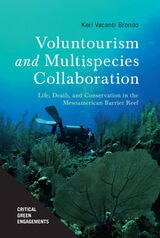
Voluntourism and Multispecies Collaboration
Life, Death, and Conservation in the Mesoamerican Barrier ReefKeri Vacanti Brondo
University of Arizona Press, 2021
Winner of the 2022 Edward M. Bruner Book Award
Voluntourism and Multispecies Collaboration is a lively ethnographic exploration of the world of conservation voluntourism and its engagement with marine and terrestrial biodiversity on the Honduran Bay Island of Utila, located in the ecologically critical Mesoamerican Barrier Reef.
In this highly readable text, anthropologist Keri Vacanti Brondo provides a pioneering theoretical framework that conceptualizes conservation voluntourism as a green industry. Brondo argues that the volunteer tourism industry is the product of coloniality and capitalism that works to produce and sustain an economy of affect while generating inequalities and dispossession. Employing a decolonizing methodology based on landscape assemblage theory, Brondo offers “thinking-like-a-mangrove” to attend to alternative worldings in Utila beyond the hegemonic tourist spectacle–dominated world attached to the volunteer tourism industry. Readers journey through the mangroves and waters alongside voluntourists, iguanas, whale sharks, turtles, lionfish, and islanders to build valuable research experience in environmental management while engaging in affective labor and multispecies relations of care.
Conservation organizations benefit from the financial capital and labor associated with conservation tourism, an industry boosted by social media. This critical work asks us to consider the impacts of this new alternative tourism market, one that relies on the exchange of “affect” with other species. How are human socialities made through interactions with other species? What lives and dies in Utila’s affect economy? Why are some species killable? Who gets to decide?