Results by title
71 books match the query 'Digital' and 7 start with v
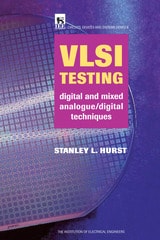
VLSI Testing
Digital and mixed analogue/digital techniquesStanley L. Hurst
The Institution of Engineering and Technology, 1998
The importance of testing integrated circuits (ICs) has escalated with the increasing complexity of circuits fabricated on a single IC chip. No longer is it possible to design a new IC and then think about testing: such considerations must be part of the initial design activity, and testing strategies should be part of every circuit and system designer's education. This book is a comprehensive introduction and reference for all aspects of IC testing. It includes all of the basic concepts and theories necessary for advanced students, from practical test strategies and industrial practice, to the economic and managerial aspects of testing. In addition to detailed coverage of digital network testing, VLSI testing also considers in depth the growing area of testing analogue and mixed analogue/digital ICs, used particularly in signal processing.
[more]
Video Game Art Reader
Volume 1Tiffany Funk
Amherst College Press, 2017
The inaugural issue of VGAR celebrates video game culture as inclusive and global. Opening with an interview with the art director of the first independent Cuban video game, Savior, while the following essays from art historians, literary theorists, game designers, artists, educators, museum curators, and programmers all engage with video games as an important part of the global art landscape. Each engages with what makes good game art with special attention to the transnational cadre of gamers that play them.
Contributions by Jesse de Vos, Jacob Euteneuer, Monica Evans, Tiffany Funk, René Glas, Eddie Lohmeyer, Evan Meaney, Kieran Nolan, Josuhe Pagliery, Sercan Şengün, Teresa Silva, Christopher W. Totten, and Jasper van Vught.
Contributions by Jesse de Vos, Jacob Euteneuer, Monica Evans, Tiffany Funk, René Glas, Eddie Lohmeyer, Evan Meaney, Kieran Nolan, Josuhe Pagliery, Sercan Şengün, Teresa Silva, Christopher W. Totten, and Jasper van Vught.
[more]
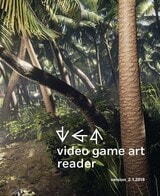
Video Game Art Reader
Volume 2Tiffany Funk
Amherst College Press, 2018
This volume of VGAR critically analyzes video game art as a means of survival. Though “survival strategy” exists as a defined gaming genre, all video games—as unique, participatory artworks—model both individual and collaborative means of survival through play. Video games offer opportunities to navigate both historical and fictional conflicts, traverse landscapes devastated by climate change or nuclear holocaust, and manage the limited resources of individuals or even whole civilizations on earth and beyond. They offer players a dizzying array of dystopian scenarios in which to build and invent, cooperate with others (through other players, NPCs, or AI) to survive another day. Contributors show how video games focus attention, hone visuospatial skills, and shape cognitive control and physical reflexes and thus have the power to participate in the larger context of radical, activist artworks that challenge destructive hegemonic structures as methods of human conditioning, coping, and creating.
Contributions by Anna Anthropy , Andrew Bailey, Michael Anthony DeAnda, Luisa Salvador Dias, Tiffany Funk, Elizabeth LaPensée, Treva Michelle Legassie, Michael Paramo, and Martin Zeilinger.
Contributions by Anna Anthropy , Andrew Bailey, Michael Anthony DeAnda, Luisa Salvador Dias, Tiffany Funk, Elizabeth LaPensée, Treva Michelle Legassie, Michael Paramo, and Martin Zeilinger.
[more]
Video Game Art Reader
Volume 3Tiffany Funk
Amherst College Press, 2019
This special edition of the VGA Reader, guest-edited by Christopher W. Totten and Enrica Lovaglio Costello, focuses on the connections between video games and architectural design. Each of the essays in this volume engages in critical investigations that reveal how game spaces evoke meaning, enhance game narratives, and explore unconventional themes.
Contributions by Christopher Barney, Enrica Lovaglio Costello, Ross De Vito, Chanelle Mosquera, Zack Ragozzino, Gabriella Santiago, Bobby Schweizer, Christopher W. Totten, Dr. Zöe J. Wood, and Robert Yang.
Contributions by Christopher Barney, Enrica Lovaglio Costello, Ross De Vito, Chanelle Mosquera, Zack Ragozzino, Gabriella Santiago, Bobby Schweizer, Christopher W. Totten, Dr. Zöe J. Wood, and Robert Yang.
[more]
Video Game Art Reader
Volume 4Tiffany Funk
Amherst College Press, 2022
In computing, overclocking refers to the common practice of increasing the clock rate of a computer to exceed that certified by the manufacturer. The concept is seductive but overclocking may destroy your motherboard or system memory, even irreparably corrupt the hard drive. Volume 4 of the Video Game Art Reader (VGAR) proposes overclocking as a metaphor for how games are produced and experienced today, and the temporal compressions and expansions of the many historical lineages that have shaped game art and culture. Contributors reflect on the many ways in which overclocking can be read as a means of oppression but also a strategy to raise awareness of how inequities have shaped video games.
Contributions by Uche Anomnachi, Andrew Bailey, Chaz Evans, Tiffany Funk, D’An Knowles Ball, Alexandre Paquet, Chris Reeves, and Regina Siewald.
Contributions by Uche Anomnachi, Andrew Bailey, Chaz Evans, Tiffany Funk, D’An Knowles Ball, Alexandre Paquet, Chris Reeves, and Regina Siewald.
[more]
Video Game Art Reader
Volume 5: The Game Art Curators KitTiffany Funk
Amherst College Press, 2024
Many ambitious and experimental game forms don't fit into the digital download or retail distribution channels that support so-called “traditional” video games. Instead, these games are supported by a new global movement in video game curation. This special edition of the Video Game Art Reader features an international collaboration of video game professionals working together to create a resource for game exhibition organization, design, and curation. Professionals, artists, and others who organize and curate video game exhibitions and events act within a rhizomatic network of methods, missions, and goals. They establish organizations like galleries, collectives, and non-profits. Methods of sharing video games as critical cultural phenomena continue to evolve and expand. Conceived during the first meeting of GAIA (Game Arts International Assembly), the Game Art Curators Kit documents and shares the collective experience of an international network of video game curators and organizers. Sharing practical tips on everything from accessibility to preservation, the book also serves as a guide to support a new global movement in video game curation.
[more]
Virtual Memory
Time-Based Art and the Dream of DigitalityHomay King
Duke University Press, 2015
In Virtual Memory, Homay King traces the concept of the virtual through the philosophical works of Henri Bergson, Gilles Deleuze, and Giorgio Agamben to offer a new framework for thinking about film, video, and time-based contemporary art. Detaching the virtual from its contemporary associations with digitality, technology, simulation, and speed, King shows that using its original meaning—which denotes a potential on the cusp of becoming—provides the means to reveal the "analog" elements in contemporary digital art. Through a queer reading of the life and work of mathematician Alan Turing, and analyses of artists who use digital technologies such as Christian Marclay, Agnès Varda, and Victor Burgin, King destabilizes the analog/digital binary. By treating the virtual as the expression of powers of potential and change and of historical contingency, King explains how these artists transcend distinctions between disembodiment and materiality, abstraction and tangibility, and the unworldly and the earth-bound. In so doing, she shows how their art speaks to durational and limit-bound experience more than contemporary understandings of the virtual and digital would suggest.
[more]