728 books match the query 'Economic aspects' and 5 start with v

cover of Value Wars: The Global Market Versus the Life Economy

Value Wars

The Global Market Versus the Life Economy

John McMurtry

Pluto Press, 2002

[more]
cover of Valuing Health for Policy: An Economic Approach

Valuing Health for Policy

An Economic Approach

Edited by George Tolley, Donald Kenkel, and Robert Fabian

University of Chicago Press, 1994
How much should citizens invest in promoting health, and how should resources be allocated to cover the costs? A major contribution to economic approaches to the value of health, this volume brings together classic and up-to-date research by economists and public health experts on theories and measurements of health values, providing useful information for shaping public policy.
[more]
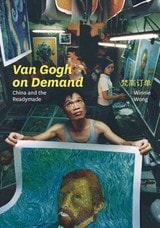
cover of Van Gogh on Demand: China and the Readymade

Van Gogh on Demand

China and the Readymade

Winnie Won Yin Wong

University of Chicago Press, 2014
In a manufacturing metropolis in south China lies Dafen, an urban village that famously houses thousands of workers who paint van Goghs, Da Vincis, Warhols, and other Western masterpieces for the world market, producing an astonishing five million paintings a year. To write about work and life in Dafen, Winnie Wong infiltrated this world, first investigating the work of conceptual artists who made projects there; then working as a dealer; apprenticing as a painter; surveying wholesalers and retailers in Europe, East Asia and North America; establishing relationships with local leaders; and organizing a conceptual art exhibition for the Shanghai World Expo. The result is Van Gogh on Demand, a fascinating book about a little-known aspect of the global art world—one that sheds surprising light on the workings of art, artists, and individual genius.
 
Confronting big questions about the definition of art, the ownership of an image, and the meaning of originality and imitation, Wong describes an art world in which idealistic migrant workers, lofty propaganda makers, savvy dealers, and international artists make up a global supply chain of art and creativity. She examines how Berlin-based conceptual artist Christian Jankowski, who collaborated with Dafen’s painters to reimagine the Dafen Art Museum, unwittingly appropriated the work of a Hong Kong-based photographer Michael Wolf. She recounts how Liu Ding, a Beijing-based conceptual artist, asked Dafen “assembly-line” painters to perform at the Guangzhou Triennial, neatly styling himself into a Dafen boss. Taking the Shenzhen-based photojournalist Yu Haibo’s award-winning photograph from the Amsterdam's World Press Photo organization, she finds and meets the Dafen painter pictured in it and traces his paintings back to an unlikely place in Amsterdam. Through such cases, Wong shows how Dafen’s painters force us to reexamine our preconceptions about creativity, and the role of Chinese workers in redefining global art.
 
Providing a valuable account of art practices in an ascendant China, Van Gogh on Demand is a rich and detailed look at the implications of a world that can offer countless copies of everything that has ever been called “art.”
[more]
cover of Virtual Migration: The Programming of Globalization

Virtual Migration

The Programming of Globalization

A. Aneesh

Duke University Press, 2006

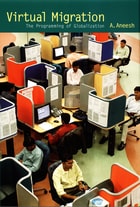
Workers in India program software applications, transcribe medical dictation online, chase credit card debtors, and sell mobile phones, diet pills, and mortgages for companies based in other countries around the world. While their skills and labor migrate abroad, these workers remain Indian citizens, living and working in India. A. Aneesh calls this phenomenon “virtual migration,” and in this groundbreaking study he examines the emerging “transnational virtual space” where labor and vast quantities of code and data cross national boundaries, but the workers themselves do not. Through an analysis of the work of computer programmers in India working for the American software industry, Aneesh argues that the programming code connecting globally dispersed workers through data servers and computer screens is the key organizing structure behind the growing phenomenon of virtual migration. This “rule of code,” he contends, is a crucial and underexplored aspect of globalization.

Aneesh draws on the sociology of science, social theory, and research on migration to illuminate the practical and theoretical ramifications of virtual migration. He combines these insights with his extensive ethnographic research in offices in three locations in India—in Delhi, Gurgaon, and Noida—and one in New Jersey. Aneesh contrasts virtual migration with “body shopping,” the more familiar practice of physically bringing programmers from other countries to work on site, in this case, bringing them from India to New Jersey. A significant contribution to the social theory of globalization, Virtual Migration maps the expanding transnational space where globalization is enacted via computer programming code.

[more]
cover of Vital Enemies: Slavery, Predation, and the Amerindian Political Economy of Life

Vital Enemies

Slavery, Predation, and the Amerindian Political Economy of Life

By Fernando Santos-Granero

University of Texas Press, 2009

Analyzing slavery and other forms of servitude in six non-state indigenous societies of tropical America at the time of European contact, Vital Enemies offers a fascinating new approach to the study of slavery based on the notion of "political economy of life." Fernando Santos-Granero draws on the earliest available historical sources to provide novel information on Amerindian regimes of servitude, sociologies of submission, and ideologies of capture.

Estimating that captive slaves represented up to 20 percent of the total population and up to 40 percent when combined with other forms of servitude, Santos-Granero argues that native forms of servitude fulfill the modern understandings of slavery, though Amerindian contexts provide crucial distinctions with slavery as it developed in the American South. The Amerindian understanding of life forces as being finite, scarce, unequally distributed, and in constant circulation yields a concept of all living beings as competing for vital energy. The capture of human beings is an extreme manifestation of this understanding, but it marks an important element in the ways Amerindian "captive slavery" was misconstrued by European conquistadors.

Illuminating a cultural facet that has been widely overlooked or miscast for centuries, Vital Enemies makes possible new dialogues regarding hierarchies in the field of native studies, as well as a provocative re-framing of pre- and post-contact America.

[more]
