Results by title
1038 books match the query 'Economic conditions' and 5 start with v

Viet Nam Expose
French Scholarship on Twentieth-Century Vietnamese SocietyGisele Bousquet and Pierre Brocheux, Editors
University of Michigan Press, 2002
The book is divided into three parts. Part I, "Vietnamese Society in the Early Twentieth Century," takes a micro approach to the study of Vietnamese society on the eve of the irreversible social transformation that occurred as the colonial infrastructure took root in Indochina. Part II, "Vietnamese Intellectuals: Contesting Colonial Power," contains biographical accounts of Vietnamese intellectuals who tried to reform their society under colonial domination. Part III, "Post-Colonial Vietnam: From Welfare State to Market-Oriented Economy," traces Vietnam's search for a viable economic model while maintaining itself as a socialist state.
The book speaks to diverse themes, including the nature of village life, the development of health care during the colonial era, the status of women, the role of Vietnamese intellectuals in the anticolonial struggle, the building of a socialist state, contemporary rural migration, labor relations, and Vietnam in an age of globalization.
Gisele Bousquet is Research Associate at the Center for Southeast Asian Studies, University of California, Berkeley. Pierre Brocheux is Maître de Conference of History, Université Denis Diderot-Paris VII.
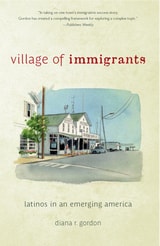
Village of Immigrants
Latinos in an Emerging AmericaGordon, Diana R
Rutgers University Press, 2015
Greenport today boasts a population that is one-third Hispanic. Gordon contends that these immigrants have effectively saved the town’s economy by taking low-skill jobs, increasing the tax base, filling local schools, and patronizing local businesses. Greenport’s seaside beauty still attracts summer tourists, but it is only with the support of the local Latino workforce that elegant restaurants and bed-and-breakfasts are able to serve these visitors. For Gordon the picture is complex, because the wave of immigrants also presents the town with challenges to its services and institutions. Gordon’s portraits of local immigrants capture the positive and the negative, with a cast of characters ranging from a Guatemalan mother of three, including one child who is profoundly disabled, to a Colombian house painter with a successful business who cannot become licensed because he remains undocumented. Village of Immigrants weaves together these people’s stories, fears, and dreams to reveal an environment plagued by threats of deportation, debts owed to coyotes, low wages, and the other bleak realities that shape the immigrant experience—even in the charming seaport town of Greenport.
A timely contribution to the national dialogue on immigration, Gordon’s book shows the pivotal role the American small town plays in the ongoing American immigrant story—as well as how this booming population is shaping and reviving rural communities.
Visible Borders, Invisible Economies
Living Death in Latinx NarrativesKristy L. Ulibarri
University of Texas Press, 2022
2023 Outstanding Book Award, National Association for Ethnic Studies
A thorough examination of the political and economic exploitation of Latinx subjects, migrants, and workers through the lens of Latinx literature, photography, and film.
Globalization in the United States can seem paradoxical: free trade coincides with fortification of the southern border, while immigration is reimagined as a national-security threat. US politics turn aggressively against Latinx migrants and subjects even as post-NAFTA markets become thoroughly reliant on migrant and racialized workers. But in fact, there is no incongruity here. Rather, anti-immigrant politics reflect a strategy whereby capital uses specialized forms of violence to create a reserve army of the living, laboring dead.
Visible Borders, Invisible Economies turns to Latinx literature, photography, and films that render this unseen scheme shockingly vivid. Works such as Valeria Luiselli’s Tell Me How It Ends and Alex Rivera’s Sleep Dealer crystallize the experience of Latinx subjects and migrants subjugated to social death, their political existence erased by disenfranchisement and racist violence while their bodies still toil in behalf of corporate profits. In Kristy L. Ulibarri’s telling, art clarifies what power obscures: the national-security state performs anti-immigrant and xenophobic politics that substitute cathartic nationalism for protections from the free market while ensuring maximal corporate profits through the manufacture of disposable migrant labor.
Visions of Transformation
Hegemony, Plurinationality, and Revolution in BoliviaAaron Augsburger
University of Arizona Press, 2025
On a wave of revolutionary upheaval in the early twenty-first century, Evo Morales was swept into state power as Bolivia’s first Indigenous president with a mandate to radically transform the country. The ensuing period, known simply as “el proceso de cambio” (the process of change), has been a tension-filled and contradictory process involving progressive transformations, ambiguous continuities, and outright revolutionary failures. Importantly, the contradictions have been just as much ideological as they are material.
By examining and illuminating the contrasting logics underlying opposing theories of revolutionary change, Visions of Transformation provides an analytical framework through which to understand and interpret the central conflicts and contradictions of Bolivia under Evo Morales and the Movimiento al Socialismo.
Based on nearly two years of immersive fieldwork, Visions of Transformation explores the relation between theoretical production and political practice. Through the contrasting perspectives of hegemony and plurinationality, the book analyzes three specific conjunctural moments—a proposed highway through the TIPNIS, a conflict over representation of the highland Indigenous movement organization CONAMAQ, and the struggle for Indigenous autonomy—to shed light on the primary economic, social, political, and theoretical tensions at the heart of Bolivia’s proceso de cambio.
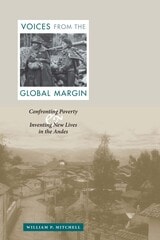
Voices from the Global Margin
Confronting Poverty and Inventing New Lives in the AndesBy William P. Mitchell
University of Texas Press, 2006
2007 — LASA Peru Flora Tristán Book Prize from the Peru Section – Latin American Studies Association
Voices from the Global Margin looks behind the generalities of debates about globalization to explore the personal impact of global forces on the Peruvian poor. In this highly readable ethnography, William Mitchell draws on the narratives of people he has known for forty years, offering deep insight into how they have coped with extreme poverty and rapid population growth—and their creation of new lives and customs in the process. In their own passionate words they describe their struggles to make ends meet, many abandoning rural homes for marginal wages in Lima and the United States. They chronicle their terror during the Shining Path guerrilla war and the government's violent military response. Mitchell's long experience as an anthropologist living with the people he writes about allows him to put the stories in context, helping readers understand the impact of the larger world on individuals and their communities. His book reckons up the human costs of the global economy, urging us to work toward a more just world.