Results by title
715 books match the query 'Ethnic relations' and 5 start with v
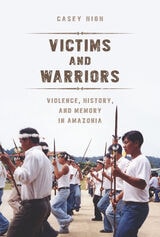
Victims and Warriors
Violence, History, and Memory in AmazoniaCasey High
University of Illinois Press, 2015
Victims and Warriors examines contemporary violence in the context of political and economic processes that transcend local events. Casey High explores how popular imagery of Amazonian violence has become part of Waorani social memory in oral histories, folklore performances, and indigenous political activism. As Amazonian forms of social memory merge with constructions of masculinity and other intercultural processes, the Waorani absorb missionaries, oil development, and logging depredations into their legacy of revenge killings and narratives of victimhood. High shows that these memories of past violence form sites of negotiation and cultural innovation, and thus violence comes to constitute a central part of Amazonian sociality, identity, and memory.
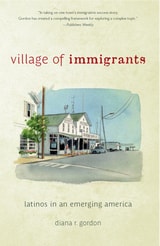
Village of Immigrants
Latinos in an Emerging AmericaGordon, Diana R
Rutgers University Press, 2015
Greenport today boasts a population that is one-third Hispanic. Gordon contends that these immigrants have effectively saved the town’s economy by taking low-skill jobs, increasing the tax base, filling local schools, and patronizing local businesses. Greenport’s seaside beauty still attracts summer tourists, but it is only with the support of the local Latino workforce that elegant restaurants and bed-and-breakfasts are able to serve these visitors. For Gordon the picture is complex, because the wave of immigrants also presents the town with challenges to its services and institutions. Gordon’s portraits of local immigrants capture the positive and the negative, with a cast of characters ranging from a Guatemalan mother of three, including one child who is profoundly disabled, to a Colombian house painter with a successful business who cannot become licensed because he remains undocumented. Village of Immigrants weaves together these people’s stories, fears, and dreams to reveal an environment plagued by threats of deportation, debts owed to coyotes, low wages, and the other bleak realities that shape the immigrant experience—even in the charming seaport town of Greenport.
A timely contribution to the national dialogue on immigration, Gordon’s book shows the pivotal role the American small town plays in the ongoing American immigrant story—as well as how this booming population is shaping and reviving rural communities.
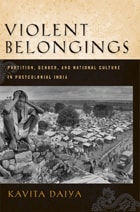
Violent Belongings
Partition, Gender, and National Culture in Postcolonial IndiaKavita Daiya
Temple University Press, 2008
In addition to challenging the official narratives of independence and Partition, these narratives challenge our contemporary understanding of gender and ethnicity in history and politics. Violent Belongings argues that both male and female bodies, and heterosexual coupledom, became symbols of the nation in public life. In the newly independent Indian nation both men and women were transformed into ideal citizens or troubling bodies, immigrants or refugees, depending on whether they were ethnically Hindu, Muslim, Jewish or Sikh. The divisions set in motion during Partition continue into our own time and account for ethnic violence in South Asia.
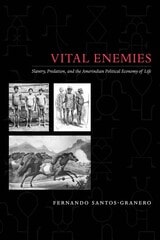
Vital Enemies
Slavery, Predation, and the Amerindian Political Economy of LifeBy Fernando Santos-Granero
University of Texas Press, 2009
Analyzing slavery and other forms of servitude in six non-state indigenous societies of tropical America at the time of European contact, Vital Enemies offers a fascinating new approach to the study of slavery based on the notion of "political economy of life." Fernando Santos-Granero draws on the earliest available historical sources to provide novel information on Amerindian regimes of servitude, sociologies of submission, and ideologies of capture.
Estimating that captive slaves represented up to 20 percent of the total population and up to 40 percent when combined with other forms of servitude, Santos-Granero argues that native forms of servitude fulfill the modern understandings of slavery, though Amerindian contexts provide crucial distinctions with slavery as it developed in the American South. The Amerindian understanding of life forces as being finite, scarce, unequally distributed, and in constant circulation yields a concept of all living beings as competing for vital energy. The capture of human beings is an extreme manifestation of this understanding, but it marks an important element in the ways Amerindian "captive slavery" was misconstrued by European conquistadors.
Illuminating a cultural facet that has been widely overlooked or miscast for centuries, Vital Enemies makes possible new dialogues regarding hierarchies in the field of native studies, as well as a provocative re-framing of pre- and post-contact America.
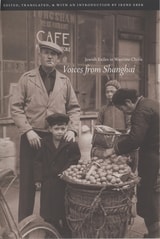
Voices from Shanghai
Jewish Exiles in Wartime ChinaEdited by Irene Eber
University of Chicago Press, 2008
When Hitler came to power and the German army began to sweep through Europe, almost 20,000 Jewish refugees fled to Shanghai. A remarkable collection of the letters, diary entries, poems, and short stories composed by these refugees in the years after they landed in China, Voices from Shanghai fills a gap in our historical understanding of what happened to so many Jews who were forced to board the first ship bound for anywhere.
Once they arrived, the refugees learned to navigate the various languages, belief systems, and ethnic traditions they encountered in an already booming international city, and faced challenges within their own community based on disparities in socioeconomic status, levels of religious observance, urban or rural origin, and philosophical differences. Recovered from archives, private collections, and now-defunct newspapers, these fascinating accounts make their English-languge debut in this volume. A rich new take on Holocaust literature, Voices from Shanghai reveals how refugees attempted to pursue a life of creativity despite the hardships of exile.