455 books match the query 'Feminism' and 4 start with v

cover of Vanishing Women: Magic, Film, and Feminism

Vanishing Women

Magic, Film, and Feminism

Karen Beckman

Duke University Press, 2003

With the help of mirrors, trap doors, elevators, photographs, and film, women vanish and return in increasingly spectacular ways throughout the nineteenth and twentieth centuries. Karen Beckman tracks the proliferation of this elusive figure, the vanishing woman, from her genesis in Victorian stage magic through her development in conjunction with photography and film. Beckman reveals how these new visual technologies projected their anxieties about insubstantiality and reproducibility onto the female body, producing an image of "woman" as utterly unstable and constantly prone to disappearance.

Drawing on cinema studies and psychoanalysis as well as the histories of magic, spiritualism, and photography, Beckman looks at particular instances of female vanishing at specific historical moments—in Victorian magic’s obsessive manipulation of female and colonized bodies, spiritualist photography’s search to capture traces of ghosts, the comings and goings of bodies in early cinema, and Bette Davis’s multiple roles as a fading female star. As Beckman places the vanishing woman in the context of feminism’s discussion of spectacle and subjectivity, she explores not only the problems, but also the political utility of this obstinate figure who hovers endlessly between visible and invisible worlds. Through her readings, Beckman argues that the visibly vanishing woman repeatedly signals the lurking presence of less immediately perceptible psychic and physical erasures, and she contends that this enigmatic figure, so ubiquitous in late-nineteenth- and twentieth-century culture, provides a new space through which to consider the relationships between visibility, gender, and agency.
[more]
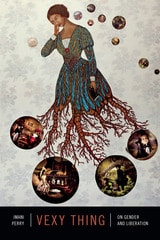
cover of Vexy Thing: On Gender and Liberation

Vexy Thing

On Gender and Liberation

Imani Perry

Duke University Press, 2018

Even as feminism has become increasingly central to our ideas about institutions, relationships, and everyday life, the term used to diagnose the problem—“patriarchy”—is used so loosely that it has lost its meaning. In Vexy Thing Imani Perry resurrects patriarchy as a target of critique, recentering it to contemporary discussions of feminism through a social and literary analysis of cultural artifacts from the Enlightenment to the present. Drawing on a rich array of sources—from nineteenth-century slavery court cases and historical vignettes to writings by Toni Morrison and Audre Lorde and art by Kara Walker and Wangechi Mutu—Perry shows how the figure of the patriarch emerged as part and parcel of modernity, the nation-state, the Industrial Revolution, and globalization. She also outlines how digital media and technology, neoliberalism, and the security state continue to prop up patriarchy. By exploring the past and present of patriarchy in the world we have inherited and are building for the future, Perry exposes its mechanisms of domination as a necessary precursor to dismantling it.
[more]
cover of Vibrator Nation: How Feminist Sex-Toy Stores Changed the Business of Pleasure

Vibrator Nation

How Feminist Sex-Toy Stores Changed the Business of Pleasure

Lynn Comella

Duke University Press, 2017

In the 1970s a group of pioneering feminist entrepreneurs launched a movement that ultimately changed the way sex was talked about, had, and enjoyed. Boldly reimagining who sex shops were for and the kinds of spaces they could be, these entrepreneurs opened sex-toy stores like Eve’s Garden, Good Vibrations, and Babeland not just as commercial enterprises, but to provide educational and community resources as well. In Vibrator Nation Lynn Comella tells the fascinating history of how these stores raised sexual consciousness, redefined the adult industry, and changed women's lives. Comella describes a world where sex-positive retailers double as social activists, where products are framed as tools of liberation, and where consumers are willing to pay for the promise of better living—one conversation, vibrator, and orgasm at a time.
[more]
cover of Visible Women: New Essays on American Activism

Visible Women

New Essays on American Activism

Edited by Nancy A. Hewitt and Suzanne Lebsock

University of Illinois Press, 1993

In this collection, fifteen leading historians of women and American history explore women's political action from 1830 to the present. Together, their contributions illustrate the tremendous scope and racial, ethnic, and class diversity of women's public activism while also clarifying various conceptual issues. Essays include an analysis of ideologies and strategies; suffrage militance in 1870s; ideas for a feminist approach to public life; labor feminism in the urban South; women's activism in Tampa, Florida; black women and economic nationalism; black women's clubs; the YMCA's place in the community; the role of Southern churchwomen in racial reform and transformation; and other topics.

"Establishes important links between citizenship, race, and gender following the Reconstruction amendments and the Dawes Act of 1887."--Sharon Hartmann Strom, American Historical Review

[more]