Results by title
28 books match the query 'Universe'
A Miracle, A Universe
Settling Accounts with TorturersLawrence Weschler
University of Chicago Press, 1998
"Disturbing and often enthralling."—New York Times Book Review
"Extraordinarily moving. . . . Weschler writes brilliantly."—Newsday
"Implausible, intricate and dazzling."—Times Literary Supplement
"As Weschler's interviewees told their tales, I paced agitatedly, choked back tears. . . . Weschler narrates these two episodes with skill and tact. . . . An inspiring book."—George Scialabba, Los Angeles Weekly
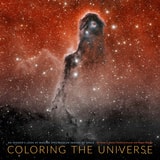
Coloring the Universe
An Insider's Look at Making Spectacular Images of SpaceTravis Rector, Kimberly Arcand, and Megan Watzke
University of Alaska Press, 2015
Coloring the Universe uses accessible language to describe how these giant telescopes work, what scientists learn with them, and how they are used to make color images. It talks about how otherwise un-seeable rays, such as radio waves, infrared light, X-rays, and gamma rays, are turned into recognizable colors. And it is filled with fantastic images taken in far-away pockets of the universe. Informative and beautiful, Coloring the Universe will give space fans of all levels an insider’s look at how scientists bring deep space into brilliant focus.
Disturbing the Universe
Power and Repression in Adolescent LiteratureRoberta S. Trites
University of Iowa Press, 2004
The Young Adult novel is ordinarily characterized as a coming-of-age story, in which the narrative revolves around the individual growth and maturation of a character, but Roberta Trites expands this notion by chronicling the dynamics of power and repression that weave their way through YA books. Characters in these novels must learn to negotiate the levels of power that exist in the myriad social institutions within which they function, including family, church, government, and school.
Trites argues that the development of the genre over the past thirty years is an outgrowth of postmodernism, since YA novels are, by definition, texts that interrogate the social construction of individuals. Drawing on such nineteenth-century precursors as Little Women and Adventures of Huckleberry Finn, Disturbing the Universe demonstrates how important it is to employ poststructuralist methodologies in analyzing adolescent literature, both in critical studies and in the classroom. Among the twentieth-century authors discussed are Blume, Hamilton, Hinton, Le Guin, L'Engle, and Zindel.
Trites' work has applications for a broad range of readers, including scholars of children's literature and theorists of post-modernity as well as librarians and secondary-school teachers.
Disturbing the Universe: Power and Repression in Adolescent Literature by Roberta Seelinger Trites is the winner of the 2002 Children's Literature Association's Book Award. The award is given annually in order to promote and recognize outstanding contributions to children's literature, history, scholarship, and criticisim; it is one of the highest academic honors that can accrue to an author of children's literary criticism.
Encountering Life in the Universe
Ethical Foundations and Social Implications of AstrobiologyEdited by Chris Impey, Anna H. Spitz, and William Stoeger
University of Arizona Press, 2013
Encountering Life in the Universe examines the intersection of scientific research and society to further explore the ethics of how to behave in a universe where much is unknown. Taking contributions from notable experts in several fields, the editors skillfully introduce and develop a broad look at the moral questions facing humans on Earth and beyond.
Major advances in biology, biotechnology, and medicine create an urgency to ethical considerations in those fields. Astrobiology goes on to debate how we might behave as we explore new worlds, or create new life in the laboratory, or interact with extraterrestrial life forms. Stimulated by new technologies for scientific exploration on and off the Earth, astrobiology is establishing itself as a distinct scientific endeavor.
In what way can established philosophies provide guidance for the new frontiers opened by astrobiology research? Can the foundations of ethics and moral philosophy help answer questions about modifying other planets? Or about how to conduct experiments to create life in the lab or about? How to interact with organisms we might discover on another world?
While we wait for the first echo that might indicate life beyond Earth, astobiologists, along with philosophers, theologians, artists, and the general public, are exploring how we might behave—even before we know for sure they are there. Encountering Life in the Universe is a remarkable resource for such philosophical challenges.
God's Gift of the Universe
An Introduction to Creation TheologyPaul O'Callaghan
Catholic University of America Press, 2021
How to Create a Universe
Jakob Ion Wille, Simon Jon Andreasen, and Gunnar Wille
University of Westminster Press, 2025
Into the Universe of Technical Images
Vilém Flusser
University of Minnesota Press, 2010
Flusser charts how communication evolved from direct interaction with the world to mediation through various technologies. The invention of writing marked one significant shift; the invention of photography marked another, heralding the current age of the technical image. The automation of the processing of technical images carries both promise and threat: the promise of freeing humans to play and invent and the threat for networks of automation to proceed independently of humans.
Is God The Only Reality
Science Points Deeper Meaning Of UniverseJohn Marks Templeton
Templeton Press, 2012

Jerusalem the Center of the Universe
Its Archaeology and History (1800–100 BCE)Israel Finkelstein
SBL Press, 2024
Lenore Tawney
Mirror of the UniverseEdited by Karen Patterson
University of Chicago Press, 2019
Raised and trained in Chicago before she moved to New York, Tawney had a storied career. She was known for employing an ancient Peruvian gauze weave technique to create a painterly effect that appeared to float in space rather than cling to the wall, as well as for being one of the first artists to blend sculptural techniques with weaving practices and, in the process, pioneered a new direction in fiber art. Despite her prominence on the New York art scene, however, she has only recently begun to receive her due from the greater art world. Accompanying a retrospective at the John Michael Kohler Arts Center, this catalog features a comprehensive biography of Tawney, additional essays on her work, and two hundred full-color illustrations, making it of interest to contemporary artists, art historians, and the growing audience for fiber art.
Copublished with the John Michael Kohler Arts Center.
Magical Arrows
The Maori, The Greeks, And The Folklore Of The UniverseGregory A. Schrempp
University of Wisconsin Press, 1992
Schrempp suggests that perhaps the most noteworthy Zenoian insight is that paradox is intrinsic to cosmological speculation. But he points out that there are many other characteristics of Zeno’s approach, including the strategy of juxtaposing concrete images to mathematical forms of representation, that reappear persistently in Western intellectual history. Schrempp proceeds through a series of juxtapositions—between Zeno, Kant, Lovejoy, and Lévi-Strauss, and between Western cosmologists and those from other cultures—to highlight subtle similarities and differences among intellectual traditions and to examine the conceptual apparatus of Western social science.
Schrempp concludes that a meaningful comparative cosmology is possible and that the tradition of Zeno provides a propitious starting point for such a perspective.

Measuring the Cosmos
How Scientists Discovered the Dimensions of the UniverseDavid H. Clark and Matthew D.H. Clark
Rutgers University Press, 2004
Humans have always viewed the heavens with wonder and awe. The skies have inspired reflection on the vastness of space, the wonder of creation, and humankind’s role in the universe. In just over one hundred years, science has moved from almost total ignorance about the actual distances to the stars and earth’s place in the galaxy to our present knowledge about the enormous size, mass, and age of the universe. We are reaching the limits of observation, and therefore the limits of human understanding. Beyond lies only our imagination, seeded by the theories of physics. In Measuring the Cosmos, science writers David and Matthew Clark tell the stories of both the well-known and the unsung heroes who played key roles in these discoveries. These true accounts reveal ambitions, conflicts, failures, as well as successes, as the astonishing scale and age of the universe were finally established. Few areas of scientific research have witnessed such drama in the form of ego clashes, priority claims, or failed (or even falsified) theories as that resulting from attempts to measure the universe. Besides giving credit where long overdue, Measuring the Cosmos explains the science behind these achievements in accessible language sure to appeal to astronomers, science buffs, and historians.
Measuring the Universe
Cosmic Dimensions from Aristarchus to HalleyAlbert Van Helden
University of Chicago Press, 1986
"Van Helden's authoritative treatment is concise and informative; he refers to numerous sources of information, draws on the discoveries of modern scholarship, and presents the first book-length treatment of this exceedingly important branch of science."—Edward Harrison, American Journal of Physics
"Van Helden writes well, with a flair for clear explanation. I warmly recommend this book."—Colin A. Ronan, Journal of the British Astronomical Association
Metaphysical Experiments
Physics and the Invention of the UniverseBjørn Ekeberg
University of Minnesota Press, 2019
An engaging critique of the science and metaphysics behind our understanding of the universe
The James Webb Space Telescope, when launched in 2021, will be the premier orbital observatory, capable of studying every phase of the history of the universe, from the afterglow of the Big Bang to the formation of our solar system. Examining the theoretical basis for key experiments that have made this latest venture in astrophysics possible, Bjørn Ekeberg reveals that scientific cosmology actually operates in a twilight zone between the physical and metaphysical.
Metaphysical Experiments explains how our current framework for understanding the universe, the Big Bang theory, is more determined by a deep faith in mathematical universality than empirical observation. Ekeberg draws on philosophical insights by Spinoza, Bergson, Heidegger, and Arendt; on the critical perspectives of Latour, Stengers, and Serres; and on cutting-edge physics research at the Large Hadron Collider, to show how the universe of modern physics was invented to reconcile a Christian metaphysical premise with a claim to the theoretical unification of nature.
By focusing on the nonmathematical assumptions underlying some of the most significant events in modern science, Metaphysical Experiments offers a critical history of contemporary physics that demystifies such concepts as the universe, particles, singularity, gravity, blackbody radiation, the speed of light, wave/particle duality, natural constants, black holes, dark matter, and dark energy. Ekeberg’s incisive reading of the metaphysical underpinnings of scientific cosmology offers an innovative account of how we understand our place in the universe.
Mind Of The Universe
Understanding Science & ReligionMariano Artigas
Templeton Press, 2001
Plants, Animals, People, Aliens
An Aristotelian-Thomist Perspective on Life in the UniverseMarie I. George
Catholic University of America Press, 2026

Relativistic Astrophysics, 2
The Structure and Evolution of the UniverseYa. B. Zel'dovich and I. D. Novikov
University of Chicago Press, 1983
This second volume of Relativistic Astrophysics provides a remarkably complete picture of the present state of cosmology. It is a synthesis of the theoretical foundations of contemporary cosmology, which are derived from work in relativity, plasma theory, thermodynamics, hydrodynamics, and particle physics. It presents the theoretical work that explains, describes, and predicts the nature of the universe, the physical process that occur in it, the formation of galaxies, the synthesis of the light elements, and the cosmological singularity and the theory of gravitation.
This book, long and eagerly awaited, is essential for everyone whose work is related to cosmology and astrophysics.
Ripples of the Universe
Spirituality in Sedona, ArizonaSusannah Crockford
University of Chicago Press, 2021
Many people move to Sedona because, they claim, they are called there by its special energy. But they are also often escaping job loss, family breakdown, or foreclosure. Spirituality, Crockford shows, offers a way for people to distance themselves from and critique current political and economic norms in America. Yet they still find themselves monetizing their spiritual practice as a way to both “raise their vibration” and meet their basic needs. Through an analysis of spirituality in Sedona, Crockford gives shape to the failures and frustrations of middle- and working-class people living in contemporary America, describing how spirituality infuses their everyday lives. Exploring millenarianism, conversion, nature, food, and conspiracy theories, Ripples of the Universe combines captivating vignettes with astute analysis to produce a unique take on the myriad ways class and spirituality are linked in contemporary America.
Science, Society, and the Search for Life in the Universe
Bruce Jakosky
University of Arizona Press, 2006
Astrobiology is the relatively new, but fast growing scientific discipline that involves trying to understand the origin, evolution, and distribution of life within the universe. It is also one of the few scientific disciplines that attracts the public’s intense curiosity and attention. This interest stems largely from the deep personal meaning that the possible existence of extraterrestrial life has for so many. Whether this meaning relates to addressing the “Big Questions” of our existence, the possibility of encountering life on other planets, or the potential impact on our understanding of religion, there is no doubt that the public is firmly vested in finding answers.
In this broadly accessible introduction to the field, Bruce Jakosky looks at the search for life in the universe not only from a scientific perspective, but also from a distinctly social one. In lucid and engaging prose, he addresses topics including the contradiction between the public’s fascination and the meager dialogue that exists between those within the scientific community and those outside of it, and what has become some of the most impassioned political wrangling ever seen in government science funding.
Secrets of the Universe
How We Discovered the CosmosPaul Murdin
University of Chicago Press, 2009
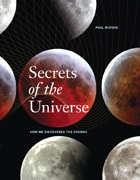
Discoveries in astronomy challenge our fundamental ideas about the universe. Where the astronomers of antiquity once spoke of fixed stars, we now speak of whirling galaxies and giant supernovae. Where we once thought Earth was the center of the universe, we now see it as a small planet among millions of other planetary systems, any number of which could also hold life. These dramatic shifts in our perspective hinge on thousands of individual discoveries: moments when it became clear to someone that some part of the universe—whether a planet or a supermassive black hole—was not as it once seemed.
Secrets of the Universe invites us to participate in these moments of revelation and wonder as scientists first experienced them. Renowned astronomer Paul Murdin here provides an ambitious and exciting overview of astronomy, conveying for newcomers and aficionados alike the most important discoveries of this science and introducing the many people who made them. Lavishly illustrated with more than 400 color images, the book outlines in seventy episodes what humankind has learned about the cosmos—and what scientists around the world are poised to learn in the coming decades. Arranged by types of discovery, it also provides an overarching narrative throughout that explains how the earliest ideas of the cosmos evolved into the cutting-edge astronomy we know today. Along the way, Murdin never forgets that science is a human endeavor, and that every discovery was the result of inspiration, hard work, or luck—usually all three.
The first section of Secrets explores discoveries made before the advent of the telescope, from stars and constellations to the position of our own sun. The second considers discoveries made within our own solar system, from the phases of Venus and the moons of Jupiter to the comets and asteroids at its distant frontier. The next section delves into discoveries of the dynamic universe, like gravitation, relativity, pulsars, and black holes. A fourth examines discoveries made within our own galaxy, from interstellar nebulae and supernovae to Cepheid variable stars and extrasolar planets. Next Murdin turns to discoveries made within the deepest recesses of the universe, like quasars, supermassive black holes, and gamma ray bursters. In the end, Murdin unveils where astronomy still teeters on the edge of discovery, considering dark matter and alien life.
The Colossal P. T. Barnum Reader
Nothing Else Like It in the UniversePhineas T. Barnum. Edited by James W. Cook
University of Illinois Press, 2005
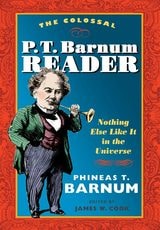
James W. Cook's The Colossal P. T. Barnum Reader is the largest collection of Barnum's works ever produced. Included are excerpts from his pseudo-autobiographical novel The Adventures of an Adventurer (1841), his European letters from 1844-46 informing readers of the New York Atlas of his regal reception overseas, and a large selection from his Ancient and Modern Humbugs of the World, Barnum's 1864-65 insider's look into the frauds of nineteenth-century American culture. It offers a glimpse of Tom Thumb's minstrel and singing performances in front of Queen Victoria, Barnum's many fraudulent representations of the supposedly ancient Joice Heth, and a more immediate, less filtered sense of Barnum as cultural and social critic in his serialized writings and travelogues. This volume also features reproductions of difficult to find posters from Barnum's two-decade collaboration with the prominent New York lithographers, Currier and Ives, and vintage photographs.
Finally, the reader also helps us to understand Barnum's role in building the modern culture industry. We follow his career from itinerant hawker, hardly distinguishable from his pre-industrial forebears, to manager of the world's first show business empire, with a staff of thousands and brand recognition across four continents. The Colossal P. T. Barnum Reader tracks the shifting personas of the great showman, his representational choices, and his publics across the nineteenth century.
The Man Who Painted the Universe
The Story of a Planetarium in the Heart of the North WoodsRon Legro
Wisconsin Historical Society Press, 2015
The Man Who Painted the Universe: The Story of a Planetarium in the Heart of the North Woods introduces readers to the mild-mannered astronomy enthusiast whose creativity, ingenuity, fervor, and endurance realized a dream of galactic proportions. The story of this stargazer from Wisconsin’s North Woods so inspired two newspapermen, authors Ron Legro and Avi Lank, that they sought to document the story of the Kovac Planetarium for a new generation of stargazers and dreamers.
The Size of the Universe
Joseph Cardinale
University of Alabama Press, 2010
The landscape of this novel in stories—Joseph Cardinale’s first book-length work of fiction—is as familiar as childhood yet beguilingly surreal. The question of whether or not the child in the first fiction and the man in the last story are the same person—and whether any person is the same from one moment to the next—is perhaps the book’s main question.
In prose as spare as it is meticulous, The Size of the Universe conjures an elegant labyrinth of time, space, and memory, in which a wavering self, a self on the verge of becoming nothing, seeks a safe haven from the throes of near-religious ecstasy. It is a debut work that is inviting, perplexing, and bold.
The Universe in Thirteen Graphs
Charting Cosmic Discoveries Across Space and TimeChris Lintott, Jeffrey Grube, and Daina Bouquin
University of Chicago Press, 2027
See the Universe as astronomers do: These thirteen graphs distill the cutting-edge discoveries of the cosmos—from planets and stars to galaxies, to ripples in spacetime itself.
From the front page of newspapers to your favorite t-shirt, the visual language of the cosmos is pervasive. Yet while you may have seen stunning images of planets, nebulae, and even the shadow of a black hole, pretty pictures alone cannot reveal the universe. Whether you’re looking for planets outside our solar system, searching for dark matter, listening for ripples in spacetime, or looking back to very early times, to truly understand the cosmos you need graphs.
In this fully illustrated and engaging book, astronomers Chris Lintott and Jeffrey Grube and data scientist Daina Bouquin focus on thirteen graphs to offer a tour of the major astronomical discoveries of the last century. Meet the HR diagram, which tells us about stellar lives; marvel at the Hubble diagram’s evidence for the expansion of the Universe; understand special relativity through Minkowski spacetime; and turn back time to the earliest visible light of the cosmic microwave background. With fascinating stories of discovery and accessible science for understanding ongoing debates, this book proves that while a picture may be worth a thousand words, a graph can show you the universe.
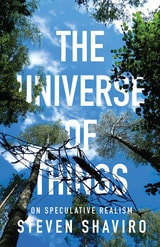
The Universe of Things
On Speculative RealismSteven Shaviro
University of Minnesota Press, 2014
From the rediscovery of Alfred North Whitehead’s work to the rise of new materialist thought, including object-oriented ontology, there has been a rapid turn toward speculation in philosophy as a way of moving beyond solely human perceptions of nature and existence. Now Steven Shaviro maps this quickly emerging speculative realism, which is already dramatically influencing how we interpret reality and our place in a universe in which humans are not the measure of all things.
The Universe of Things explores the common insistence of speculative realism on a noncorrelationist thought: that things or objects exist apart from how our own human minds relate to and comprehend them. Shaviro focuses on how Whitehead both anticipates and offers challenges to prevailing speculative realist thought, moving between Whitehead’s own panpsychism, Harman’s object-oriented ontology, and the reductionist eliminativism of Quentin Meillassoux and Ray Brassier.
The stakes of this recent speculative realist thought—of the effort to develop new ways of grasping the world—are enormous as it becomes clear that our inherited assumptions are no longer adequate to describe, much less understand, the reality we experience around us. As Shaviro acknowledges, speculative realist thought has its dangers, but it also, like the best speculative fiction, holds the potential to liberate us from confining views of what is outside ourselves and, he believes, to reclaim aesthetics and beauty as a principle of life itself.
Bringing together a wide array of contemporary thought, and evenhandedly assessing its current debates, The Universe of Things is an invaluable guide to the evolution of speculative realism and the provocation of Alfred North Whitehead’s pathbreaking work.
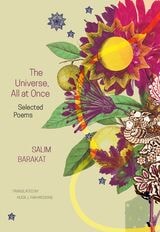
The Universe, All at Once
Selected PoemsSalim Barakat
Seagull Books, 2024
Salim Barakat, the captivating Kurdish-Syrian poet and novelist known for his mastery of Arabic style, is hailed as an enigmatic and intricate figure in contemporary Arabic literature. In The Universe, All at Once, he curates, in collaboration with translator Huda J. Fakhreddine, a selection from his later works, considering them the pinnacle of his poetic career. Drawn from pieces composed between 2021 and 2023, the poems in this collection vary from excerpts of an expansive book-length poem to concise, intense fragments. Fakhreddine expertly renders his writing in English, a courageous and praiseworthy attempt to challenge the barriers of the untranslatable.
This volume not only showcases the prolific author’s poetic evolution but also features a comprehensive interview with Barakat. Conducted by Fakhreddine, the interview delves into Barakat’s early influences, hobbies, talents, reader expectations, and reflections on displacement, childhood, and interpersonal connections. Together, The Universe, All at Once presents the best of Barakat’s latest poetry to his readers and allows invaluable insight into the writing processes and motivations of a visionary modern poet.
Three Steps to the Universe
From the Sun to Black Holes to the Mystery of Dark MatterDavid Garfinkle and Richard Garfinkle
University of Chicago Press, 2008
The authors begin by inviting readers to step away from the Earth and reconsider our Sun. What we can directly observe of this star is limited to its surface, but with the advent of telescopes and spectroscopy, scientists know more than ever about its physical characteristics, origins, and projected lifetime. From the Sun, the authors journey further out into space to explore black holes. The Garfinkle brothers explain that our understanding of these astronomical oddities began in theory, and growing mathematical and physical evidence has unexpectedly supported it. From black holes, the authors lead us further into the unknown, to the dark matter and energy that pervade our universe, where science teeters on the edge of theory and discovery. Returning from the depths of space, the final section of the book brings the reader back down to Earth for a final look at the practice of science, ending with a practical guide to discerning real science from pseudoscience among the cacophony of print and online scientific sources.
Three Steps to the Universe will reward anyone interested in learning more about the universe around us and shows how scientists uncover its mysteries.
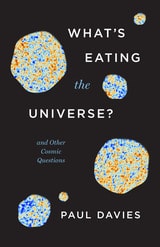
What's Eating the Universe?
And Other Cosmic QuestionsPaul Davies
University of Chicago Press, 2021
In the constellation of Eridanus, there lurks a cosmic mystery: It’s as if something has taken a huge bite out of the universe. But what is the culprit? The hole in the universe is just one of many puzzles keeping cosmologists busy. Supermassive black holes, bubbles of nothingness gobbling up space, monster universes swallowing others—these and many other bizarre ideas are being pursued by scientists. Due to breathtaking progress in astronomy, the history of our universe is now better understood than the history of our own planet. But these advances have uncovered some startling riddles. In this electrifying new book, renowned cosmologist and author Paul Davies lucidly explains what we know about the cosmos and its enigmas, exploring the tantalizing—and sometimes terrifying—possibilities that lie before us.
As Davies guides us through the audacious research offering mind-bending solutions to these and other mysteries, he leads us up to the greatest outstanding conundrum of all: Why does the universe even exist in the first place? And how did a system of mindless, purposeless particles manage to bring forth conscious, thinking beings? Filled with wit and wonder, What’s Eating the Universe? is a dazzling tour of cosmic questions, sure to entertain, enchant, and inspire us all.