Results by title
783 books match the query 'History & Theory' and 8 start with v
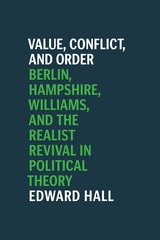
Value, Conflict, and Order
Berlin, Hampshire, Williams, and the Realist Revival in Political TheoryEdward Hall
University of Chicago Press, 2020
Is the purpose of political philosophy to articulate the moral values that political regimes would realize in a virtually perfect world and show what that implies for the way we should behave toward one another? That model of political philosophy, driven by an effort to draw a picture of an ideal political society, is familiar from the approach of John Rawls and others. Or is political philosophy more useful if it takes the world as it is, acknowledging the existence of various morally non-ideal political realities, and asks how people can live together nonetheless?
The latter approach is advocated by “realist” thinkers in contemporary political philosophy. In Value, Conflict, and Order, Edward Hall builds on the work of Isaiah Berlin, Stuart Hampshire, and Bernard Williams in order to establish a political realist’s theory of politics for the twenty-first century. The realist approach, Hall argues, helps us make sense of the nature of moral and political conflict, the ethics of compromising with adversaries and opponents, and the character of political legitimacy. In an era when democratic political systems all over the world are riven by conflict over values and interests, Hall’s conception is bracing and timely.

Vibrant Matter
A Political Ecology of ThingsJane Bennett
Duke University Press, 2010
Bennett examines the political and theoretical implications of vital materialism through extended discussions of commonplace things and physical phenomena including stem cells, fish oils, electricity, metal, and trash. She reflects on the vital power of material formations such as landfills, which generate lively streams of chemicals, and omega-3 fatty acids, which can transform brain chemistry and mood. Along the way, she engages with the concepts and claims of Spinoza, Nietzsche, Thoreau, Darwin, Adorno, and Deleuze, disclosing a long history of thinking about vibrant matter in Western philosophy, including attempts by Kant, Bergson, and the embryologist Hans Driesch to name the “vital force” inherent in material forms. Bennett concludes by sketching the contours of a “green materialist” ecophilosophy.

Victorian Critics of Democracy
Carlyle, Ruskin, Arnold, Stephen, Maine, LeckyBenjamin Evans Lippincott
University of Minnesota Press, 1938
Victorian Critics of Democracy was first published in 1938. Minnesota Archive Editions uses digital technology to make long-unavailable books once again accessible, and are published unaltered from the original University of Minnesota Press editions.
Violence and Peace
From the Atomic Bomb to Ethnic CleansingPierre Hassner
Central European University Press, 1997
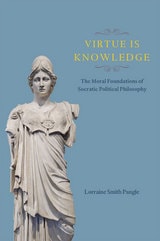
Virtue Is Knowledge
The Moral Foundations of Socratic Political PhilosophyLorraine Smith Pangle
University of Chicago Press, 2014
Lorraine Smith Pangle traces the argument for the primacy of virtue and the power of knowledge throughout the five dialogues that feature them most prominently—the Apology, Gorgias, Protagoras, Meno, and Laws—and reveals the truth at the core of these seemingly strange claims. She argues that Socrates was more aware of the complex causes of human action and of the power of irrational passions than a cursory reading might suggest. Pangle’s perceptive analyses reveal that many of Socrates’s teachings in fact explore the factors that make it difficult for humans to be the rational creatures that he at first seems to claim. Also critical to Pangle’s reading is her emphasis on the political dimensions of the dialogues. Underlying many of the paradoxes, she shows, is a distinction between philosophic and civic virtue that is critical to understanding them.
Ultimately, Pangle offers a radically unconventional way of reading Socrates’s views of human excellence: Virtue is not knowledge in any ordinary sense, but true virtue is nothing other than wisdom.
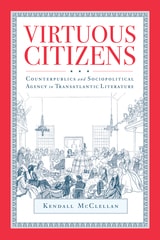
Virtuous Citizens
Counterpublics and Sociopolitical Agency in Transatlantic LiteratureKendall McClellan
University of Alabama Press, 2021
Transatlantic Perspectives on Civic Identity and Political Participation.
The rise of the bourgeois public sphere and the contemporaneous appearance of counterpublics in the eighteenth century deeply influenced not only how politicians and philosophers understood the relationships among citizens, disenfranchised subjects, and the state but also how members of the polity understood themselves. In Virtuous Citizens: Counterpublics and Sociopolitical Agency in Transatlantic Literature, Kendall McClellan uncovers a fundamental and still redolent transformation in conceptions of civic identity that occurred over the course of the eighteenth and nineteenth centuries. Literature of this period exposes an emotional investment in questions of civic selfhood born out of concern for national stability and power, which were considered products of both economic strength and a nation’s moral fiber. McClellan shows how these debates traversed the Atlantic to become a prominent component of early American literature, evident in works by James Fenimore Cooper, Catharine Maria Sedgwick, Sarah Josepha Hale, and Harriet Beecher Stowe, among others.
Underlying popular opinion about who could participate in the political public, McClellan argues, was an impassioned rhetorical wrestling match over the right and wrong ways to demonstrate civic virtue. Relying on long-established tropes of republican virtue that lauded self-sacrifice and disregard for personal safety, abolitionist writers represented loyalty to an ideals-based community as the surest safeguard of both private and public virtue. This evolution in civic virtue sanctioned acts of protest against the state, offered disenfranchised citizens a role in politics, and helped usher in the modern transnational public sphere.
Virtuous Citizens shows that the modern public sphere has always constituted a vital and powerful space for those invested in addressing injustice and expanding democracy. To illuminate some of the fundamental issues underlying today’s sociopolitical unrest, McClellan traces the transatlantic origins of questions still central to the representation of movements like Black Lives Matter, the Women’s March, and the Alt-Right: What is the primary loyalty of a virtuous citizen? Are patriots those who defend the current government against attacks, external and internal, or those who challenge the government to fulfill sociopolitical ideals?
Visionary Pragmatism
Radical and Ecological Democracy in Neoliberal TimesRomand Coles
Duke University Press, 2016
Vocations Of Political Theory
Jason A. Frank
University of Minnesota Press, 2000
Eminent and emerging thinkers seek to bridge the gap between political thought and political action.
Political Science
Eminent and emerging thinkers seek to bridge the gap between political thought and political action. Written by scholars with a rare sense of the historical and conceptual breadth of politics and theory, the essays in this volume explore possibilities for political theory in a world marked by disorienting political transformations. In doing so, they document and address the character and status of contemporary political theory, its changing place in the academy, and its role in public life. Whether challenging the settlement between political theory and political science, whereby theorists stuck to the "old texts" and left the "real world" to their empirical colleagues, or interrogating the relationship between political theory and political action, these essays expand and elaborate the parameters of political discourse-making their timeliness, relevance, and reach powerfully apparent.Contributors: Mark B. Brown; Wendy Brown, UC Santa Cruz; William E. Connolly, Johns Hopkins U; Thomas L. Dumm, Amherst College; J. Peter Euben, UC Santa Cruz; Russell Arben Fox; Samantha Frost, UC Santa Cruz; Shane Gunster; Jill Locke, Gustavus Adolphus College; David Paul Mandell, Reed College; Lon Troyer; Sheldon S. Wolin; Linda M. B. Zerilli, Northwestern U.Translation Inquiries: University of Minnesota Press