Results by title
1031 books match the query 'Intellectual life' and 10 start with v
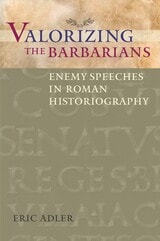
Valorizing the Barbarians
Enemy Speeches in Roman HistoriographyBy Eric Adler
University of Texas Press, 2011
With the growth of postcolonial theory in recent decades, scholarly views of Roman imperialism and colonialism have been evolving and shifting. Much recent discussion of the topic has centered on the ways in which ancient Roman historians consciously or unconsciously denigrated non-Romans. Similarly, contemporary scholars have downplayed Roman elite anxiety about their empire's expansion.
In this groundbreaking new work, Eric Adler explores the degree to which ancient historians of Rome were capable of valorizing foreigners and presenting criticisms of their own society. By examining speeches put into the mouths of barbarian leaders by a variety of writers, he investigates how critical of the empire these historians could be.
Adler examines pairs of speeches purportedly delivered by non-Roman leaders so that the contrast between them might elucidate each writer's sense of imperialism. Analyses of Sallust's and Trogus's treatments of the Eastern ruler Mithradates, Polybius's and Livy's speeches from Carthage's Hannibal, and Tacitus's and Cassius Dio's accounts of the oratory of the Celtic warrior queen Boudica form the core of this study. Adler supplements these with examinations of speeches from other characters, as well as contextual narrative from the historians. Throughout, Adler wrestles with broader issues of Roman imperialism and historiography, including administrative greed and corruption in the provinces, the treatment of gender and sexuality, and ethnic stereotyping.
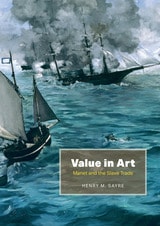
Value in Art
Manet and the Slave TradeHenry M. Sayre
University of Chicago Press, 2022
How did art critics come to speak of light and dark as, respectively, “high in value” and “low in value”? Henry M. Sayre traces the origin of this usage to one of art history’s most famous and racially charged paintings, Édouard Manet’s Olympia.
Art critics once described light and dark in painting in terms of musical metaphor—higher and lower tones, notes, and scales. Sayre shows that it was Émile Zola who introduced the new “law of values” in an 1867 essay on Manet. Unpacking the intricate contexts of Zola’s essay and of several related paintings by Manet, Sayre argues that Zola’s usage of value was intentionally double coded—an economic metaphor for the political economy of slavery. In Manet’s painting, Olympia and her maid represent objects of exchange, a commentary on the French Empire’s complicity in the ongoing slave trade in the Americas.
Expertly researched and argued, this bold study reveals the extraordinary weight of history and politics that Manet’s painting bears. Locating the presence of slavery at modernism’s roots, Value in Art is a surprising and necessary intervention in our understanding of art history.
Vernon Lee
Aesthetics, History, and the Victorian Female IntellectualChrista Zorn
Ohio University Press, 2003
The subject of renewed interest among literary and cultural scholars, Vernon Lee wrote more than forty books, in a broad range of genres, including fiction, history, aesthetics, and travel literature. Early on, Lee established her reputation as a public critic whose unconventional viewpoints stood out among those of her contemporaries.
To feminist and cultural critics, she is a fascinating model of the independent female intellectual who, as Desmond MacCarthy once put it, provides a rare combination of intellectual curiosity and imaginative sensibility.
A startlingly original critical study, Vernon Lee adds new dimensions to the legacy of this woman of letters whose career spans the transition from the late Victorian to the modernist period. Zorn draws on archival materials to discuss Lee’s work in terms of British aestheticism and in the context of the Western European history of ideas.
Zorn contends that Lee’s fiction and nonfiction represent a literary position that bridges and surpasses both the Victorian sage and the modernist aesthetic critic.
Through Professor Zorn’s approach, which combines theoretical framings of texts in terms of recent feminist and cultural criticism with passages of close reading, Vernon Lee emerges as an influential figure in late-nineteenth-century British and continental European thinking on history, art, culture, and gender.
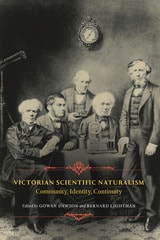
Victorian Scientific Naturalism
Community, Identity, ContinuityEdited by Gowan Dawson and Bernard Lightman
University of Chicago Press, 2014
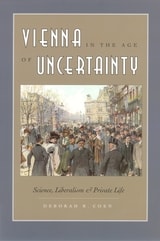
Vienna in the Age of Uncertainty
Science, Liberalism, and Private LifeDeborah R. Coen
University of Chicago Press, 2007
Vienna in the Age of Uncertainty traces the vital and varied roles of science through the story of three generations of the eminent Exner family, whose members included Nobel Prize–winning biologist Karl Frisch, the teachers of Freud and of physicist Erwin Schrödinger, artists of the Vienna Secession, and a leader of Vienna’s women’s movement. Training her critical eye on the Exners through the rise and fall of Austrian liberalism and into the rise of the Third Reich, Deborah R. Coen demonstrates the interdependence of the family’s scientific and domestic lives, exploring the ways in which public notions of rationality, objectivity, and autonomy were formed in the private sphere. Vienna in the Age of Uncertainty presents the story of the Exners as a microcosm of the larger achievements and tragedies of Austrian political and scientific life in the late nineteenth and early twentieth centuries.
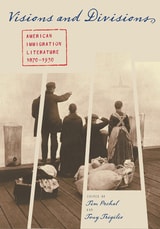
Visions and Divisions
American Immigration Literature, 1870-1930Prchal, Timothy
Rutgers University Press, 2008
From these debates came such novels as Willa Cather’s My Ántonia and Upton Sinclair’s The Jungle. Henry James, Charlotte Perkins Gilman, and Carl Sandburg added to the diversity of viewpoints of native born Americans while equally divergent immigrant perspectives were represented by writers such as Anzia Yezierska, Kahlil Gibran, and Claude McKay. This anthology presents the writing of these authors, among others less well known, to show the many ways literature participated in shaping the face of immigration. The volume also includes an introduction, annotations, a timeline, and historical documents that contextualize the literature.
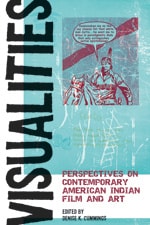
Visualities
Perspectives on Contemporary American Indian Film and ArtDenise K. Cummings
Michigan State University Press, 2011
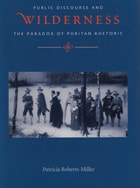
Voices in the Wilderness
Public Discourse and the Paradox of Puritan RhetoricPatricia Roberts-Miller
University of Alabama Press, 1999
Both Jürgen Habermas and Wayne Booth—two of the most influential theorists in the domain of public discourse and good citizenry—argue for an inclusive public deliberation that involves people who are willing to listen to one another, to identify points of agreement and disagreement, and to make good faith attempts to validate any disputed claims. The Puritan voice crying in the wilderness, Roberts-Miller shows, does none of these things. To this individual of conscience engaged in a ceaseless battle of right and wrong against greedy philistines, all inclusion, mediation, and reciprocity are seen as evil, corrupting, and unnecessary. Hence, the voice in the wilderness does not in any real sense participate in public deliberation, only in public pronouncement.
Arguing that our culture’s continuing affection for the ethos of the voice crying in the wilderness is one of our more troubling inheritances from the early American ambivalence to public discourse—including the Puritan denigration of rhetoric—Roberts-Miller contends that the monologic discourse of the Puritans in fact contains within it arguments for dialogism. Thus, the history of rhetoric can provide much richer fields for reimagining discourse than heretofore credited. Roberts-Miller concludes by extending her findings into their practical applications for argumentation in the public sphere and in the composition classroom.
Voicing America
Language, Literary Form, and the Origins of the United StatesChristopher Looby
University of Chicago Press, 1996
Voyages of Catholic Thought to North America
Intellectual Networks and Cultural Exchanges Between Europe, Canada, and the United States, 1920-1950Florian Michel
Catholic University of America Press, 2026