Results by title
448 books match the query 'Interviews' and 4 start with v
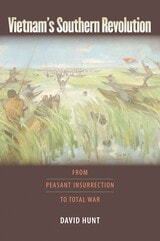
Vietnam's Southern Revolution
From Peasant Insurrection to Total WarDavid Hunt
University of Massachusetts Press, 2009
In Vietnam, the American government vowed to win the “hearts and minds” of the people. On the other side, among those who led and sympathized with the insurgents, the term “people's war” gained a wide currency. Yet while much has been written about those who professed to speak for the Vietnamese population, we know surprisingly little about the everyday life of the peasants who made up the bulk of the country's inhabitants. This book illuminates that subject. Drawing on a wide range of sources, including interviews conducted by the Rand Corporation with informants from My Tho Province in the Mekong Delta, David Hunt brings to light the daily experience of villagers in the midst of war and revolution.
The peasants of southern Vietnam were neither onlookers nor mere victims as fighting raged throughout their country. From the “concerted uprising” in 1959–1960 to the Tet Offensive of 1968, the revolutionary movement they created was in fact the driving force within the war. Known as the “Viet Cong” to their adversaries, the rebels called themselves the “Liberation Front.” They demanded an end to landlordism and an egalitarian distribution of the means of subsistence as well as a democratization of relations between town and countryside, parents and children, men and women. They hoped the Vietnamese people would achieve a fuller sense of their place in the world and of the power they possessed to fashion their own destinies, without reliance on supernatural forces.In the first half of the book, Hunt analyzes this cultural revolution. As fighting spread and became more destructive, especially after the U.S. escalation in 1965, villagers were driven from their homes, the rural infrastructure collapsed, and customary notions of space and time lost purchase on an increasingly chaotic world. In the second half of the book, Hunt shows how peasants, who earlier had aspired to a kind of revolutionary modernism, now found themselves struggling to survive and to cope with the American intruders who poured into My Tho, and how they managed to regroup and spearhead the Tet Offensive that irrevocably altered the course of the war.

Violence, the Sacred, and Things Hidden
A Discussion with René Girard at Esprit (1973)René Girard
Michigan State University Press, 2022

Voice in the Wilderness
Conversations with Terry Tempest Williamsedited by Michael Austin
Utah State University Press, 2006
In her writings, Terry Tempest Williams repeatedly invites us as readers into engagement and conversation with both her and her subject matter, whether it is nature or society, environment or art. From her evocation, in Desert Quartet: An Erotic Landscape, of an eroticism of place that defines erotic as "in relation," to the spiritual connectivity and familial bonds she explores in Refuge: An Unnatural History of Family and Place and the political engagement she urges in The Open Space of Democracy, much of her work is about relationship, connection, and community. Like much good writing, her books invite readers into thoughtful dialogue with the text. Frequently in demand for workshops, lectures, and other speaking venues and well known as an environmental activist, Williams has a public persona and voice almost indistinguishable from her written ones.
Thus, the interviews she has often granted--in print, on the radio, on the Web--seamlessly elaborate the ideas and extend the explorations of her written texts. They also tell us much about the genesis, context, and intent of her books. With her distinctive, impassioned voice and familiar felicity of language, she talks about wilderness and wildlife, place and eroticism, art and literature, democracy and politics, family and heritage, Mormonism and religion, writing and creativity, and other subjects that engage her agile mind. The set of interviews gathered and introduced by Michael Austin in A Voice in the Wilderness represent the span of Terry Tempest Williams's career as a naturalist, author, and activist.
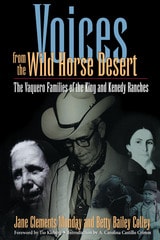
Voices from the Wild Horse Desert
The Vaquero Families of the King and Kenedy RanchesBy Jane Clements Monday and Betty Bailey Colley
University of Texas Press, 1997
Founded before the Civil War, the King and Kenedy Ranches have become legendary for their size, their wealth, and their endless herds of cattle. A major factor in the longevity of these ranches has always been the loyal workforce of vaqueros (Mexican and Mexican American cowboys) and their families. Some of the vaquero families have worked on the ranches through five or six generations.
In this book, Jane Clements Monday and Betty Bailey Colley bring together the voices of these men and women who make ranching possible in the Wild Horse Desert. From 1989 to 1995, the authors interviewed more than sixty members of vaquero families, ranging in age from 20 to 93. Their words provide a panoramic view of ranch work and life that spans most of the twentieth century.
The vaqueros and their families describe all aspects of life on the ranches, from working cattle and doing many kinds of ranch maintenance to the home chores of raising children, cooking, and cleaning. The elders recall a life of endless manual labor that nonetheless afforded the satisfaction of jobs done with skill and pride. The younger people describe how modernization has affected the ranches and changed the lifeways of the people who work there.