Results by title
8113 books match the query 'Literary Criticism' and 99 start with v
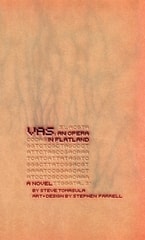
VAS
An Opera in Flatland: A Novel. By Steve Tomasula. Art and Design by Stephen Farrell.Steve Tomasula and Stephen Farrell
University of Chicago Press, 2004
A constantly surprising, VAS combines a variety of voices, from journalism and libretto to poem and comic book. Often these voices meet in counterpoint, and the meaning of the narrative emerges from their juxtapositions, harmonies, or discords. Utilizing a wide and historical sweep of representations of the body—from pedigree charts to genetic sequences—VAS is, finally, the story of finding one's identity within the double helix of language and lineage.
VICTORIAN SENSATIONS
ESSAYS ON A SCANDALOUS GENREKIMBERLY HARRISON
The Ohio State University Press, 2006

Value and Vision in American Literature
Essays in Honor of Ray Lewis WhiteJoseph Candido
Ohio University Press, 1999
Through their various (and sometimes contrasting) critical points of view, these essays call attention to ideas or connections that demand a reappraisal of conventional attitudes or ingrained responses. Ranging in focus from the period of the mid-nineteenth century to the present day, they treat indisputably canonical figures such as Hawthorne, Faulkner, James, Hemingway, Cather, Bellow, Porter, Welty, and Warren in the same breath and often refreshingly on the same terms with Wallace Stegner, Cormac McCarthy, Dunstan Thompson, neglected Civil War poets, and the New Formalist critics of the last ten years.
In celebration and in reflection of the important critical contribution Ray Lewis White has made to the study of American literature, these writers, each a noted scholar in the field of literary studies, present a picture of American literature that manages to value the past at the same time that it asks us to envision that past anew.
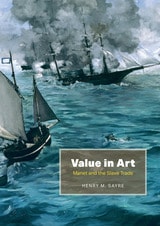
Value in Art
Manet and the Slave TradeHenry M. Sayre
University of Chicago Press, 2022
How did art critics come to speak of light and dark as, respectively, “high in value” and “low in value”? Henry M. Sayre traces the origin of this usage to one of art history’s most famous and racially charged paintings, Édouard Manet’s Olympia.
Art critics once described light and dark in painting in terms of musical metaphor—higher and lower tones, notes, and scales. Sayre shows that it was Émile Zola who introduced the new “law of values” in an 1867 essay on Manet. Unpacking the intricate contexts of Zola’s essay and of several related paintings by Manet, Sayre argues that Zola’s usage of value was intentionally double coded—an economic metaphor for the political economy of slavery. In Manet’s painting, Olympia and her maid represent objects of exchange, a commentary on the French Empire’s complicity in the ongoing slave trade in the Americas.
Expertly researched and argued, this bold study reveals the extraordinary weight of history and politics that Manet’s painting bears. Locating the presence of slavery at modernism’s roots, Value in Art is a surprising and necessary intervention in our understanding of art history.
Vampire Lectures
Laurence A. Rickels
University of Minnesota Press, 1999
A wild and wide-ranging “psycho-history” of the vampire.
A wild and wide-ranging “psycho-history” of the vampire.
Bela Lugosi may-as the eighties gothic rock band Bauhaus sang-be dead, but the vampire lives on. A nightmarish figure dwelling somewhere between genuine terror and high camp, a morbid repository for the psychic projections of diverse cultures, an endlessly recyclable mass-media icon, the vampire is an enduring object of fascination, fear, ridicule, and reverence. In The Vampire Lectures, Laurence A. Rickels sifts through the rich mythology of vampirism, from medieval folklore to Marilyn Manson, to explore the profound and unconscious appeal of the undead.Based on the course Rickels has taught at the University of California, Santa Barbara, for several years (a course that is itself a cult phenomenon on campus), The Vampire Lectures reflects Rickels’s unique lecture style and provides a lively history of vampirism in legend, literature, and film. Rickels unearths a trove that includes eyewitness accounts of vampire attacks; burial rituals and sexual taboos devised to keep vampirism at bay; Hungarian countess Elisabeth Bathory’s use of girls’ blood in her sadistic beauty regimen; Bram Stoker’s Dracula, with its turn-of-the-century media technologies; F. W. Murnau’s haunting Nosferatu; and crude, though intense, straight-to-video horror films such as Subspecies. He makes intuitive, often unexpected connections among these sometimes wildly disparate sources.More than a compilation of vampire lore, however, The Vampire Lectures makes an original and intellectually rigorous contribution to literary and psychoanalytic theory, identifying the subconscious meanings, complex symbolism, and philosophical arguments-particularly those of Marx, Freud, and Nietzsche-embedded in vampirism and gothic literature.ISBN 0-8166-3391-6 Cloth £34.50 $49.95xxISBN 0-8166-3392-4 Paper £14.00 $19.95376 Pages 5 7/8 x 9 SeptemberTranslation inquiries: University of Minnesota Press
Vampire Nation
Violence as Cultural ImaginaryTomislav Z. Longinovi
Duke University Press, 2011
Interpreting oral and written narratives and visual culture, Longinović traces the early modern invention of ‘the serbs’ and the category’s twentieth-century transformations. He describes the influence of Bram Stoker’s nineteenth-century novel Dracula on perceptions of the Balkan region and reflects on representations of hybrid identities and their violent destruction in the works of the region’s most prominent twentieth-century writers. Concluding on a hopeful note, Longinović considers efforts to imagine a new collective identity in non-nationalist terms. These endeavors include the emigrant Yugoslav writer David Albahari’s Canadian Trilogy and Cyber-Yugoslavia, a mock nation-state with “citizens” in more than thirty countries.
Vampires, Mummies and Liberals
Bram Stoker and the Politics of Popular FictionDavid Glover
Duke University Press, 1996
Glover’s efforts reveal a writer who was more wide-ranging and politically engaged than his current reputation suggests. An Irish Protestant and nationalist, Stoker nonetheless drew his political inspiration from English liberalism at a time of impending crisis, and the tradition’s contradictions and uncertainties haunt his work. At the heart of Stoker’s writing Glover exposes a preoccupation with those sciences and pseudo-sciences—from physiognomy and phrenology to eugenics and sexology—that seemed to cast doubt on the liberal faith in progress. He argues that Dracula should be read as a text torn between the stances of the colonizer and the colonized, unable to accept or reject the racialized images of backwardness that dogged debates about Irish nationhood. As it tracks the phantasmatic form given to questions of character and individuality, race and production, sexuality and gender, across the body of Stoker’s writing, Vampires, Mummies, and Liberals draws a fascinating portrait of an extraordinary transitional figure.
Combining psychoanalysis and cultural theory with detailed historical research, this book will be of interest to scholars of Victorian and Irish fiction and to those concerned with cultural studies and popular culture.
Vanguard Performance Beyond Left and Right
Kimberly Jannarone, Editor
University of Michigan Press, 2015
Vanishing Moments
Class and American LiteratureEric Schocket
University of Michigan Press, 2010
Schocket offers careful readings of works by Herman Melville, Rebecca Harding Davis, William Dean Howells, Jack London, T. S. Eliot, Gertrude Stein, Muriel Rukeyser, and Langston Hughes, among others, and explores how these authors worked to try to heal the rift between the classes. He considers the challenges writers faced before the Civil War in developing a language of class amidst the predominant concerns about race and slavery; how early literary realists dealt with the threat of class insurrection; how writers at the turn of the century attempted to span the divide between the classes by going undercover as workers; how early modernists used working-class characters and idioms to shape their aesthetic experiments; and how leftists in the 1930s struggled to develop an adequate model to connect class and literature. Vanishing Moments’ unique combination of a broad historical scope and in-depth readings makes it an essential book for scholars and students of American literature and culture, as well as for political scientists, economists, and humanists.
“An important book containing many brilliant arguments—hard-hitting and original. Schocket demonstrates a sophisticated acquaintance with issues within the working-class studies movement.”
--Barbara Foley, Rutgers University
Varieties of Social Imagination
Barbara Celarent
University of Chicago Press, 2017
Sociologist and AJS editor Andrew Abbott edited the Celarent essays, and in Varieties of Social Imagination, he brings the work together for the first time. Previously available only in the journal, the thirty-six meditations found here allow readers not only to engage more deeply with a diversity of thinkers from the past, but to imagine more fully a sociology—and a broader social science—for the future.
Variety
The Life of a Roman ConceptWilliam Fitzgerald
University of Chicago Press, 2016
William Fitzgerald looks at the definition and use of the Latin term varietas and how it has played out in different works and with different authors. He shows that, starting with the Romans, variety has played a key role in our thinking about nature, rhetoric, creativity, pleasure, aesthetics, and empire. From the lyric to elegy and satire, the concept of variety has helped to characterize and distinguish different genres. Arguing that the ancient Roman ideas and controversies about the value of variety have had a significant afterlife up to our own time, Fitzgerald reveals how modern understandings of diversity and choice derive from what is ultimately an ancient concept.
Varro the Agronomist
Political Philosophy, Satire, and Agriculture in the Late RepublicGrant A. Nelsestuen
The Ohio State University Press, 2015
On one level, Varro’s treatise presents an innovative account of the Roman farm, which rationalizes new agricultural and pastoral opportunities for contemporary elite owners of large-scale estates. But on another level, this bold agronomical vision associates the farm’s different spheres with distinct areas under Roman control, thereby allegorizing Rome’s empire on the model of a farm. Nelsestuen argues that Varro’s treatise thus provides his contemporaries with a model for governing the Roman state, anticipates Augustus’ subsequent transformation of Roman dominion into a coherent territorial state, and offers an ancient theory of imperialism.
Shedding new light on the only completely extant work of a much-celebrated but ill-understood figure, Varro the Agronomist has much to offer to those interested in Latin literature—especially, Cicero and Vergil—as well as on the political dimensions of intellectual life in first-century bce Rome, ancient imperialism, and Roman political philosophy.
Vasily Zhukovsky's Romanticism and the Emotional History of Russia
Ilya Vinitsky
Northwestern University Press, 2015
The first major study in English of Vasily Zhukovsky (1783–1852)—poet, translator of German romantic verse, and mentor of Pushkin—this book brings overdue attention to an important figure in Russian literary and cultural history. Vinitsky’s “psychological biography” argues that Zhukovsky very consciously set out to create for himself an emotional life reflecting his unique brand of romanticism, different from what we associate with Pushkin or poets such as Byron or Wordsworth. For Zhukovsky, ideal love was harmonious, built on a mystical foundation of spiritual kinship. Vinitsky shows how Zhukovksy played a pivotal role in the evolution of ideas central to Russia’s literary and cultural identity from the end of the eighteenth century into the decades following the Napoleonic Wars.

Vasto Pensamiento, Vast Thought
Latinas in the Nineteenth-Century California PressVanessa Ovalle Perez
Amherst College Press, 2027
Following the California Gold Rush, writing by local Latinas was increasingly published in the California Spanish-language press, including many women who were not wealthy or of elite social standing. In Vasto Pensamiento, Vast Thought: Latinas in the Nineteenth-Century California Press, Vanessa Ovalle Perez identifies a diverse selection of Latina voices, focusing particularly on social justice messages and creative works. She traces how Latinas leveraged rhetorical strategies that were both socially performative and literary in a culturally specific Latinx context. In the oscillation between expressions of intimacy and self-conscious cultural and social positioning, these women sought platforms for both their personal ambitions and social justice causes. Taking an intersectional feminist approach paired with deep historical investigation, Vasto Pensamiento, Vast Thought centers the words and stories of these women writers and public speakers, providing transcriptions and translations of numerous key texts. These include Anastasia Leyva’s testimony of her brother’s lynching; speeches and toasts of women who participated in Mexican Patriotic Assemblies; fiction and poetry of sisters Guadalupe and Carlota Gutierrez; and verses by the anonymous poet “Josefina.” These texts offer insight related to nineteenth-century Latina personal and political investments across both sides of the border, allowing us to see the connectedness of rhetorical strategy and Latina self-fashioning in the public sphere.
Vengeance in Reverse
The Tangled Loops of Violence, Myth, and MadnessMark R. Anspach
Michigan State University Press, 2017

Vengeance of the Victim
History and Symbol in Giorgio Bassani’s FictionMarilyn Schneider
University of Minnesota Press, 1986
Vengeance of the Victim was first published in 1986. Minnesota Archive Editions uses digital technology to make long-unavailable books once again accessible, and are published unaltered from the original University of Minnesota Press editions.
More profoundly than any documentary record, the collected fiction of Giorgio Bassani—Il Romanzo di Ferrara — captures a very particular and powerful historical reality: Italian Jewish life under Fascism, especially between the passage of the so-called racial laws in 1938 and the end of World War II. Set primarily in the provincial city of Ferrara, Bassani's narratives interweave themes of death, victimization, betrayal, survival, and artistic production. His best-known novel, The Garden of the Finzi-Continis — and other works that concentrate on the crucial years of 1938-1945—stand at the center of the Romanzo.They are preceded by texts that look back on Jewish life in the liberal era of the Risorgimento, and followed by texts set in the liberated, democratic society of the postwar years. These framing narratives provide a space for remembrance and reflection.
Marilyn Schneider's aim, in Vengeance of the Victim, is to uncover the symbolic layers — historical, spatial, topographical, mythopoeic, allegorical, and sexual — that five Bassani's texts their richness and ambiguity, and in so doing to achieve a full understanding of his work and its representation of the Italian Jewish experience. Death and victimization, which pervade these texts, set in motion a process of artistic renewal that is most fully embodied in the vibrant young Micol Finzi-Contini, Bassani's textual icon and a victim of the Holocaust. Schneider also finds that the narratives, especially the late ones, pay self-reflexive attention to the creation of the text, constructing an authorial persona engaged in an existential, moral, and artistic journey from symbolic death to rebirth. It is the writing subject's successful completion of the journey that constitutes the vengeance of the victim.
Venture Smith and the Business of Slavery and Freedom
James Brewer Stewart
University of Massachusetts Press, 2010
But what began as a scientific inquiry into African origins rapidly evolved into an unparalleled interdisciplinary collaboration between historians, literary analysts, geographers, genealogists, anthropologists, political philosophers, genomic biologists, and, perhaps most revealingly, a poet. Their common goal has been to reconstruct the life of an extraordinary African American and to assay its implications for the sprawling, troubled eighteenth-century world of racial exploitation over which he triumphed. This volume displays the rich results of that collaboration.
A highly intelligent, deeply self-motivated and immensely energetic slave transported from Africa, Venture Smith transformed himself through unstinting labor into a respectable Connecticut citizen, a successful entrepreneur, and the liberator of other enslaved African Americans. As James O. Horton emphasizes in his foreword to this volume, "Venture Smith's saga is a gift to all who seek to understand the complex racial beginnings of America. It helps to connect the broad American story with the stories of many Americans whose lives illustrate the national struggle to live out the national ideals."
In addition to Horton and volume editor James Brewer Stewart, contributors include Cameron Blevins, Vincent Carretta, Anna Mae Duane, Robert P. Forbes, Anne L. Hiskes, Paul Lovejoy, Marilyn Nelson, David Richardson, Chandler B. Saint, Linda Strausbaugh, Kevin Tulimieri, and John Wood Sweet.
Ventures into Childland
Victorians, Fairy Tales, and FemininityU. C. Knoepflmacher
University of Chicago Press, 1998
"Ventures into Childland is acute, well written and stimulating. It also has a political purpose, to insist on the importance of protecting and nurturing children, imaginatively and physically."—Jan Marsh, Times Literary Supplement
"A provocative and interesting book about Victorian culture."—Library Journal
Vergil's Aeneid and the Roman Self
Subject and Nation in Literary DiscourseYasmin Syed
University of Michigan Press, 2005
Now in Paper!
As the most widely read Roman poem in antiquity, the Aeneid was indelibly burned into the memories of generations of Roman school children. In this book, author Yasmin Syed analyzes the formative influence the poem exerted on its broad audience of educated Romans. Syed analyzes Roman pedagogy and reading practices as well as ancient beliefs about the powerful influence of poetry. Her study considers these cultural components together with the aspects of identity that define the Aeneid’s characters. By doing so, Syed shows how Vergil’s ancient audiences saw themselves—their experiences, goals, and values—reflected in the poem and guided by it. In particular, Syed’s treatment of gender and ethnicity brings to light the key role of Vergil’s poem in the formation of Romanness.
Vergil, Philodemus, and the Augustans
Edited by David Armstrong, Jeffrey Fish, Patricia A. Johnston, and Marilyn B. Skinner
University of Texas Press, 2003
The Epicurean teacher and poet Philodemus of Gadara (c. 110-c. 40/35 BC) exercised significant literary and philosophical influence on Roman writers of the Augustan Age, most notably the poets Vergil and Horace. Yet a modern appreciation for Philodemus' place in Roman intellectual history has had to wait on the decipherment of the charred remains of Philodemus' library, which was buried in Herculaneum by the eruption of Vesuvius in 79 AD. As improved texts and translations of Philodemus' writings have become available since the 1970s, scholars have taken a keen interest in his relations with leading Latin poets.
The essays in this book, derived from papers presented at the First International Symposium on Philodemus, Vergil, and the Augustans held in 2000, offer a new baseline for understanding the effect of Philodemus and Epicureanism on both the thought and poetic practices of Vergil, Horace, and other Augustan writers. Sixteen leading scholars trace his influence on Vergil's early writings, the Eclogues and the Georgics, and on the Aeneid, as well as on the writings of Horace and others. The volume editors also provide a substantial introduction to Philodemus' philosophical ideas for all classicists seeking a fuller understanding of this pivotal figure.
Versification and Authorship Attribution
Petr Plechác
Karolinum Press, 2022
The technique known as contemporary stylometry uses different methods, including machine learning, to discover a poem’s author based on features like the frequencies of words and character n-grams. However, there is one potential textual fingerprint stylometry tends to ignore: versification, or the very making of language into verse. Using poetic texts in three different languages (Czech, German, and Spanish), Petr Plecháč asks whether versification features like rhythm patterns and types of rhyme can help determine authorship. He then tests his findings on two unsolved literary mysteries. In the first, Plecháč distinguishes the parts of the Elizabethan verse play The Two Noble Kinsmen written by William Shakespeare from those written by his coauthor, John Fletcher. In the second, he seeks to solve a case of suspected forgery: how authentic was a group of poems first published as the work of the nineteenth-century Russian author Gavriil Stepanovich Batenkov? This book of poetic investigation should appeal to literary sleuths the world over.
Versification
A Short IntroductionJames McAuley
Michigan State University Press, 1996
Versification: A Short Introduction is written by one of Australia's most distinguished poets. The book discusses poetic meter, and may be the only source you need. McAuley devotes a short chapter to versification based on accent, syllable count, free verse and "classical" meters, but the book as a whole focuses on metrical verse and its constant reference back to stress in normal speech—it suceeds in showing meterical verse as a natural outgrowth of what we do naturally. This dispels quickly any sense of the esoteric—poetry is of and for people in general not for a special literati. After establishing meter in the normal sphere of speech, McAuley then discusses how abstract meterical patterns are actually applied and how variety is added to avoid a sing-song effect.
Versions of Academic Freedom
From Professionalism to RevolutionStanley Fish
University of Chicago Press, 2014
Depending on who’s talking, academic freedom is an essential bulwark of democracy, an absurd fig leaf disguising liberal agendas, or, most often, some in-between muddle that both exaggerates its own importance and misunderstands its actual value to scholarship. Fish enters the fray with his typical clear-eyed, no-nonsense analysis. The crucial question, he says, is located in the phrase “academic freedom” itself: Do you emphasize “academic” or “freedom”? The former, he shows, suggests a limited, professional freedom, while the conception of freedom implied by the latter could expand almost infinitely. Guided by that distinction, Fish analyzes various arguments for the value of academic freedom: Is academic freedom a contribution to society's common good? Does it authorize professors to critique the status quo, both inside and outside the university? Does it license and even require the overturning of all received ideas and policies? Is it an engine of revolution? Are academics inherently different from other professionals? Or is academia just a job, and academic freedom merely a tool for doing that job?
No reader of Fish will be surprised by the deftness with which he dismantles weak arguments, corrects misconceptions, and clarifies muddy arguments. And while his conclusion—that academic freedom is simply a tool, an essential one, for doing a job—may surprise, it is unquestionably bracing. Stripping away the mystifications that obscure academic freedom allows its beneficiaries to concentrate on what they should be doing: following their intellectual interests and furthering scholarship.
Veteran Americans
Literature and Citizenship from Revolution to ReconstructionBenjamin Cooper
University of Massachusetts Press, 2018
“I may dare to speak, and I intend to speak and write what I think,” wrote a New York volunteer serving in the Mexican War in 1848. Such sentiments of resistance and confrontation run throughout the literature produced by veteran Americans in the nineteenth century—from prisoner-of-war narratives and memoirs to periodicals, adventure pamphlets, and novels. Military men and women were active participants in early American print culture, yet they struggled against civilian prejudice about their character, against shifting collective memories that removed military experience from the nation's self-definition, and against a variety of headwinds in the uneven development of antebellum print culture.
In this new literary history of early American veterans, Benjamin Cooper reveals how soldiers and sailors from the Revolutionary War through the Civil War demanded, through their writing, that their value as American citizens and authors be recognized. Relying on an archive of largely understudied veteran authors, Cooper situates their perspective against a civilian monopoly in defining American citizenship and literature that endures to this day.
Via Crucis
Essays on Early Medieval Sources and IdeasTHOMAS N. HALL
West Virginia University Press, 2002
This book originated as a series of papers delivered at a Symposium on Irish and Anglo-Saxon Literary Culture in Honor of J. E. Cross, held in conjunction with the 30th International Congress on Medieval Studies at Kalamazoo in May 1996. The purpose of that symposium was to bring together a number of friends and admirers of Professor Cross to celebrate his remarkably rich career as a scholar of Old English and Insular Latin literature; Anglo-Saxon manuscripts; and medieval sermons, saints’ lives, and apocrypha.
Vicious Infants
Dangerous Childhoods in Antebellum U.S. LiteratureLaura Soderberg
University of Massachusetts Press, 2021
Vicious Infants offers a counterhistory of literary childhood as both perceived social threat and site of resistance, revealing that many children were not only cut off from family and society, they were also preemptively excluded from the rewards of citizenship and adulthood. Turning to prison documents, medical journals, overlooked periodical fiction, and literary works from William Apess, Harriet Wilson, Herman Melville, Susan Paul, and Harriet Beecher Stowe, Laura Soderberg recovers alternate narratives of childhood and provides an important window into the cultural links between race, reproduction, and childhood in the antebellum period.
Victorian Afterlife
Postmodern Culture Rewrites the Nineteenth CenturyJohn Kucich
University of Minnesota Press, 2000
A foundational look at contemporary uses of the Victorian and the presence of the past in postmodern culture.
Celebrated films by Francis Ford Coppola, Jane Campion, and Ang Lee; best-selling novels by A. S. Byatt and William Gibson; revivals of Oscar Wilde, Lewis Carroll’s Alice, and nostalgic photography; computer graphics and cyberpunk performances: contemporary culture, high and low, has fallen in love with the nineteenth century. Major critical thinkers have found in the period the origins of contemporary consumerism, sexual science, gay culture, and feminism. And postmodern theory, which once drove a wedge between contemporary interpretation and its historical objects, has lately displayed a new self-consciousness about its own appropriations of the past. This diverse collection of essays begins a long-overdue discussion of how postmodernism understands the Victorian as its historical predecessor.
Contributors: Nancy Armstrong, Brown U; Ian Baucom, Duke U; Jay Clayton, Vanderbilt U; Mary A. Favret, Indiana U; Simon Gikandi, U of Michigan; Jennifer Green-Lewis, George Washington U; Kali Israel, U of Michigan; Laurie Langbauer, U of North Carolina; Susan Lurie, Rice U; John McGowan, U of North Carolina; Judith Roof, Indiana U; Hilary M. Schor, USC; Ronald R. Thomas, Trinity College; and Shelton Waldrep, U of Southern Maine.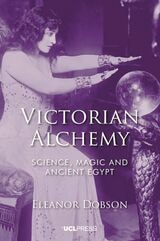
Victorian Alchemy
Science, Magic and Ancient EgyptEleanor Dobson
University College London, 2022
With its material remnants paradoxically symbolizing both antiquity and modernity to Victorian audiences, ancient Egypt was at once evocative of ancient magical power and of cutting-edge science, a tension that might be productively conceived of as “alchemical.” Examining literature and other cultural forms including art, photography, and early film, Eleanor Dobson herein traces the myriad ways in which the Victorian fascination with ancient Egypt evoked the entwined forces of magic and science, providing more than a mere setting for Orientalist fantasies and nightmares. From imaging technologies and astronomy to investigations into the electromagnetic spectrum and the human mind itself, this book demonstrates how conceptions of modernity were inextricably bound up in the contemporary reception of the ancient world, illustrating how such ideas took root and flourished in the Victorian era and persist to this day.
Victorian Art Criticism and the Woman Writer
John Paul M. Kanwit
The Ohio State University Press, 2013
Victorian Bestseller
The Life of Dinah CraikKaren Bourrier
University of Michigan Press, 2019
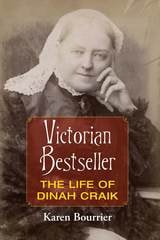
Victorian Bestseller is the first book to relate the story of Dinah Craik’s remarkable life. Combining extensive archival work with theoretical work in disability studies and the professionalization of women’s authorship, Karen Bourrier engagingly traces the contours of this author’s life. Craik, who wrote extensively about disability in her work, was no stranger to it in her personal and professional life, marked by experiences of mental and physical disability, and the ebb and flow of health. Following scholarship in the ethics of care and disability studies, the book posits Craik as an interdependent subject, placing her within a network of writers, publishers, editors and artists, friends, and family members. Victorian Bestseller also traces the conditions in the material history of the book that allowed Victorian women writers’ careers to flourish. In doing so, the biography connects corporeality, gender, and the material history of the book to the professionalization of Victorian women’s authorship.
Victorian Dogs, Victorian Men
Affect and Animals in Nineteenth-Century Literature and CultureKeridiana W. Chez
The Ohio State University Press, 2017
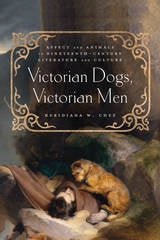
Chez traces the evolution of the human-dog relationship as it developed parallel to an increasingly imperialist national discourse. The dog began as the affective mediator of the family, then addressed the emotional needs of its individual members, and finally evolved into both “man’s best friend” and worst enemy. By the last decades of the nineteenth century, the porous human-animal boundary served to produce the “humane” man: a liberal subject enabled to engage in aggressive imperial projects. Reading the work of Charles Dickens, George Eliot, Margaret Marshall Saunders, Bram Stoker, and Jack London, Victorian Dogs, Victorian Men charts the mobilization of affect through transatlantic narratives, demonstrating the deep interconnections between animals, affect, and gender.
Victorian Domesticity
Families in the Life and Art of Louisa May AlcottCharles Strickland
University of Alabama Press, 1985
The subject of Victorian Domesticity is family life in America. The life and works of Louisa May Alcott served as the vehicle for exploring and analyzing this subject. Although Alcott was deeply influenced by popular currents of sentimentality, her own experience exposed her to the confusions and contradictions generated when sentiment confronted the reality of life in 19th-century America.
In the first chapter Strickland outlines the ways in which sentimentality colored the perception of 19th-century Americans about such issues as courtship, marriage, the relationship between the sexes, generational relationships, and the relationship between the nuclear family and the community outside the family. Chapters two and three trace Alcott’s childhood and adolescent experiences, exploring the tensions that developed between Louisa and her father, and detailing the ways in which she carried the double burden of being both poor and female as she sought her identity as a writer.
The following six chapters treat the varieties of family life that appear in Alcott’s stories, the impact of feminism on her life, and her emphasis on the importance of child nurture. In the final two chapters the author treats the relationships that Alcott perceived between the family and the world around it and assesses the legacy of the Victorian family idea.
Victorian Ghosts in the Noontide
Women Writers and the SupernaturalVanessa D. Dickerson
University of Missouri Press, 1996
During the nineteenth century, British society was making rapid advancements in science and technology. While the men became materially productive, women were expected to be the fulcrums of society's changes. As one means of adjusting to these changes, many women focused on supernaturalism and spirituality.
In Victorian Ghosts in the Noontide, Vanessa D. Dickerson analyzes women's spirituality in a materialistic age by examining the supernatural fiction of Charlotte and Emily Brontë, Elizabeth Gaskell, and George Eliot and provides interpretive readings of familiar texts like Jane Eyre and Wuthering Heights. Other works by lesser-known authors are also examined.
Technological advances eliminated many of the jobs women were accustomed to doing. This left women looking for their place in society. A sense of "in-betweenness" developed in these women who were now expected to attend not only to the physical but also to the moral and spiritual needs of the family. As an answer to this "in-betweenness" some channeled their power toward the art of writing. Because people in the mid-1800s were so thoroughly engaged in scientific thought and advancements, supernatural folklore and spirituality were disreputable ideas for anyone, especially women, to explore. Ghosts and spirits were tied to old-wives' tales, superstitions, and legends. However, by focusing on these concepts and using fiction as an outlet, women were able to make great strides in being seen and heard. The art of writing functioned as an exploration of their spiritualism in which women discovered expression, freedom, and power.
This perceptive, well-written book will add a new dimension to our understanding of women's supernatural writings of the Victorian era. Scholars of Victorian literature, women's studies, and popular culture will benefit from its insights.
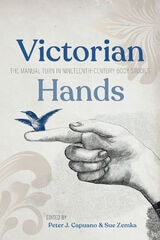
Victorian Hands
The Manual Turn in Nineteenth-Century Body StudiesEdited by Peter J. Capuano and Sue Zemka
The Ohio State University Press, 2020
Contributors
James Eli Adams, Karen Bourrier, Aviva Briefel, Peter J. Capuano, Jonathan Cheng, Kate Flint, Pamela K. Gilbert, Tamara Ketabgian, J. Hillis Miller, Deborah Denenholz Morse, Daniel A. Novak, Julianne Smith, Herbert F. Tucker, and Sue Zemka
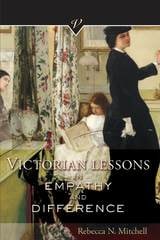
Victorian Lessons in Empathy and Difference
Rebecca N. Mitchell
The Ohio State University Press, 2011
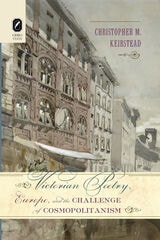
Victorian Poetry, Europe, and the Challenge of Cosmopolitanism
Christopher M. Keirstead
The Ohio State University Press, 2011
The scope and complexity of the encounter with Europe in Victorian poetry remains largely underappreciated despite recent critical attention to the genre’s global and transnational contexts. Providing much more than colorful settings or a convenient place of self-exile from England, Europe—as destination and idea—formed the basis of a dynamic, evolving form of critical cosmopolitanism much in tune with attempts to theorize the concept today. Christopher M. Keirstead’s Victorian Poetry, Europe, and the Challenge of Cosmopolitanism synthesizes the complex relationship between several notable Victorian poets, including Elizabeth Barrett Browning, Robert Browning, Matthew Arnold, and A. C. Swinburne, and their respective attitudes toward Europe as a cosmopolitan whole. Examining their international relationships and experiences, the monograph explores the ways in which these poets worked to reconcile their emotional and intellectual affinity for world citizenship with their British identity.
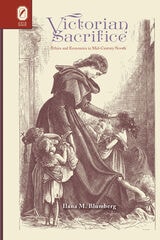
Victorian Sacrifice
Ilana M. Blumberg
The Ohio State University Press, 2013
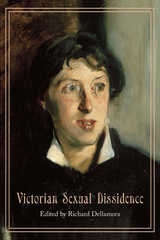
Victorian Sexual Dissidence
Edited by Richard Dellamora
University of Chicago Press, 1999
One essay, for example, traces the remarkable feminist appropriation of male-identified fields of study, such as Classical philology. Others address the validation of male bodies as objects of desire in writing, painting, and emergent modernist choreography. The writings shed light on the diverse interests served by a range of cultural practitioners and on the complex ways in which the late Victorians invented themselves as modern subjects.
This volume will be essential reading for students of British literary and cultural history as well as for those interested in feminist, gay, and lesbian studies.
Contributors are: Oliver Buckton, Richard Dellamora, Dennis Denisoff, Regenia Gagnier, Eric Haralson, Andrew Hewitt, Christopher Lane, Thaïs Morgan, Yopie Prins, Kathy Alexis Psomiades, Julia Saville, Robert Sulcer, Jr., Martha Vicinus.

Victorian Subjects
J. Hillis Miller
Duke University Press, 1991
Miller defines the term “Victorian subjects” in more than one sense. The phrase identifies an historical time but also names a concern throughout with subjectivity, consciousness, and selfhood in Victorian literature. The essays show various Victorian subjectivities seeking to ground themselves in their own underlying substance or in some self beneath or beyond the self. But “Victorian subjects” also discusses those who were subject to Queen Victoria, to the reigning ideologies of the time, to historical, social, and material conditions, including the conditions under which literature was written, published, distributed, and consumed.
These essays, taken together, sketch the outlines of ideological assumptions within the period about the self, interpersonal relations, nature, literary form, the social function of literature, and other Victorian subjects.
Victorian Vogue
British Novels on ScreenDianne F. Sadoff
University of Minnesota Press, 2009
Ranging from cinematic images of Jane Austen's estates to Oscar Wilde's drawing rooms, Dianne F. Sadoff looks at popular heritage films, often featuring Hollywood stars, that have been adapted from nineteenth-century novels.
Victorian Vogue argues that heritage films perform different cultural functions at key historical moments in the twentieth century. According to Sadoff, they are characterized by a double historical consciousness-one that is as attentive to the concerns of the time of production as to those of the Victorian period. If James Whale's Frankenstein and Tod Browning's Dracula exploited post-Depression fear in the 1930s, the horror films of the 1950s used the genre to explore homosexual panic, 1970s movies elaborated the sexuality only hinted at in the thirties, and films of the 1990s indulged the pleasures of consumption.
Taking a broad view of the relationships among film, literature, and current events, Sadoff contrasts films not merely with their nineteenth-century source novels but with crucial historical moments in the twentieth century, showing their cultural use in interpreting the present, not just the past.
Victorian Women Writers, Radical Grandmothers, and the Gendering of God
Gail Turley Houston
The Ohio State University Press, 2013
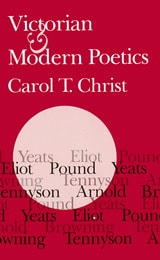
Victorian and Modern Poetics
Carol T. Christ
University of Chicago Press, 1984
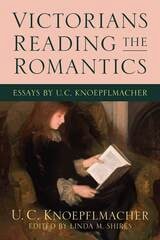
Victorians Reading the Romantics
Essays by U. C. KnoepflmacherEssays by U. C. Knoepflmacher, edited by Linda M. Shires
The Ohio State University Press, 2016
Victorians Reading the Romantics: Essays by U. C. Knoepflmacher, edited by LindaM. Shires, offers a compelling new perspective on the long and influential publishing career and thought of Knoepflmacher, a leading critic of the novel and Victorian poetry. This volume draws together essays on nineteenth-century literature written between 1963 and 2012.An introductory essay and new scaffolding emphasize the interrelations among the essays, which together form a consistent approach to literary criticism.
Knoepflmacher’s vision of texts and readersstressesthe emotional knowledge afforded by reading, writing about, and teaching literary texts.Each chapter links Romantic texts to those of later writers. Shelley and Keats try to revise Wordsworth, but they are themselves recast by Browning and Hardy. Similarly, George Eliot and Virginia Woolf’s reliance on Romantic tropes are fruitfully examined. Above all, however, these chapters stress the impact of Wordsworth on his many contemporaries and successors. Knoepflmacher probes into their texts to find, as Wordsworth did, a momentaryfusionof opposites.He posits a reader who is flexible—able to move in multiple directions by paying attention to spatial, verbal, and imagistic coordinates, across and down a page.Given the attention paid tothe translation of affect into thought,this collectionwillcontribute to Victorian studiesas well as enhance our understanding of the affective dynamics of nineteenth-century literature.
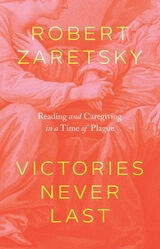
Victories Never Last
Reading and Caregiving in a Time of PlagueRobert Zaretsky
University of Chicago Press, 2022
In any time of disruption or grief, many of us seek guidance in the work of great writers who endured similar circumstances. During the first year of the COVID-19 pandemic, historian and biographer Robert Zaretsky did the same while also working as a volunteer in a nursing home in south Texas. In Victories Never Last Zaretsky weaves his reflections on the pandemic siege of his nursing home with the testimony of six writers on their own times of plague: Thucydides, Marcus Aurelius, Michel de Montaigne, Daniel Defoe, Mary Shelley, and Albert Camus, whose novel The Plague provides the title of this book.
Zaretsky delves into these writers to uncover lessons that can provide deeper insight into our pandemic era. At the same time, he goes beyond the literature to invoke his own experience of the tragedy that enveloped his Texas nursing home, one which first took the form of chronic loneliness and then, inevitably, the deaths of many residents whom we come to know through Zaretsky’s stories. In doing so, Zaretsky shows the power of great literature to connect directly to one’s own life in a different moment and time.
For all of us still struggling to comprehend this pandemic and its toll, Zaretsky serves as a thoughtful and down-to-earth guide to the many ways we can come to know and make peace with human suffering.
Views from the Inside
Czech Underground Literature and Culture (1948–1989)Edited by Martin Machovec
Karolinum Press, 2019
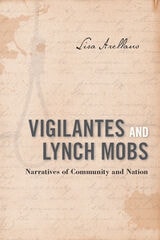
Vigilantes and Lynch Mobs
Narratives of Community and NationLisa Arellano
Temple University Press, 2012
Looking at the narrative accounts of mob violence produced by vigilantes and their advocates as “official” histories, Lisa Arellano shows how these nonfiction narratives conformed to a common formula whose purpose was to legitimate frontier justice and lynching.
In Vigilantes and Lynch Mobs, Arellano closely examines such narratives as well as the work of Western historian and archivist Hubert Howe Bancroft, who was sympathetic to them, and that of Ida B. Wells, who wrote in fierce opposition to lynching. Tracing the creation, maintenance, and circulation of dominant, alternative, and oppositional vigilante stories from the nineteenth-century frontier through the Jim Crow South, she casts new light on the role of narrative in creating a knowable past.
Demonstrating how these histories ennobled the actions of mobs and rendered their leaders and members as heroes, Arellano presents a persuasive account of lynching’s power to create the conditions favorable to its own existence.
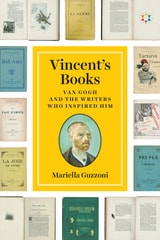
Vincent's Books
Van Gogh and the Writers Who Inspired HimMariella Guzzoni
University of Chicago Press, 2020
One of the most famous artists in history, Vincent van Gogh (1853–1890) was also a man with another powerful passion—for books. An insatiable reader, Van Gogh spent his life hungrily consuming as many books as he could. He read, reread, and copied out books in Dutch, English, and French. He knew many passages by heart from works by Dickens, Zola, Shakespeare, and Maupassant, among many others. As he wrote to his brother, Theo, in one of their hundreds of letters: “I have a more or less irresistible passion for books.”
In Vincent’s Books, Mariella Guzzoni explores Van Gogh’s life as a voracious bookworm, noting what he read, what he wrote about, and how his love of reading influenced his art. She walks us through his life, chapter by chapter: from the religious aspirations of his early adulthood, to his decision to be a painter, to the end of his tragically short life. He moved from Holland to Paris to Provence; at each moment, ideas he encountered in books defined and guided his thoughts and his worldview. Van Gogh wrote with eloquence and insight about what he was reading in his letters to Theo, referring to at least two hundred authors. Books and readers are frequent subjects of his paintings, and Guzzoni highlights over one hundred of these works, such as Still Life with Bible in the Van Gogh Museum and his vivid paintings of l’Arlesienne.
A gorgeously illustrated biography that will appeal to any booklover, Vincent’s Books takes us on a fresh, fascinating journey through the pages of a beloved artist’s life.
Explore Van Gogh’s musings on his favorite writers, including
Thomas à Kempis, Charles Blanc, Honoré de Balzac, Edmond and Jules de Goncourt, Guy de Maupassant, Charles Dickens, Erckmann-Chatrian, Homer, Victor Hugo, Pierre Loti, Jules Michelet, William Shakespeare, Harriet Beecher Stowe, Émile Zola

Violence and Difference
Girard, Derrida, and DeconstructionAndrew J. McKenna
University of Illinois Press, 1992
theory of Jacques Derrida in terms of each other--to create an interpretive strategy that he
hopes will "salvage deconstruction from the flashy sterility it favors."
Violence and Grace
Exceptional Life between Shakespeare and ModernityNichole E. Miller
Northwestern University Press, 2014
In Violence and Grace, Nichole Miller establishes a conceptual link between early modern English drama and twentieth-century political theology, both of which emerge from the experience of political crisis. Miller’s analyses accordingly undertake to retrieve for political theology the relations between gender, sexuality, and the political aesthetics of violence on the early modern stage, addressing the plays of Marlowe, Middleton, and especially Shakespeare. In doing so, she expands our understanding of drama’s continuing theoretical impact.
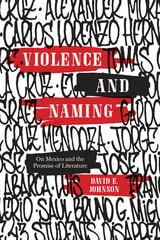
Violence and Naming
On Mexico and the Promise of LiteratureBy David E. Johnson
University of Texas Press, 2019
Reclaiming the notion of literature as an institution essential for reflecting on the violence of culture, history, and politics, Violence and Naming exposes the tension between the irreducible, constitutive violence of language and the reducible, empirical violation of others. Focusing on an array of literary artifacts, from works by journalists such as Elena Poniatowska and Sergio González Rodríguez to the Zapatista communiqués to Roberto Bolaño's The Savage Detectives and 2666, this examination demonstrates that Mexican culture takes place as a struggle over naming—with severe implications for the rights and lives of women and indigenous persons.
Through rereadings of the Conquest of Mexico, the northern Mexican feminicide, the Zapatista uprising in Chiapas, the disappearance of the forty-three students at Iguala in 2014, and the 1999 abortion-rights scandal centering on “Paulina,” which revealed the tenuousness of women’s constitutionally protected reproductive rights in Mexico, Violence and Naming asks how societies can respond to violence without violating the other. This essential question is relevant not only to contemporary Mexico but to all struggles for democracy that promise equality but instead perpetuate incessant cycles of repression.