Results by title
1210 books match the query 'Mexico' and 11 start with v
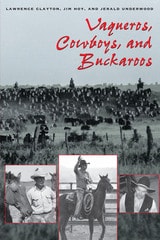
Vaqueros, Cowboys, and Buckaroos
By Lawrence Clayton, Jim Hoy, and Jerald Underwood
University of Texas Press, 2001
Herding cattle from horseback has been a tradition in northern Mexico and the American West since the Spanish colonial era. The first mounted herders were the Mexican vaqueros, expert horsemen who developed the skills to work cattle in the brush country and deserts of the Southwestern borderlands. From them, Texas cowboys learned the trade, evolving their own unique culture that spread across the Southwest and Great Plains. The buckaroos of the Great Basin west of the Rockies trace their origin to the vaqueros, with influence along the way from the cowboys, though they, too, have ways and customs distinctly their own.
In this book, three long-time students of the American West describe the history, working practices, and folk culture of vaqueros, cowboys, and buckaroos. They draw on historical records, contemporary interviews, and numerous photographs to show what makes each group of mounted herders distinctive in terms of working methods, gear, dress, customs, and speech. They also highlight the many common traits of all three groups.
This comparative look at vaqueros, cowboys, and buckaroos brings the mythical image of the American cowboy into focus and detail and honors the regional and national variations. It will be an essential resource for anyone who would know or portray the cowboy—readers, writers, songwriters, and actors among them.
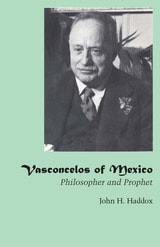
Vasconcelos of Mexico
Philosopher and ProphetBy John H. Haddox
University of Texas Press, 1967
José Vasconcelos—lawyer, politician, writer, educator, philosopher, prophet, and mystic—was one of the most influential and controversial figures in the intellectual life of twentieth-century Mexico.
Vasconcelos was driven by the desire to gain a complete and comprehensive vision of reality, employing his own aesthetic-emotive method and a poetic mode of expression. The complex philosophical system that resulted is what he called “aesthetic monism.” But this is only one side of the man. Vasconcelos was also vitally interested in both the proximate realities and remote possibilities of Mexico, in the character of the “cosmic race” of his homeland, and in the relations between his own country and the others of this hemisphere.
Soon after Vasconcelos’s death in 1959, Eduardo García Máynez spoke of him, in a moving tribute, as “without question the most inspiring intellectual and human figure that Mexico has produced.” Unhappily—and perhaps disgracefully—he has remained almost unknown outside the Spanish-speaking world. Histories of Mexico published in English usually give passing mention to his role as Minister of Public Education or his unsuccessful campaign for the presidency, but his aesthetic system and his socio-political ideas have been ignored by philosophers in the United States.
Here, for the first time, is a unified, inclusive, and occasionally critical presentation of the entire range of Vasconcelos’s thought, from his metaphysics and theory of knowledge through his aesthetics and ethics to his social and political philosophy. It is enriched by an appendix in which the most significant passages from Vasconcelos’s own philosophical writings are presented in English translations.
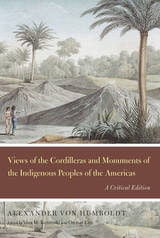
Views of the Cordilleras and Monuments of the Indigenous Peoples of the Americas
A Critical EditionAlexander von Humboldt
University of Chicago Press, 2013
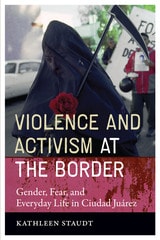
Violence and Activism at the Border
Gender, Fear, and Everyday Life in Ciudad JuarezBy Kathleen Staudt
University of Texas Press, 2008
Between 1993 and 2003, more than 370 girls and women were murdered and their often-mutilated bodies dumped outside Ciudad Juárez in Chihuahua, Mexico. The murders have continued at a rate of approximately thirty per year, yet law enforcement officials have made no breakthroughs in finding the perpetrator(s). Drawing on in-depth surveys, workshops, and interviews of Juárez women and border activists, Violence and Activism at the Border provides crucial links between these disturbing crimes and a broader history of violence against women in Mexico. In addition, the ways in which local feminist activists used the Juárez murders to create international publicity and expose police impunity provides a unique case study of social movements in the borderlands, especially as statistics reveal that the rates of femicide in Juárez are actually similar to other regions of Mexico.
Also examining how non-governmental organizations have responded in the face of Mexican law enforcement's "normalization" of domestic violence, Staudt's study is a landmark development in the realm of global human rights.
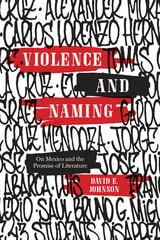
Violence and Naming
On Mexico and the Promise of LiteratureBy David E. Johnson
University of Texas Press, 2019
Reclaiming the notion of literature as an institution essential for reflecting on the violence of culture, history, and politics, Violence and Naming exposes the tension between the irreducible, constitutive violence of language and the reducible, empirical violation of others. Focusing on an array of literary artifacts, from works by journalists such as Elena Poniatowska and Sergio González Rodríguez to the Zapatista communiqués to Roberto Bolaño's The Savage Detectives and 2666, this examination demonstrates that Mexican culture takes place as a struggle over naming—with severe implications for the rights and lives of women and indigenous persons.
Through rereadings of the Conquest of Mexico, the northern Mexican feminicide, the Zapatista uprising in Chiapas, the disappearance of the forty-three students at Iguala in 2014, and the 1999 abortion-rights scandal centering on “Paulina,” which revealed the tenuousness of women’s constitutionally protected reproductive rights in Mexico, Violence and Naming asks how societies can respond to violence without violating the other. This essential question is relevant not only to contemporary Mexico but to all struggles for democracy that promise equality but instead perpetuate incessant cycles of repression.
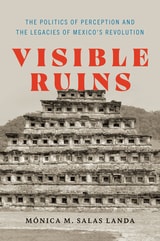
Visible Ruins
The Politics of Perception and the Legacies of Mexico's RevolutionMónica M. Salas Landa
University of Texas Press, 2024
2026 Honorable Mention, Mejor Libro, Historia Reciente y Memoria Section of the Latin American Studies Association
An examination of the failures of the Mexican Revolution through the visual and material records.
The Mexican Revolution (1910–1920) introduced a series of state-led initiatives promising modernity, progress, national grandeur, and stability; state surveyors assessed land for agrarian reform, engineers used nationalized oil for industrialization, archaeologists reconstructed pre-Hispanic monuments for tourism, and anthropologists studied and photographed Indigenous populations to achieve their acculturation. Far from accomplishing their stated goals, however, these initiatives concealed violence, and permitted land invasions, forced displacement, environmental damage, loss of democratic freedom, and mass killings. Mónica M. Salas Landa uses the history of northern Veracruz to demonstrate how these state-led efforts reshaped the region's social and material landscapes, affecting what was and is visible. Relying on archival sources and ethnography, she uncovers a visual order of ongoing significance that was established through postrevolutionary projects and that perpetuates inequality based on imperceptibility.
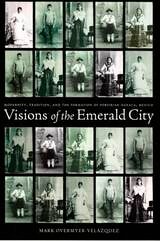
Visions of the Emerald City
Modernity, Tradition, and the Formation of Porfirian Oaxaca, MexicoMark Overmyer-Velázquez
Duke University Press, 2006
Incorporating a nuanced understanding of visual culture into his analysis, Overmyer-Velázquez shows how ideas of modernity figured in Oaxacans’ ideologies of class, race, gender, sexuality, and religion and how they were expressed in Oaxaca City’s streets, plazas, buildings, newspapers, and public rituals. He pays particular attention to the roles of national and regional elites, the Catholic church, and popular groups—such as Oaxaca City’s madams and prostitutes—in shaping the discourses and practices of modernity. At the same time, he illuminates the dynamic interplay between these groups. Ultimately, this well-illustrated history provides insight into provincial life in pre-Revolutionary Mexico and challenges any easy distinctions between the center and the periphery or modernity and tradition.
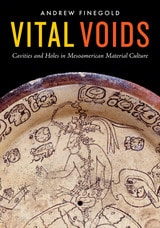
Vital Voids
Cavities and Holes in Mesoamerican Material CultureBy Andrew Finegold
University of Texas Press, 2021
The Resurrection Plate, a Late Classic Maya dish, is decorated with an arresting scene. The Maize God, assisted by two other deities, emerges reborn from a turtle shell. At the center of the plate, in the middle of the god’s body and aligned with the point of emergence, there is a curious sight: a small, neatly drilled hole.
Art historian Andrew Finegold explores the meanings attributed to this and other holes in Mesoamerican material culture, arguing that such spaces were broadly understood as conduits of vital forces and material abundance, prerequisites for the emergence of life. Beginning with, and repeatedly returning to, the Resurrection Plate, this study explores the generative potential attributed to a wide variety of cavities and holes in Mesoamerica, ranging from the perforated dishes placed in Classic Maya burials, to caves and architectural voids, to the piercing of human flesh. Holes are also discussed in relation to fire, based on the common means through which both were produced: drilling. Ultimately, by attending to what is not there, Vital Voids offers a fascinating approach to Mesoamerican cosmology and material culture.
Viva Cristo Rey!
The Cristero Rebellion and the Church-State Conflict in MexicoBy David C. Bailey
University of Texas Press, 1974
Between 1926 and 1929, thousands of Mexicans fought and died in an attempt to overthrow the government of their country. They were the Cristeros, so called because of their battle cry, ¡Viva Cristo Rey!—Long Live Christ the King! The Cristero rebellion and the church-state conflict remain one of the most controversial subjects in Mexican history, and much of the writing on it is emotional polemic. David C. Bailey, basing his study on the most important published and unpublished sources available, strikes a balance between objective reporting and analysis. This book depicts a national calamity in which sincere people followed their convictions to often tragic ends.
The Cristero rebellion climaxed a century of animosity between the Catholic church and the Mexican state, and this background is briefly summarized here. With the coming of the 1910 revolution the hostility intensified. The revolutionists sought to impose severe limitations on the Church, and Catholic anti-revolutionary militancy grew apace. When the government in 1926 decreed strict enforcement of anticlerical legislation, matters reached a crisis. Church authorities suspended public worship throughout Mexico, and Catholics in various parts of the country rose up in arms. There followed almost three years of indecisive guerrilla warfare marked by brutal excesses on both sides. Bailey describes the armed struggle in broad outline but concentrates on the political and diplomatic maneuvering that ultimately decided the issue.
A de facto settlement was brought about in 1929, based on the government’s pledge to allow the Church to perform its spiritual offices under its own internal discipline. The pact was arranged mainly through the intercession of U.S. Ambassador Dwight Morrow. His role in the conflict, as well as that of other Americans who decisively influenced the course of events, receives detailed attention in the study. The position of the Vatican during the conflict and its role in the settlement are also examined in detail.
With the 1929 settlement the clergy returned to the churches, whereupon the Cristeros lost public support and the rebellion collapsed. The spirit of the settlement soon evaporated, more strife followed, and only after another decade did permanent religious peace come to Mexico.
Viva George!
Celebrating Washington's Birthday at the US-Mexico BorderBy Elaine A. Peña
University of Texas Press, 2020
For 120 years, residents of the cross-border community of Laredo/Nuevo Laredo have celebrated George Washington's birthday together, and this account reveals the essential political work of a time-honored civic tradition.
Since 1898, residents of Laredo, Texas, and Nuevo Laredo, Tamaulipas, have reached across the US-Mexico border to celebrate George Washington's birthday. The celebration can last a whole month, with parade goers reveling in American and Mexican symbols; George Washington saluting; and “Pocahontas” riding on horseback. An international bridge ceremony, the heart and soul of the festivities, features children from both sides of the border marching toward each other to link the cities with an embrace. ¡Viva George! offers an ethnography and a history of this celebration, which emerges as both symbol and substance of cross-border community life. Anthropologist and Laredo native Elaine A. Peña shows how generations of border officials, civil society organizers, and everyday people have used the bridge ritual to protect shared economic and security interests as well as negotiate tensions amid natural disasters, drug-war violence, and immigration debates. Drawing on previously unknown sources and extensive fieldwork, Peña finds that border enactments like Washington's birthday are more than goodwill gestures. From the Rio Grande to the 38th Parallel, they do the meaningful political work that partisan polemics cannot.
Voices in Aerosol
Youth Culture, Institutional Attunement, and Graffiti in Urban MexicoCaitlin Frances Bruce
University of Texas Press, 2024
2024 Visual Communication Division Award, National Communication Association
2025 Philosophy of Communication, Theory, and Critique Division Distinguished Book Award, National Communication Association
2025 Winans-Wichelns Memorial Award for Distinguished Scholarship in Rhetoric and Public Address, National Communication Association
How a city government in central Mexico evolved from waging war on graffiti in the early 2000s to sanctioning its creation a decade later, and how youth navigated these changing conditions for producing art.
The local government, residents, and media outlets in León, Mexico, treated graffiti as a disease until the state began sponsoring artistic graffiti through a program of its own. In Voices in Aerosol, the first book-length study of state-sponsored graffiti, Caitlin Frances Bruce considers the changing perceptions and recognition of graffiti artists, their right to the city, and the use of public space over the span of eighteen years (2000–2018). Focusing on the midsized city of León, Bruce offers readers a look at the way negotiations with the neoliberal state unfolded at different levels and across decades.
Issues brought to light in this case study, such as graffiti as a threat and graffiti as a sign of gentrification, resonate powerfully with those germane to other urban landscapes throughout the Western Hemisphere and beyond. Combining archival work, interviews, considerations of urban planning, local politics in Mexico, and insights gained by observing graffiti events and other informal artistic encounters, Bruce offers a new lens through which to understand the interplay between sanctioned and unsanctioned forms of cultural expression. Ultimately, Voices in Aerosol builds a strong case for graffiti as a contested tool for "voicing" public demands.