Results by title
225 books match the query 'Modernism' and 6 start with v
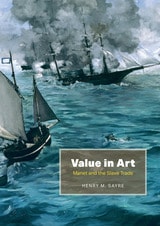
Value in Art
Manet and the Slave TradeHenry M. Sayre
University of Chicago Press, 2022
How did art critics come to speak of light and dark as, respectively, “high in value” and “low in value”? Henry M. Sayre traces the origin of this usage to one of art history’s most famous and racially charged paintings, Édouard Manet’s Olympia.
Art critics once described light and dark in painting in terms of musical metaphor—higher and lower tones, notes, and scales. Sayre shows that it was Émile Zola who introduced the new “law of values” in an 1867 essay on Manet. Unpacking the intricate contexts of Zola’s essay and of several related paintings by Manet, Sayre argues that Zola’s usage of value was intentionally double coded—an economic metaphor for the political economy of slavery. In Manet’s painting, Olympia and her maid represent objects of exchange, a commentary on the French Empire’s complicity in the ongoing slave trade in the Americas.
Expertly researched and argued, this bold study reveals the extraordinary weight of history and politics that Manet’s painting bears. Locating the presence of slavery at modernism’s roots, Value in Art is a surprising and necessary intervention in our understanding of art history.
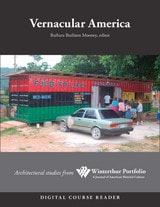
Vernacular America
Architectural Studies from Winterthur PortfolioEdited by Barbara Burlison Mooney
University of Chicago Press, 2014
Many instructors of New World architectural history seek to bring broad social, ethnic, political, and technical perspectives to the study of the built environment. While they await a survey book that fully integrates academic and vernacular narratives, the articles in this course reader are intended to encourage instructors and students to incorporate a diverse and inclusive approach into the curriculum, one that continues to understand the past, but also one that pays attention to the future. The aim of this publication is to offer both instructors and students the opportunity to create and nurture a more comprehensive picture of the history of the built environment of the United States.
Barbara Burlison Mooney is associate professor of art history at the University of Iowa. Professor Mooney’s area of specialization encompasses both American architecture and African American art.
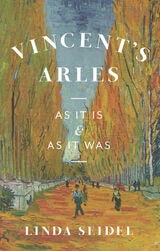
Vincent's Arles
As It Is and as It WasLinda Seidel
University of Chicago Press, 2023
Once admired as “a little Rome” on the banks of the Rhône, the town of Arles in the south of France had been a place of significance long before the painter Vincent van Gogh arrived in February of 1888. Aware of Arles’s history as a haven for poets, van Gogh spent an intense fifteen months there, scouring the city’s streets and surroundings in search of subjects to paint when he wasn’t thinking about other places or lamenting his woeful circumstances.
In Vincent’s Arles, Linda Seidel serves as a guide to the mysterious and culturally rich town of Arles, taking us to the places immortalized by van Gogh and cherished by innumerable visitors and pilgrims. Drawing on her extensive expertise on the region and the medieval world, Seidel presents Arles then and now as seen by a walker, visiting sites old and new. Roman, Romanesque, and contemporary structures come alive with the help of the letters the artist wrote while in Arles. The result is the perfect blend of history, art, and travel, a chance to visit a lost past and its lingering, often beautiful, traces in the present.
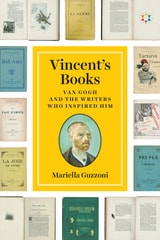
Vincent's Books
Van Gogh and the Writers Who Inspired HimMariella Guzzoni
University of Chicago Press, 2020
One of the most famous artists in history, Vincent van Gogh (1853–1890) was also a man with another powerful passion—for books. An insatiable reader, Van Gogh spent his life hungrily consuming as many books as he could. He read, reread, and copied out books in Dutch, English, and French. He knew many passages by heart from works by Dickens, Zola, Shakespeare, and Maupassant, among many others. As he wrote to his brother, Theo, in one of their hundreds of letters: “I have a more or less irresistible passion for books.”
In Vincent’s Books, Mariella Guzzoni explores Van Gogh’s life as a voracious bookworm, noting what he read, what he wrote about, and how his love of reading influenced his art. She walks us through his life, chapter by chapter: from the religious aspirations of his early adulthood, to his decision to be a painter, to the end of his tragically short life. He moved from Holland to Paris to Provence; at each moment, ideas he encountered in books defined and guided his thoughts and his worldview. Van Gogh wrote with eloquence and insight about what he was reading in his letters to Theo, referring to at least two hundred authors. Books and readers are frequent subjects of his paintings, and Guzzoni highlights over one hundred of these works, such as Still Life with Bible in the Van Gogh Museum and his vivid paintings of l’Arlesienne.
A gorgeously illustrated biography that will appeal to any booklover, Vincent’s Books takes us on a fresh, fascinating journey through the pages of a beloved artist’s life.
Explore Van Gogh’s musings on his favorite writers, including
Thomas à Kempis, Charles Blanc, Honoré de Balzac, Edmond and Jules de Goncourt, Guy de Maupassant, Charles Dickens, Erckmann-Chatrian, Homer, Victor Hugo, Pierre Loti, Jules Michelet, William Shakespeare, Harriet Beecher Stowe, Émile Zola
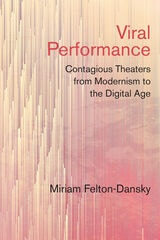
Viral Performance
Contagious Theaters from Modernism to the Digital AgeMiriam Felton-Dansky
Northwestern University Press, 2018
Viral performance practices testify to the age-old—and ever renewed—instinct that when people gather, something spreads. Performance, an art form requiring and relying on live contact, renders such spreading visible, raises its stakes, and encodes it in theatrical form. The artists explored here rarely disseminate their ideas or gestures as directly as a viral marketer or a political movement would; rather, they undermine simplified forms of contagion while holding dialogue with the philosophical and popular discourses, old and new, that have surrounded viral culture.
Viral Performance argues that the concept of the viral is historically deeper than immediate associations with the contemporary digital landscape might suggest, and far more intimately linked to live performance
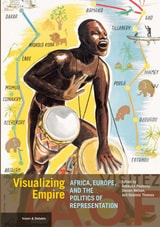
Visualizing Empire
Africa, Europe, and the Politics of RepresentationRebecca Peabody
J. Paul Getty Trust, The, 2021
An exploration of how an official French visual culture normalized France’s colonial project and exposed citizens and subjects to racialized ideas of life in the empire.
By the end of World War I, having fortified its colonial holdings in the Caribbean, Latin America, Africa, the Indian Ocean, and Asia, France had expanded its dominion to the four corners of the earth. This volume examines how an official French visual culture normalized the country’s colonial project and exposed citizens and subjects alike to racialized ideas of life in the empire. Essays analyze aspects of colonialism through investigations into the art, popular literature, material culture, film, and exhibitions that represented, celebrated, or were created for France’s colonies across the seas.
These studies draw from the rich documents and media—photographs, albums, postcards, maps, posters, advertisements, and children’s games—related to the nineteenth- and twentieth-century French empire that are held in the Getty Research Institute’s Association Connaissance de l’histoire de l’Afrique contemporaine (ACHAC) collections. ACHAC is a consortium of scholars and researchers devoted to exploring and promoting discussions of race, iconography, and the colonial and postcolonial periods of Africa and Europe.