426 books match the query 'Philosophy & Social Aspects' and 5 start with v
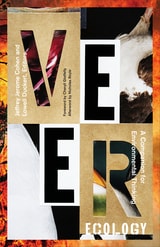
cover of Veer Ecology: A Companion for Environmental Thinking

Veer Ecology

A Companion for Environmental Thinking

Jeffrey Jerome Cohen

University of Minnesota Press, 2017

The words most commonly associated with the environmental movement—save, recycle, reuse, protect, regulate, restore—describe what we can do to help the environment, but few suggest how we might transform ourselves to better navigate the sudden turns of the late Anthropocene. Which words can help us to veer conceptually along with drastic environmental flux? Jeffrey Jerome Cohen and Lowell Duckert asked thirty brilliant thinkers to each propose one verb that stresses the forceful potential of inquiry, weather, biomes, apprehensions, and desires to swerve and sheer. Each term is accompanied by a concise essay contextualizing its meaning in times of resource depletion, environmental degradation, and global climate change.

Some verbs are closely tied to natural processes: compost, saturate, seep, rain, shade, sediment, vegetate, environ. Many are vaguely unsettling: drown, unmoor, obsolesce, power down, haunt. Others are enigmatic or counterintuitive: curl, globalize, commodify, ape, whirl. And while several verbs pertain to human affect and action—love, represent, behold, wait, try, attune, play, remember, decorate, tend, hope—a primary goal of Veer Ecology is to decenter the human. Indeed, each of the essays speaks to a heightened sense of possibility, awakening our imaginations and inviting us to think the world anew from radically different perspectives. A groundbreaking guide for the twenty-first century, Veer Ecology foregrounds the risks and potentialities of living on—and with—an alarmingly dynamic planet.

Contributors: Stacy Alaimo, U of Texas at Arlington; Joseph Campana, Rice U; Holly Dugan, George Washington U; Lara Farina, West Virginia U; Cheryll Glotfelty, U of Nevada, Reno; Anne F. Harris, DePauw U; Tim Ingold, U of Aberdeen; Serenella Iovino, U of Turin; Stephanie LeMenager, U of Oregon; Scott Maisano, U of Massachusetts, Boston; Tobias Menely, U of California, Davis; Steve Mentz, St. John’s U; J. Allan Mitchell, U of Victoria; Timothy Morton, Rice U; Vin Nardizzi, U of British Columbia; Laura Ogden, Dartmouth College; Serpil Opperman, Hacettepe U, Ankara; Daniel C. Remein, U of Massachusetts, Boston; Margaret Ronda, U of California, Davis; Nicholas Royle, U of Sussex; Catriona Sandilands, York U; Christopher Schaberg, Loyola U; Rebecca R. Scott, U of Missouri; Theresa Shewry, U of California, Santa Barbara; Mick Smith, Queen’s U; Jesse Oak Taylor, U of Washington; Brian Thill, Golden West College; Coll Thrush, U of British Columbia, Vancouver; Cord J. Whitaker, Wellesley College; Julian Yates, U of Delaware.

[more]
cover of Vinyl Theory

Vinyl Theory

Jeffrey R. Di Leo

Lever Press, 2020
Why are vinyl records making a comeback? How is their resurgence connected to the political economy of music? Vinyl Theory responds to these and other questions by exploring the intersection of vinyl records with critical theory. In the process, it asks how the political economy of music might be connected with the philosophy of the record. The young critical theorist and composer Theodor Adorno’s work on the philosophy of the record and the political economy of music of the contemporary French public intellectual, Jacques Attali, are brought together with the work of other theorists in order to understand the fall and resurrection of vinyl records. The major argument of Vinyl Theory is that the very existence of vinyl records may be central to understanding the resiliency of neoliberalism. This argument is made by examining the work of Adorno, Attali, Friedrich Nietzsche, and others on music through the lens of Michel Foucault’s biopolitics.
[more]
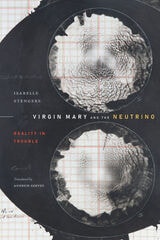
cover of Virgin Mary and the Neutrino: Reality in Trouble

Virgin Mary and the Neutrino

Reality in Trouble

Isabelle Stengers

Duke University Press, 2023
In Virgin Mary and the Neutrino, first published in French in 2006 and here appearing in English for the first time, Isabelle Stengers experiments with the possibility of addressing modern practices not as a block but through their divergence from each other. Drawing on thinkers ranging from John Dewey to Gilles Deleuze, she develops what she calls an “ecology of practices” into a capacious and heterogeneous perspective that is inclusive of cultural and political forces but not reducible to them. Stengers first advocates for an approach to sciences that would emphasize the way each should be situated by the kind of relationships demanded by what it attempts to address. This approach turns away from the disabling scientific/nonscientific binary—like the opposition between the neutrino and the Virgin Mary. An ecology of practices instead stimulates an appetite for thinking reality not as an arbiter but as what we can relate to through the generation of diverging concerns and obligations.
[more]
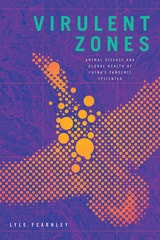
cover of Virulent Zones: Animal Disease and Global Health at China's Pandemic Epicenter

Virulent Zones

Animal Disease and Global Health at China's Pandemic Epicenter

Lyle Fearnley

Duke University Press, 2020

Scientists have identified southern China as a likely epicenter for viral pandemics, a place where new viruses emerge out of intensively farmed landscapes and human--animal interactions. In Virulent Zones, Lyle Fearnley documents the global plans to stop the next influenza pandemic at its source, accompanying virologists and veterinarians as they track lethal viruses to China's largest freshwater lake, Poyang Lake. Revealing how scientific research and expert agency operate outside the laboratory, he shows that the search for origins is less a linear process of discovery than a constant displacement toward new questions about cause and context. As scientists strive to understand the environments from which the influenza virus emerges, the unexpected scale of duck farming systems and unusual practices such as breeding wild geese unsettle research objects, push scientific inquiry in new directions, and throw expert authority into question. Drawing on fieldwork with global health scientists, state-employed veterinarians, and poultry farmers in Beijing and at Poyang Lake, Fearnley situates the production of ecological facts about disease emergence inside the shifting cultural landscapes of agrarian change and the geopolitics of global health.
[more]
cover of Vita Sexualis: Karl Ulrichs and the Origins of Sexual Science

Vita Sexualis

Karl Ulrichs and the Origins of Sexual Science

Ralph M. Leck

University of Illinois Press, 2020

Karl Ulrichs's studies of sexual diversity galvanized the burgeoning field of sexual science in the nineteenth century. But in the years since, his groundbreaking activism has overshadowed his scholarly achievements. Ulrichs publicly defied Prussian law to agitate for gay equality and marriage, and founded the world's first organization dedicated to the legal and social emancipation of homosexuals. Ralph M. Leck returns Ulrichs to his place as the inventor of the science of sexual heterogeneity. Leck's analysis situates sexual science in a context that includes politics, aesthetics, the languages of science, and the ethics of gender. Although he was the greatest nineteenth-century scholar of sexual heterogeneity, Ulrichs retained certain traditional conjectures about gender. Leck recognizes these subtleties and employs the analytical concepts of modernist vita sexualis and traditional psychopathia sexualis to articulate philosophical and cultural differences among sexologists. Original and audacious, Vita Sexualis uses a bedrock figure's scientific and political innovations to open new insights into the history of sexual science, legal systems, and Western amatory codes.
[more]