546 books match the query 'Semiotics & Theory' and 6 start with v

cover of Vampires, Mummies and Liberals: Bram Stoker and the Politics of Popular Fiction

Vampires, Mummies and Liberals

Bram Stoker and the Politics of Popular Fiction

David Glover

Duke University Press, 1996

Nearly a hundred years after its debut in 1897, Dracula is still one of the most popular of all Gothic narratives, always in print and continually adapted for stage and screen. Paradoxically, David Glover suggests, this very success has obscured the historical conditions and authorial circumstances of the novel’s production. By way of a long overdue return to the novels, short stories, essays, journalism, and correspondence of Bram Stoker, Vampires, Mummies, and Liberals reconstructs the cultural and political world that gave birth to Dracula. To bring Stoker’s life into productive relationship with his writing, Glover offers a reading that locates the author within the changing commercial contours of the late-Victorian public sphere and in which the methods of critical biography are displaced by those of cultural studies.
Glover’s efforts reveal a writer who was more wide-ranging and politically engaged than his current reputation suggests. An Irish Protestant and nationalist, Stoker nonetheless drew his political inspiration from English liberalism at a time of impending crisis, and the tradition’s contradictions and uncertainties haunt his work. At the heart of Stoker’s writing Glover exposes a preoccupation with those sciences and pseudo-sciences—from physiognomy and phrenology to eugenics and sexology—that seemed to cast doubt on the liberal faith in progress. He argues that Dracula should be read as a text torn between the stances of the colonizer and the colonized, unable to accept or reject the racialized images of backwardness that dogged debates about Irish nationhood. As it tracks the phantasmatic form given to questions of character and individuality, race and production, sexuality and gender, across the body of Stoker’s writing, Vampires, Mummies, and Liberals draws a fascinating portrait of an extraordinary transitional figure.
Combining psychoanalysis and cultural theory with detailed historical research, this book will be of interest to scholars of Victorian and Irish fiction and to those concerned with cultural studies and popular culture.
[more]
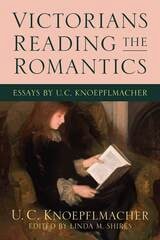
cover of Victorians Reading the Romantics: Essays by U. C. Knoepflmacher

Victorians Reading the Romantics

Essays by U. C. Knoepflmacher

Essays by U. C. Knoepflmacher, edited by Linda M. Shires

The Ohio State University Press, 2016

Victorians Reading the Romantics: Essays by U. C. Knoepflmacher, edited by LindaM. Shires, offers a compelling new perspective on the long and influential publishing career and thought of Knoepflmacher, a leading critic of the novel and Victorian poetry. This volume draws together essays on nineteenth-century literature written between 1963 and 2012.An introductory essay and new scaffolding emphasize the interrelations among the essays, which together form a consistent approach to literary criticism.

Knoepflmacher’s vision of texts and readersstressesthe emotional knowledge afforded by reading, writing about, and teaching literary texts.Each chapter links Romantic texts to those of later writers. Shelley and Keats try to revise Wordsworth, but they are themselves recast by Browning and Hardy. Similarly, George Eliot and Virginia Woolf’s reliance on Romantic tropes are fruitfully examined. Above all, however, these chapters stress the impact of Wordsworth on his many contemporaries and successors. Knoepflmacher probes into their texts to find, as Wordsworth did, a momentaryfusionof opposites.He posits a reader who is flexible—able to move in multiple directions by paying attention to spatial, verbal, and imagistic coordinates, across and down a page.Given the attention paid tothe translation of affect into thought,this collectionwillcontribute to Victorian studiesas well as enhance our understanding of the affective dynamics of nineteenth-century literature.
[more]
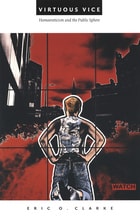
cover of Virtuous Vice: Homoeroticism and the Public Sphere

Virtuous Vice

Homoeroticism and the Public Sphere

Eric O. Clarke

Duke University Press, 2000

In this daring study of queer life and the public sphere, Eric O. Clarke examines the effects of inclusion within public culture. Departing from studies that emphasize homophobia and its mechanisms of exclusion, Virtuous Vice details how mainstream efforts to represent queers affirmatively continually fall short of full democratic enfranchisement. Clarke draws on contemporary writings along with late-eighteenth- and nineteenth-century English and European cultural history to investigate how concepts of value, representation, and homoeroticism have interacted and circulated in the West since the Enlightenment.
Examining the role of eroticism in citizenship and why only normalizing
constructions of homosexuality enable inclusion, Clarke reconsiders the work of Habermas and Foucault in relation to contemporary visibility politics, Kant’s moral and political theory, Marx’s analysis of value, and the sexualized dynamics of the Victorian cultural public sphere. The juxtaposition of Habermas with Foucault reveals the surprising value of reading the former in the context of queer politics and the usefulness of the theory of the public sphere for understanding contemporary identity politics and the visibility politics of the 1990s. Examining how a host of nonsexual factors impinge historically upon the constitution of sexual identities and practices, Clarke negotiates the relation between questions of publicity and categories of value. Discussions of television sitcoms (such as Ellen), marketing techniques, authenticity, and literary culture add to this daring analysis of visibility politics.
As a critique of the claim that equal representation of gays and lesbians necessarily constitutes progress, this significant intervention into social theory will find enthusiastic readers in the fields of Victorian, cultural, literary, and gay and lesbian studies, as well as other fields engaged with categories of identity.
[more]
cover of Visions of Global America and the Future of Critical Reading

Visions of Global America and the Future of Critical Reading

Daniel T. O’Hara

The Ohio State University Press, 2009
The forces of globalization have transformed literary studies in America, and not for the better. The detailed critical reading of artistic texts has been replaced by newly minted catchphrases describing widely divergent snippets and anecdotes—deemed mere documents—regardless of the critic’s expertise in the appropriate languages and cultures. Visions of Global America and the Future of Critical Reading by Daniel T. O’Hara traces the origin of this global approach to Emerson. But it also demonstrates another, tragic tradition of vision from Henry James that counters the Emersonian global imagination with the hard realities of being human. Building on this tradition, on Lacan’s insights into the Real, and on Badiou’s original theory of truth, O’Hara points to how we can, and should, reground literary study in critical reading.
            In Emerson’s classic essay “Experience” (1844), America appears in and as a symptom of the critic’s self-making that sacrifices the power of love to this visionary project—a literary version of the American self-made man. O’Hara rescues critical reading using James’s late work, especially The Golden Bowl (1904), and builds on this vision with examinations of texts by St. Paul, Emerson, Wallace Stevens, James Purdy, John Cheever, James Baldwin, John Ashbery, and others.
 
 
[more]
cover of Visualizing the Text: From Manuscript Culture to the Age of Caricature

Visualizing the Text

From Manuscript Culture to the Age of Caricature

Lauren Beck

University of Delaware Press, 2017

This volume presents in-depth and contextualized analyses of a wealth of visual materials. These documents provide viewers with a mesmerizing and informative glimpse into how the early modern world was interpreted by image-makers and presented to viewers during a period that spans from manuscript culture to the age of caricature. The premise of this collection responds to a fundamental question: how are early modern texts, objects, and systems of knowledge imaged and consumed through bimodal, hybrid, or intermedial products that rely on both words and pictures to convey meaning? The twelve contributors to this collection go beyond traditional lines of inquiry into word-and-image interaction to deconstruct visual dynamics and politics—to show how images were shaped, manipulated, displayed, and distributed to represent the material world, to propagate official and commercial messages, to support religious practice and ideology, or to embody relations of power. These chapters are anchored in various theoretical and disciplinary points of departure, such as the history of collections and collecting, literary theory and criticism, the histories of science, art history and visual culture, word-and-image studies, as well as print culture and book illustration. Authors draw upon a wide range of visual material hitherto insufficiently explored and placed in context, in some cases hidden in museums and archives, or previously assessed only from a disciplinary standpoint that favored either the image or the text but not both in relation to each other. They include manuscript illuminations representing compilers and collections, frontispieces and other accompanying plates published in catalogues and museographies, astronomical diagrams, mixed pictographic-alphabetic accounting documents, Spanish baroque paintings, illustrative frontispieces or series inspired by or designed for single novels or anthologies, anatomical drawings featured in encyclopedic publications, visual patterns of volcanic formations, engravings representing the New World that accompany non-fictional travelogues, commonplace books that interlace text and images, and graphic satire. Geographically, the collection covers imperial centers (Great Britain, France, the Netherlands, and Spain), as well as their colonial periphery (New France; Mexico; Central America; South America, in particular Brazil; parts of Africa; and the island of Ceylon). Emblematic and thought-provoking, these images are only fragments of the multifaceted and comprehensive visual mosaic created during the early modern period, but their consideration has far reaching implications.
[more]
cover of Vladimir Nabokov and the Poetics of Liberalism

Vladimir Nabokov and the Poetics of Liberalism

Dana Dragunoiu

Northwestern University Press, 2011

Alongside the puzzles contained in Nabokov’s fiction, scholars have been unable to untangle the seemingly contradictory relationship between, on one hand, the fiction and the beliefs and principles suggested by Nabokov’s biography and, on the other hand, the statements he made outside of his work. Through a close examination of Nabokov’s father’s political, moral, and aesthetic values and, more generally, Russian liberalism as it existed in the first few decades of the twentieth century, Dragunoiu provides persuasive answers to many long-standing questions in this deeply researched, innovative study. 

Showing the particular influence of the thought of Kant and Berkeley, she focuses on what she calls Nabokov’s “most deceptively apolitical novels”: The Gift, Lolita, Pale Fire, and Ada. In bringing to them a more extensive context than previous Nabokov scholars, Dragunoiu argues that their treatment of various moral and political subjects can be more clearly understood in the light of ideas inherited by Nabokov from his father and his father’s generation.
[more]