Results by title
323 books match the query 'Southeast Asia' and 9 start with v
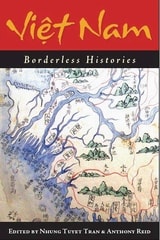
Viet Nam
Borderless HistoriesEdited by Nhung Tuyet Tran and Anthony Reid
University of Wisconsin Press, 2006
“A wonderful introduction to the exciting work that a new generation of scholars is engaging in.”—Liam C. Kelley, International Journal of Asian Studies
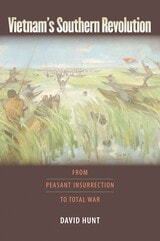
Vietnam's Southern Revolution
From Peasant Insurrection to Total WarDavid Hunt
University of Massachusetts Press, 2009
In Vietnam, the American government vowed to win the “hearts and minds” of the people. On the other side, among those who led and sympathized with the insurgents, the term “people's war” gained a wide currency. Yet while much has been written about those who professed to speak for the Vietnamese population, we know surprisingly little about the everyday life of the peasants who made up the bulk of the country's inhabitants. This book illuminates that subject. Drawing on a wide range of sources, including interviews conducted by the Rand Corporation with informants from My Tho Province in the Mekong Delta, David Hunt brings to light the daily experience of villagers in the midst of war and revolution.
The peasants of southern Vietnam were neither onlookers nor mere victims as fighting raged throughout their country. From the “concerted uprising” in 1959–1960 to the Tet Offensive of 1968, the revolutionary movement they created was in fact the driving force within the war. Known as the “Viet Cong” to their adversaries, the rebels called themselves the “Liberation Front.” They demanded an end to landlordism and an egalitarian distribution of the means of subsistence as well as a democratization of relations between town and countryside, parents and children, men and women. They hoped the Vietnamese people would achieve a fuller sense of their place in the world and of the power they possessed to fashion their own destinies, without reliance on supernatural forces.In the first half of the book, Hunt analyzes this cultural revolution. As fighting spread and became more destructive, especially after the U.S. escalation in 1965, villagers were driven from their homes, the rural infrastructure collapsed, and customary notions of space and time lost purchase on an increasingly chaotic world. In the second half of the book, Hunt shows how peasants, who earlier had aspired to a kind of revolutionary modernism, now found themselves struggling to survive and to cope with the American intruders who poured into My Tho, and how they managed to regroup and spearhead the Tet Offensive that irrevocably altered the course of the war.
Vietnam's Strategic Thinking during the Third Indochina War
Kosal Path
University of Wisconsin Press, 2023
In contrast to earlier studies, Path traces the moving target of these changing policy priorities, providing a vital addition to existing scholarship on asymmetric wartime decision-making and alliance formation among small states. The result uncovers how this critical period had lasting implications for the ways Vietnam continues to conduct itself on the global stage.
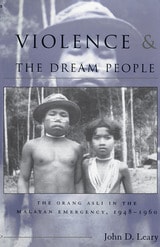
Violence and the Dream People
The Orang Asli in the Malayan Emergency, 1948-1960John D. Leary
Ohio University Press, 1995
Violence and the Dream People is an account of a little-known struggle by the Malayan government and the communist guerrillas, during the 1948-1960 Malayan Emergency, to win the allegiance of the Orang Asli, the indigenous people of the peninsular Malaya. The author argues that the use of force by both sides in their attempts to woo or coerce the jungle dwellers to support one side or the other in the conflict, caused tensions among the Orang Asli that resulted in counter violence against the interlopers and internecine killings in the tribal groups.
This study challenges the depiction of the Orang Asli as naïve innocents, unwittingly manipulated by outsiders for their own purposes. Heavily outnumbered, they looked to their own resources to survive, in the face of relocation, conscription, random bombings, and haphazard killing. Leary argues that they were shrewd enough to recognize the winning side and backed their judgment with force where necessary.
Violence and the Dream People is an important study of a much neglected facet of the Malayan Emergency and of the history of the indigenous peoples of the Malay Peninsula.
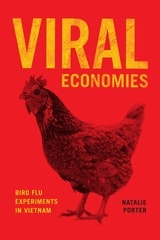
Viral Economies
Bird Flu Experiments in VietnamNatalie Porter
University of Chicago Press, 2019
In Viral Economies, Natalie Porter draws from long-term research on bird flu in Vietnam to chart the pathways of scientists, NGO workers, state veterinarians, and poultry farmers as they define and address pandemic risks. Porter argues that as global health programs expand their purview to include life and livestock, they weigh the interests of public health against those of commercial agriculture, rural tradition, and scientific innovation. Porter challenges human-centered analyses of pandemics and shows how dynamic and often dangerous human-animal relations take on global significance as poultry and their pathogens travel through global livestock economies and transnational health networks. Viral Economies urges readers to think critically about the ideas, relationships, and practices that produce our everyday commodities, and that shape how we determine the value of life—both human and nonhuman.

Virtual Lotus
Modern Fiction of Southeast AsiaTeri Shaffer Yamada, Editor
University of Michigan Press, 2002
Short introductions to each story provide a sketch of the country's literary history, revealing the interaction between individual writers and their sociopolitical situations. Many of the stories are ethnographic and provide snapshots of cultures at a specific historical moment. The stories also reflect gender balance, diversity of style, and quality of literary expression. Exploring everything from the realities of being a middle-aged woman in Burma in the witty drama "An Umbrella" to the difficult choice between appeasing a troubled Vietnamese community or tending to an ailing father in "Tu Ben the Actor," this collection is sure to appeal to a variety of readers the world over.
This anthology will be useful in courses in comparative translation and culture, postcolonial studies, political science, Asian history, and gender studies. It is also appropriate for a literary reading public interested in comparative world literature.
Teri Shaffer Yamada is Associate Professor, California State University, Long Beach.
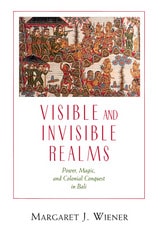
Visible and Invisible Realms
Power, Magic, and Colonial Conquest in BaliMargaret J. Wiener
University of Chicago Press, 1995
Wiener challenges colonial and academic claims that Klungkung had no "real" power and argues that such claims enabled colonial domination. By focusing on Balinese discourses she makes clear the choices open to Balinese, both at the time of the Dutch conquest and in its narration. At the same time, she shows how these discourses, which revolve around magical weapons acquired from invisible agents such as gods, spirits, and ancestors, offer an alternative understanding of Klungkung's power.
Moving between Balinese and Dutch narratives and between past and present, Wiener critiques colonial accounts by recounting Balinese memories and interpretations. Her attention to history and local situations illuminates the ways in which colonialism and orientalist scholarship have obscured the power of indigenous rulers and shows how Klungkung, once Bali's paramount realm, was relegated to a peripheral corner of the Indonesian nation-state. Both as a fascinating story and as a rich example of interdisciplinary scholarship, this book will interest students of colonialism, anthropology, history, religion, and Southeast Asia.
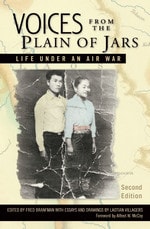
Voices from the Plain of Jars
Life under an Air WarEdited by Fred Branfman with essays and drawings by Laotian villagers; Foreword by Alfred W. McCoy
University of Wisconsin Press, 2013
When first published in 1972, this book was instrumental in exposing the bombing. In this expanded edition, Branfman follows the story forward in time, describing the hardships that Laotians faced after the war when they returned to find their farm fields littered with cluster munitions—explosives that continue to maim and kill today.
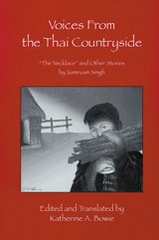
Voices from the Thai Countryside
Samruam Singh
University of Wisconsin Press, 2008
Set in northern Thailand during the mid-1970s, the stories in this collection capture a period of dramatic social and economic change. Amidst a setting of marketplaces and paddyfields, lemon trees and leaf-roofed houses, these vignettes offer revealing insights into the daily lives of ordinary villagers and hillspeople struggling to survive.