Results by title
99 books match the query 'Vietnam' and 12 start with v
Viet Nam Expose
French Scholarship on Twentieth-Century Vietnamese SocietyGisele Bousquet and Pierre Brocheux, Editors
University of Michigan Press, 2002
The book is divided into three parts. Part I, "Vietnamese Society in the Early Twentieth Century," takes a micro approach to the study of Vietnamese society on the eve of the irreversible social transformation that occurred as the colonial infrastructure took root in Indochina. Part II, "Vietnamese Intellectuals: Contesting Colonial Power," contains biographical accounts of Vietnamese intellectuals who tried to reform their society under colonial domination. Part III, "Post-Colonial Vietnam: From Welfare State to Market-Oriented Economy," traces Vietnam's search for a viable economic model while maintaining itself as a socialist state.
The book speaks to diverse themes, including the nature of village life, the development of health care during the colonial era, the status of women, the role of Vietnamese intellectuals in the anticolonial struggle, the building of a socialist state, contemporary rural migration, labor relations, and Vietnam in an age of globalization.
Gisele Bousquet is Research Associate at the Center for Southeast Asian Studies, University of California, Berkeley. Pierre Brocheux is Maître de Conference of History, Université Denis Diderot-Paris VII.
Viet Nam
Borderless HistoriesEdited by Nhung Tuyet Tran and Anthony Reid
University of Wisconsin Press, 2006
“A wonderful introduction to the exciting work that a new generation of scholars is engaging in.”—Liam C. Kelley, International Journal of Asian Studies
Viet Nam
Tradition and ChangeH?u Ng?c
Ohio University Press, 2016
During his twenty-year tenure as a columnist for Việt Nam News, Hà Nội’s English-language newspaper, Hữu Ngọc charmed and invigorated an international readership hungry for straightforward but elegant entrees into understanding Vietnamese culture. The essays were originally collected in the massive Wandering through Vietnamese Culture. With Viet Nam: Tradition and Change, Ohio University Press presents a selection from these many treasures, which are perfectly suited to students of Vietnamese culture and travelers seeking an introduction to the country’s rich history, culture, and daily life.
With extraordinary linguistic ability and a prodigious memory, Hữu Ngọc is among Việt Nam’s keenest observers of and writers about traditional Vietnamese culture and recent history. The author’s central theme—that all tradition is change through acculturation—twines through each of the book’s ten sections, which contain Hữu Ngọc’s ideas on Vietnamese religion, literature, history, exemplary figures, and more. Taken on its own, each brief essay is an engaging discussion of key elements of Vietnamese culture and the history of an issue confronting Việt Nam today.
Vietnam Veteranos
Chicanos Recall the WarBy Lea Ybarra
University of Texas Press, 2004
One of the most decorated groups that served in the Vietnam War, Chicanos fought and died in numbers well out of proportion to their percentage of the United States' population. Yet despite this, their wartime experiences have never received much attention in either popular media or scholarly studies. To spotlight and preserve some of their stories, this book presents substantial interviews with Chicano Vietnam veterans and their families that explore the men's experiences in combat, the war's effects on the Chicano community, and the veterans' postwar lives.
Lea Ybarra groups the interviews topically to bring out different aspects of the Chicano vets' experiences. In addition to discussing their involvement in and views on the Vietnam War, the veterans also reflect on their place in American society, American foreign policy, and the value of war. Veterans from several states and different socioeconomic classes give the book a broad-based perspective, which Ybarra frames with sociological material on the war and its impact on Chicanos.
Vietnam and Other American Fantasies
H. Bruce Franklin
University of Massachusetts Press, 2000
There is now fairly widespread acknowledgment that the Vietnam War shattered many of the traditional narratives central to formerly prevailing vision of the United States and its history. Some people regret this and seek to restore old narratives that they consider essential to a unifying national identity, but their mighty efforts are unlikely to put Humpty Dumpty together again. Others see this shattering as a liberation from dangerous illusions, a wake-up call that forced millions of Americans toward more truthful and beneficial narratives about American history and culture. There is a third view, one that has gained considerable influence in intellectual circles, that sees any “master narrative” or “meta-narrative”—or, for that matter, any coherently structured narrative—as a socially constructed fantasy that radically falsifies the fragmentary, conflicted, and de-centered character of social experience. Although in this book the author does not engage in overt arguments about narrative theory, he does operate from a theoretical position that highly values narratives, especially coherently structures narratives—including some forms of fantasy—as crucial to comprehending, within our human limits, human reality.
Vietnam's Children in a Changing World
Rachel Burr
Rutgers University Press, 2006
Like the majority of children living in the global South today, a large number of Vietnamese youths work to help support their families. International human rights organizations have focused on these children, seeking to bring their lives into line with an understanding of childhood that is generally accepted in the developed world.
In this ethnographic study, Rachel Burr draws on her daily observations of working children in Hanoi and argues that these youngsters are misunderstood by the majority of agencies that seek to help them. Most aid programs embrace a model of childhood that is based on Western notions of individualism and bountiful resources. They further assume that this model is universally applicable even in cultures that advocate a collective sense of self and in countries that do not share the same economic advantages.
Burr presents the voices and experiences of Vietnamese children in the streets, in a reform school, and in an orphanage to show that workable solutions have become lost within the rhetoric propagated by aid organizations. The reality of providing primary education or adequate healthcare for all children, for instance, does not stand a chance of being achieved until adequate resources are put in place. Yet, organizations preoccupied with the child rights agenda are failing to acknowledge the distorted global distribution of wealth in favor of Western nations.
Offering a unique, firsthand look at the experiences of children in contemporary Vietnam, this book also provides a broad analysis of how internationally led human rights agendas are often received at the local level.
Vietnam's Southern Revolution
From Peasant Insurrection to Total WarDavid Hunt
University of Massachusetts Press, 2009
In Vietnam, the American government vowed to win the “hearts and minds” of the people. On the other side, among those who led and sympathized with the insurgents, the term “people's war” gained a wide currency. Yet while much has been written about those who professed to speak for the Vietnamese population, we know surprisingly little about the everyday life of the peasants who made up the bulk of the country's inhabitants. This book illuminates that subject. Drawing on a wide range of sources, including interviews conducted by the Rand Corporation with informants from My Tho Province in the Mekong Delta, David Hunt brings to light the daily experience of villagers in the midst of war and revolution.
The peasants of southern Vietnam were neither onlookers nor mere victims as fighting raged throughout their country. From the “concerted uprising” in 1959–1960 to the Tet Offensive of 1968, the revolutionary movement they created was in fact the driving force within the war. Known as the “Viet Cong” to their adversaries, the rebels called themselves the “Liberation Front.” They demanded an end to landlordism and an egalitarian distribution of the means of subsistence as well as a democratization of relations between town and countryside, parents and children, men and women. They hoped the Vietnamese people would achieve a fuller sense of their place in the world and of the power they possessed to fashion their own destinies, without reliance on supernatural forces.In the first half of the book, Hunt analyzes this cultural revolution. As fighting spread and became more destructive, especially after the U.S. escalation in 1965, villagers were driven from their homes, the rural infrastructure collapsed, and customary notions of space and time lost purchase on an increasingly chaotic world. In the second half of the book, Hunt shows how peasants, who earlier had aspired to a kind of revolutionary modernism, now found themselves struggling to survive and to cope with the American intruders who poured into My Tho, and how they managed to regroup and spearhead the Tet Offensive that irrevocably altered the course of the war.
Vietnam's Strategic Thinking during the Third Indochina War
Kosal Path
University of Wisconsin Press, 2023
In contrast to earlier studies, Path traces the moving target of these changing policy priorities, providing a vital addition to existing scholarship on asymmetric wartime decision-making and alliance formation among small states. The result uncovers how this critical period had lasting implications for the ways Vietnam continues to conduct itself on the global stage.
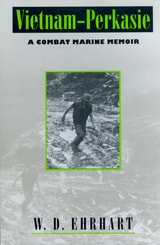
Vietnam-Perkasie
W. D. Ehrhart
University of Massachusetts Press, 1995
In 1982, John Newman, curator of the Vietnam War Literature Collection at Colorado State University, said of W.D. Ehrhart: “As a poet and editor, Bill Ehrhart is clearly one of the major figures in Vietnam War literature.” This autobiographical account of the war, the author's first extended prose work, demonstrates Ehrhart's abilities as a writer of prose as well. Vietnam–Perkasie is grim, comical, disturbing, and accurate. The presentation is novelistic—truly, a “page-turner”—but the events are all real, the atmosphere intensely evocative.
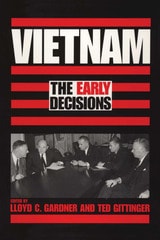
Vietnam
The Early DecisionsEdited by Lloyd C. Gardner and Ted Gittinger
University of Texas Press, 1997
Haunting questions remain about our involvement in Vietnam. Perhaps the most persistent of these is whether President Kennedy would have ended American involvement in Vietnam if he had lived.
For many Americans, Oliver Stone's film JFK left no doubt that before his assassination Kennedy had determined to quit Vietnam. Yet the historical record offers a more complex answer. In this fresh look at the archival evidence, noted scholars take up the challenge to provide us with their conclusions about the early decisions that put the United States on the path to the greatest American tragedy since the Civil War. The tensions and turmoil that accompanied those decisions reveal the American presidency at the center of a storm of conflicting advice.
The book is divided into four sections. Parts one and two delve into the political and military contexts of the early decisions. Part three raises the intriguing questions of Kennedy's and Johnson's roles in the conflict, particularly the thorny issue of whether Kennedy did, in fact, intend to withdraw from Vietnam and whether Johnson reversed that policy. Part four reveals an uncanny parallel between early Soviet policy toward Hanoi and U.S. policy toward Saigon.
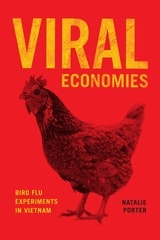
Viral Economies
Bird Flu Experiments in VietnamNatalie Porter
University of Chicago Press, 2019
In Viral Economies, Natalie Porter draws from long-term research on bird flu in Vietnam to chart the pathways of scientists, NGO workers, state veterinarians, and poultry farmers as they define and address pandemic risks. Porter argues that as global health programs expand their purview to include life and livestock, they weigh the interests of public health against those of commercial agriculture, rural tradition, and scientific innovation. Porter challenges human-centered analyses of pandemics and shows how dynamic and often dangerous human-animal relations take on global significance as poultry and their pathogens travel through global livestock economies and transnational health networks. Viral Economies urges readers to think critically about the ideas, relationships, and practices that produce our everyday commodities, and that shape how we determine the value of life—both human and nonhuman.
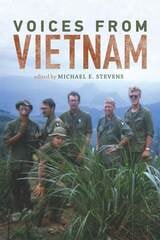
Voices from Vietnam
Michael E. Stevens
Wisconsin Historical Society Press, 1996
An unforgettable collection of 174 letters and diary entries written by 92 wisconsin men and women who served in Vietnam. Includes a journal kept by Menasha native Frederic Flom on cigarette wrappers during his final 16 days of captivity — the only known diary smuggled out by a Vietnam prisoner of war.