51 books match the query 'Voegelin, Eric' and 2 start with v
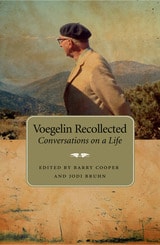
cover of Voegelin Recollected: Conversations on a Life

Voegelin Recollected

Conversations on a Life

Edited by Barry Cooper & Jodi Bruhn

University of Missouri Press, 2007

Although his contributions to philosophy are revered and his writings have been collected, Eric Voegelin’s persona will inevitably fade with the memories of those who knew him. This book preserves the human element of Voegelin by capturing those valuable personal recollections.

            Barry Cooper and Jodi Bruhn conducted intensive interviews with Voegelin’s wife, his closest friends, and his first-generation students—many of whom have since passed on—in order to bring to print everything important about his life and personality. American scholars will especially appreciate the glimpses provided by Voegelin’s German colleagues into his life in Munich, as well as the thoughts of his students in Vienna. Reflections of people such as Paul Caringella, Bruno Schlesinger, and Heinz Barazon capture Voegelin’s greatness and shortcomings alike and also shed new light on his philosophical quest for truth.

By descending progressively further into the past, the book takes readers deeper into the essence of Voegelin as reminiscences become more dramatic. Ranging widely from America back to Germany—with recollections of Gestapo intimidation and eventual emigration—the accounts interweave episodes of pathos, humor, fear, rivalry, and ambition. We witness Voegelin’s persistent and partly self-imposed communication problems and impatience with administrative duties, his respect for prudent political actors and public servants, and his genuine affection not only for his colleagues and best students but also for diligent secretaries and empathetic nurses. Through these recollections, key elements of his personality repeatedly emerge: his intelligence, optimism, and integrity, combined with an acute perception of the significance of his work.

            This is the most revealing and comprehensive biographical work yet available on a man known to be captivating as a thinker—and now shown to be equally fascinating as a human being. His own publications attest to his mind and methods; Voegelin Recollected provides a deeper understanding of the man himself. 
[more]
cover of Voegelin, Schelling, and the Philosophy of Historical Existence

Voegelin, Schelling, and the Philosophy of Historical Existence

Jerry Day

University of Missouri Press, 2003

In this important new work, Jerry Day brings to light the need for an extensive reinterpretation of the mature philosophy of Eric Voegelin, based on Voegelin’s published and unpublished appreciation for nineteenth-century German philosopher F. W. J. Schelling.
Schelling, whom Day maintains was one of the most important guides to Voegelin’s mature philosophy of consciousness and historiography, has been described as the father of several disparate movements and schools of continental philosophy—chief among them being “Hegelian” idealism and existentialism. This characterization implies that Schelling was a scattered thinker with little or no appreciation for philosophy as a disciplined inquiry into the nature of human affairs.
Voegelin was critical of this portrayal of Schelling. He argued that it lacked proper sensitivity for the impressive extent to which this giant of continental thought was able to rise above the “creed communities” of his time and recover the abiding concern of mature philosophers everywhere: the philosophia perennis. Those who claim that Schelling was scattered have failed, according to Voegelin, to appreciate the nonideological breadth of this great philosopher, misled by the splinter movements and schools that arose from mere fragments of his thought. In truth, Schelling founded no school and launched no movement. Instead, he reasoned with the disciplined integrity and wonder of a “spiritual realist.”
Day argues that Voegelin was a fine interpreter of Schelling, particularly during the decisive years when the central orientation of Voegelin’s mature thought was beginning to take hold—between the writing of his History of Political Ideas and its eventual transformation into Order and History. Day gathers an impressive array of evidence to interpret Voegelin’s little-known support for Schelling’s achievements, while offering detailed analyses and helpful summaries of a vast body of literature that has yet to be translated into English.
Day’s partial agreement with Voegelin’s uncommon assessment of Schelling provides him with the point of departure that leads to one of this book’s most distinctive contributions to contemporary thought. It has the rare ability to help clear the way for philosophical realists to make peace with many of their contemporaries, giving them further grounds for accepting the strongest anthropological and psychological insights of recent continental philosophy, while helping them to avoid its tendencies toward nihilistic despair or fideistic historicism.
By reading each philosopher through the eyes of the other, Day provides an analysis that will be illuminating for Voegelin scholars and Schelling scholars alike. The book will also appeal to readers with more general interests in the history and development of continental philosophy, political theory, and comparative religion over the past century.
[more]