2194 books match the query 'Women's Studies' and 21 start with v
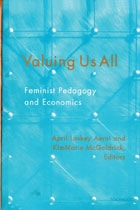
cover of Valuing Us All: Feminist Pedagogy and Economics

Valuing Us All

Feminist Pedagogy and Economics

April Laskey Aerni and KimMarie McGoldrick, Editors

University of Michigan Press, 1999
A basic knowledge of economics is critical for making informed decisions in today's world. By offering courses and materials that are more relevant to our students' lives and encouraging more active participation in the discovery of economic concepts and theories, we promote the development of informed citizens.
This volume collects pioneering work on the integration of feminist pedagogy in economics. Part 1 introduces a vision of feminist pedagogy, explains the importance of developing feminist pedagogy in economics, and proposes a model for achieving feminist pedagogy in economics that suggests changes in both course content and teaching methods. Part 2 reveals how current course content is narrowly defined and demonstrates how content can be altered to be more inclusive. Included are an analysis of current textbook treatments and examples of broadening discussions of labor supply models, U.S. poverty, and stereotyping, as well as general overviews of macro- and microeconomic courses. Part 3 reports on current disparities in economics education by gender and provides alternative teaching strategies for correcting this problem, including the service learning, peer review, e-mail discussion lists, case studies, internships, and collaborative learning.
The contributors incorporate their vision of a new pedagogy with important economic concepts emphasizing equity as well as efficiency, cooperation as well as competition, and inter-dependence as well as independence. The volume will be a valuable resource for college faculty teaching economics in the United States, as well as to those teaching in related disciplines who want to design exercises that promote a more inclusive classroom environment through changes in both content and teaching methods.
April Laskey Aerni is Associate Professor of Economics, Nazareth College of Rochester. KimMarie McGoldrick is Associate Professor of Economics, University of Richmond.
[more]
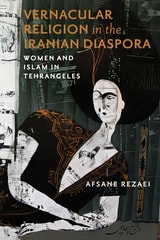
cover of Vernacular Religion in the Iranian Diaspora: Women and Islam in Tehrangeles

Vernacular Religion in the Iranian Diaspora

Women and Islam in Tehrangeles

Afsane Rezaei

University of Wisconsin Press, 2026

With nearly half a million Iranian Americans living in and around Los Angeles, Southern California is home to more Iranians than anywhere outside Iran itself. Although many community members identify as secular, stereotypes characterize Iranian Americans, like other populations from Muslim-majority countries, as pejoratively religious and culturally suspect. For Iranian American women who do practice Islam, navigating their religious, ethnic, and political identities, on both personal and communal levels, is complex and fraught, influenced not only by racialized discourses but also by intra-community narratives that equate Islamic practice with the authoritarian state in Iran.

Folklorist Afsane Rezaei applies theories of vernacular religion to explore how these women shape their religious identities in this particularly delicate diasporic context, how they engage with external imaginaries in their practices and narratives, and how they develop a sense of agency over their religious identification. For many, Islamic religiosity in the diaspora is an integrated and embodied aspect of folklife, closely tied to the sense of self, social networks, and communal identity, and is negotiated and reimagined in everyday, improvised, and sometimes contradictory ways. Rezaei’s detailed, respectful ethnography reaches beyond the binary of piety and resistance and offers new and nuanced understandings of Iranian American lived religion.
[more]
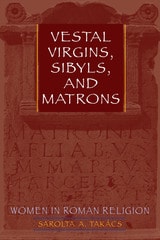
cover of Vestal Virgins, Sibyls, and Matrons: Women in Roman Religion

Vestal Virgins, Sibyls, and Matrons

Women in Roman Religion

By Sarolta A. Takács

University of Texas Press, 2007

Roman women were the procreators and nurturers of life, both in the domestic world of the family and in the larger sphere of the state. Although deterred from participating in most aspects of public life, women played an essential role in public religious ceremonies, taking part in rituals designed to ensure the fecundity and success of the agricultural cycle on which Roman society depended. Thus religion is a key area for understanding the contributions of women to Roman society and their importance beyond their homes and families.

In this book, Sarolta A. Takács offers a sweeping overview of Roman women's roles and functions in religion and, by extension, in Rome's history and culture from the republic through the empire. She begins with the religious calendar and the various festivals in which women played a significant role. She then examines major female deities and cults, including the Sibyl, Mater Magna, Isis, and the Vestal Virgins, to show how conservative Roman society adopted and integrated Greek culture into its mythic history, artistic expressions, and religion. Takács's discussion of the Bona Dea Festival of 62 BCE and of the Bacchantes, female worshippers of the god Bacchus or Dionysus, reveals how women could also jeopardize Rome's existence by stepping out of their assigned roles. Takács's examination of the provincial female flaminate and the Matres/Matronae demonstrates how women served to bind imperial Rome and its provinces into a cohesive society.

[more]
cover of Vibrator Nation: How Feminist Sex-Toy Stores Changed the Business of Pleasure

Vibrator Nation

How Feminist Sex-Toy Stores Changed the Business of Pleasure

Lynn Comella

Duke University Press, 2017
In the 1970s a group of pioneering feminist entrepreneurs launched a movement that ultimately changed the way sex was talked about, had, and enjoyed. Boldly reimagining who sex shops were for and the kinds of spaces they could be, these entrepreneurs opened sex-toy stores like Eve’s Garden, Good Vibrations, and Babeland not just as commercial enterprises, but to provide educational and community resources as well. In Vibrator Nation Lynn Comella tells the fascinating history of how these stores raised sexual consciousness, redefined the adult industry, and changed women's lives. Comella describes a world where sex-positive retailers double as social activists, where products are framed as tools of liberation, and where consumers are willing to pay for the promise of better living—one conversation, vibrator, and orgasm at a time.
[more]
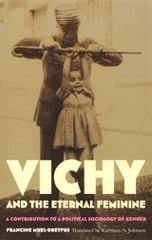
cover of Vichy and the Eternal Feminine: A Contribution to a Political Sociology of Gender

Vichy and the Eternal Feminine

A Contribution to a Political Sociology of Gender

Francine Muel-Dreyfus

Duke University Press, 2001

In this nuanced history of occupied France, Francine Muel-Dreyfus presents a powerful examination of the political and social construction of gender under the Vichy regime. Arguing that the regime used symbolic violence to reshape a liberal culture once based on individual rights into one of deference to hierarchical authority, Muel-Dreyfus shows how Vichy invoked theories of “natural” gender inequality and “eternal” opposition between the masculine and the feminine to justify women’s legal and social subordination, and how these ideologies were incorporated into the French woman’s sense of self.
Drawing on an extensive body of legislative, religious, educational, medical, and literary texts, Muel-Dreyfus examines how the Vichy regime brutally resurrected the gender politics that had been rejected during France’s social struggles in the 1930s. Strikingly, she reveals how this resurrection in turn fed into racial politics: childless women, for instance, and those who had abortions were construed—like Jews—as threats to France’s racial “purity.” With its atendant patterns of social inclusion and exclusion that were deeply rooted in the political and cultural history of the Third Republic, Muel-Dreyfus claims, a pervasive range of gendered metaphors helped to structure the very laws and policies of the Vichy regime.
The French language edition of this book was published in 1996 to wide acclaim. Contributing to theories about the role of gender in political philosophy, to the cultural anthropology of symbolic representation, and to our understanding of the history of fascism, Vichy and the Eternal Feminine will appeal to French, European, and twentieth-century historians; students and scholars of gender and racial studies; political scientists; and anthropologists.


[more]
cover of Victims as Offenders: The Paradox of Women's Violence in Relationships

Victims as Offenders

The Paradox of Women's Violence in Relationships

Miller, Susan L.

Rutgers University Press, 2005

Arrests of women for assault increased more than 40 percent over the past decade, while male arrests for this offense have fallen by about one percent. Some studies report that for the first time ever the rate of reported intimate partner abuse among men and women is nearly equal. Susan L. Miller’s timely book explores the important questions raised by these startling statistics.

            Are women finally closing the gender gap on violence? Or does this phenomenon reflect a backlash shaped by men who batter? How do abusive men use the criminal justice system to increase control over their wives? Do police, courts, and treatment providers support aggressive arrest policies for women?  Are these women “victims” or “offenders”? 

             In answering these questions, Miller draws on extensive data from a study of police behavior in the field, interviews with criminal justice professionals and social service providers, and participant observation of female offender programs. She offers a critical analysis of the theoretical assumptions framing the study of violence and provides insight into the often contradictory implications of the mandatory and pro-arrest policies enacted in the 1980s and 1990s. Miller argues that these enforcement strategies, designed to protect women, have often victimized women in different ways. Without sensationalizing, Miller unveils a reality that looks very different from what current statistics on domestic violence imply.


[more]
cover of Victorian Ghosts in the Noontide: Women Writers and the Supernatural

Victorian Ghosts in the Noontide

Women Writers and the Supernatural

Vanessa D. Dickerson

University of Missouri Press, 1996

During the nineteenth century, British society was making rapid advancements in science and technology. While the men became materially productive, women were expected to be the fulcrums of society's changes. As one means of adjusting to these changes, many women focused on supernaturalism and spirituality.

In Victorian Ghosts in the Noontide, Vanessa D. Dickerson analyzes women's spirituality in a materialistic age by examining the supernatural fiction of Charlotte and Emily Brontë, Elizabeth Gaskell, and George Eliot and provides interpretive readings of familiar texts like Jane Eyre and Wuthering Heights. Other works by lesser-known authors are also examined.

Technological advances eliminated many of the jobs women were accustomed to doing. This left women looking for their place in society. A sense of "in-betweenness" developed in these women who were now expected to attend not only to the physical but also to the moral and spiritual needs of the family. As an answer to this "in-betweenness" some channeled their power toward the art of writing. Because people in the mid-1800s were so thoroughly engaged in scientific thought and advancements, supernatural folklore and spirituality were disreputable ideas for anyone, especially women, to explore. Ghosts and spirits were tied to old-wives' tales, superstitions, and legends. However, by focusing on these concepts and using fiction as an outlet, women were able to make great strides in being seen and heard. The art of writing functioned as an exploration of their spiritualism in which women discovered expression, freedom, and power.

This perceptive, well-written book will add a new dimension to our understanding of women's supernatural writings of the Victorian era. Scholars of Victorian literature, women's studies, and popular culture will benefit from its insights.
[more]
cover of Village Ties: Women, NGOs, and Informal Institutions in Rural Bangladesh

Village Ties

Women, NGOs, and Informal Institutions in Rural Bangladesh

Nayma Qayum

Rutgers University Press, 2022
Across the global South, poor women’s lives are embedded in their social relationships and governed not just by formal institutions – rules that exist on paper – but by informal norms and practices. Village Ties takes the reader to Bangladesh, a country that has risen from the ashes of war, natural disaster, and decades of resource drain to become a development miracle. The book argues that grassroots women’s mobilization programs can empower women to challenge informal institutions when such programs are anti-oppression, deliberative, and embedded in their communities. Qayum dives into the work of Polli Shomaj (PS), a program of the development organization BRAC to show how the women of PS negotiate with state and society to alter the rules of the game, changing how poor people access resources including safety nets, the law, and governing spaces. These women create a complex and rapidly transforming world where multiple overlapping institutions exist – formal and informal, old and new, desirable and undesirable. In actively challenging power structures around them, these women defy stereotypes of poor Muslim women as backward, subservient, oppressed, and in need of saving.
[more]
cover of Violence and Indigenous Communities: Confronting the Past and Engaging the Present

Violence and Indigenous Communities

Confronting the Past and Engaging the Present

Edited by Susan Sleeper-Smith, Jeffrey Ostler, and Joshua L. Reid

Northwestern University Press, 2021

In contrast to past studies that focus narrowly on war and massacre, treat Native peoples as victims, and consign violence safely to the past, this interdisciplinary collection of essays opens up important new perspectives. While recognizing the long history of genocidal violence against Indigenous peoples, the contributors emphasize the agency of individuals and communities in genocide’s aftermath and provide historical and contemporary examples of activism, resistance, identity formation, historical memory, resilience, and healing. The collection also expands the scope of violence by examining the eyewitness testimony of women and children who survived violence, the role of Indigenous self-determination and governance in inciting violence against women, and settler colonialism’s promotion of cultural erasure and environmental destruction.

By including contributions on Indigenous peoples in the United States, Canada, the Pacific, Greenland, Sápmi, and Latin America, the volume breaks down nation-state and European imperial boundaries to show the value of global Indigenous frameworks. Connecting the past to the present, this book confronts violence as an ongoing problem and identifies projects that mitigate and push back against it.
[more]
cover of Viral Mothers: Breastfeeding in the Age of HIV/AIDS

Viral Mothers

Breastfeeding in the Age of HIV/AIDS

Bernice L. Hausman

University of Michigan Press, 2010

Viral Mothers: Breastfeeding in the Age of HIV/AIDS addresses modern fears of dangerous motherhood, focusing on preoccupations with mothers' bodies as vectors for infection and contamination. The book examines how the maternal body is perceived as a conduit for disease, drugs, or contaminants that end up in the body of an innocent---and pure---infant. Paying special attention to HIV transmission through breastfeeding, Viral Mothers examines ideologies of maternal embodiment that influence public health protocols and mothers' behaviors worldwide. The medical community has known since the late 1980s that HIV is passed through breast milk from infected mothers to their babies. In highly industrialized countries, HIV-positive mothers are advised not to breastfeed their babies, but in poor countries breastfeeding has continued to be a predominant and medically recommended practice as a partial solution to problems of infant health and welfare in resource-poor contexts. Now, in areas of high rates of HIV infection and high infant mortality, decisions concerning infant feeding are, literally, about life and death. Public health debates concerning breastfeeding and HIV transmission must consider both the mortality associated with not breastfeeding and the possibility of HIV infection from mother to child. The transmission of HIV through breastfeeding is a medical and public health issue that touches on and augments contemporary concerns about bodies, germs, and the environment. These concerns affect all people around the globe as we struggle with the meanings of health, risk, and embodiment in modernity. Viral Mothers addresses and explores the dense cultural meanings evoked by mothers' postnatal transmission of HIV. In so doing, the book pays special attention to fears of contamination and contagion that emerge as consequences of a medicalizing modernity. The main themes of the book---risk, purity, denial, and choice---define the terms through which the viral mother is constituted in discourse and enacted publicly as a set of identifiable, culturally legible, concerns.
[more]
cover of Virgin Crossing Borders: Feminist Resistance and Solidarity in Translation

Virgin Crossing Borders

Feminist Resistance and Solidarity in Translation

Emek Ergun

University of Illinois Press, 2023

The Turkish-language release of Hanne Blank’s Virgin: The Untouched History is a politically engaged translation aimed at disrupting Turkey’s heteropatriarchal virginity codes. In Virgin Crossing Borders, Emek Ergun maps how she crafted her rendering of the text and draws on her experience and the book’s impact to investigate the interventionist power of feminist translation.

Ergun’s comparative framework reveals translation’s potential to facilitate cross-border flows of feminist theories, empower feminist interventions, connect feminist activists across differences and divides, and forge transnational feminist solidarities. As she considers hopeful and woeful pictures of border crossings, Ergun invites readers to revise their views of translation’s role in transnational feminism and examine their own potential as ethically and politically responsible agents willing to search for new meanings.

Sophisticated and compelling, Virgin Crossing Borders reveals translation’s vital role in exchanges of feminist theories, stories, and knowledge.

[more]
cover of Virginia Woolf Icon

Virginia Woolf Icon

Brenda R. Silver

University of Chicago Press, 1999

This is a book about "Virginia Woolf": the face that sells more postcards than any other at Britain's National Portrait Gallery, the name that Edward Albee's play linked with fear, the cultural icon so rich in meanings that it has been used to market everything from the New York Review of Books to Bass Ale. Brenda Silver analyzes Virginia Woolf's surprising visibility in both high and popular culture, showing how her image and authority have been claimed or challenged in debates about art, politics, anger, sexuality, gender, class, the canon, feminism, race, and fashion.

From Virginia Woolf's 1937 appearance on the cover of Time magazine to her current roles in theater, film, and television, Silver traces the often contradictory representations and the responses they provoke, highlighting the recurring motifs that associate Virginia Woolf with fear. By looking more closely at who is afraid and the contexts in which she is perceived to be frightening, Silver illustrates how Virginia Woolf has become the site of conflicts about cultural boundaries and legitimacy that continue to rage today.
[more]
cover of Virtual Gender: Fantasies of Subjectivity and Embodiment

Virtual Gender

Fantasies of Subjectivity and Embodiment

Mary Ann O'Farrell and Lynne Vallone, Editors

University of Michigan Press, 1999
This collection breaks new ground in the area of gender studies both because it creates a name for gender fantasy--virtual gender--that introduces a new understanding of the concept, and in expanding the idea of virtuality to include people and events in history. The essays in Virtual Gender help identify and name the persistent cultural desire for an imaginative space in which to "put on" alternative gender identities, while examining as well the equally persistent and consequent critique of that desire.The sweep of the volume's coverage is impressive, ranging across historical periods and academic disciplines, as contributors consider the place of the body in gender fantasy and the consequences of gender fantasy for real people and real bodies. The essays investigate figures and topics including Amelia Earhart, soap-opera chat groups, Elizabeth I, mesmerism, lesbianism in the early modern period, cybergames, women in the federalist period, the transgendered body, and performance art. Also examined are the status of embodiment, the origins of gender, gender politics, the pains of subjectivity, the uses of utopian fantasy, technological advances and information technology, the experience of gendered communities, and the role of gender in global politics. Contributors include Harriette Andreadis, Seyla Benhabib, Charlotte Canning, Bernice Hausman, Janel Mueller, Mary Ann O'Farrell, Kay Schaffer, Sidonie Smith, Carroll Smith-Rosenberg, Helen F. Thompson, Lynne Vallone, and Robyn Warhol. The book will appeal to an interdisciplinary audience of scholars, critics, and students with interests in gender, identity, and cyberculture.
[more]
cover of Virtue and Venom: Catalogs of Women from Antiquity to the Renaissance

Virtue and Venom

Catalogs of Women from Antiquity to the Renaissance

Glenda McLeod

University of Michigan Press, 1991
Virtue and Venom traces the history of a previously neglected genre, the catalog of women, from its origins in Greece and Rome to the late Middle Ages, revealing the catalogs’ considerable importance as cultural documents of the evolution of the Western definition of womankind. These catalogs were simple listings of past heroines, sometimes described in extended biographies, sometimes merely enumerated by name. Catalog heroines often appeared in familiar guises—anonymous mothers of great men, fascinating seductresses, self-effacing spouses, abused victims of love, strong and bnilliant achievers. Wnitten by some of the finest authors of the ages, the catalogs fulfilled important functions. By defining women typologically, they instilled stereotypes in the popular mind, and by illustrating proper and improper feminine conduct they reinforced the late medieval link between literature and ethics. Despite the repetitive form of the genre, the catalogs were extremely flexible, able to illustrate different, even antithetical views of femininity—invoking the past as authority or reinterpreting the past in an attempt to associate femininity with changing cultural values. Thus, as well as being the vehicle for the transmission of knowledge, the form could also be manipulated to contest authority, in the guise of invoking it, and present new paradigms. McLeod examines a host of catalogs, including those of Homer, Hesiod, Vergil, Ovid, Juvenal, Plutarch, St. Jerome, and Jean de Meun, but gives special attention to Boccaccio’s De claris mulieribus and Chaucer’s Legend of Good Women. She then shows how the tradition ultimately produced the first major defense of womankind in Christine de Pizan’s Cité des Dames. This book will be of interest to classicists, medievalists, Renaissance and feminist scholars, and anyone interested in the misogynist tradition in the West and the response it engendered.
[more]
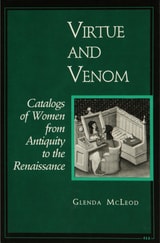
cover of Virtue and Venom: Catalogs of Women from Antiquity to the Renaissance

Virtue and Venom

Catalogs of Women from Antiquity to the Renaissance

Glenda McLeod

University of Michigan Press, 1991
Virtue and Venom traces the history of a previously neglected genre, the catalog of women, from its origins in Greece and Rome to the late Middle Ages, revealing the catalogs’ considerable importance as cultural documents of the evolution of the Western definition of womankind. These catalogs were simple listings of past heroines, sometimes described in extended biographies, sometimes merely enumerated by name. Catalog heroines often appeared in familiar guises—anonymous mothers of great men, fascinating seductresses, self-effacing spouses, abused victims of love, strong and bnilliant achievers. Wnitten by some of the finest authors of the ages, the catalogs fulfilled important functions. By defining women typologically, they instilled stereotypes in the popular mind, and by illustrating proper and improper feminine conduct they reinforced the late medieval link between literature and ethics. Despite the repetitive form of the genre, the catalogs were extremely flexible, able to illustrate different, even antithetical views of femininity—invoking the past as authority or reinterpreting the past in an attempt to associate femininity with changing cultural values. Thus, as well as being the vehicle for the transmission of knowledge, the form could also be manipulated to contest authority, in the guise of invoking it, and present new paradigms. McLeod examines a host of catalogs, including those of Homer, Hesiod, Vergil, Ovid, Juvenal, Plutarch, St. Jerome, and Jean de Meun, but gives special attention to Boccaccio’s De claris mulieribus and Chaucer’s Legend of Good Women. She then shows how the tradition ultimately produced the first major defense of womankind in Christine de Pizan’s Cité des Dames. This book will be of interest to classicists, medievalists, Renaissance and feminist scholars, and anyone interested in the misogynist tradition in the West and the response it engendered.
[more]
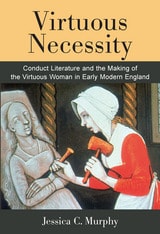
cover of Virtuous Necessity: Conduct Literature and the Making of the Virtuous Woman in Early Modern England

Virtuous Necessity

Conduct Literature and the Making of the Virtuous Woman in Early Modern England

Jessica C. Murphy

University of Michigan Press, 2015
While many scholars find the early modern triad of virtues for women—silence, chastity, and obedience—to be straightforward and nonnegotiable, Jessica C. Murphy demonstrates that these virtues were by no means as direct and inflexible as they might seem. Drawing on the literature of the period—from the plays of Shakespeare to a conduct manual written for a princess to letters from a wife to her husband—as well as contemporary gender theory and philosophy, she uncovers the multiple meanings of behavioral expectations for sixteenth- and seventeenth-century women. Through her renegotiation of cultural ideals as presented in both literary and nonliterary texts of early modern England, Murphy presents models for “acceptable” women’s conduct that lie outside of the rigid prescriptions of the time.

Virtuous Necessity will appeal to readers interested in early modern English literature, including canonical authors such as Shakespeare, Spenser, and Milton, as well as their female contemporaries such as Amelia Lanyer and Elizabeth Cary. It will also appeal to scholars of conduct literature; of early modern drama, popular literature, poetry, and prose; of women’s history; and of gender theory.
[more]
cover of Visible Histories, Disappearing Women: Producing Muslim Womanhood in Late Colonial Bengal

Visible Histories, Disappearing Women

Producing Muslim Womanhood in Late Colonial Bengal

Mahua Sarkar

Duke University Press, 2008

In Visible Histories, Disappearing Women, Mahua Sarkar examines how Muslim women in colonial Bengal came to be more marginalized than Hindu women in nationalist discourse and subsequent historical accounts. She also considers how their near-invisibility except as victims has underpinned the construction of the ideal citizen-subject in late colonial India. Through critical engagements with significant feminist and postcolonial scholarship, Sarkar maps out when and where Muslim women enter into the written history of colonial Bengal. She argues that the nation-centeredness of history as a discipline and the intellectual politics of liberal feminism have together contributed to the production of Muslim women as the oppressed, mute, and invisible “other” of the normative modern Indian subject.

Drawing on extensive archival research and oral histories of Muslim women who lived in Calcutta and Dhaka in the first half of the twentieth century, Sarkar traces Muslim women as they surface and disappear in colonial, Hindu nationalist, and liberal Muslim writings, as well as in the memories of Muslim women themselves. The oral accounts provide both a rich source of information about the social fabric of urban Bengal during the final years of colonial rule and a glimpse of the kind of negotiations with stereotypes that even relatively privileged, middle-class Muslim women are still frequently obliged to make in India today. Sarkar concludes with some reflections on the complex links between past constructions of Muslim women, current representations, and the violence against them in contemporary India.
[more]
cover of Visible Women: New Essays on American Activism

Visible Women

New Essays on American Activism

Edited by Nancy A. Hewitt and Suzanne Lebsock

University of Illinois Press, 1993

In this collection, fifteen leading historians of women and American history explore women's political action from 1830 to the present. Together, their contributions illustrate the tremendous scope and racial, ethnic, and class diversity of women's public activism while also clarifying various conceptual issues. Essays include an analysis of ideologies and strategies; suffrage militance in 1870s; ideas for a feminist approach to public life; labor feminism in the urban South; women's activism in Tampa, Florida; black women and economic nationalism; black women's clubs; the YMCA's place in the community; the role of Southern churchwomen in racial reform and transformation; and other topics.

"Establishes important links between citizenship, race, and gender following the Reconstruction amendments and the Dawes Act of 1887."--Sharon Hartmann Strom, American Historical Review
[more]
cover of Voices in the Shadows: Women and Verbal Art in Serbia and Bosnia

Voices in the Shadows

Women and Verbal Art in Serbia and Bosnia

Celia Hawkesworth

Central European University Press, 2000

Women are conspicuously absent from traditional cultural histories of south-east Europe. This book addresses that imbalance by describing the contribution of women to literary culture in the Orthodox/ Ottoman areas of Serbia and Bosnia.

The first complete literary history in relation to women's writing in south-east Europe. The author provides a broad chronological account of this contribution, dividing the book into two main parts; the earlier period up until the eighteenth century concentrates on the projections of gender through the medium of oral tradition and the lives of a handful of educated women in medieval Serbia and the few works of literature they left. Hawkesworth also looks at the written literature produced by women, first in the mid-nineteenth century and then at the turn of the century. The second part focuses on the trials and tribulations that affected feminism and women's literature throughout the twentieth century. The author finishes by highlighting the new women's movement, 1975-1990, a great period for women in Yugoslavia which created a stimulating atmosphere for outstanding pieces of women's journalism, prose and verse, culminating in the creation of new women's studies courses in many universities.
[more]
cover of Voodoo Priests, Noble Savages, and Ozark Gypsies: The Life of Folklorist Mary Alicia Owen

Voodoo Priests, Noble Savages, and Ozark Gypsies

The Life of Folklorist Mary Alicia Owen

Greg Olson

University of Missouri Press, 2025

Folklorist Wayland Hand once called Mary Alicia Owen “the most famous American Woman Folklorist of her time.” Drawing on primary sources, such as maps, census records, court documents, personal letters and periodicals, and the scholarship of others who have analyzed various components of Owen’s multifaceted career, historian Greg Olson offers the most complete account of her life and work to date. He also offers a critical look at some of the short stories Owen penned, sometimes under the name Julia Scott, and discusses how the experience she gained as a fiction writer helped lead her to a successful career in folklore.

Olson begins with an in-depth look at St. Joseph, Missouri, the place where Owen lived most of her life. He explores the role that her grandparents and parents had in transforming the small trading village into one of the American West’s most exciting boomtowns. He also examines the family’s position of affluence and the effect that the devastation of the Civil War had on their family life and their standing within the community. He describes the interaction of Owen with her two younger sisters, both of whom had interesting and, for women of the time, unconventional careers.

Olson analyzes many of the nineteenth-century theories, stereotypes, and popular beliefs that influenced the work of Owen and many of her peers. By taking a cross-disciplinary look at her works of fiction, poetry, folklore, history, and anthropology, this volume sheds new light on elements of Owen’s career that have not previously been discussed in print. Examples of the romance stories that Owen wrote for popular magazines in the 1880’s are identified and examined in the context of the time in which Owen wrote them.

This groundbreaking biography shows that Owen was more than just a folklorist—she was a nineteenth-century woman of many contradictions. She was an independent woman of many interests who possessed a keen intellect and a genuine interest in people and their stories. Specialists in folklore, anthropology, women’s studies, local and regional history, and Missouriana will find much to like in this thoroughly researched study.
[more]
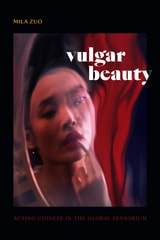
cover of Vulgar Beauty: Acting Chinese in the Global Sensorium

Vulgar Beauty

Acting Chinese in the Global Sensorium

Mila Zuo

Duke University Press, 2022

In Vulgar Beauty Mila Zuo offers a new theorization of cinematic feminine beauty by showing how mediated encounters with Chinese film and popular culture stars produce feelings of Chineseness. To illustrate this, Zuo uses the vulgar as an analytic to trace how racial, gendered, and cultural identity is imagined and produced through affect. She frames the vulgar as a characteristic that is experienced through the Chinese concept of weidao, or flavor, in which bitter, salty, pungent, sweet, and sour performances of beauty produce non-Western forms of sexualized and racialized femininity. Analyzing contemporary film and media ranging from actress Gong Li’s post-Mao movies of the late 1980s and 1990s to Joan Chen’s performance in Twin Peaks to Ali Wong’s stand-up comedy specials, Zuo shows how vulgar beauty disrupts Western and colonial notions of beauty. Vulgar beauty, then, becomes the taste of difference. By demonstrating how Chinese feminine beauty becomes a cinematic invention invested in forms of affective racialization, Zuo makes a critical reconsideration of aesthetic theory.
[more]