173 books match the query 'Women in literature' and 4 start with v
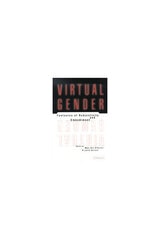
cover of Virtual Gender: Fantasies of Subjectivity and Embodiment

Virtual Gender

Fantasies of Subjectivity and Embodiment

Mary Ann O'Farrell and Lynne Vallone, Editors

University of Michigan Press, 1999
This collection breaks new ground in the area of gender studies both because it creates a name for gender fantasy--virtual gender--that introduces a new understanding of the concept, and in expanding the idea of virtuality to include people and events in history. The essays in Virtual Gender help identify and name the persistent cultural desire for an imaginative space in which to "put on" alternative gender identities, while examining as well the equally persistent and consequent critique of that desire.The sweep of the volume's coverage is impressive, ranging across historical periods and academic disciplines, as contributors consider the place of the body in gender fantasy and the consequences of gender fantasy for real people and real bodies. The essays investigate figures and topics including Amelia Earhart, soap-opera chat groups, Elizabeth I, mesmerism, lesbianism in the early modern period, cybergames, women in the federalist period, the transgendered body, and performance art. Also examined are the status of embodiment, the origins of gender, gender politics, the pains of subjectivity, the uses of utopian fantasy, technological advances and information technology, the experience of gendered communities, and the role of gender in global politics. Contributors include Harriette Andreadis, Seyla Benhabib, Charlotte Canning, Bernice Hausman, Janel Mueller, Mary Ann O'Farrell, Kay Schaffer, Sidonie Smith, Carroll Smith-Rosenberg, Helen F. Thompson, Lynne Vallone, and Robyn Warhol. The book will appeal to an interdisciplinary audience of scholars, critics, and students with interests in gender, identity, and cyberculture.
[more]
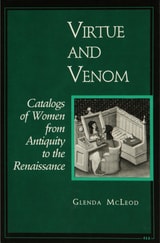
cover of Virtue and Venom: Catalogs of Women from Antiquity to the Renaissance

Virtue and Venom

Catalogs of Women from Antiquity to the Renaissance

Glenda McLeod

University of Michigan Press, 1991
Virtue and Venom traces the history of a previously neglected genre, the catalog of women, from its origins in Greece and Rome to the late Middle Ages, revealing the catalogs’ considerable importance as cultural documents of the evolution of the Western definition of womankind. These catalogs were simple listings of past heroines, sometimes described in extended biographies, sometimes merely enumerated by name. Catalog heroines often appeared in familiar guises—anonymous mothers of great men, fascinating seductresses, self-effacing spouses, abused victims of love, strong and bnilliant achievers. Wnitten by some of the finest authors of the ages, the catalogs fulfilled important functions. By defining women typologically, they instilled stereotypes in the popular mind, and by illustrating proper and improper feminine conduct they reinforced the late medieval link between literature and ethics. Despite the repetitive form of the genre, the catalogs were extremely flexible, able to illustrate different, even antithetical views of femininity—invoking the past as authority or reinterpreting the past in an attempt to associate femininity with changing cultural values. Thus, as well as being the vehicle for the transmission of knowledge, the form could also be manipulated to contest authority, in the guise of invoking it, and present new paradigms. McLeod examines a host of catalogs, including those of Homer, Hesiod, Vergil, Ovid, Juvenal, Plutarch, St. Jerome, and Jean de Meun, but gives special attention to Boccaccio’s De claris mulieribus and Chaucer’s Legend of Good Women. She then shows how the tradition ultimately produced the first major defense of womankind in Christine de Pizan’s Cité des Dames. This book will be of interest to classicists, medievalists, Renaissance and feminist scholars, and anyone interested in the misogynist tradition in the West and the response it engendered.
[more]
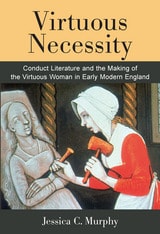
cover of Virtuous Necessity: Conduct Literature and the Making of the Virtuous Woman in Early Modern England

Virtuous Necessity

Conduct Literature and the Making of the Virtuous Woman in Early Modern England

Jessica C. Murphy

University of Michigan Press, 2015

While many scholars find the early modern triad of virtues for women—silence, chastity, and obedience—to be straightforward and nonnegotiable, Jessica C. Murphy demonstrates that these virtues were by no means as direct and inflexible as they might seem. Drawing on the literature of the period—from the plays of Shakespeare to a conduct manual written for a princess to letters from a wife to her husband—as well as contemporary gender theory and philosophy, she uncovers the multiple meanings of behavioral expectations for sixteenth- and seventeenth-century women. Through her renegotiation of cultural ideals as presented in both literary and nonliterary texts of early modern England, Murphy presents models for “acceptable” women’s conduct that lie outside of the rigid prescriptions of the time.

Virtuous Necessity will appeal to readers interested in early modern English literature, including canonical authors such as Shakespeare, Spenser, and Milton, as well as their female contemporaries such as Amelia Lanyer and Elizabeth Cary. It will also appeal to scholars of conduct literature; of early modern drama, popular literature, poetry, and prose; of women’s history; and of gender theory.
[more]
cover of Voices Made Flesh: Performing Women'S Autobiography

Voices Made Flesh

Performing Women'S Autobiography

Lynn C. Miller

University of Wisconsin Press, 2003

Fourteen bold, dynamic, and daring women take the stage in this collection of women's lives and stories. Individually and collectively, these writers and performers speak the unspoken and perform the heretofore unperformed.

The first section includes scripts and essays about performances of the lives of Gertrude Stein, Georgia O'Keeffe, Mary Church Terrell, Charlotte Cushman, Anaïs Nin, Calamity Jane, and Mary Martin. The essays consider intriguing interpretive issues that arise when a woman performer represents another woman's life. In the second section, seven performers—Tami Spry, Jacqueline Taylor, Linda Park-Fuller, Joni Jones, Terri Galloway, Linda M. Montano, and Laila Farah—tell their own stories. Ranging from narrrative lectures (sometimes aided by slides and props) to theatrical performances, their works wrest comic and dramatic meaning from a world too often chaotic and painful. Their performances engage issues of sexual orientation, ethnicity, race, loss of parent, disability, life and death, and war and peace. The volume as a whole highlights issues of representation, identity, and staging in autobiographical performance. It examines the links among theory and criticism of women's autobiography, feminist performance theory, and performance practice.

[more]