Results by title
312 books match the query 'African American authors' and 15 start with w
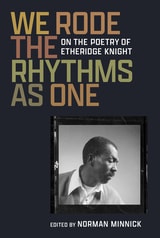
We Rode the Rhythms as One
On the Poetry of Etheridge KnightEdited by Norman Minnick
University of Michigan Press, 2026
Knight’s story is one of transformation—an odyssey from hardship and incarceration to artistic prominence—anchored by his unwavering belief in the power of poetry to unite and heal. This comprehensive volume is also a historical and cultural exploration, situating Knight’s work amid the Black Arts Movement, the Civil Rights Movement, and the ongoing fight for social justice. Readers will find themselves drawn to Knight’s unfiltered voice, his reflections on Black identity, and his insistence on making poetry accessible to all—whether through intimate letters or reflections on the sociopolitical climate that shaped his art. Suitable for poetry enthusiasts, scholars, and general readers alike, We Rode the Rhythms as One invites us to reconsider Knight’s enduring impact and the vital role of poetry in reflecting and reshaping human experience.
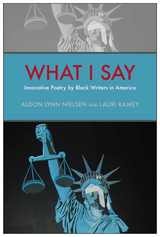
What I Say
Innovative Poetry by Black Writers in AmericaAldon Lynn Nielsen
University of Alabama Press, 2015
The elder poets in this collection, such as Nathaniel Mackey, C. S. Giscombe, Will Alexander, and Ron Allen, came of age during and were powerfully influenced by the Black Arts Movement, and What I Say grounds the collection in its black modernist roots. In tracing the fascinating and unexpected paths of experimentation these poets explored, however, Nielsen and Ramey reveal the tight delineations of African American poetry that omitted noncanonical forms. This invigorating panoply of work, when restored, brings into focus the creatively elastic frontiers and multifaceted expressions of contemporary black poetry.
Several of the poets discussed in What I Say forged relationships with members of the L=A=N=G=U=A=G=E poetry movement and participated in the broader community of innovative poetry that emerged in the late 1970s and early 1980s and continues to exert a powerful influence today.
Each volume can stand on its own, and reading them in tandem will provide a clear vision of how innovative African American poetries have evolved across the twentieth century and into the twenty-first. What I Say is infinitely teachable, compelling, and rewarding. It will appeal to a broad readership of poets, poetics teachers, poetics scholars, students of African American literature in nonnarrative forms, Afro-futurism, and what lies between the modern and the contemporary in global and localized writing practices.
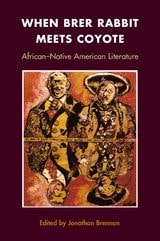
When Brer Rabbit Meets Coyote
AFRICAN-NATIVE AMERICAN LITERATUREEdited by Jonathan Brennan
University of Illinois Press, 2003
Jonathan Brennan, in a sweeping historical and analytical introduction to this collection of essays, surveys several centuries of literature in the context of the historical and cultural exchange and development of distinct African-Native American traditions. Positing a new African-Native American literary theory, he illuminates the roles subjectivity, situational identities, and strategic discourse play in defining African-Native American literatures.
Brennan provides a thorough background to the literary tradition and a valuable overview to topics discussed in the essays. He examines African-Native American political and historical texts, travel narratives, and the Mardi Gras Indian tradition, suggesting that this evolving oral tradition parallels the development of numerous Black Indian literary traditions in the United States and Latin America.
When Race Becomes Real
Black and White Writers Confront Their Personal HistoriesEdited by Bernestine Singley
Southern Illinois University Press, 2002
When Race Becomes Real is a critically acclaimed collection that pushes the boundaries of current discussions about race. In these personal and evocative essays, thirty contemporary black and white writers describe their own intimate experiences with race and discrimination, taking an unflinching look at both society and themselves. The result is an incisive and powerful anthology that rethinks what it means to be black—and white—in the modern world.
Only through frank and tough conversation, Singley tells us, can America hope to realize its goals of justice and racial equality. This collection opens that much needed honest dialogue, exploring a wide range of racial experiences in relation to a myriad of topics: from crime and religion to humor, history, and desire. Readers will find within these pages examinations of the roots of racial beliefs and the origins of the language and rules that have heretofore governed discussion; analysis of the reasons behind our reticence to discuss the subject openly; and suggestions for solutions to the problems that plague open racial discourse. The writers of When Race Becomes Real demonstrate the progress that can be made when our ingrained wariness on the subject of race is abandoned, and we instead confront the issue openly and personally. Included are contributions by a variety of authors, from Pulitzer Prize winners such as Robert Coles, Leonard Pitts, and Natalie Angier to popular writers and emerging voices. In each essay the author sweeps aside the cautious rules that often dominate racial discussions to address what race really means in the twenty-first century.
When Race Becomes Real directly tackles one of our most taboo subjects with bravery, wit, and emotion. Sometimes shocking, sometimes amusing but always honest, this collection encourages readers to move beyond the ineffective reluctance and objectivity that hinder contemporary conversations and in doing so forge a new path in racial consciousness.
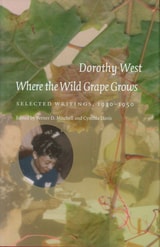
Where the Wild Grape Grows
Selected Writings, 1930–1950Dorothy West. Edited by Cynthia Davis and Verner D. Mitchell
University of Massachusetts Press, 2026
When Where the Wild Grape Grows was published in 2005 by the University of Massachusetts Press, it was the first book-length critical study of Dorothy West. Since then, the publication of more volumes on West and her circle testify to popular and academic interest in under-represented artists of the Harlem Renaissance, many of whom appeared first in West’s literary magazine, Challenge (1934-1937). Challenge included poems by West’s cousin Helene Johnson as well as by her friends Lucia Mae Pitts, Waring Cuney, Pauli Murray, Grace Walker, Mae Cowdery, Marcia Prendergast, and Bessie Calhoun Bird. West also published work by her romantic partner Marian Minus and by Juanita DeShields (the first Black Canadian graduate of McGill University) and the Trinidadian author Alfred Mendes. She included artwork by Mildred Jones and journalism by Eslanda Robeson and Dorothy Peterson. In addition to her editorial activities, West corresponded with important African American musicians including Maud Cuney Hare, Alberta Hunter, and Henry T. Burleigh, and with sculptors Augusta Savage and Richmond Barthé. Just as West mentored others, she was encouraged by such academic luminaries as Columbia Professors Blanche Colton Williams and Dorothy Scarborough, and by the controversial novelist Erskine Caldwell.
The new Introduction to Wild Grape will include fresh research on these individuals, many of whom formed part of West’s social and artistic circle. Lucia Pitts, for example, was a poet who served in the famous WAC (Women’s Army Corps) 6888th Battalion. The work of Marian Minus and Mae Cowdery has received critical attention recently and they also merit closer investigation. The Boston writer and musicologist Maud Cuney Hare was an artistic mentor to West; her cousin Waring Cuney was a close friend: both will receive more attention in the paperback edition. The artist Mildred Jones accompanied West and twenty other young African Americans to Russia in 1932 as participants in an ultimately aborted propaganda film on race relations in America; Jones studied with the important Russian Modernist painter Aleksandr Deyneka.
The original edition of Wild Grape cites two stories about West’s Russian experiences (penned under the pseudonym Mary Christopher in 1934), “Room in Red Square” and “Russian Correspondence,” but the volume does not include the actual stories. The stories are interesting because they shed light on West’s unrequited romance with Langston Hughes and her relationships with other members of the group, and they offer a unique perspective on daily life in the U.S.S.R. Both stories will be published in the new edition, along with a detailed discussion of new research about West’s visit to Russia.
A third uncollected story, “Cook” (1934), written by West under the pseudonym Jane Isaac will also be included. This story is extremely important to West’s oeuvre and her artistic development; it includes characters, themes, tropes, and plot lines that she expanded and developed in her two novels, The Living Is Easy (1948) and The Wedding (1995).
Since 2005, new material has been added to the West archive in Harvard’s Schlesinger Library. The section of Wild Grape devoted to West’s correspondence will include additional unpublished letters which underscore West’s dedication to African American art and culture.
The book includes the Benson-West family tree in Appendix II. Several scholars have expressed appreciation for this information which has not been published elsewhere; the chart will be updated to include the birth of several of West’s descendants.
White Scholars/African American Texts
Edited by Lisa A. Long
Rutgers University Press, 2005
What makes someone an authority? What makes one person's knowledge more credible than another's? In the ongoing debates over racial authenticity, some attest that we can know each other's experiences simply because we are all "human," while others assume a more skeptical stance, insisting that racial differences create unbridgeable gaps in knowledge.
Bringing new perspectives to these perennial debates, the essays in this collection explore the many difficulties created by the fact that white scholars greatly outnumber black scholars in the study and teaching of African American literature. Contributors, including some of the most prominent theorists in the field as well as younger scholars, examine who is speaking, what is being spoken and what is not, and why framing African American literature in terms of an exclusive black/white racial divide is problematic and limiting.
In highlighting the "whiteness" of some African Americanists, the collection does not imply that the teaching or understanding of black literature by white scholars is definitively impossible. Indeed such work is not only possible, but imperative. Instead, the essays aim to open a much needed public conversation about the real and pressing challenges that white scholars face in this type of work, as well as the implications of how these challenges are met.
Wild Women in the Whirlwind
Afra-American Culture and the Contemporary Literary RenaissanceEdited by Joanne M. Braxton and Andree Nicola McLaughlin
Rutgers University Press, 1989
--New York Times Book Review
"The cultural and literary achievements of black American women are examined and celebrated in some 20 enjoyable, erudite essays by prominent scholars, critics, and activists."
--Publishers Weekly
This book is the first comprehensive collection of critical and theoretical essays to explore the literary and multi-cultural traditions of Black American women in many genres over a broad span of time. The essays explore cultural and literary experience in a wide context and offer a variety of critical theoretical constructs in which to view that experience. The editors have written excellent introductions providing both historical and comparative discussions of the contemporary literary renaissance. The book also includes a valuable bibliography of selected English-language works by Black women in the Americas from the 1970s to the present.
Witches, Goddesses, and Angry Spirits
The Politics of Spiritual Liberation in African Diaspora Women's FictionMaha Marouan
The Ohio State University Press, 2013
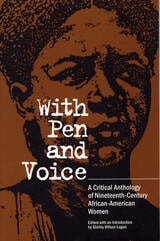
With Pen and Voice
A Critical Anthology of Nineteenth-Century African-American WomenShirley Wilson Logan
Southern Illinois University Press, 1995
"Owoman, woman! upon you I call; for upon your exertions almost entirely depends whether the rising generation shall be any thing more than we have been or not. Owoman, woman! your example is powerful, your influence great."—Maria W. Stewart, "An Address Delivered Before the Afric-American Female Intelligence Society of Boston" (1832)
Here—in the only collection of speeches by nineteenth-century African-American women—is the battle of words these brave women waged to address the social ills of their century. While there have been some scattered references to the unique roles these early "race women" played in effecting social change, until now few scholars have considered the rhetorical strategies they adopted to develop their powerful arguments.
In this chronological anthology, Shirley Wilson Logan highlights the public addresses of these women, beginning with Maria W. Stewart’s speech at Franklin Hall in 1832, believed to be the first delivered to an audience of men and women by an American-born woman. In her speech, she focused on the plight of the Northern free black. Sojourner Truth spoke in 1851 at the Akron, Ohio, Women’s Rights Convention not only for the rights of black women but also for the rights of all oppressed nineteenth-century women. Frances Ellen Watkins Harper struggled with the conflict between universal suffrage and suffrage for black men. Anna Julia Cooper chastised her unique audience of black Episcopalian clergy for their failure to continue the tradition of the elevation of womanhood initiated by Christianity and especially for their failure to support the struggling Southern black woman. Ida B. Wells’s rhetoric targeted mob violence directed at Southern black men. Her speech was delivered less than a year after her inaugural lecture on this issue—following a personal encounter with mob violence in Memphis. Fannie Barrier Williams and Victoria Earle Matthews advocated social and educational reforms to improve the plight of Southern black women. These speeches—all delivered between 1832 and 1895—are stirring proof that, despite obstacles of race and gender, these women still had the courage to mount the platform in defense of the oppressed.
Introductory essays focus on each speaker’s life and rhetoric, considering the ways in which these women selected evidence and adapted language to particular occasions, purposes, and audiences in order to persuade. This analysis of the rhetorical contexts and major rhetorical tactics in the speeches aids understanding of both the speeches and the skill of the speakers. A rhetorical timeline serves as a point of reference.
Historically grounded, this book provides a black feminist perspective on significant events of the nineteenth century and reveals how black women of that era influenced and were influenced by the social problems they addressed.
"A government which can protect and defend its citizens from wrong and outrage and does not is vicious. A government which would do itand cannot is weak; and where human life is insecure through either weakness or viciousness in the administration of law, there must be a lack of justice, and where this is wanting nothing can make up the deficiency."—Frances Ellen Watkins Harper, "Duty to Dependent Races," National Council of Women of the United States, Washington, D.C. (1891)
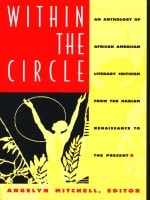
Within the Circle
An Anthology of African American Literary Criticism from the Harlem Renaissance to the PresentAngelyn Mitchell
Duke University Press, 1994
The essays in this collection—many of which are not widely available today—either initiated or gave critical definition to specific periods or movements of African American literature. They address issues such as integration, separatism, political action, black nationalism, Afrocentricity, black feminism, as well as the role of art, the artist, the critic, and the audience. With selections from Langston Hughes, Sterling Brown, W. E. B. DuBois, Zora Neale Hurston, Richard Wright, James Baldwin, Toni Morrison, Barbara Smith, Alice Walker, Henry Louis Gates, Jr., and many others, this definitive collection provides a dynamic model of the cultural, ideological, historical, and aesthetic considerations in African American literature and literary criticism.
A major contribution to the study of African American literature, this volume will serve as a foundation for future work by students and scholars. Its importance will be recognized by all those interested in modern literary theory as well as general readers concerned with the African American experience.
Selections by (partial list): Houston A. Baker, Jr., James Baldwin, Sterling Brown, Barbara Christian, W. E. B. DuBois, Ralph Ellison, LeRoi Jones, Sarah Webster Fabio, Henry Louis Gates, Jr., W. Lawrence Hogue, Langston Hughes, Zora Neale Hurston, Alain Locke, Deborah E. McDowell, Toni Morrison, J. Saunders Redding, George Schuyler, Barbara Smith, Valerie Smith, Hortense J. Spillers, Robert B. Stepto, Alice Walker, Margaret Walker, Mary Helen Washington, Richard Wright
Witnessing Slavery
The Development Of Ante-Bellum Slave NarrativesFrances Smith Foster
University of Wisconsin Press, 1994
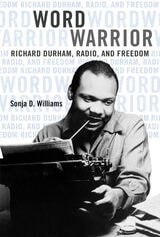
Word Warrior
Richard Durham, Radio, and FreedomSonja D. Williams
University of Illinois Press, 2015
In Word Warrior, award-winning radio producer Sonja D. Williams draws on archives and hard-to-access family records, as well as interviews with family and colleagues like Studs Terkel and Toni Morrison, to illuminate Durham's astounding career. Durham paved the way for black journalists as a dramatist and a star investigative reporter and editor for the pioneering black newspapers the Chicago Defender and Muhammed Speaks. Talented and versatile, he also created the acclaimed radio series Destination Freedom and Here Comes Tomorrow and wrote for popular radio fare like The Lone Ranger. Incredibly, his energies extended still further--to community and labor organizing, advising Chicago mayoral hopeful Harold Washington, and mentoring generations of activists.
Incisive and in-depth, Word Warrior tells the story of a tireless champion of African American freedom, equality, and justice during an epoch that forever changed a nation.
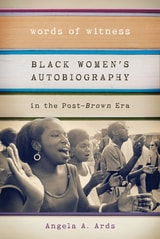
Words of Witness
Black Women's Autobiography in the Post-<i>Brown</i> EraAngela A. Ards
University of Wisconsin Press, 2015
Exploring works by the critically acclaimed June Jordan and Edwidge Danticat, as well as by popular and emerging authors such as Melba Beals, Rosemary Bray, and Eisa Davis, Ards demonstrates how each text asserts countermemories to official—and often nostalgic—understandings of the civil rights and Black Power movements. She situates each writer as activist-citizen, adopting and remaking particular roles—warrior, “the least of these,” immigrant, hip-hop head—to crystallize a range of black feminist responses to urgent but unresolved political issues.
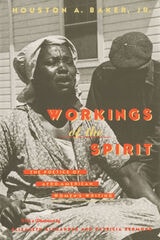
Workings of the Spirit
The Poetics of Afro-American Women's WritingHouston A. Baker Jr.
University of Chicago Press, 1990
"Brilliant, and tenderly riveted to gratitude as an indispensable facet of analysis, Houston Baker arrives, yet again, bearing the loveliest flowers of his devotion and delight: thank God he's here!"—June Jordan
Writers of the Black Chicago Renaissance
Edited by Steven C. Tracy
University of Illinois Press, 2011
The volume covers a vast collection of subjects, including many important writers such as Richard Wright, Gwendolyn Brooks, and Lorraine Hansberry as well as cultural products such as black newspapers, music, and theater. The book includes individual entries by experts on each subject; a discography and filmography that highlight important writers, musicians, films, and cultural presentations; and an introduction that relates the Harlem Renaissance, the White Chicago Renaissance, the Black Chicago Renaissance, and the Black Arts Movement.
Contributors are Robert Butler, Robert H. Cataliotti, Maryemma Graham, James C. Hall, James L. Hill, Michael Hill, Lovalerie King, Lawrence Jackson, Angelene Jamison-Hall, Keith Leonard, Lisbeth Lipari, Bill V. Mullen, Patrick Naick, William R. Nash, Charlene Regester, Kimberly Ruffin, Elizabeth Schultz, Joyce Hope Scott, James Smethurst, Kimberly M. Stanley, Kathryn Waddell Takara, Steven C. Tracy, Zoe Trodd, Alan Wald, Jamal Eric Watson, Donyel Hobbs Williams, Stephen Caldwell Wright, and Richard Yarborough.