Results by title
187 books match the query 'African American women' and 9 start with w
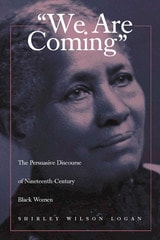
We Are Coming
The Persuasive Discourse of Nineteenth-Century Black WomenShirley Wilson Logan
Southern Illinois University Press, 1999
Shirley Wilson Logan analyzes the distinctive rhetorical features in the persuasive discourse of nineteenth-century black women, concentrating on the public discourse of club and church women from 1880 until 1900.
Logan develops each chapter in this illustrated study around a feature of public address as best exemplified in the oratory of a particular woman speaker of the era. She analyzes not only speeches but also editorials, essays, and letters.
Logan first focuses on the prophetic oratory of Maria Stewart, the first American-born black woman to speak publicly. Turning to Frances Harper, she considers speeches that argue for common interests between divergent communities. And she demonstrates that central to the antilynching rhetoric of Ida Wells is the concept of "presence," or the tactic of enhancing certain selected elements of the presentation.
In her discussion of Fannie Barrier Williams and Anna Cooper, Logan shows that when speaking to white club women and black clergymen, both Williams and Cooper employ what Kenneth Burke called identification. To analyze the rhetoric of Victoria Matthews, she applies Carolyn Miller's modification of Lloyd Bitzer's concept of the rhetorical situation.
Logan also examines the discourse of women associated with the black Baptist women's movement and those participating in college-affiliated conferences.
The book includes an appendix with little-known speeches and essays by Anna Julia Cooper, Selena Sloan Butler, Lucy Wilmot Smith, Mary V. Cook, Adella Hunt Logan, Victoria Earle Matthews, Lucy C. Laney, and Georgia Swift King.
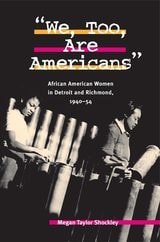
We, Too, Are Americans
African American Women in Detroit and Richmond, 1940-54Megan Taylor Shockley
University of Illinois Press, 2003
As demands on them intensified, the women working to provide American troops with clothing, medical supplies, and other services became increasingly aware of their key role in the war effort. A considerable number of the African Americans among them began to use their indispensability to leverage demands for equal employment, welfare and citizenship benefits, fair treatment, good working conditions, and other considerations previously denied them.
Shockley shows that as these women strove to redefine citizenship, backing up their claims to equality with lawsuits, sit-ins, and other forms of activism, they were forging tools that civil rights activists would continue to use in the years to come.
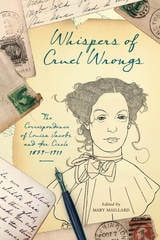
Whispers of Cruel Wrongs
The Correspondence of Louisa Jacobs and Her Circle, 1879-1911Edited by Mary Maillard
University of Wisconsin Press, 2020
New voices call out from the lost world of nineteenth-century African American women in this annotated correspondence. Unidentified for nearly one hundred years, over seventy rare letters from Louisa Jacobs, Annie Purvis, and Charlotte Forten to their friend Eugenie Webb disclose the lives of these educated, resourceful women. Jacobs taught at Howard University, ran her own small business, advocated for civil rights, cared for her ailing mother, and worked for two federal agencies. Purvis, Forten, and Webb were descendants of some of Philadelphia's earliest free black abolitionist families. Sustained by friendship and faith, these women created warm and sympathetic relationships, despite difficult family obligations and the racist strife that marked the post-Reconstruction era in Washington, Philadelphia, and New Jersey.
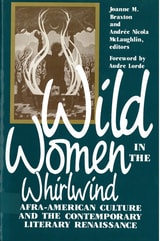
Wild Women in the Whirlwind
Afra-American Culture and the Contemporary Literary RenaissanceEdited by Joanne M. Braxton and Andree Nicola McLaughlin
Rutgers University Press, 1989
--New York Times Book Review
"The cultural and literary achievements of black American women are examined and celebrated in some 20 enjoyable, erudite essays by prominent scholars, critics, and activists."
--Publishers Weekly
This book is the first comprehensive collection of critical and theoretical essays to explore the literary and multi-cultural traditions of Black American women in many genres over a broad span of time. The essays explore cultural and literary experience in a wide context and offer a variety of critical theoretical constructs in which to view that experience. The editors have written excellent introductions providing both historical and comparative discussions of the contemporary literary renaissance. The book also includes a valuable bibliography of selected English-language works by Black women in the Americas from the 1970s to the present.
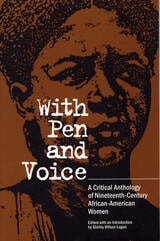
With Pen and Voice
A Critical Anthology of Nineteenth-Century African-American WomenShirley Wilson Logan
Southern Illinois University Press, 1995
"Owoman, woman! upon you I call; for upon your exertions almost entirely depends whether the rising generation shall be any thing more than we have been or not. Owoman, woman! your example is powerful, your influence great."—Maria W. Stewart, "An Address Delivered Before the Afric-American Female Intelligence Society of Boston" (1832)
Here—in the only collection of speeches by nineteenth-century African-American women—is the battle of words these brave women waged to address the social ills of their century. While there have been some scattered references to the unique roles these early "race women" played in effecting social change, until now few scholars have considered the rhetorical strategies they adopted to develop their powerful arguments.
In this chronological anthology, Shirley Wilson Logan highlights the public addresses of these women, beginning with Maria W. Stewart’s speech at Franklin Hall in 1832, believed to be the first delivered to an audience of men and women by an American-born woman. In her speech, she focused on the plight of the Northern free black. Sojourner Truth spoke in 1851 at the Akron, Ohio, Women’s Rights Convention not only for the rights of black women but also for the rights of all oppressed nineteenth-century women. Frances Ellen Watkins Harper struggled with the conflict between universal suffrage and suffrage for black men. Anna Julia Cooper chastised her unique audience of black Episcopalian clergy for their failure to continue the tradition of the elevation of womanhood initiated by Christianity and especially for their failure to support the struggling Southern black woman. Ida B. Wells’s rhetoric targeted mob violence directed at Southern black men. Her speech was delivered less than a year after her inaugural lecture on this issue—following a personal encounter with mob violence in Memphis. Fannie Barrier Williams and Victoria Earle Matthews advocated social and educational reforms to improve the plight of Southern black women. These speeches—all delivered between 1832 and 1895—are stirring proof that, despite obstacles of race and gender, these women still had the courage to mount the platform in defense of the oppressed.
Introductory essays focus on each speaker’s life and rhetoric, considering the ways in which these women selected evidence and adapted language to particular occasions, purposes, and audiences in order to persuade. This analysis of the rhetorical contexts and major rhetorical tactics in the speeches aids understanding of both the speeches and the skill of the speakers. A rhetorical timeline serves as a point of reference.
Historically grounded, this book provides a black feminist perspective on significant events of the nineteenth century and reveals how black women of that era influenced and were influenced by the social problems they addressed.
"A government which can protect and defend its citizens from wrong and outrage and does not is vicious. A government which would do itand cannot is weak; and where human life is insecure through either weakness or viciousness in the administration of law, there must be a lack of justice, and where this is wanting nothing can make up the deficiency."—Frances Ellen Watkins Harper, "Duty to Dependent Races," National Council of Women of the United States, Washington, D.C. (1891)
Woman's Legacy
Essays on Race, Sex, and Class in American HistoryBettina Aptheker
University of Massachusetts Press, 1982
Woman's Legacy: Essays on Race, Sex, and Class in American History is a groundbreaking collection of essays by prominent feminist scholar and historian Bettina Aptheker. Emerging from her dissertation research, this work examines the interconnected systems of racial, sexual, and class oppression that have shaped the experiences of women in American history. Through careful historical analysis and feminist scholarship, Aptheker explores how race, sex, and class work together to form complex systems of domination and resistance in the American historical context. The essays investigate women's community roles, activism, and agency while centering the lived experiences of women, particularly Black women, across different historical periods. This seminal work contributes to African American women's history and feminist historiography, bridging women's studies with critical analysis of historical structures and social movements. An essential text for those interested in intersectional approaches to American history and women's studies.
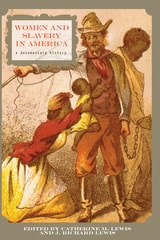
Women and Slavery in America
A Documentary HistoryCatherine M. Lewis
University of Arkansas Press, 2011
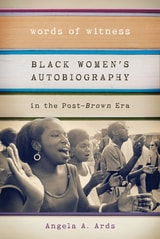
Words of Witness
Black Women's Autobiography in the Post-<i>Brown</i> EraAngela A. Ards
University of Wisconsin Press, 2015
Exploring works by the critically acclaimed June Jordan and Edwidge Danticat, as well as by popular and emerging authors such as Melba Beals, Rosemary Bray, and Eisa Davis, Ards demonstrates how each text asserts countermemories to official—and often nostalgic—understandings of the civil rights and Black Power movements. She situates each writer as activist-citizen, adopting and remaking particular roles—warrior, “the least of these,” immigrant, hip-hop head—to crystallize a range of black feminist responses to urgent but unresolved political issues.
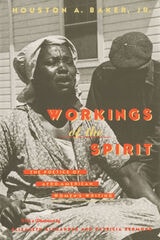
Workings of the Spirit
The Poetics of Afro-American Women's WritingHouston A. Baker Jr.
University of Chicago Press, 1990
"Brilliant, and tenderly riveted to gratitude as an indispensable facet of analysis, Houston Baker arrives, yet again, bearing the loveliest flowers of his devotion and delight: thank God he's here!"—June Jordan