264 books match the query 'Asian Studies' and 7 start with w
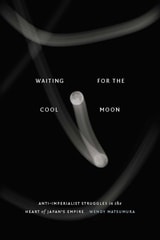
cover of Waiting for the Cool Moon: Anti-imperialist Struggles in the Heart of Japan's Empire

Waiting for the Cool Moon

Anti-imperialist Struggles in the Heart of Japan's Empire

Wendy Matsumura

Duke University Press, 2024
In Waiting for the Cool Moon Wendy Matsumura interrogates the erasure of colonial violence at the heart of Japanese nation-state formation. She critiques Japan studies’ role in this effacement and contends that the field must engage with anti-Blackness and anti-Indigeneity as the grounds on which to understand imperialism, colonialism, fascism, and other forces that shape national consciousness. Drawing on Black radical thinkers’ critique of the erasure of the Middle Passage in universalizing theories of modernity’s imbrication with fascism, Matsumura traces the consequences of the Japanese empire’s categorization of people as human and less-than-human as manifested in the 1920s and 1930s, and the struggles of racialized and colonized people against imperialist violence. She treats the archives safeguarded by racialized, colonized women throughout the empire as traces of these struggles, including the work they performed to keep certain stories out of view. Matsumura demonstrates that tracing colonial sensibility and struggle is central to grappling with their enduring consequences for the present.
[more]
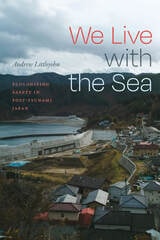
cover of We Live with the Sea: Ecologizing Safety in Post-Tsunami Japan

We Live with the Sea

Ecologizing Safety in Post-Tsunami Japan

Andrew Littlejohn

Duke University Press, 2026
In We Live with the Sea, Andrew Littlejohn addresses the implementation and controversy surrounding safety infrastructures following the March 2011 tsunami in northeastern Japan. While the Japanese government proposed and enforced infrastructural transformations in the wake of the tsunami, these changes did not consider the impact on residents who built their communities and livelihoods around the coast. Focusing on the tsunami survivors who resisted government plans for increased coastal defenses, Littlejohn highlights alternative proposals offered by the local residents as well as the environmental, ecological, and more-than-human dependencies and imbrications those proposals reveal. In doing so, he argues that imposed modernist safety structures undermine the very things they claim to protect, showing how attempts to “ecologize” safety may offer more sustainable ways of thinking about security, preservation, and infrastructure.
[more]
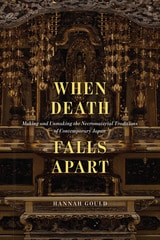
cover of When Death Falls Apart: Making and Unmaking the Necromaterial Traditions of Contemporary Japan

When Death Falls Apart

Making and Unmaking the Necromaterial Traditions of Contemporary Japan

Hannah Gould

University of Chicago Press, 2023

Through an ethnographic study inside Japan’s Buddhist goods industry, this book establishes a method for understanding change in death ritual through attention to the dynamic lifecourse of necromaterials.
 
Deep in the Fukuyama mountainside, “the grave of the graves” (o-haka no haka) houses acres of unwanted headstones—the material remains of Japan’s discarded death rites. In the past, the Japanese dead became venerated ancestors through sustained ritual offerings at graves and at butsudan, Buddhist altars installed inside the home. But in twenty-first-century Japan, this intergenerational system of care is rapidly collapsing.

In noisy carpentry studios, flashy funeral-goods showrooms, neglected cemeteries, and cramped kitchens where women prepare memorial feasts, Hannah Gould analyzes the lifecycle of butsudan, illuminating how they are made, circulate through religious and funerary economies, mediate intimate exchanges between the living and the dead, and—as the population ages, families disperse, and fewer homes have space for large lacquer cabinets—eventually fall into disuse. What happens, she asks, when a funerary technology becomes obsolete? And what will take its place? Gould examines new products better suited to urban apartments: miniature urns and sleek altars inspired by Scandinavian design, even reliquary jewelry. She visits an automated columbarium and considers new ritual practices that embrace impermanence. At an industry expo, she takes on the role of “demonstration corpse.” Throughout, Gould invites us to rethink memorialization and describes a distinct form of Japanese necrosociality, one based on material exchanges that seek to both nurture the dead and disentangle them from the world of the living.
[more]
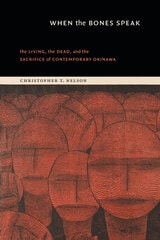
cover of When the Bones Speak: The Living, the Dead, and the Sacrifice of Contemporary Okinawa

When the Bones Speak

The Living, the Dead, and the Sacrifice of Contemporary Okinawa

Christopher T. Nelson

Duke University Press, 2025
Haunted by the past, ordinary Okinawans struggle to live with the unbearable legacies of war, Japanese nationalism, and American imperialism. They are caught up in a web of people and practices—living and dead, visible and immaterial—that exert powerful forces often beyond their control. In When the Bones Speak, Christopher T. Nelson examines the myriad ways contemporary Okinawans experience, remember, and contest sacrifice. He attends to the voices of those who find their vocation in service to others, from shamans, fortune tellers, laborers, and artists to dead soldiers, war survivors, antiwar activists, and Christian missionaries. Nelson shows how the memories of past sacrifices, atrocities, and exploitation as well as residual trauma shape modern life in Okinawa and the possibility and hope for creative action grounded in the everyday. Offering new understandings of colonial transformation, wartime violence, and military occupation, Nelson writes from the intersection of temporalities and possibilities, where the hard finality of the past may be broken open to reveal a “not yet” that has always remained just beyond reach.
[more]
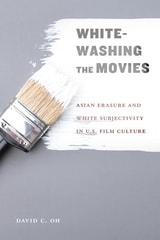
cover of Whitewashing the Movies: Asian Erasure and White Subjectivity in U.S. Film Culture

Whitewashing the Movies

Asian Erasure and White Subjectivity in U.S. Film Culture

David C Oh

Rutgers University Press, 2022
Whitewashing the Movies addresses the popular practice of excluding Asian actors from playing Asian characters in film. Media activists and critics have denounced contemporary decisions to cast White actors to play Asians and Asian Americans in movies such as Ghost in the Shell and Aloha. The purpose of this book is to apply the concept of “whitewashing” in stories that privilege White identities at the expense of Asian/American stories and characters. To understand whitewashing across various contexts, the book analyzes films produced in Hollywood, Asian American independent production, and US-China co-productions. Through the analysis, the book examines the ways in which whitewashing matters in the project of Whiteness and White racial hegemony. The book contributes to contemporary understanding of mediated representations of race by theorizing whitewashing, contributing to studies of Whiteness in media studies, and producing a counter-imagination of Asian/American representation in Asian-centered stories.
[more]
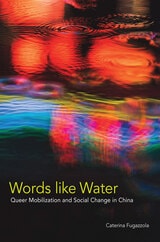
cover of Words like Water: Queer Mobilization and Social Change in China

Words like Water

Queer Mobilization and Social Change in China

Fugazzola, Caterina

Temple University Press, 2023

After China officially “decriminalized” same-sex behavior in 1997, both the visibility and public acceptance of tongzhi, an inclusive identity term that refers to nonheterosexual and gender nonconforming identities in the People’s Republic of China, has improved. However, for all the positive change, there are few opportunities for political and civil rights advocacy under Xi Jinping’s authoritarian rule.

Words like Water explores the nonconfrontational strategies the tongzhi movement uses in contemporary China. Caterina Fugazzola analyzes tongzhi organizers’ conceptualizations of, and approaches to, social change, explaining how they avoid the backlash that meets Western tactics, such as protests, confrontation, and language about individual freedoms. In contrast, the groups’ intentional use of community and family-oriented narratives, discourses, and understandings of sexual identity are more effective, especially in situations where direct political engagement is not possible.

Providing on-the-ground stories that examine the social, cultural, and political constraints and opportunities, Words like Water emphasizes the value of discursive flexibility that allows activists to adapt to changing social and political conditions.
[more]
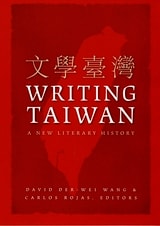
cover of Writing Taiwan: A New Literary History

Writing Taiwan

A New Literary History

David Der-wei Wang and Carlos Rojas, eds.

Duke University Press, 2007

Writing Taiwan is the first volume in English to examine the entire span of modern Taiwan literature, from the first decades of the twentieth century to the present. In this collection, leading literary scholars based in Taiwan and the United States consider prominent Taiwanese authors and works in genres including poetry, travel writing, and realist, modernist, and postmodern fiction. The diversity of Taiwan literature is signaled by the range of authors treated, including Yang Chichang, who studied Japanese literature in Tokyo in the early 1930s and wrote all of his own poetry and fiction in Japanese; Li Yongping, an ethnic Chinese born in Malaysia and educated in Taiwan and the United States; and Liu Daren, who was born in mainland China and effectively exiled from Taiwan in the 1970s on account of his political activism.

Because the island of Taiwan spent the first half of the century as a colony of Japan and the second half in an umbilical relationship to China, its literature challenges basic assumptions about what constitutes a “national literature.” Several contributors directly address the methodological and epistemological issues involved in writing about “Taiwan literature.” Other contributors investigate the cultural and political grounds from which specific genres and literary movements emerged. Still others explore themes of history and memory in Taiwan literature and tropes of space and geography, looking at representations of boundaries as well as the boundary-crossing global flows of commodities and capital. Like Taiwan’s history, modern Taiwan literature is rife with conflicting legacies and impulses. Writing Taiwan reveals a sense of its richness and diversity to English-language readers.

Contributors. Yomi Braester, Sung-sheng Yvonne Chang, Fangming Chen, Lingchei Letty Chen, Chaoyang Liao, Ping-hui Liao, Joyce C. H. Liu, Kim-chu Ng, Carlos Rojas, Xiaobing Tang, Ban Wang, David Der-wei Wang, Gang Gary Xu, Michelle Yeh, Fenghuang Ying

[more]