Results by title
484 books match the query 'Biblical Studies' and 16 start with w
Warfare, Ritual, and Symbol in Biblical and Modern Contexts
Brad E. Kelle
SBL Press, 2014
New perspectives on Israelite warfare for biblical studies, military studies, and social theory
Contributors investigate what constituted a symbol in war, what rituals were performed and their purpose, how symbols and rituals functioned in and between wars and battles, what effects symbols and rituals had on insiders and outsiders, what ways symbols and rituals functioned as instruments of war, and what roles rituals and symbols played in the production and use of texts.
Features:
- Thirteen essays examine war in textual, historical, and social contexts
- Texts from the Hebrew Bible are read in light of ancient Near Eastern texts and archaeology
- Interdisciplinary studies make use of contemporary ritual and social theory
Was There a Wisdom Tradition
New Prospects in Israelite Wisdom StudiesMark R. Sneed
SBL Press, 2015
Essential reading for scholars and students in wisdom studies
This collection of essays explores questions that challenge the traditional notion of a wisdom tradition among the Israelite literati, such as: Is the wisdom literature a genre or mode of literature or do we need new terminology? Who were the tradents? Is there such a thing as a “wisdom scribe” and what would that look like? Did the scribes who composed wisdom literature also have a hand in producing the other “traditions,” such as the priestly, prophetic, and apocalyptic, as well as other non-sapiential works? Were Israelite sages open to non-sapiential forms of knowledge in their conceptualization of wisdom?
Features:
- Recent genre theory in distinction from traditional form criticism
- Ancient Near Eastern comparative material
- A balanced collection that includes essays that seriously challenge and affirm the consensus view, as well as those that reconfigure it
What John Knows
Storytelling in the Fourth GospelDouglas Estes
SBL Press, 2025
What is Modern Israel?
Yakov M. Rabkin
Pluto Press, 2016
Drawing on many overlooked pages of history, including English, French, Hebrew, Yiddish and Russian sources, Yakov Rabkin shows that Zionism was conceived as a sharp break with Judaism and Jewish continuity. Israel’s past and present must be seen in the context of European ethnic nationalism, colonial expansion and geopolitical interests, rather than as an incarnation of Biblical prophecies or a culmination of Jewish history.
When Texts Are Canonized
Timothy H. Lim
SBL Press, 2017
How did canonization take place, and what difference does it make?
Essays in this collection probe the canonical process: Why were certain books, but not others, included in the canon? What criteria were used to select the books of the canon? Was canonization a divine fiat or human act? What was the nature of the authority of the laws and narratives of the Torah? How did prophecy come to be included in the canon? Others reflect on the consequences of canonization: What are the effects in elevating certain writings to the status of “Holy Scriptures”? What happens when a text is included in an official list? What theological and hermeneutical questions are at stake in the fact of the canon? Should the canon be unsealed or reopened to include other writings?
Features:
- Essays that contribute to our understanding of the complex processes of canonization
- Exploration of early concepts of canonicity
- Discussion of reopening the New Testament canon
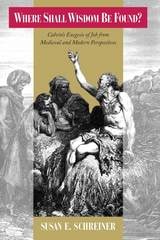
Where Shall Wisdom be Found?
Calvin's Exegesis of Job from Medieval and Modern PerspectivesSusan E. Schreiner
University of Chicago Press, 1994
For Calvin and his predecessors, Schreiner argues, the concept of intellectual perception is the key to an understanding of Job. The texts she examines constantly raise questions about the human capacity for knowledge: What can the sufferer who stands within history perceive about the self, God, and reality? Can humans truly perceive the workings of providence in their personal lives or in the tumult of history? Are evil and injustice a reality that we must confront before finding wisdom?
In her final chapter, Schreiner turns to the wide array of twentieth-century interpretations of Job, including modern biblical commentaries, the work of Carl Jung, and literary transfigurations by Wells, MacLeish, Wiesel, and Kafka. The result is a compelling demonstration of how the history of exegesis can yield vital insights for contemporary culture.
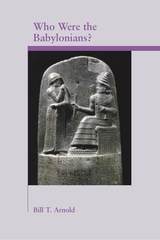
Who Were the Babylonians?
Bill T. Arnold
SBL Press, 2004
Why Are We Created
Increasing Our Understanding of Humanity's Purpose on EarthSir John Templeton
Templeton Press, 2003
While many books strive to stimulate thinking through provocative anecdotes and theories, Why Are We Created? takes a different path. It begins with a question and continues with a multitude of questions like these:
•What is the importance of recognizing the presence of the sacred within us and around us?•How can individuals create a purposeful and fruitful way of life?
•How does happiness relate to one's purpose?
Wisdom Discourse and Torah in Second Temple Judaism
Challenging the Integration ParadigmJiseong James Kwon
SBL Press, 2025
Did wisdom literature in the Hebrew Bible develop over time from secular to religious, as many early modern scholars believed? Did it develop in reaction to historical events or out of conflict with other traditions, including Torah? In Wisdom Discourse and Torah in Second Temple Judaism, JiSeong James Kwon moves beyond this impasse by applying a discourse-critical method to intertextual readings of Proverbs, Ben Sira, the Wisdom of Solomon, Baruch, the Dead Sea Scrolls, and Deuteronomy. Kwon’s study reveals that wisdom literature maintained an independent identity and theological orientation distinct from the legal traditions of the Torah. Rather than wisdom being subsumed into legal material, Jewish intellectual production remained pluralistic in form, genre, and theological orientation throughout the Persian and Hellenistic periods.
Wisdom From World Religions
Pathways Toward Heaven On EarthJohn Marks Templeton
Templeton Press, 2002
Every religion acknowledges certain spiritual principles and records them in its sacred literature and traditions. This book curates these ancient teachings and shows how they apply to modern life with the help of parables, quotations, and commentaries.
By reading Wisdom from World Religions, people from all walks of life will be inspired to pursue their own spiritual growth and to contemplate questions central to our existence, such as how, through love and creativity, can we be agents of divinity on earth?
Uplifting and instructional, this is a book to be treasured, studied, and practiced.
Wisdom from the Late Bronze Age
Yoram Cohen
SBL Press, 2013
With the Loyal You Show Yourself Loyal
Essays on Relationships in the Hebrew Bible in Honor of Saul M. OlyanT. M. Lemos
SBL Press, 2021
Contributors to this volume come together to honor the lifetime of work of Saul M. Olyan, Samuel Ungerleider Jr. Professor of Judaic Studies and Professor of Religious Studies at Brown University. Essays by his students, colleagues, and friends focus on and engage with his work on relationships in the Hebrew Bible, from the marking of status in relationships of inequality, to human family, friend, and sexual relationships, to relationships between divine beings. Contributors include Susan Ackerman, Klaus-Peter Adam, Rainer Albertz, Andrea Allgood, Debra Scoggins Ballentine, Bob Becking, John J. Collins, Stephen L. Cook, Ronald Hendel, T. M. Lemos, Nathaniel B. Levtow, Carol Meyers, Susan Niditch, Brian Rainey, Thomas Römer, Jordan D. Rosenblum, Rüdiger Schmitt, Jennifer Elizabeth Singletary, Kerry M. Sonia, Karen B. Stern, Stanley Stowers, Andrew Tobolowsky, Karel van der Toorn, Emma Wasserman, and Steven Weitzman.
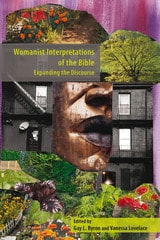
Womanist Interpretations of the Bible
Expanding the DiscourseGay L. Byron
SBL Press, 2016
Expand the discourse and open the spheres of engagement to include new voices of scholars and bold, innovative interpretive approaches
This edited volume brings together cross-generational and cross-cultural readings of the Bible and other sacred sources by including scholars from the Caribbean, India, and Africa who have not traditionally fit into the narrow U.S., African American paradigm for understanding womanist biblical interpretation. The volume engages the reader in a wide range of interdisciplinary methods and perspectives, such as gender and feminist criticism, social-scientific methods, post-colonial and psychoanalytical theory that emphasize the inherently intersectional dynamics of race, ethnicity, and class at work in womanist thought and analysis.
Features
- Topics include the Black Lives Matter movement, domestic violence, and AIDS, while at the same time uncovering the roles of children, women, and other marginalized persons in biblical narratives
- Coverage of Hebrew Bible and New Testament texts, as well as Ifa spiritual narratives, Hindu scripture, and Ethiopic texts
- Responses from four respected womanist and feminist critics: Katherine Doob Sakenfeld, Emilie Townes, Layli (Phillips) Maparyan, and Sarojini Nadar

Women at Work in the Deuteronomistic History
Mercedes L. García Bachmann
SBL Press, 2013
A thorough study of the socio-economic and literary contexts of women in the Deuteronomistic History
Mercedes L. García Bachmann examines the key texts in the Deuteronomistic History that mention women in service occupations: slaves and dependents, cooks, wet nurses, childcare givers, prostitutes, and scribes. The mostly anonymous women who performed this work for others are sometimes mentioned only in a single verse. Consequently, they often are as unrecognized in modern scholarship as they seem in the biblical text. García Bachmann shows that these women were honored not in relation to matters such as sexual purity or marital faithfulness but on account of the valuable service that they provided.
- A close examination of unnamed women
- A review of previous work in feminist, ancient Near Eastern, biblical, and social-scientific studies
- Extensive coverage of Hebrew terms used for women workers

Worthy Lamb
An Exegetical-Spiritual Commentary on John's ApocalypseAndreas Hoeck
Saint Paul Seminary Press, 2024
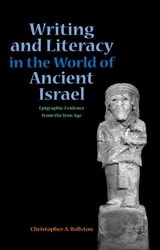
Writing and Literacy in the World of Ancient Israel
Epigraphic Evidence from the Iron AgeChristopher A. Rollston
SBL Press, 2010