Results by title
5550 books match the query 'Biography & Autobiography' and 258 start with w
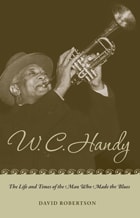
W. C. Handy
The Life and Times of the Man Who Made the BluesDavid Robertson
University of Alabama Press, 2011
Normal0falsefalsefalseEN-USX-NONEX-NONEMicrosoftInternetExplorer4

W. E. B. Du Bois
Revolutionary Across the Color LineBill V. Mullen
Pluto Press, 2016
Du Bois was born in Massachusetts in 1868, just three years after formal emancipation of America’s slaves. In his extraordinarily long and active political life, he would emerge as the first black man to earn a PhD from Harvard; surpass Booker T. Washington as the leading advocate for African American rights; co-found the NAACP, and involve himself in anti-imperialist and anti-colonial struggles across Asia and Africa. Beyond his Civil Rights work, Mullen also examines Du Bois's attitudes towards socialism, the USSR, China’s Communist Revolution, and the intersectional relationship between capitalism, poverty and racism.
An accessible introduction to a towering figure of American Civil Rights, perfect for anyone wanting to engage with Du Bois’s life and work.

WERNER VON SIEMENS
INVENTOR AND INTERNATIONAL ENTREPRENEURWILFRIED FELDENKIRCHEN
The Ohio State University Press, 1994
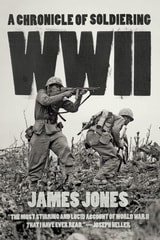
WWII
A Chronicle of SoldieringJames Jones
University of Chicago Press, 1975
Moving chronologically and thematically through the complex history of the conflict, Jones interweaves his own vivid memories of soldiering in the Pacific—from the look on a Japanese fighter pilot’s face as he bombed Pearl Harbor, so close that Jones could see him smile and wave, to hitting the beach under fire in Guadalcanal—while always returning to resounding larger themes. Much of WWII can be read as a tribute to the commitment of American soldiers, but Jones also pulls no punches, bluntly chronicling resentment at the privilege of the officers, questionable strategic choices, wartime suffering, disorganization, the needless loss of life, and the brutal realization that a single soldier is ultimately nothing but a replaceable cog in a heartless machine. As the generation that fought and won World War II leaves the stage, James Jones’s book reminds us of what they accomplished—and what they sacrificed to do so.
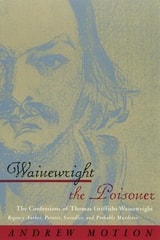
Wainewright the Poisoner
The Confessions of Thomas Griffiths WainewrightAndrew Motion
University of Chicago Press, 2001
"Thomas Griffiths Wainewright is a dream subject for either novelist or biographer. . . . Andrew Motion, Britain's poet laureate, clearly felt that neither straight biography nor pure fiction would do Wainewright's complexities justice, and so he combined the two genres. The result is stunning. The central voice is that of Wainewright himself, reflecting back on his life. After each chapter Mr. Motion has added detailed notes that inform and flesh out the narrative, giving not only his own informed opinion of Wainewright's actions but also those of Wainewright's contemporaries and the scholars and writers who have studied him over the past two centuries."—Lucy Moore, Washington Times
"Brilliantly innovative, gripping, intricately researched, Motion's biography does justice to its subject at last."—John Carey, The Sunday Times
"Engaging and convincing. . . . The trajectory of this character-from neglected and resentful child to arrogant and envious London dandy to sociopathic murderer on to an enfeebled, frightened prisoner-is indelibly imagined and drawn."—Edmund White, Financial Times
"[A] fascinating look at an evil artist, a charmer still having his way with us. We can hear him being economical with the truth, telling us and himself just what he wants to hear."—Michael Olmert, New Jersey Star Ledger
"Motion crafts a fascinating tale as complex and compelling as if Wainewright himself had written it."—Michael Spinella, Booklist
"Did he kill his servant, and possibly others as well? . . . The footnotes seem to say yes, but Wainewright adamantly argues his own case. Motion's prose is flawless, and Wainewright's voice is convincing. But in the long run, it's this ambiguity that makes Wainewright the Poisoner a fascinating and memorable read."—R.V. Schelde, Sacramento News and Review
"Who could as for a better Romantic villain than Thomas Griffiths Wainewright? . . . [The book] succeeds on many levels: as an act of ventriloquism, a work of scholarship, a psychological study, as a set of sharp portraits of famous men and an engrossing read. . . ."—Polly Shulman, Newsday
"Instead of a straightforward biography, Andrew Motion gives us Wainewright's first person, fictionalized "confession."—a document as circumspect, slyly reticent, and oeaginously smooth as the man himself. Splendid."—John Banville, Literary Review
"A genuine tour de force, and on a non-fictional level, a telling portrait of a strange, intriguing and repellant man."—Brian Fallon, Irish Times
"A marvelous literary hybrid that totters with one foot in the world of nonfiction, the other in the land of make-believe. One is alternatively swept up in Motion's dizzy imaginative pastiche, or sent crashing into a dusty stack of scholarly cogitations. . . ."—Philadelphia Inquirer
"As true a portrait of a liar as its subject could wish. Rich and strange. . . ."—Glasgow Herald
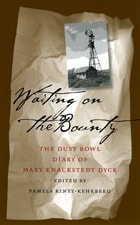
Waiting On The Bounty
Dust Bowl Diary Mary DyckPamela Riney-Kehrberg
University of Iowa Press, 1999
Though she had only a fifth-grade education, Mary Knackstedt Dyck faithfully kept a diary. Written with pencil on lined notebook paper, her daily notations tell the story of farm life on the far western border of Kansas during the grim Dust Bowl years. Manuscript diaries from this era and region are extremely rare, and those written by farm women are even more so. From the point of view of a wife, mother, and partner in the farming enterprise, Dyck recorded the everyday events as well as the frustrations of living with drought and dust storms and the sadness of watching one's children leave the farm.
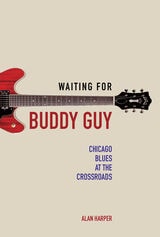
Waiting for Buddy Guy
Chicago Blues at the CrossroadsAlan Harper
University of Illinois Press, 2016
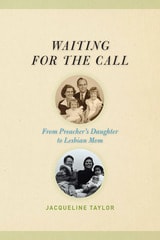
Waiting for the Call
From Preacher's Daughter to Lesbian MomJacqueline Taylor
University of Michigan Press, 2007
“Well-written, absorbing, and a great pleasure to read . . . will appeal to Christians struggling to square their traditional beliefs with acceptance of homosexuality as well as to all those interested in adoption, lesbian marriage, and the changing shape of America’s families.”
—Elizabeth C. Fine, Virginia Tech University
Waiting for the Call takes readers from the foothills of the Appalachians—where Jacqueline Taylor was brought up in a strict evangelical household—to contemporary Chicago, where she and her lesbian partner are raising a family. In a voice by turns comic and loving, Taylor recounts the amazing journey that took her in profoundly different directions from those she or her parents could have ever envisioned.
Taylor’s father was a Southern Baptist preacher, and she struggled to deal with his strictures as well as her mother’s manic-depressive episodes. After leaving for college, Taylor finds herself questioning her faith and identity, questions that continue to mount when—after two divorces, a doctoral degree, and her first kiss with a woman—she discovers her own lesbianism and begins a most untraditional family that grows to include two adopted children from Peru.
Even as she celebrates and cherishes this new family, Taylor insists on the possibility of maintaining a loving connection to her religious roots. While she and her partner search for the best way to explain adoption to their children and answer the inevitable question, “Which one is your mom?” they also seek out a church that will unite their love of family and their faith. Told in the great storytelling tradition of the American South, full of deep feeling and wry humor, Waiting for the Call engagingly demonstrates how one woman bridged the gulf between faith and sexual identity without abandoning her principles.
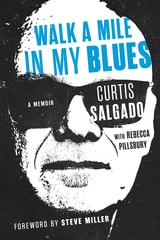
Walk a Mile in My Blues
A MemoirCurtis Salgado with Rebecca Pillsbury; Foreword by Steve Miller
University of Illinois Press, 2027
In this memoir, Salgado shares stories of his career against the backdrop of encounters with music legends, the Oregon scene’s cultural heyday, and his journey to overcome addiction and life-threatening health challenges. His poignant and at times humorous stories of touring and playing with artists like Robert Cray, Muddy Waters, Cab Calloway, and Stevie Ray Vaughan fuse with an invitation to embrace the blues and soul music that shaped his life and help define America.
Walk a Mile in My Blues shares the hidden and heartfelt story of a musical legend, living and loving the blues.
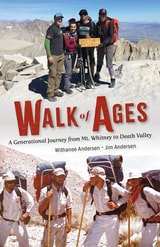
Walk of Ages
A Generational Journey from Mt. Whitney to Death ValleyWithanee Andersen
University of Nevada Press, 2024
With hopes of being listed in the Guinness Book of World Records, Jim led the first documented walk from the highest to lowest point in the contiguous United States in 1974. He lived, albeit just barely, to tell the tale to his daughter, sparking a desire in Withanee to retrace his steps in his honor. In 2017, she took on the incredible task of recreating Jim’s legacy trek of 131 miles with the help of divine intervention, ice-cold beer, and her parents, who were following along as the support party.
Walk of Ages humorously relates the parallel journey of an epic adventure told from two perspectives—a daughter’s difficult quest, and a father who supports her through it while recalling his own experiences from four decades earlier. Throughout this momentous odyssey, readers will realize how a once-in-a-generation adventure leads to life-changing transformation, and that the bond between father and daughter knows no bounds.
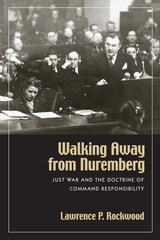
Walking Away from Nuremberg
Just War and the Doctrine of Command ResponsibilityLawrence P. Rockwood
University of Massachusetts Press, 2007
In September 1994, Lawrence P. Rockwood, then a counterintelligence officer with the U.S. Army's Tenth Mountain Division, was deployed to Haiti as part of Operation Restore Democracy, the American-led mission to oust the regime of Raoul Cedras and reinstall President Jean-Bertrand Aristide. Shortly after arriving in-country, Captain Rockwood began receiving reports of human rights abuses at the local jails, including the murder of political prisoners. He appealed to his superiors for permission to take action but was repeatedly turned down. Eventually, after filing a formal complaint with an army inspector general, he set off to inspect the jails on his own. The next day, Captain Rockwood found himself on a plane headed back to the United States, where he was tried by court-martial, convicted on several counts, and discharged from military service.
In this book, Rockwood places his own experience within the broader context of the American military doctrine of “command responsibility”—the set of rules that holds individual officers directly responsible for the commission of war crimes under their authority. He traces the evolution of this doctrine from the Civil War, where its principles were first articulated as the “Lieber Code,” through the Nuremberg trials following World War II, where they were reaffirmed and applied, to the present. Rockwood shows how in the past half-century the United States has gradually abandoned its commitment to these standards, culminating in recent Bush administration initiatives that in effect would shield American commanders and officials from prosecution for many war crimes. The Abu Ghraib and Guantánamo prison abuse scandals, the recently disclosed illegal CIA detention centers, the unprecedented policy of tolerating acts considered as torture by both international standards and U.S. military doctrine, and the recent cover-ups of such combat-related war crimes as the Haditha massacre of November 2005, all reflect an “official anti-humanitarian” trend, Rockwood argues, that is at odds with our nation's traditions and principles.
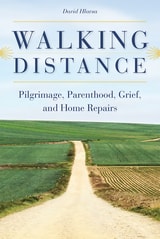
Walking Distance
Pilgrimage, Parenthood, Grief, and Home RepairsDavid Hlavsa
Michigan State University Press, 2015
Though walking more than 400 miles across the north of Spain turned out to be more difficult than they had anticipated, after a series of misadventures, including a brief stay in a Spanish hospital, they arrived in Santiago. Shortly after their return to Seattle, Lisa became pregnant, and the hardships of the Camino were no comparison to what followed: the stillbirth of their first son and Lisa’s harrowing second pregnancy.
Walking Distance is a moving and disarmingly funny book, a good story with a happy ending—the safe arrival of David and Lisa’s second son, Benjamin. David and Lisa get more than they bargained for, but they also get exactly what they wanted: a child, a solid marriage, and a richer life.
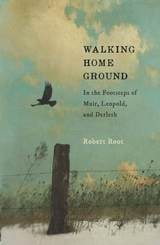
Walking Home Ground
In the Footsteps of Muir, Leopold, and DerlethRobert Root
Wisconsin Historical Society Press, 2017
When longtime author Robert Root moves to a small town in southeast Wisconsin, he gets to know his new home by walking the same terrain traveled by three Wisconsin luminaries who were deeply rooted in place—John Muir, Aldo Leopold, and August Derleth. Root walks with Muir at John Muir State Natural Area, with Leopold at the Shack, and with Derleth in Sac Prairie; closer to home, he traverses the Ice Age Trail, often guided by such figures as pioneering scientist Increase Lapham. Along the way, Root investigates the changes to the natural landscape over nearly two centuries, and he chronicles his own transition from someone on unfamiliar terrain to someone secure on his home ground.In prose that is at turns introspective and haunting, Walking Home Ground inspires us to see history’s echo all around us: the parking lot that once was forest; the city that once was glacier. "Perhaps this book is an invitation to walk home ground," Root tells us. "Perhaps, too, it’s a time capsule, a message in a bottle from someone given to looking over his shoulder even as he tries to examine the ground beneath his feet."

Walking Nature Home
A Life's JourneyBy Susan J. Tweit
University of Texas Press, 2009
Without a map, navigate by the stars. Susan Tweit began learning this lesson as a young woman diagnosed with an autoimmune disease that was predicted to take her life in two to five years. Offered no clear direction for getting well through conventional medicine, Tweit turned to the natural world that was both her solace and her field of study as a plant ecologist. Drawing intuitive connections between the natural processes and cycles she observed and the functions of her body, Tweit not only learned healthier ways of living but also discovered a great truth—love can heal. In this beautifully written, moving memoir, she describes how love of the natural world, of her husband and family, and of life itself literally transformed and saved her own life.
In tracing the arc of her life from young womanhood to middle age, Tweit tells stories about what silence and sagebrush, bird bones and sheep dogs, comets, death, and one crazy Englishman have to teach us about living. She celebrates making healthy choices, the inner voices she learned to hear on days alone in the wilderness, the joys of growing and eating an organic kitchen garden, and the surprising redemption in restoring a once-blighted neighborhood creek. Linking her life lessons to the stories she learned in childhood about the constellations, Tweit shows how qualities such as courage, compassion, and inspiration draw us together and bind us into the community of the land and of all living things.
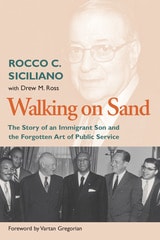
Walking On Sand
The Story of an Immigrant Son and the Forgotten Art of Public ServiceRocco C Siciliano
University of Utah Press, 2004
Rocco C. Siciliano broke new ground as the first Italian-American to serve in the White House as an assistant to the president, Dwight D. Eisenhower. At 31, "Ike’s Youngest" attained a prominence not suggested in his humble beginnings in Salt Lake City, Utah. But his upbringing in the Mormon-dominated community, where he balanced the heritage of his striving immigrant parents with his own aspirations for success, prepared him for a wide variety of service. This service includes leading a special weapons platoon in the 10th Mountain Division in World War II, bringing Martin Luther King Jr. to meet with President Eisenhower, and becoming a recognized business leader in California.
Siciliano used his expertise in labor, personnel management, and business to contribute substantively to the J. Paul Getty Center, the Los Angeles Philharmonic Association, the Committee for Economic Development, and the "Volcker" Commission on Public Service, among others.
The variety of Siciliano’s experiences reinvigorates our understanding of the forgotten art of public service. Walking on Sand emphasizes the role that public service can play for corporations, communities, states, and the nation. This story is a gift from the Greatest Generation to the many people who serve America today and will serve her tomorrow.
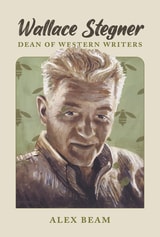
Wallace Stegner
Dean of Western WritersBeam, Alex
Signature Books, 2025
In this brisk and riveting biography, Alex Beam takes readers on a journey through Wallace Stegner’s life and complicated legacy as one of the twentieth century’s best storytellers and chroniclers of the American West.
In a career that spanned half a century, Stegner wrote fourteen novels and seventeen works of nonfiction. Reared on the Canadian-American frontier and educated in Salt Lake City, Utah, this quintessential Man of the West won both the Pulitzer Prize and the National Book Award. He landed a coveted teaching job at Harvard but, eager to get back to the West, left it for a professorship at Stanford.
Stegner was a full-throated environmentalist who served on the board of the Sierra Club, worked for the Secretary of the Interior, and wrote the famous Wilderness Letter on the healing power of open spaces. He founded Stanford University’s legendary Stegner Writing Fellowship, where his students included Edward Abbey, Wendell Berry, Ken Kesey, Larry McMurtry, Sandra Day O'Connor, Tillie Olsen, and Scott Turow.
In his later years Stegner wondered if he had lived too deep into the wrong century. He left Stanford when he felt students no longer accorded professors the respect they deserved, and later became embroiled in a plagiarism scandal that tarred his Pulitzer Prize-winning Angle of Repose.
Stegner ended his career with his valedictory masterpiece, Crossing to Safety. It was his rare Eastern novel, set in his adopted home of Greensboro, Vermont, where he chose to be buried.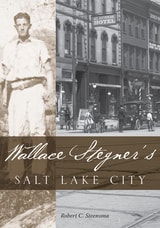
Wallace Stegners Salt Lake City
Robert C. Steensma
University of Utah Press, 2007
As he was later to say in his essay 'At Home in the Fields of the Lord,' he eventually realized that, if he had to have a hometown, it was Salt Lake City. He came to use the 'City of the Saints' for settings in three novels: The Big Rock Candy Mountain, Recapitulation, and The Preacher and the Slave (later retitled Joe Hill). His years in Utah helped develop the environmental ethic he espoused so eloquently in his famous 'Wilderness Letter.'
Robert Steensma has meticulously searched through archival photographs, quotations from Stegner’s writings, and interpretive essays in order to recreate the Salt Lake City of the 1920s and 1930s, the city of Stegner’s youth and young adulthood. This is a book that will appeal to all who have been moved by Stegner’s novels, nonfiction, or his urgent appeals for conservation.

Wallace Stevens - American Writers 11
University of Minnesota Pamphlets on American WritersWilliam York Tindall
University of Minnesota Press, 1961
Wallace Stevens - American Writers 11 was first published in 1961. Minnesota Archive Editions uses digital technology to make long-unavailable books once again accessible, and are published unaltered from the original University of Minnesota Press editions.
Walt Whitman - American Writers 9
University of Minnesota Pamphlets on American WritersRichard Chase
University of Minnesota Press, 1961
Walt Whitman - American Writers 9 was first published in 1961. Minnesota Archive Editions uses digital technology to make long-unavailable books once again accessible, and are published unaltered from the original University of Minnesota Press editions.
Walt Whitman
The Correspondence, Volume VIITed Genoways
University of Iowa Press, 2005
Now, more than forty years after the inaugural volume’s original publication, Ted Genoways brings scholars the latest volume in Walt Whitman: The Correspondence. Incorporating all of the letters Miller had collected before his death in 2001 and combining them with more than a hundred previously unknown letters he himself gathered, Genoways’s volume is a perfect accompaniment to Miller’s original work.
Among the more than one hundred fifty letters collected in this volume are numerous correspondences concerning Whitman’s Civil War years, including a letter sending John Hay, the personal secretary to Abraham Lincoln, a manuscript copy of “O Captain, My Captain!” Additional letters address various aspects of the production of Leaves of Grass, the most notable being an extensive correspondence surrounding the Deathbed Edition, gathered by Whitman’s friend Horace Traubel, and reproduced here for the first time. Most significantly, this volume at last incorporates Whitman’s early letters to Abraham Paul Leech, first published by Arthur Golden in American Literature in 1986. The revelations contained in these letters must be considered among the most important discoveries about Whitman’s life made during the last half of the twentieth century.
Regardless of whether their significance is great or small, immediate or long-term, each new piece of Whitman’s correspondence returns us to a particular moment in his life and suggests the limitless directions that remain for Whitman scholarship.
Walter Benjamin
An Introduction to His Work and ThoughtUwe Steiner
University of Chicago Press, 2010
Acknowledged only by a small circle of intellectuals during his lifetime, Benjamin is now a major figure whose work is essential to an understanding of modernity. Steiner traces the development of Benjamin’s thought chronologically through his writings on philosophy, literature, history, politics, the media, art, photography, cinema, technology, and theology. Walter Benjamin reveals the essential coherence of its subject’s thinking while also analyzing the controversial or puzzling facets of Benjamin’s work. That coherence, Steiner contends, can best be appreciated by placing Benjamin in his proper context as a member of the German philosophical tradition and a participant in contemporary intellectual debates.
As Benjamin’s writing attracts more and more readers in the English-speaking world, Walter Benjamin will be a valuable guide to this fascinating body of work.
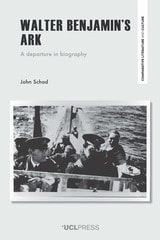
Walter Benjamin’s Ark
A Departure in BiographyJohn Schad
University College London, 2025
Walter Benjamin’s Ark rereads the life and work of the German philosopher and critic through the life of his estranged son. With this innovative biography, John Schad not only brings to light the intriguing figure that is Stefan Rafael Benjamin, but also identifies him as that most crucial of Benjaminian specters, namely, the secret “you” or addressee of his father’s writings. In the process, he brings Walter Benjamin into a series of unlikely dramatic dialogues with Virginia Woolf, Rosa Luxemburg, Ludwig Wittgenstein, Gertrud Kolmar, Oscar Wilde, Franz Kafka, and Hamlet.
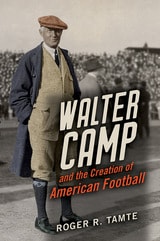
Walter Camp and the Creation of American Football
Roger R Tamte
University of Illinois Press, 2018
Roger R. Tamte tells the engrossing but forgotten life story of Walter Camp, the man contemporaries called "the father of American football." He charts Camp's leadership as American players moved away from rugby and for the first time tells the story behind the remarkably inventive rule change that, in Camp's own words, was "more important than all the rest of the legislation combined." Trials also emerged, as when disputes over forward passing, the ten-yard first down, and other rules became so public that President Theodore Roosevelt took sides. The resulting political process produced losses for Camp as well as successes, but soon a consensus grew that football needed no new major changes. American football was on its way, but as time passed, Camp's name and defining influence became lost to history.
Entertaining and exhaustively researched, Walter Camp and the Creation of American Football weaves the life story of an important sports pioneer with a long-overdue history of the dramatic events that produced the nation's most popular game.
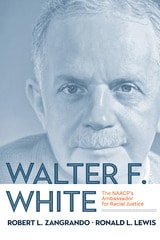
Walter F. White
The NAACP's Ambassador for Racial JusticeRONALD L. LEWIS
West Virginia University Press, 2018
Walter F. White of Atlanta, Georgia, joined the National Association for the Advancement of Colored People (NAACP) in 1918 as an assistant to Executive Secretary James Weldon Johnson. When Johnson retired in 1929, White replaced him as head of the NAACP, a position he maintained until his death in 1955. During his long tenure, White was in the vanguard of the struggle for interracial justice. His reputation went into decline, however, in the era of grassroots activism that followed his death. White’s disagreements with the US Left, and his ambiguous racial background—he was of mixed heritage, could “pass” as white, and divorced a black woman to marry a white woman—fueled ambivalence about his legacy.
In this comprehensive biography, Zangrando and Lewis seek to provide a reassessment of White within the context of his own time, revising critical interpretations of his career. White was a promoter of and a participant in the Harlem Renaissance, a daily fixture in the halls of Congress lobbying for civil rights legislation, and a powerful figure with access to the administrations of Roosevelt (via Eleanor) and Truman. As executive secretary of the NAACP, White fought incessantly to desegregate the American military and pushed to ensure equal employment opportunities. On the international stage, White advocated for people of color in a decolonized world, and for economic development aid to nations like India and Haiti, bridging the civil rights struggles at home and abroad.
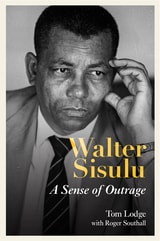
Walter Sisulu
A Sense of OutrageTom Lodge with Roger Southall
Ohio University Press, 0
Although hailed, alongside Nelson Mandela and Oliver Tambo, as one of the African National Congress’s holy trinity, Walter Sisulu has remained a relatively neglected figure in the historiography of the struggle for liberation in South Africa. Modest and unassuming, Sisulu was always content to stay in the background in a way that has long belied his importance. This nuanced and highly original biography, drafted by political historian Tom Lodge before his untimely death, provides a powerful corrective. Lodge describes Sisulu as an exceptional organizer, the most influential planner of the ANC’s mass campaigning during the 1950s, a principled but undoctrinaire communist, and like Mandela, an advocate of the necessity of armed struggle. He also served as the careful navigator of the ambiguous relationship between the ANC and Umkhonto we Sizwe, and Lodge details how Sisulu, with his exceptional grasp of the subtleties of fact and law, confounded the prosecution as he sat in the dock in the Rivonia trial. Sentenced to life imprisonment with his fellow defendants, Sisulu became a calming influence amid the divisive ideological debates that took place on Robben Island, as well as a constant source of strength and support to Mandela. After his 1989 release from jail—ahead of Mandela—he again demonstrated his prowess as the chief organizer of the ANC as it reestablished itself ahead of the 1994 elections. Sociologist Roger Southall stepped in to complete Lodge’s detailed analysis of Sisulu’s commitment and contribution to South African freedom, an encomium that Walter Sisulu richly deserves.
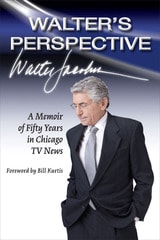
Walter's Perspective
A Memoir of Fifty Years in Chicago TV NewsWalter Jacobson, Foreword by Bill Kurtis
Southern Illinois University Press, 2012
This highly readable book provides a unique glimpse into the rough-and-tumble Chicago news business as seen through the eyes of one of its legendary players. From his first news job working as a legman for Daily News columnist Jack Mabley in the 1950s to his later role as a news anchor and political commentator at CBS-owned WBBM, Walter Jacobson battled along the front lines of an industry undergoing dramatic changes. While it is ultimately Jacobson’s story, a memoir of a long and distinguished (and sometimes highly controversial) career, it is also an insider’s account of the inner workings of Chicago television news, including the ratings games, the process of defining news and choosing stories, the media’s power and its failures, and the meddling by corporate and network executives.
As a reporter, Jacobson was regularly contentious and confrontational. He was fired on a number of occasions and was convicted of libeling tobacco company Brown and Williamson, resulting in a multimillion-dollar federal court judgment against him and CBS. Yet it was this gutsy attitude that put him at the top of the news game. With an engaging writing style, Jacobson recollects his interactions with Chicago mayors Richard J. and Richard M. Daley, Jane Byrne, Harold Washington, and Rahm Emanuel; recounts his coverage of such fascinating news stories as the violent 1968 Democratic National Convention and the execution of convicted mass murderer John Wayne Gacy; and recalls his reporting on and interviews with Louis Farrakhan, governors George Ryan and Rod Blagojevich, and Barack Obama. More than a memoir, Walter’s Perspective is the extraordinary journey of one reporter whose distinctive career followed the changing face of Chicago’s local news.
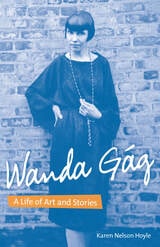
Wanda Gág
A Life of Art and StoriesKaren Nelson Hoyle
University of Minnesota Press, 2009
Now in paper.
At the young age of just 15, Wanda Gág received her dying father's last wish that she take up his dream of becoming a successful artist: "What papa couldn't do, Wanda would have to finish." Wanda assumed the role of head of the household and became the sole means of support for her sick mother and six siblings. Although times were tough, Wanda persevered and eventually became a celebrated artist and author living in New York City.
Karen Nelson Hoyle tells the story of Wanda Gág's eccentric life as a children's book author and traces the significant contributions she made to the genre. Drawn from extensive research of the artist's personal and professional papers and correspondence with friends and contemporaries, Hoyle presents a rich portrait of a gifted artist.
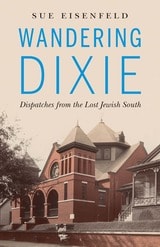
Wandering Dixie
Dispatches from the Lost Jewish SouthSue Eisenfeld
The Ohio State University Press, 2020
From South Carolina to Arkansas, she explores the small towns where Jewish people once lived and thrived. She visits the site of her distant cousin and civil rights activist Andrew Goodman’s murder during 1964’s Freedom Summer. She also talks with the only Jews remaining in some of the “lost” places, from Selma to the Mississippi Delta to Natchitoches, and visits areas with no Jewish community left—except for an old temple or overgrown cemetery. Eisenfeld follows her curiosity about Jewish Confederates and casts an unflinching eye on early southern Jews’ participation in slavery. Her travels become a journey of revelation about our nation’s fraught history and a personal reckoning with the true nature of America.
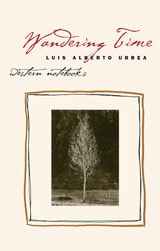
Wandering Time
Western NotebooksLuis Alberto Urrea
University of Arizona Press, 1999
Fleeing a failed marriage and haunted by ghosts of his past, Luis Alberto Urrea jumped into his car and headed west. Driving cross-country with a cat named Rest Stop, Urrea wandered the West from one year’s spring through the next.
Hiking into aspen forests where leaves “shiver and tinkle like bells” and poking alongside creeks in the Rockies, he sought solace and wisdom. In the forested mountains he learned not only the names of trees—he learned how to live. As nature opened Urrea’s eyes, writing opened his heart. In journal entries that sparkle with discovery, Urrea ruminates on music, poetry, and the landscape. With wonder and spontaneity, he relates tales of marmots, geese, bears, and fellow travelers. He makes readers feel mountain air “so crisp you feel you could crunch it in your mouth” and reminds us all to experience the magic and healing of small gestures, ordinary people, and common creatures.
Urrea has been heralded as one of the most talented writers of his generation. In poems, novels, and nonfiction, he has explored issues of family, race, language, and poverty with candor, compassion, and often astonishing power. Wandering Time offers his most intimate work to date, a luminous account of his own search for healing and redemption.

Wanderlust
The Amazing Ida Pfeiffer, the First Female TouristJohn van Wyhe
National University of Singapore Press, 2019
In 1797 in Vienna, Ida Pfeiffer was born into a world that should have been too small for her dreams. The daughter of an Austrian merchant, she made clear from an early age that she would not be bound by convention, dressing in boys’ clothing and playing sports. After her tutor introduced her to stories of faraway lands, she became determined to see the world first-hand. This determination led to a lifetime of travel—much of it alone—and made her one of the most famous women of the nineteenth century.
Pfeiffer faced many obstacles, not least expectations of her gender. She was a typical nineteenth century housewife with a husband and two sons. She was not wealthy nor well connected. Yet after the death of her husband, and once her sons were grown and settled, at the age of forty-one she set off on her first journey, not telling anyone the true extent of her travel plans. Between that trip and her death in 1858, she would barely pause for breath, circling the globe twice—the first woman to do so—and publishing numerous popular books about her travels. Usually traveling solo, Pfeiffer faced storms at sea, trackless deserts, plague, malaria, earthquakes, robbers, murderers, and other risks.
In Wanderlust, John Van Wyhe tells Pfeiffer’s story, with generous excerpts from her published accounts, tell of her involvement with spies, international intrigue, and more. The result is a compelling portrait of the remarkable life of a pioneer unjustly forgotten.
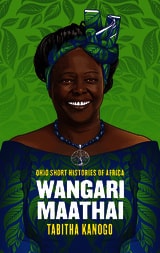
Wangari Maathai
Tabitha Kanogo
Ohio University Press, 2020
Wangari Muta Maathai is one of Africa’s most celebrated female activists. Originally trained as a scientist in Kenya and abroad, Professor Maathai returned to her home country of Kenya with a renewed political consciousness. There, she began her long career as an activist, campaigning for environmental and social justice while speaking out against government corruption. In 2004, Maathai was awarded the Nobel Peace Prize for her leadership of the Green Belt Movement, a conservation effort that resulted in the restoration of African forests decimated during the colonial era.
In this biography, Tabitha Kanogo follows Wangari Maathai from her modest, rural Kenyan upbringing to her rise as a national figure campaigning for environmental and ecological conservation, sustainable development, democracy, human rights, gender equality, and the eradication of poverty until her death in 2011.
War Diary
Ingeborg Bachmann
Seagull Books, 2011
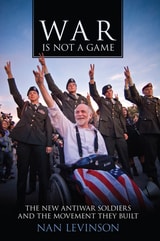
War Is Not a Game
The New Antiwar Soldiers and the Movement They BuiltLevinson, Nan
Rutgers University Press, 2016
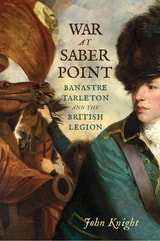
War at Saber Point
Banastre Tarleton and the British LegionJohn Knight
Westholme Publishing, 2023
The British Legion was one of the most remarkable regiments, not only of the American Revolution, but of any war. A corps made up of American Loyalists, it saw its first action in New York and then engaged in almost every battle in the Southern colonies. Led by a twenty-four-year-old libertine who purchased his commission to escape enormous gambling debts, the Legion gained notoriety for its ruthless tactics. Excelling in “special operations,” they frequently overwhelmed the Continental forces they fought, becoming the most feared British regiment of the war.
Banastre Tarleton and the Americans he led have always been characterized as brutal, immoral villains—most recently in the movie, The Patriot. But this study subverts our pre-conceived notions of patriotism. The men who filled the Legions ranks were not weak-willed collaborators or treacherous renegades, but free men as motivated by conscience as the Patriots they battled. Few were wealthy. None had a vested stake in the British Government. Each believed that in defending the Crown; they were upholding the rule of law and preserving individual liberty.
These men followed Banastre Tarleton clear across America for years, sacrificing not only their families and homes but, in many instances, their lives. Self-interest could not have persuaded them to do this. Patriotism and fidelity did. Relying on first-hand accounts—letters, diaries, and journals—War at Saber Point: Banastre Tarleton and the British Legion is the enthralling story of those forgotten Americans and the young Englishman who led them.
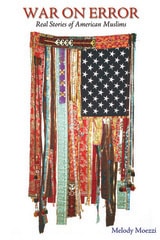
War on Error
Real Stories of American MuslimsMelody Moezzi
University of Arkansas Press, 2007
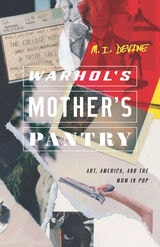
Warhol's Mother's Pantry
Art, America, and the Mom in PopM. I. Devine
The Ohio State University Press, 2020
“What are these fragments we’ve Jersey Shored against our ruin?” asks M. I. Devine, remixing T. S. Eliot, in this dizzying collection of essays that pays homage to the cultural forms that hold us steady. These fragments are stored in Warhol’s Mother’s Pantry, which takes us deep beneath the surfaces of pop to explore our shared quest for meaning today. Julia Warhola, an immigrant who arrived as the US was closing its borders a century ago, is the muse of reuse in these essays that cross boundaries—between now and then, high and low. She is the mom in pop who cut tin cans into flowers and taught Andy (and us) how to reshape and redeem our world. In essays as lyrical, witty, and experimental as the works they cover, Devine offers a new account of pop humanism. How we cut new things from the traditions we’re given, why we don’t stop believin’ (and carry on, wayward sons) when so much is stacked against us. Here are Leonard Cohen’s last songs and Molly Bloom’s last words; Vampire Weekend’s Rostam and Philip Larkin too; Stevie Smith, John Donne, and Kendrick Lamar; sonnets and selfies; early cinema and post–9/11 film, pop hooks, and pop art. In Devine’s hands, these literary and cultural artifacts are provocatively reassembled into an urgent and refreshing history that refuses to let its readers forget where pop came from and where it can go.
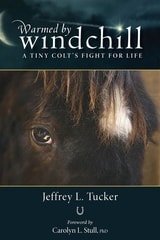
Warmed by Windchill
A Tiny Colt’s Fight for LifeJeffrey L. Tucker; Foreword by Carolyn L. Stull, PhD
University of Wisconsin Press, 2013
One bitterly cold winter afternoon, a nine-month-old colt—extremely weak, starving, left to die—was frozen to the rock-hard white landscape of a northern Wisconsin pasture. His whinny for help barely carried through thirty-mile-an-hour winds lashing snow and ice against his thin coat. But somewhere inside him a light refused to go out.
The colt's call for help was answered, and that light inspired a worldwide response to his story. The struggle of the little colt, called Windchill by his rescuers, was reported widely, and soon 1.2 million people were following Windchill's progress on a blog and webcam.
Warmed by Windchill tells how Jeffrey L. Tucker, owner of nearby Raindance Farms, and Kathi Davis, owner of a horse training operation co-located at Raindance, rescued and cared for the colt, aided by an outpouring of assistance. Donations of money, feed, blankets, and other supplies streamed in as round-the-clock volunteers tried to save Windchill. Warmed by Windchill is both heartening and heartbreaking.
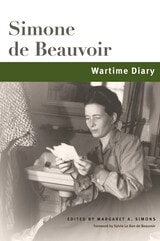
Wartime Diary
Simone de Beauvoir; Translation and Notes by Anne Deing Cordero; Edited by Margaret A. Simons and Sylvie Le Bon de Beauvoir; Foreword by Sylvie Le Bon de Beauvoir
University of Illinois Press, 2021
Provocative insights into Beauvoir's philosophical and personal development during wartime
Written from September 1939 to January 1941, Simone de Beauvoir’s Wartime Diary gives English readers unabridged access to a scandalous text that threatened to overturn traditional views of Beauvoir’s life and work.
Beauvoir's clandestine affair with Jacques Bost and sexual relationships with various young women challenge the conventional picture of Beauvoir as the devoted companion of Jean-Paul Sartre. At the same time, her account of completing her novel She Came to Stay at a time when Sartre had just begun Being and Nothingness questions the traditional view of Beauvoir’s novel as merely illustrating Sartre’s philosophy.
Wartime Diary also traces Beauvoir's philosophical transformation as she broke from the prewar solipsism of She Came to Stay in favor of the postwar political engagement of The Second Sex. Beauvoir's emerging existentialist ethics reflect the dramatic collective experiences of refugees fleeing German invasion and life under Nazi occupation. The evolution of her thought also reveals the courageous reaffirmation of her individuality in constructing a humanist ethics of freedom and solidarity.
This edition also features previously unpublished material, including her musings about consciousness and order, recommended reading lists, and notes on labor unions. In providing new insights into Beauvoir’s philosophical development, the Wartime Diary promises to rewrite a crucial chapter of Western philosophy and intellectual history.

Wartime Washington
The Civil War Letters of Elizabeth Blair LeeEdited by Virginia Jeans Laas
University of Illinois Press, 1991
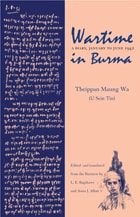
Wartime in Burma
A Diary, January to June 1942Theippan Maung Wa
Ohio University Press, 2009
This diary, begun after the Japanese attack on Pearl Harbor and covering the invasion of Burma up to June 1942, is a moving account of the dilemmas faced by the well-loved and prolific Burmese author Theippan Maung Wa (a pseudonym of U Sein Tin) and his family. At the time of the Japanese invasion, U Sein Tin was deputy secretary in the Ministry of Home and Defense Affairs. An Oxford-trained member of the Indian Civil Service, working for the British administration on the eve of the invasion, he lived with his wife and three small children in Rangoon.
Wartime in Burma is a stirring memoir that presents a personal account of U Sein Tin’s feelings about the war, his anxiety for the safety of his family, the bombing of Rangoon, and what happened to them during the next six chaotic months of the British retreat. The author and his family leave Rangoon to live in a remote forest in Upper Burma with several other Burmese civil servants, their staff, and valuable possessions—rich pickings for robbers. His diary ends abruptly on June 5, his forty-second birthday; U Sein Tin was murdered on June 6 by a gang of Burmese bandits. The diary pages, scattered on the floor of the house, were rescued by his wife and eventually published in Burma in 1966. What survives is a unique account that shines new light on the military retreat from Burma.
Washington Irving - American Writers 25
University of Minnesota Pamphlets on American WritersLewis Leary
University of Minnesota Press, 1963
Washington Irving - American Writers 25 was first published in 1963. Minnesota Archive Editions uses digital technology to make long-unavailable books once again accessible, and are published unaltered from the original University of Minnesota Press editions.
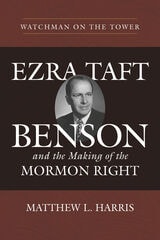
Watchman on the Tower
Ezra Taft Benson and the Making of the Mormon RightMatthew L. Harris
University of Utah Press, 2020
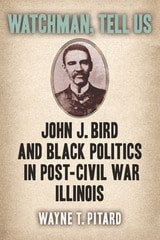
Watchman, Tell Us
John J. Bird and Black Politics in Post-Civil War IllinoisWayne T. Pitard
Southern Illinois University Press, 2024
The most influential Black leader in 19th century southern Illinois
This key biography of John J. Bird unveils the forgotten story of a remarkable Black political figure in post-Civil War Illinois. Emerging as a leader in Cairo, the city with Illinois’ second-largest Black community, Bird played a pivotal role in advancing civil rights within the state, also becoming Illinois’ first Black elected judge and first Black trustee of the University of Illinois. Watchman, Tell Us deftly examines Bird’s lifetime of service and advocacy for a vulnerable community and the ways in which he successfully advocated for and protected voting rights, educational opportunity, and public access for the Black residents of southern Illinois.
Bird arrived in Cairo at age twenty during the Civil War to aid the 2,000 Black refugees from the South living there. By 1870, he had established the city’s substantial Black Republican wing, providing the Black community with unprecedented political influence in this hostile, majority white, Democratic town. Under Bird’s leadership, the Black Republicans pressed for policies that improved the well-being of the African American population, including the early establishment of a Black public school, the rise of an integrated judicial system, and the ability to access public and private businesses. Bird became influential across Illinois as a judge and university trustee, a leader in the Black convention movement, and a significant newspaper editor in Cairo and Springfield. When Bird died in 1912, the nation he loved had once again betrayed its Black citizens, and it appeared that most of the achievements he had fought for had collapsed. But the work of Bird and the other civil rights workers of the nineteenth century created the foundation upon which the movements of the twentieth century could stand.
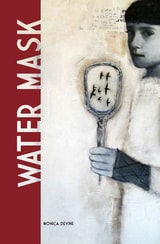
Water Mask
Monica Devine
University of Alaska Press, 2019
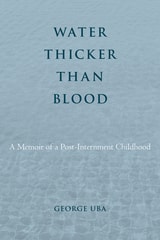
Water Thicker Than Blood
A Memoir of a Post-Internment ChildhoodGeorge Uba
Temple University Press, 2022
“I thought my life began in Chicago. I was mistaken. That is where my body first made its appearance, but the contours of my life…had their start much sooner.”
In Water Thicker Than Blood, poet and professor George Uba traces his life as a Japanese American born in the late 1940s, a period of insidious anti-Japanese racism. His beautiful, impressionist memoir chronicles how he, like many Sansei (and Nisei) across the United States, grappled with dislocation and trauma while seeking acceptance and belonging.
Uba’s personal account of his efforts to achieve normality and assuage guilt unfolds as racial demographics in America are shifting. He struggled with inherently violent midcentury educational and childrearing practices and a family health crisis, along with bullying. Uba describes boy scouts and yogore (community rebels and castoffs) with vivid detail, using these vignettes to show how margins were blurred and how both sets of youth experienced injury through the same ideological pressures.
Water Thicker Than Blood is not a conventional story about recovery or family reconciliation. But itoffers an intimate look at the lasting—in some ways irreversible—damage caused by post-internment ideologies of “being accepted” and “fitting in inconspicuously.” It speaks volumes for the greater Sansei post-internment experience.
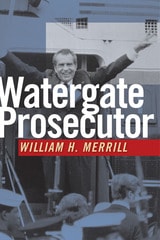
Watergate Prosecutor
William H. Merrill
Michigan State University Press, 2008
DC. Both of these crimes were eventually traced back to the "plumbers unit," which was directed by John Ehrlichman, President Nixon's top domestic aide. As he convincingly recounts, Merrill sought the job as Assistant Special Prosecutor for one reason: to bring these criminals to justice. In addition, as this revelatory account makes clear, he pursued that goal tenaciously.
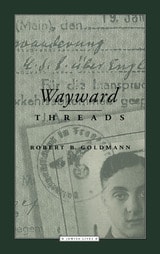
Wayward Threads
Robert Goldmann
Northwestern University Press, 1998
We All Got History
The Memory Books of Amos WebberNick Salvatore
University of Illinois Press, 2006
Lost for over a hundred years until their rediscovery by Nick Salvatore, Amos Webber’s “Thermometer Books” recorded six decades of the daily experiences of a black freeman in nineteenth-century Philadelphia and Worcester, Massachusetts. These diaries form the basis for Salvatore’s vital portrait of an everyday hero who struggled unrelentingly for his people in a land that still considered blacks to be less than human.
In We All Got History, we see Amos Webber working as a janitor; rescuing fugitive slaves on the Underground Railroad; marching triumphantly into Richmond with the Fifth Massachusetts Cavalry; and active in the religious and fraternal organizations that became the cement of the African American community. What emerges from this moving history is not only a picture of Webber the man, but also of the vibrant African American culture that nurtured him.
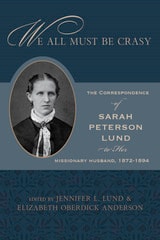
We All Must Be Crasy
The Correspondence of Sarah Peterson Lund to Her Missionary Husband, 1872–1894Jennifer L. Lund and Elizabeth Oberdick Anderson
University of Utah Press, 2026
While Latter-day Saint missionary work has been extensively studied, the experiences of the wives left behind remain relatively absent from the scholarship. We All Must Be Crasy helps fill this gap, offering a glimpse into the lived experiences of Mormon women and families during the late nineteenth century.
Through more than one hundred candid letters to her missionary husband, Sarah (Sanie) Peterson Lund reveals the private costs of missionization: strained marriages, economic hardship, shifting gender roles, and the constant need for community support. Sanie’s correspondence conveys her frustrations, anxieties, and fears alongside her pride in her children, devotion to her family, and longing for her absent husband. Her letters also show daily life in Ephraim, Utah: town gossip, vulnerabilities and ethnic tensions among residents, and reflections on plural marriage. This collection illuminates experiences only previously sketched in broad strokes, enriching our understanding of women, faith, and community in the American West.

We Are Danny
Targeted Inside the WireElizabeth R. OuYang
Temple University Press, 2027
Private Danny Chen was only nineteen years old when he was found dead on a U.S. Army base in Afghanistan. His non-combat death took place under “suspicious circumstances inside the wire.” The court martials revealed that Chen faced weeks of unrelenting hazing and racial harassment by his superiors. We Are Danny is both Elizabeth OuYang’s troubling and critical account of what transpired and her memoir of Chen’s death and life, starting with his funeral.
OuYang, who led the fight for justice, narrates Chen’s story in a personal style that speaks directly to him. We Are Danny chronicles the community-based efforts to stand up to injustice where young enlistees like Chen, who fight for their country, are met with bigotry. OuYang details organizing local and national campaigns to petition the Army for a timely and thorough investigation of Chen’s death. She describes an unprecedented group meeting with high-ranking officials from the Pentagon, and recounts candlelight vigils, community protests, and the naming of Pvt. Danny Chen Way in Manhattan’s Chinatown to honor him.
There are, sadly, many Private Danny Chens. We Are Danny offers a valuable lesson on how community advocacy and demanding accountability can focus attention on needed military reforms.