Results by title
277 books match the query 'Biology' and 7 start with w
What Is Biodiversity?
James Maclaurin and Kim Sterelny
University of Chicago Press, 2008
Here, Maclaurin and Sterelny explore not only the origins of the concept of biodiversity, but also how that concept has been shaped by ecology and more recently by conservation biology. They explain the different types of biodiversity important in evolutionary theory, developmental biology, ecology, morphology and taxonomy and conclude that biological heritage is rich in not just one biodiversity but many. Maclaurin and Sterelny also explore the case for the conservation of these biodiversities using option value theory, a tool borrowed from economics.
An erudite, provocative, timely, and creative attempt to answer a fundamental question, What Is Biodiversity? will become a foundational text in the life sciences and studies thereof.
What Is Regeneration?
Jane Maienschein and Kate MacCord
University of Chicago Press, 2022
In punishment for his stealing fire, the Greek gods chained Prometheus to a rock, where every day an eagle plucked out his liver, and every night the liver regenerated. While Prometheus may be a figure of myth, scholars today ask whether ancient Greeks knew that the human liver does, in fact, have a special capacity to regenerate. Some organs and tissues can regenerate, while others cannot, and some organisms can regenerate more fully and more easily than others. Cut an earthworm in half, and two wiggly worms may confront you. Cut off the head of a hydra, and it may grow a new head. Cut off a human arm, and the human will be missing an arm. Why the differences? What are the limits of regeneration, and how, when, and why does it occur?
In this book, historians and philosophers of science Jane Maienschein and Kate MacCord explore biological regeneration, delving into a topic of increasing interest in light of regenerative medicine, new tools in developmental and neurobiology, and the urgent need to understand and repair damage to ecosystems brought on by climate change. Looking across scales, from germ, nerve, and stem cells to individual organisms and complex systems, this short and accessible introduction poses a range of deep and provocative questions: What conditions allow some damaged microbiomes to regenerate where others do not? Why are forests following a fire said to regenerate sometimes but not always? And in the face of climate change in the era called the Anthropocene, can the planet regenerate to become healthy again, or will the global ecosystem collapse?
Wild Justice
The Moral Lives of AnimalsMarc Bekoff and Jessica Pierce
University of Chicago Press, 2009
Scientists have long counseled against interpreting animal behavior in terms of human emotions, warning that such anthropomorphizing limits our ability to understand animals as they really are. Yet what are we to make of a female gorilla in a German zoo who spent days mourning the death of her baby? Or a wild female elephant who cared for a younger one after she was injured by a rambunctious teenage male? Or a rat who refused to push a lever for food when he saw that doing so caused another rat to be shocked? Aren’t these clear signs that animals have recognizable emotions and moral intelligence? With Wild Justice Marc Bekoff and Jessica Pierce unequivocally answer yes.
Marrying years of behavioral and cognitive research with compelling and moving anecdotes, Bekoff and Pierce reveal that animals exhibit a broad repertoire of moral behaviors, including fairness, empathy, trust, and reciprocity. Underlying these behaviors is a complex and nuanced range of emotions, backed by a high degree of intelligence and surprising behavioral flexibility. Animals, in short, are incredibly adept social beings, relying on rules of conduct to navigate intricate social networks that are essential to their survival. Ultimately, Bekoff and Pierce draw the astonishing conclusion that there is no moral gap between humans and other species: morality is an evolved trait that we unquestionably share with other social mammals.
Sure to be controversial, Wild Justice offers not just cutting-edge science, but a provocative call to rethink our relationship with—and our responsibilities toward—our fellow animals.
Wild Mammals in Captivity
Principles and Techniques for Zoo Management, Second EditionEdited by Devra G. Kleiman, Katerina V. Thompson, and Charlotte Kirk Baer
University of Chicago Press, 2010
Zoos, aquaria, and wildlife parks are vital centers of animal conservation and management. For nearly fifteen years, these institutions have relied on Wild Mammals in Captivity as the essential reference for their work. Now the book reemerges in a completely updated second edition. Wild Mammals in Captivity presents the most current thinking and practice in the care and management of wild mammals in zoos and other institutions. In one comprehensive volume, the editors have gathered the most current information from studies of animal behavior; advances in captive breeding; research in physiology, genetics, and nutrition; and new thinking in animal management and welfare.
In this edition, more than three-quarters of the text is new, and information from more than seventy-five contributors is thoroughly updated. The standard text for all courses in zoo biology, Wild Mammals in Captivity will, in its new incarnation, continue to be used by zoo managers, animal caretakers, researchers, and anyone with an interest in how to manage animals in captive conditions.
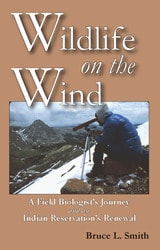
Wildlife on the Wind
A Field Biologist's Journey and an Indian Reservation's RenewalBruce L Smith
Utah State University Press, 2010
In the heart of Wyoming sprawls the ancient homeland of the Eastern Shoshone Indians, who were forced by the U.S. government to share a reservation in the Wind River basin and flanking mountain ranges with their historical enemy, the Northern Arapahos. Both tribes lost their sovereign, wide-ranging ways of life and economic dependence on decimated buffalo. Tribal members subsisted on increasingly depleted numbers of other big game—deer, elk, moose, pronghorn, and bighorn sheep. In 1978, the tribal councils petitioned the U.S. Fish and Wildlife Service to help them recover their wildlife heritage. Bruce Smith became the first wildlife biologist to work on the reservation. Wildlife on the Wind recounts how he helped Native Americans change the course of conservation for some of America's most charismatic wildlife.
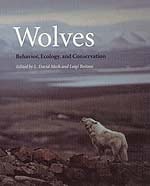
Wolves
Behavior, Ecology, and ConservationEdited by L. David Mech and Luigi Boitani
University of Chicago Press, 2003
As wolf populations have rebounded, scientific studies of them have also flourished. But there hasn't been a systematic, comprehensive overview of wolf biology since 1970. In Wolves, many of the world's leading wolf experts provide state-of-the-art coverage of just about everything you could want to know about these fascinating creatures. Individual chapters cover wolf social ecology, behavior, communication, feeding habits and hunting techniques, population dynamics, physiology and pathology, molecular genetics, evolution and taxonomy, interactions with nonhuman animals such as bears and coyotes, reintroduction, interactions with humans, and conservation and recovery efforts. The book discusses both gray and red wolves in detail and includes information about wolves around the world, from the United States and Canada to Italy, Romania, Saudi Arabia, Israel, India, and Mongolia. Wolves is also extensively illustrated with black and white photos, line drawings, maps, and fifty color plates.
Unrivalled in scope and comprehensiveness, Wolves will become the definitive resource on these extraordinary animals for scientists and amateurs alike.
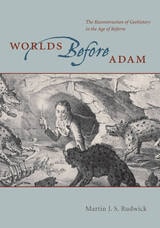
Worlds Before Adam
The Reconstruction of Geohistory in the Age of ReformMartin J. S. Rudwick
University of Chicago Press, 2008
The first detailed account of the reconstruction of prehuman geohistory, Martin J. S. Rudwick’s Worlds Before Adam picks up where his celebrated Bursting the Limits of Time leaves off. Here, Rudwick takes readers from the post-Napoleonic Restoration in Europe to the early years of Britain’s Victorian age, chronicling the staggering discoveries geologists made during the period: the unearthing of the first dinosaur fossils, the glacial theory of the last ice age, and the meaning of igneous rocks, among others. Ultimately, Rudwick reveals geology to be the first of the sciences to investigate the historical dimension of nature, a model that Charles Darwin used in developing his evolutionary theory.
Featuring an international cast of colorful characters, with Georges Cuvier and Charles Lyell playing major roles and Darwin appearing as a young geologist, Worlds Before Adam is a worthy successor to Rudwick’s magisterial first volume. Completing the highly readable narrative of one of the most momentous changes in human understanding of our place in the natural world, Worlds Before Adam is a capstone to the career of one of the world’s leading historians of science.