Results by title
79 books match the query 'Blood' and 7 start with w
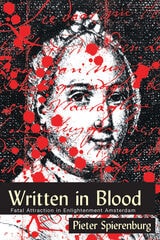
WRITTEN IN BLOOD
FATAL ATTRACTION IN ENLIGHTENMENT AMSTERDAMPieter Spierenburg
The Ohio State University Press, 2004
Pieter Spierenburg narrates two sensational murder cases among intimates in eighteenth-century Amsterdam. The cases recounted here both resulted from fatal attraction. They represented the darker side of the eighteenth-century revolution in love. This period witnessed great cultural changes affecting personal relationships and emotions. The new ideal of love demanded that couples spend much of their time together and explore each other’s feelings. But this new ideal was meant for married and engaged couples only; for others it meant disaster. Love gone wrong was the theme of the sentimental novels of the age, but it also happened to real people, with fatal consequences.
Written in Blood traces the lives and ultimate fate of Nathaniel Donker, who, together with the help of his mistress, brutally murders and dismembers the wife. The second tale focuses on J. B. F. van Gogh, who falls in love with a prostitute; she later rejects him and, when a letter written with his own blood fails to change her mind, he stabs her to death in a fit of passionate rage.
In Written in Blood, the reader gets two stories for the price of one. And, whereas earlier microhistories have been situated in a village or a small town, the scene here is Amsterdam and its canals. Spierenburg reveals in detail what concepts like honor and gender roles came down to in individual lives. He also shows that these murders produced a strange mixture of modern romantic feelings and traditional notions of honor and shame.
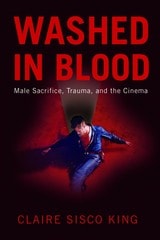
Washed in Blood
Male Sacrifice, Trauma, and the CinemaKing, Claire S
Rutgers University Press, 2012
Will Smith in I Am Legend. Leonardo DiCaprio in Titanic. Charlton Heston in just about everything.
Viewers of Hollywood action films are no doubt familiar with the sacrificial victim-hero, the male protagonist who nobly gives up his life so that others may be saved. Washed in Blood argues that such sacrificial films are especially prominent in eras when the nation—and American manhood—is thought to be in crisis. The sacrificial victim-hero, continually imperiled and frequently exhibiting classic symptoms of post-traumatic stress disorder, thus bears the trauma of the nation.
Claire Sisco King offers an in-depth study of three prominent cycles of Hollywood films that follow the sacrificial narrative: the early–to–mid 1970s, the mid–to–late 1990s, and the mid–to–late 2000s. From Vietnam-era disaster movies to post-9/11 apocalyptic thrillers, she examines how each film represents traumatized American masculinity and national identity. What she uncovers is a cinematic tendency to position straight white men as America’s most valuable citizens—and its noblest victims.
With Blood in Their Eyes
Thomas Cobb
University of Arizona Press, 2013
Winner, Spur Award for Best Western Long Novel (Western Writers of America) and Southwest Book Award (Border Regional Library Association)
On February 10, 1918, John Power woke to the sound of bells and horses’ hooves. He was sharing a cabin near the family mine with his brother Tom and their father Jeff; hired man Tom Sisson was also nearby. Then gunfire erupted, and so began the day when the Power brothers engaged the Graham County Sheriff’s Department in the bloodiest shootout in Arizona history.
Now Thomas Cobb, author of Crazy Heart and Shavetail, has taken up the story in this powerful and meticulously researched nonfiction novel. What seems at first a simple tale of crime and pursuit takes on much greater meaning and complexity as the story traces the past lives of the main characters and interconnects them—all leading back to the deadly confrontation that begins the book. Cobb cunningly weaves the story of the Power brothers’ escape with flashbacks of the boys’ father’s life and his struggle to make a living ranching, logging, and mining in the West around the turn of the century. Deftly drawn characters and cleverly concealed motivations work seamlessly to blend a compelling family history with a desperate story of the brothers as they attempt to escape.
Grappling with themes of loyalty, masculinity, technology, and honor, this sweeping saga reveals the passion and brutality of frontier life in Arizona a hundred years ago. Richly authentic and beautifully written, With Blood in Their Eyes breathes dramatic new life into this nearly forgotten episode of the American West.
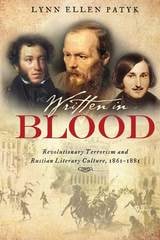
Written in Blood
Revolutionary Terrorism and Russian Literary Culture, 1861–1881Lynn Ellen Patyk
University of Wisconsin Press, 2017
Lynn Ellen Patyk contends that the prototype for the terrorist was the Russian writer, whose seditious word was interpreted as an audacious deed—and a violent assault on autocratic authority. The interplay and interchangeability of word and deed, Patyk argues, laid the semiotic groundwork for the symbolic act of violence at the center of revolutionary terrorism. While demonstrating how literary culture fostered the ethos, pathos, and image of the revolutionary terrorist and terrorism, she spotlights Fyodor Dostoevsky and his "terrorism trilogy"—Crime and Punishment (1866), Demons (1870–73), and The Brothers Karamazov (1878–80)—as novels that uniquely illuminate terrorism's methods and trajectory. Deftly combining riveting historical narrative with penetrating literary analysis of major and minor works, Patyk's groundbreaking book reveals the power of the word to spawn deeds and the power of literature to usher new realities into the world.
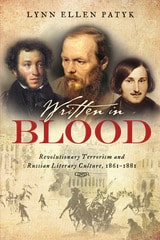
Written in Blood
Revolutionary Terrorism and Russian Literary Culture, 1861–1881Lynn Ellen Patyk
University of Wisconsin Press, 2020

Written in Blood
The History of Fort Worth's Fallen Lawmen, Volume 1, 1861-1909Richard F. Selcer
University of North Texas Press, 2010
Written in Blood
The History of Fort Worth's Fallen Lawmen, Volume 2, 1910-1928Richard F. Selcer
University of North Texas Press, 2010