Results by title
211 books match the query 'Campaigns & Elections' and 12 start with w

Waves of Discontent
Electoral Volatility, Public Policymaking, and the Health of American DemocracyJacob F.H. Smith
University of Michigan Press, 2025
Conducting statistical analyses of a wide array of surveys, Smith found that these feelings of displeasure translate to lower turnout among voters from the president’s party and a higher percentage of independents voting for the other party. Subsequently, he conducted a content analysis of New York Times articles to look at the connection between unrest in American society and seat swings in congressional elections, even before the existence of polling. Examining the consequences of volatility in congressional elections reveals that political amateurs are more likely to win in wave years than in normal years. Based on this data, Smith presents a new theory about the policy process—the policy doom loop—in which frustration among voters at both the inability of Congress to pass policy and anger at policies that actually do pass results in even more churn in congressional elections. Waves of Discontent offers some suggestions to promote constructive policymaking efforts in Washington to reduce frustration in the electorate.
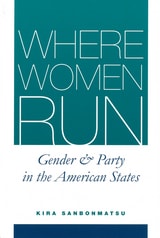
Where Women Run
Gender and Party in the American StatesKira Sanbonmatsu
University of Michigan Press, 2010
“Kira Sanbonmatsu has done a masterful job of linking the representation of women in elective office to the activities of party organizations in the states. She combines qualitative and quantitative data to show how women are navigating the campaign process to become elected leaders and the changing role of party organizations in their recruitment and election. It is a significant contribution to the study of representative democracy.”
--Barbara Burrell, Northern Illinois University
“Sanbonmatsu has produced an excellent study that will invigorate research on the role of political parties and the recruitment of women candidates. Using a variety of methods and data sources, she has crafted a tightly constructed, clearly argued, and exceedingly well-written study. A commendable and convincing job.”
--Gary Moncrief, Boise State University
“Sanbonmatsu offers important insights in two neglected areas of American politics: the role of political parties in recruiting candidates and the continued under-representation of women in elected office. Connecting the two subjects through careful qualitative and statistical methods, insightful interpretation of the literature and interesting findings, the book is a significant new addition to scholarship on parties, gender, and political recruitment.”
--Linda Fowler, Dartmouth College
Kira Sanbonmatsu is Associate Professor of Political Science at Rutgers University and Senior Scholar at the Eagleton Institute of Politics’ Center for American Women and Politics (CAWP). She was previously associate professor at Ohio State University. She is the author of Democrats, Republicans, and the Politics of Women’s Place.
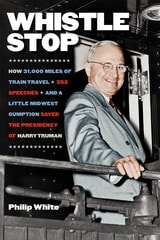
Whistle Stop
How 31,000 Miles of Train Travel, 352 Speeches, and a Little Midwest Gumption Saved the Presidency of Harry TrumanPhilip White
University Press of New England, 2015
Who Runs?
The Masculine Advantage in Candidate EmergenceSarah Oliver and Meredith Conroy
University of Michigan Press, 2020
Meredith Conroy and Sarah Oliver focus on the candidate emergence process (recruitment, perceived qualifications, and ambition), and investigate the affects of individuals’ gender personality on these variables to improve theories of women’s underrepresentation in government. They argue that since politics and masculinity are congruent, we should observe more precise variation in the candidate emergence process along gender differences, than along sex differences in isolation. Individuals who are more masculine will be more likely to be recruited, perceive of themselves as qualified, and express political ambition, than less masculine individuals. This differs from studies that look at sex differences, because it accepts that some women defy gender norms and break into politics. By including a measure of gender personality we can more fully grapple with women’s progress in American politics, and consider whether this progress rests on masculine behaviors and attributes. Who Runs? The Masculine Advantage in Candidate Emergence explores this possibility and the potential ramifications.
Who Wants to Run?
How the Devaluing of Political Office Drives PolarizationAndrew B. Hall
University of Chicago Press, 2019
Andrew B. Hall argues that we have missed one of the most important reasons for this ideological gulf: the increasing reluctance of moderate citizens to run for office. While political scientists, journalists, and pundits have largely focused on voters, worried that they may be too partisan, too uninformed to vote for moderate candidates, or simply too extreme in their own political views, Hall argues that our political system discourages moderate candidates from seeking office in the first place. Running for office has rarely been harder than it is in America today, and the costs dissuade moderates more than extremists. Candidates have to wage ceaseless campaigns, dialing for dollars for most of their waking hours while enduring relentless news and social media coverage. When moderate candidates are unwilling to run, voters do not even have the opportunity to send them to office. To understand what is wrong with our legislatures, then, we need to ask ourselves the question: who wants to run? If we want more moderate legislators, we need to make them a better job offer.
Why Americans Split Their Tickets
Campaigns, Competition, and Divided GovernmentBarry C. Burden and David C. Kimball
University of Michigan Press, 2004
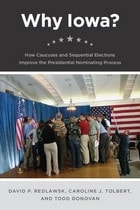
Why Iowa?
How Caucuses and Sequential Elections Improve the Presidential Nominating ProcessDavid P. Redlawsk, Caroline J. Tolbert, and Todd Donovan
University of Chicago Press, 2010
If Barack Obama had not won in Iowa, most commentators believe that he would not have been able to go on to capture the Democratic nomination for president. Why Iowa? offers the definitive account of those early weeks of the campaign season: from how the Iowa caucuses work and what motivates the candidates’ campaigns, to participation and turnout, as well as the lingering effects that the campaigning had on Iowa voters. Demonstrating how “what happens in Iowa” truly reverberates throughout the country, five-time Iowa precinct caucus chair David P. Redlawsk and his coauthors take us on an inside tour of one of the most media-saturated and speculated-about campaign events in American politics.
Considering whether a sequential primary system, in which early, smaller states such as Iowa and New Hampshire have such a tremendous impact is fair or beneficial to the country as a whole, the authors here demonstrate that not only is the impact warranted, but it also reveals a great deal about informational elements of the campaigns. Contrary to conventional wisdom, this sequential system does confer huge benefits on the nominating process while Iowa’s particularly well-designed caucus system—extensively explored here for the first time—brings candidates’ arguments, strengths, and weaknesses into the open and under the media’s lens.
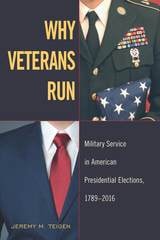
Why Veterans Run
Military Service in American Presidential Elections, 1789-2016Jeremy M. Teigen
Temple University Press, 2017
The assumptions that military service helps candidates attract votes—while lacking it harms a candidate’s chances—has been an article of faith since the electoral coronation of George Washington in 1789. Perhaps the most compelling fact driving the perception that military service helps win votes is the large number of veterans who have held public office. Some candidates even exaggerate their military service to persuade voters. However, sufficient counter-examples undermine the idea that military veterans enjoy an advantage when seeking political office.
In Why Veterans Run, Jeremy Teigenexplains the tendency of parties to elevate those with armed forces experience to run for high office. He describes the veteran candidate phenomenon by examining the related factors and patterns, showing why different eras have more former generals running and why the number of veterans in election cycles varies. With both quantitative and qualitative analysis, Why Veterans Run investigates each postwar era in U.S. electoral history and elaborates why so many veterans run for office. Teigen also reveals how election outcomes with veteran candidates illuminate the relationship between the military and civilian spheres as well as the preferences of the American electorate.
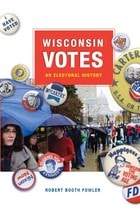
Wisconsin Votes
An Electoral HistoryRobert Booth Fowler
University of Wisconsin Press, 2008
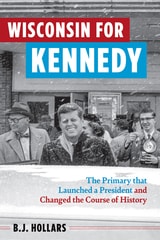
Wisconsin for Kennedy
The Primary That Launched a President and Changed the Course of HistoryB. J. Hollars
Wisconsin Historical Society Press, 2024
When John F. Kennedy ran for president in 1960, he did something no candidate had done before: he leveraged the power of state primaries to win his party’s nomination. Kennedy’s first battleground state? Wisconsin—a state that would prove more arduous, more exhausting, and more crucial to winning the presidency than any other.
Wisconsin for Kennedy brings to life the stories behind JFK’s history-making 1960 Wisconsin primary campaign, and how Kennedy’s team managed to outmaneuver his politically seasoned opponent, Hubert Humphrey. From Jackie Kennedy commandeering a supermarket loudspeaker in Kenosha, to the Wisconsin forklift driver who planned President Kennedy’s final trip to Dallas, this captivating book places readers at the heart of the action.
Author B.J. Hollars chronicles JFK’s nail-biting Wisconsin win by drawing on rarely cited oral histories from the eclectic team of people who worked together to make it happen: a cranberry farmer, a union leader, a mayor, an architect, and others. Wisconsin for Kennedy explores how Wisconsin helped propel JFK all the way to the White House in a riveting historical account that reads like a work of rollicking, page-turning fiction.
“In the spirit of Theodore H. White’s The Making of The President: 1960, B.J. Hollars offers a vivid account of the Wisconsin primary that launched JFK’s successful presidential campaign, inspiring voters to pass the torch to a new generation of leadership for our country. Anyone mesmerized by JFK’s legacy will enjoy this great read.”
—Former US Representative Ron Kind
“For generations, my family has had the great privilege of serving the people of Wisconsin. In Wisconsin for Kennedy, B.J. Hollars performs his own act of service, recounting the riveting and untold story of Wisconsin’s politically perilous 1960 primary. A poignant contribution to political history that reads like a page-turner.”
—Former Wisconsin Governor James Doyle Jr.
"A hopeful quality . . . pervades Wisconsin for Kennedy, written about a time and place when politics was conducted in a less severe and divisive way than it is now. Hollars further succeeds in showing how political history is made by a wide range of citizens. Wisconsinites, Midwesterners, and indeed Americans of all political persuasions can be grateful to B.J. Hollars for these important reminders."
— Middle West Review
Women for President
Media Bias in Eight CampaignsErika Falk
University of Illinois Press, 2007
When Hillary Clinton announced her 2008 bid for president she was the Democratic front-runner. Despite this, she received less coverage than Barack Obama, who trailed her in the polls. Such a disparity is indicative of the gender bias the media has demonstrated in covering women candidates since the first woman ran for America’s highest office in 1872. Tracing the campaigns of eight women who ran for president through 2004--Victoria Woodhull, Belva Lockwood, Margaret Chase Smith, Shirley Chisholm, Patricia Schroeder, Lenora Fulani, Elizabeth Dole, and Carol Moseley Braun--Erika Falk finds little progress in the fair treatment of women candidates. A thorough comparison of the women’s campaigns to those of their male opponents reveals a worrisome trend of sexism in press coverage--a trend that still persists today.
While women have been elected to the highest offices in countries such as England, Germany, and India, the idea that a woman could be president of the United States provokes scoffs and ridicule. The press portrays female candidates as unviable, unnatural, and incompetent, and often ignores or belittles women instead of reporting their ideas and intent. Since voters learn most details about presidential candidates through media outlets, Falk asserts that this prevailing bias calls into question the modern democratic assumption that men and women have comparable access to positions of power.
Women for President
Media Bias in Nine CampaignsErika Falk
University of Illinois Press, 2010
Newly updated to examine Hillary Clinton's formidable 2008 presidential campaign, Women for President analyzes the gender bias the media has demonstrated in covering women candidates since the first woman ran for America's highest office in 1872. Tracing the campaigns of nine women who ran for president through 2008--Victoria Woodhull, Belva Lockwood, Margaret Chase Smith, Shirley Chisholm, Patricia Schroeder, Lenora Fulani, Elizabeth Dole, Carol Moseley Braun, and Hillary Clinton--Erika Falk finds little progress in the fair treatment of women candidates. The press portrays female candidates as unviable, unnatural, and incompetent, and often ignores or belittles women instead of reporting their ideas and intent. This thorough comparison of men's and women's campaigns reveals a worrisome trend of sexism in press coverage--a trend that still persists today.