475 books match the query 'Catholic' and 14 start with w
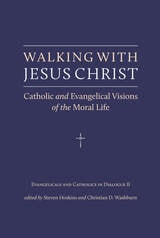
cover of Walking with Jesus Christ: Catholic and Evangelical Visions of the Moral Life

Walking with Jesus Christ

Catholic and Evangelical Visions of the Moral Life

Steven Hoskins

Saint Paul Seminary Press, 2023
Walking with Jesus Christ: Catholic and Evangelical Visions of the Moral Life is the collected essays and consensus statements of the second round of the National Evangelical-Catholic Dialogue. In 2021 the National Evangelical-Catholic Dialogue completed its four-year round of discussion on the moral life, at the University of St. Thomas in St. Paul, MN. Sessions were held each year on the following topics. In 2017, the dialogue discussed the norms governing the moral life. In 2018, the dialogue discussed sexual ethics. In 2019, the dialogue discussed social ethics. Finally, in 2021 the dialogue discussed the relationship of the moral life to eschatology. At each of the annual meetings, members presented background papers that formed the basis of that meeting’s discussion and became starting points for constructing a common statement. These common statements and background papers make up this book. The members of the dialogue hope this book will provide a fruitful starting point for future conversations between evangelicals and Catholics. The Catholic essays begin with the contributions of Catholic theologians Daniel Keating, William Stevenson and Christian Washburn, who examine the various norms for Catholic moral theology including the role of Scripture, tradition, magisterium, and natural law (2017). David Fleischacker, Daniel Keating, and Christian Washburn examine the morality of marriage, contraception, abortion, and homosexual acts (2018). Daniel Keating and William Stevenson discuss social ethics, including Catholic social teaching and socialism (2019). David Fleischacker and Christian Washburn discuss the relationship of the moral life to our final beatific end (2020). The Evangelical essays begin with the contribution of Evangelical theologians Bruce Cromwell and Dennis Jowers who explore the norms of Protestant Ethics (2017). David Van Drunen and Luke Geraty discuss sexual ethics from different ends of the Evangelical perspective (2018). Glen Menzies and Steve Hoskins evaluate approaches to evangelical social ethics from Pentecostal and Wesleyan points of view (2019). Bruce Cromwell and Steve Hoskins discuss the notions of eschatology and ethics from a Wesleyan viewpoint (2020).
[more]
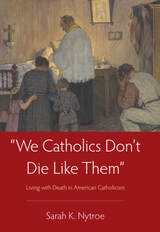
cover of We Catholics Don't Die Like Them: Living with Death Before Vatican II

We Catholics Don't Die Like Them

Living with Death Before Vatican II

Sarah Nytroe

Catholic University of America Press, 2026
We Catholics Don’t Die Like Them is the study of a minimally explored topic in American religious history, that of the Catholic approach to death and dying in the first half of the 20th century. Moreover, it advances scholarly understanding of three interrelated themes: cultural and social views of death and practices of dying; the Catholic religious culture and experience before the Second Vatican Council; and the relationship between Catholicism and modernity. While historians and scholars have explored these themes independently, this study seeks to draw them together in a manner that has yet to be fully considered. Finally, the study is grounded in a rich body of primary sources, the everyday religious literature produced to sustain the good death among Catholics. First, scholars from various disciplinary backgrounds, including history, have studied sociocultural attitudes about death and experiences of dying, those of both the past and the present. Those historical studies that examine death and dying do so through the lens of the Protestant religious culture and experience, giving limited to no attention to American Catholicism. Studies that have examined the Catholic approach to death and dying primarily focus on beliefs and practices in the medieval to early modern Church. Rarely have scholars extended the narrative into the modern period, especially the 20th century United States. This scholarly silence is surprising considering that historians have increasingly examined multiple dimensions of American Catholicism and the dynamic relationship between the institution and the "people in the pews." This study seeks to draw attention to this feature of the American Catholic religious culture and how it paralleled other aspects of the pre-Vatican II Catholic culture. Lastly, historians have long studied the relationship between Catholicism and modernity. Numerous studies have examined the ambivalence that existed in the Church towards the ideas, values, and structures of modernity in the pre-conciliar American context. Institutional anxiousness about the influence of modernity permeated the religious culture and the everyday lives of practicing Catholics. Church authorities remained apprehensive about how modern ideas influenced the faithful’s thoughts about death, how they died, how the living supported the dying in their last hour, and how they remembered the dead. This sense of anxiousness emerges in the content and tone of the religious literature produced for Catholics, and yet, historians have yet to fully explore this feature of the relationship.
[more]
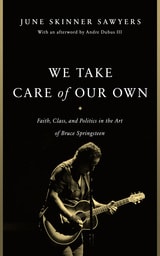
cover of We Take Care of Our Own: Faith, Class, and Politics in the Art of Bruce Springsteen

We Take Care of Our Own

Faith, Class, and Politics in the Art of Bruce Springsteen

June Skinner Sawyers

Rutgers University Press, 2024
We Take Care of Our Own traces the evolution of Bruce Springsteen’s beliefs, beginning with his New Jersey childhood and ending with his most recent works from Springsteen on Broadway to Letter to You. The author follows the singer’s life, examining his albums and a variety of influences (both musical and nonmusical), especially his Catholic upbringing and his family life, to show how he became an outspoken icon for working-class America—indeed for working-class life throughout the world. In this way, the author emphasizes the universality of Springsteen’s canon and depicts how a working-class sensibility can apply to anyone anywhere who believes in fairness and respect. In addition, the author places Springsteen in the historical context not only of literature (especially John Steinbeck) but also of the art world (specifically the work of Thomas Hart Benton and Edward Hopper). Among the themes explored in the book include community, a sense of place, America as the Promised Land, the myth of the West, and, ultimately, mortality.
 
[more]
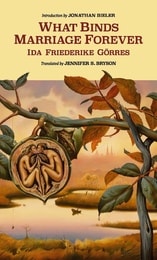
cover of What Binds Marriage Forever?

What Binds Marriage Forever?

Ida Friederike Gorres

Catholic University of America Press, 2025
What Binds Marriage Forever is a collection of texts written from 1956 to 1971 by Ida Friederike Görres, herself a married lay woman. Her main focus is the indissolubility of marriage. n the Preface, Görres observes the emergence of a marriage crisis in the West. “Each passing day,” she writes, “the conversation about marriage grows in gravity and urgency.” She wrote this in 1956; she could have written this and the other parts of this book in 2023. The centerpiece of the book is Chapter 1, written in 1971. She argues against Catholics who are trying to reframe marriage a mere love-bond that ceases when love ceases. She mounts a defense of the Catholic teaching on marriage against her counterparts’ calls to allow divorce and remarriage. She exposes the central role modern individualism plays in their arguments. She demon­strates how their arguments are ahistorical, a recipe for relational instability, and harmful to those who suffer when their spouses are adulterous, especially when the adulterous spouse is cheered on for acting out of “love.” Her core argument is that what binds marriage forever is a combination of “covenant, law, and grace, that is, sacrament.” Chapters 2 and 3 explore the topic of marriages between Catholics and bap­tized non-Catholics or non-Christians. Görres discusses the difficulties that such marriages can generate, not least of all the decision of which faith the children should be raised in. Chapter 4 is an overview of the sacramentality of marriage. She explains how marriage relates to the indissoluble bond between God and creation and she explains how the three traditional goods of marriage (fidelity, sacrament, off­spring) are reflected in the marriage liturgy.
[more]
cover of What Makes a Carmelite a Carmelite: Exploring Carmel's Charism

What Makes a Carmelite a Carmelite

Exploring Carmel's Charism

Keith J. Egan

Catholic University of America Press, 2022
Vatican II initiated lively conversations about the identity of religious orders and congregations when the council pointed out that these religious communities are divine gifts in and to the church. Keith Egan examines the nature of these charisms including, not only the original or founders’ charism, but how charisms evolve over the centuries. Special theological attention to these charisms show that they are not something but, in fact, are the dynamic presence of the Holy Spirit. This volume offers a case study the original charism of the Carmelites. The first Carmelites originated when various hermits were displaced by the armies of Saladin. These dislodged hermits sought refuge on Mount Carmel in a ravine facing the Mediterranean Sea. There, these hermits, now Carmelites, sought from Saint Albert, Patriarch of Jerusalem, a description of their life of solitude. Albert’s Formula of Life describes the original Carmelite charism as a life of prayer and contemplation. This Formula eventually became a Rule that made possible a transformation of hermits into friars. Egan is at work on a sequel that examines this radical transformation.
[more]
cover of Whose Sacrifice is the Eucharist? The Offering of Christ and His Church in Catholic and Methodist Theology

Whose Sacrifice is the Eucharist? The Offering of Christ and His Church in Catholic and Methodist Theology

Stephen B. Sours

Catholic University of America Press, 2024
This book explores what Catholics and Methodists believe about eucharistic sacrifice. Eucharistic sacrifice refers to the offering that Christ and his church make in the celebration of the Lord’s Supper. It is, therefore, both a Christian doctrine and a church practice. The sacrificial dimension of the sacrament comes both from Christ’s sacrifice on the cross and from his self-offering at the Last Supper in which Christ gives himself to the Father on behalf of his people. “This is my body, which is given for you” (Luke 22:19). The eucharist is a sacrificial meal because in the bread and cup Christians are united to the body and blood of Christ that was sacrificed for them on the cross. Moreover, the resurrected Lord is really present with his people in the eucharist, and while his historic crucifixion is an event in the past, Jesus’ salvation continues and his grace is given to his people in the sacrament, “for this is my blood of the covenant, which is poured out for many for the forgiveness of sins” (Matthew 26:28). Catholics and Methodists believe that Jesus instructs his followers to repeat his words and actions from the Last Supper in their celebration of the eucharist, but a long running assumption is that Catholics and Methodists—following the historic Reformation schism—are deeply divided over eucharistic sacrifice. This book challenges that assumption by analyzing what these churches teach on eucharistic sacrifice from historical, sacramental, liturgical, and ecumenical perspectives. Key figures like Thomas Aquinas and John Wesley help define eucharistic sacrifice in each tradition. Subsequently, authoritative texts such as ecclesial statements, eucharistic prayers, and hymns further specify what Catholics and Methodists believe they are doing when they offer the eucharist to God. Sours argues that far from being divided, Catholics and Methodists have much in common regarding this controversial doctrine.
[more]
cover of Why Read Pascal?

Why Read Pascal?

Paul J. Griffiths

Catholic University of America Press, 2021
Blaise Pascal (1623-1662) is known in the English-speaking world principally for the wager (an argument that it is rational to do what will affect belief in God and irrational not to), and, more generally, for the Pensées, a collection of philosophical and theological fragments of unusual emotional and intellectual intensity collected and published after his death. He thought and wrote, however, about much more than this: mathematics; physics; grace, freedom, and predestination; the nature of the church; the Christian life; what it is to write and read; the order of things; the nature and purpose of human life; and more. He was among the polymaths of the seventeenth century, and among the principal apologists of his time for the Catholic faith, against both its Protestant opponents and its secular critics. Why Read Pascal? engages all the major topics of Pascal's theological and philosophical writing. It provides discussion of Pascal's literary style, his linked understandings of knowledge and of the various orders of things, his anthropology (with special attention to his presentation of affliction, death, and boredom), his politics, and his understanding of the relation between Christianity and Judaism. Pascal emerges as a literary stylist of a high order, a witty and polemical writer (never have the Jesuits been more thoroughly eviscerated), and, perhaps above all else, as someone concerned to show to Christianity's cultured despisers that the fabric of their own lives implies the truth of Christianity if only they can be brought to look at what their lives are like. Why Read Pascal? is the first book in English in a generation to engage all the principal themes in Pascal's theology and philosophy. The book takes Pascal seriously as an interlocutor and as a contributor of continuing relevance to Catholic thought; but it also offers criticisms of some among the positions he takes, showing, in doing so, how lively his writing remains for us now.
[more]
cover of Why Read Pavel Florensky?

Why Read Pavel Florensky?

John Burgess

Catholic University of America Press, 2024
This book offers an excellent, accessible introduction to the life and thought of Father Pavel Florensky, one of the most prominent religious philosophers of Russia’s highly creative Silver Age at the beginning of the twentieth century. Florensky, an Orthodox priest, died in Stalin’s gulag in 1937. His writings were long suppressed in the Soviet Union, and Western Protestant and Catholic theologians have known little about him. John Burgess argues that it is time to give Florensky his due. His worldview is as important today as it was during his lifetime: a deep sensitivity to the beauty of the natural world; a conviction that the religious cult—acts of worship and ritual—make human culture possible; and an understanding of the Christian faith as, above all, a way of seeing God’s glorious presence in all of creation. The book takes a unique approach by examining Florensky not primarily as an academic philosopher but rather as an Orthodox priest and theologian, who speaks out of his personal religious experience to communicate the Christian faith to people who are seeking truth but do not yet know church life. The book makes an original contribution to Florensky scholarship and literature, especially in the United States, where his colleagues Sergei Bulgakov and Nicholas Berdiaev have been better known. John Burgess is a Protestant theologian who has lived and travelled in Russia, and has visited key places associated with Florensky. The author’s experience, even as an outsider, of Orthodox worship and practice—its liturgical cycles, iconography, seasons of fasting and feasting, and monasteries and holy sites—has enabled him to understand Florensky’s admonition that one must enter into Orthodoxy in order to understand it (and Florensky’s) thinking.
[more]
cover of Witness through Encounter: The Diplomacy of Benedict XVI

Witness through Encounter

The Diplomacy of Benedict XVI

Bernard J. O'Connor

St. Augustine's Press, 2019

Appealing to dialogue is often just a safe way of referring to something negative, or at best blandly neutral: the avoidance of conflict, the denial of similarity, not stirring deep-seated disagreement, etc. When Bernard o’Connor says pope Benedict XVI facilitated dialogue, however, he means something quite positive, very much tangible and certainly transformative. In providing an account of the pope’s interactions with various groups of the international community, O’Connor attempts to convey Benedict XVI’s diplomacy as encounter, where even in the sphere of international relations exhortations to “dialogue” are invitations to see more clearly and be moved as much as move.

To dialogue is to embrace, revise perception such that our approaches to the great questions of our day are not simply shared but correct. As O’Connor writes, “Pope Benedict attempts to promote the outlook that a renewed emphasis upon objective, critical and structured philosophical reasoning positions practice, diplomatic and otherwise, to regain its lost foundation and framework. the quest for integrity, if nothing else, should motivate our fidelity to academic pursuit, to intellectual investigation, and to rigorous interdisciplinary inquiry. so influenced, practice will then reject what is arbitrary and be guided by what is time-tested and enduring.”

O’Connor illustrates true dialogue emerging from the encounter, and in turn provides scores of characteristics of this encounter as it unfolds in papal diplomacy. In providing scores of addresses and speeches to various bodies, O’Connor presents pope Benedict XVI as an example of effective diplomacy that treats the meetings on the world stage as engaging in true dialogue. encounter is the true basis of dialogue and one that allows it to open to what is truly a catalyst for change toward cooperation––witness, both personal and collective. As o’Connor shows, “where there is authentic encounter, as meeting in mutual trust, what arises is context for witness.” If authentic even the diplomatic encounter has the means to deepen and transform one’s being.

Witness Through Encounter intends to fulfill multiple needs. the diplomatic approach exemplified herein is singular and worthy of study among political scientists, sociologists, philosophers and diplomats eager to embrace a worldview that is more personal than simply humanistic. this work will also be useful in inter-religious settings. An additional advantage of O’Connor’s presentation of Benedict XVI’s diplomatic approach, his witness through encounter, is that it contains insight valuable to the scholar alongside the resources used.
[more]
cover of Witnesses to Beatitude: Seven Romanian Greek Catholic Bishops Under Communism

Witnesses to Beatitude

Seven Romanian Greek Catholic Bishops Under Communism

Francisca Băltăceanu

Catholic University of America Press, 2026
Veteran authors Francisca Băltăceanu and Monica Broşteanu render extensive archival research into a readable, stand-alone volume about seven key figures in the outlawed Romanian Greek Catholic Church. Prefaced by the Greek Catholic bishop of Bucharest, the book synthesizes indispensable background information for reading the story of these twentieth-century church leaders from Transylvania where in 1700 an agreement of union was reached between the Romanian Orthodox leadership and the Catholic Church in Rome, forming the Romanian Church United to Rome, Greek Catholic. In 1948 the Soviet-imposed government in Romania determined that the Romanian Greek Catholic Church no longer existed and detained its bishops: Vasile Aftenie, Valeriu Traian Frenţiu, Ioan Suciu, Ioan Bălan, Alexandru Rusu, and Iuliu Hossu. At the same time, it detained numerous priests including Tit Liviu Chinezu who was secretly consecrated bishop at the request of the papal nuncio. I>Witnesses to Beatitude traces the bishops’ various origins and the extensive pressures put on them to cut their ties with the Vatican. For creatively resisting these pressures the seven men were put in the infamous Sighet prison and under house arrest where in 1969 Iuliu Hossu, the last to survive, was made a cardinal in pectore by Pope Paul VI. The book garnered a large bipartisan Catholic and Orthodox readership in Romania where it was a bestseller at the 2019 Bookfest. Drawing from the casefile submitted to the Holy See to recognize the martyrdom of the seven bishops who were beatified in June 2019, the book documents how the Communist government conducted a fierce campaign to ban the Greek Catholic Church and made the Orthodox leadership look responsible. The book includes oral testimonies suggesting the life force and humor that brought the bishops through the storm. It also contains the full bibliography of the casefile and an introduction and updated bibliography for English-language readers.
[more]
cover of Women and Religion in Medieval and Renaissance Italy

Women and Religion in Medieval and Renaissance Italy

Edited by Daniel Bornstein and Roberto Rusconi

University of Chicago Press, 1996

Between the twelfth and the sixteenth centuries, women assumed public roles of unprecedented prominence in Italian religious culture. Legally subordinated, politically excluded, socially limited, and ideologically disdained, women's active participation in religious life offered them access to power in all its forms.

These essays explore the involvement of women in religious life throughout northern and central Italy and trace the evolution of communities of pious women as they tried to achieve their devotional goals despite the strictures of the ecclesiastical hierarchy. The contributors examine relations between holy women, their devout followers, and society at large.

Including contributions from leading figures in a new generation of Italian historians of religion, this book shows how women were able to carve out broad areas of influence by carefully exploiting the institutional church and by astutely manipulating religious percepts.
[more]
cover of Words Made Flesh: The Sacramental Mission of Catholic Education

Words Made Flesh

The Sacramental Mission of Catholic Education

R. Jared Staudt

Catholic University of America Press, 2024
Forming souls and building culture together form the sacramental mission of Catholic education. These profoundly related goals are laid out by the Church for education, following the general sacramental principle that permeates the whole of Catholic life. This approach seeks conformity to the Logos, the divine mind, that shapes the way disciples think, imagine, and pray. Guided by this approach, the student will be able to contemplate the truth of reality in a holistic and integrated fashion. As sacramental, it also leads to a concrete embodiment in the life of the Christian community and the daily actions of the disciple. A sacramental approach to education draws together the inner and outer life: mind and body, soul and culture, prayer and work, salvation and mission, the individual and community. For the future of society and renewal within the Church, we need nothing less than a reintegration of the person and our communities through the renewal of education, forming students deeply rooted in our heritage and prepared to hand it on in creative ways.
[more]
cover of Writings on Grace: The Complete <i>Ecrits sur la grace</i>

Writings on Grace

The Complete <i>Ecrits sur la grace</i>

Blaise Pascal

Catholic University of America Press, 2025
A few years before he died in 1662, Blaise Pascal wrote fifteen interconnected essays on grace, which have collectively come to be known as the Écrits sur la grâce. These were not published before his death, and were not polished and revised by him with an eye to publication, which means that they show his mind at work experimentally, trying out lines of argument and engagements with magisterial and patristic texts without resolving them into anything like a final system. The Écrits are replete with experimental formulations and bursts of literary and intellectual energy; taken together, they provide an intense and extreme presentation of Pascal's version of Augustinianism with respect to grace, election, and predestination, the meaning of the Council of Trent, and much else. These essays provide one of the keys to the entirety of Pascal's thought, and they provide a view of grace's workings -- perhaps better, a grammar of grace -- which still warrants serious attention by Catholic theologians. Less than one-fifth of the Écrits has yet been published in English. This book provides a complete translation, made from the French text provided in Michel Le Guern's edition (1998, 2000) of Pascal's Oeuvres complètes, and annotated to provide full information about Pascal's sources and how he used them. The translation is followed by a substantial interpretive essay in which Pascal's positions and approaches are restated and argued with.
[more]
cover of Writings on the Apocalypse

Writings on the Apocalypse

Francis X. Gumerlock

Catholic University of America Press, 2022

The Apocalypse or Book of Revelation is one of the most frequently discussed books of the biblical canon and arguably one of the most difficult to interpret. This volume contains three texts as examples of late ancient Christian interpretation of its intriguing visions. It also includes a comprehensive introduction to each text by its respective translator. Brief Explanations of the Apocalypse by Cassiodorus (c. 580), translated by Francis X. Gumerlock from Latin and published in English for the first time in this volume, served as an introduction to the Book of Revelation for Cassiodorus’s students at the Vivarium, a monastery in southern Italy. Cassiodorus divided the Apocalypse into 33 sections, corresponding to the age of Jesus at his Passion, and expressed his belief that John’s visions were revelations of the end of the world, including the Second Coming of Christ for judgment, the defeat of the Antichrist, the general resurrection, and the arrival of the heavenly Kingdom. Testimonies of Gregory the Great on the Apocalypse, translated from Latin by Mark DelCogliano and also published here for the first time in English, is a collection of 55 excerpts on the Apocalypse from the writings of St. Gregory the Great (d. 604) compiled by an anonymous author. Drawn mainly from Gregory’s Moralia, but also from his Book on Pastoral Care and homilies, the excerpts, which are arranged from Revelation 1.4 to 22.17, illustrate Gregory’s grammatical exegesis of the Apocalypse, his interpretation of various figures in the Apocalypse, and his attempt to reconcile certain passages in the Apocalypse with seemingly contradictory texts from other parts of Scripture. The anonymous Greek Scholia on the Apocalypse contains 39 exegetical notes on chapters 1-14 of the Apocalypse, which reveal influences of Origen and Didymus the Blind, among others. The notes provide “spiritual” interpretations of the various passages and give attention to the interpretation of certain words that appear in the Book of Revelation. This new translation from the Greek by T. C. Schmidt utilizes all the Greek editions. Furthermore, its introductory matter contains updates on the Scholia from the latest scholarship and compares each scholion with interpretations found in various patristic authors, mainly of Alexandrian heritage.
[more]