Results by title
264 books match the query 'Chicago (Ill.)' and 8 start with w
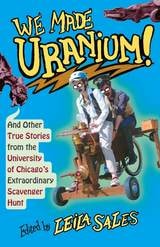
We Made Uranium!
And Other True Stories from the University of Chicago's Extraordinary Scavenger HuntEdited by Leila Sales
University of Chicago Press, 2018
Item #74: Enter a lecture class in street clothes. Receive loud phone call. Shout “I NEED TO GO, THE CITY NEEDS ME!” Remove street clothes to reveal superhero apparel. Run out for the good of the land.
Item #293: Hypnotizing a chicken seems easy, but if the Wikipedia article on the practice is to be believed, debate on the optimal method is heated. Do some trials on a real chicken and submit a report . . . for science of course.
Item #234: A walking, working, people-powered but preferably wind-powered Strandbeest.
Item #188: Fattest cat. Points per pound.
The University of Chicago’s annual Scavenger Hunt (or “Scav”) is one of the most storied college traditions in America. Every year, teams of hundreds of competitors scramble over four days to complete roughly 350 challenges. The tasks range from moments of silliness to 1,000-mile road trips, and they call on participants to fully embrace the absurd. For students it is a rite of passage, and for the surrounding community it is a chance to glimpse the lighter side of a notoriously serious university.
We Made Uranium! shares the stories behind Scav, told by participants and judges from the hunt’s more than thirty-year history. The twenty-three essays range from the shockingly successful (a genuine, if minuscule, nuclear reaction created in a dorm room) to the endearing failures (it’s hard to build a carwash for a train), and all the chicken hypnotisms and permanent tattoos in between. Taken together, they show how a scavenger hunt once meant for blowing off steam before finals has grown into one of the most outrageous annual traditions at any university. The tales told here are absurd, uplifting, hilarious, and thought-provoking—and they are all one hundred percent true.
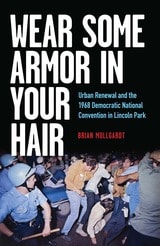
Wear Some Armor in Your Hair
Urban Renewal and the 1968 Democratic National Convention in Lincoln ParkBrian Mullgardt
Southern Illinois University Press, 2024
WINNER, 2025 Illinois State Historical Society Russell P. Strange Book of the Year Award!
Police brutality, gentrification, and grassroots activism in 1960s Chicago
In August of 1968, approximately 7,000 people protested the Vietnam War against the backdrop of the Democratic National Convention in Chicago. This highly televised event began peacefully but quickly turned into what was later termed a “police riot.” Brian Mullgardt’s investigation of this event and the preceding tensions shines a light on the ministers, Yippies, and community members who showed up and stood together against the brutality of the police. Charting a complex social history, Wear Some Armor in Your Hair brings together Chicago history, the 1960s, and urbanization, focusing not on the national leaders, but on the grassroots activists of the time.
Beginning in 1955, two competing visions of urban renewal existed, and the groups that propounded each clashed publicly, but peacefully. One group, linked to city hall, envisioned a future Lincoln Park that paid lip service to diversity but actually included very little. The other group, the North Side Cooperative Ministry, offered a different vision of Lincoln Park that was much more diverse in terms of class and race. When the Yippies announced anti-war protests for the summer of ‘68, the North Side Cooperative Ministry played an instrumental role. Ultimately, the violence of that week altered community relations and the forces of gentrification won out.
Mullgardt’s focus on the activists and community members of Lincoln Park, a neighborhood at the nexus of national trends, broadens the scope of understanding around a pivotal and monumental chapter of our history. The story of Lincoln Park, Chicago, is in many ways the story of 1960s activism writ small, and in other ways challenges us to view national trends differently.
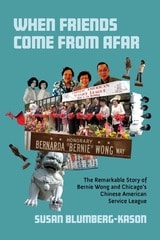
When Friends Come From Afar
The Remarkable Story of Bernie Wong and Chicago's Chinese American Service LeagueSusan Blumberg-Kason
University of Illinois Press, 2024
At once intimate and broad in scope, When Friends Come from Afar uses one woman’s life to illuminate a bedrock Chicago institution.
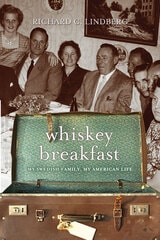
Whiskey Breakfast
My Swedish Family, My American LifeRichard C. Lindberg
University of Minnesota Press, 2011
Chicago in the 1920s: Clark Street was the city’s last Swedetown, a narrow corridor of weather-beaten storefronts, coal yards, and taverns running along the north side of the city and the locus of Swedish community life in Chicago during the first half of the twentieth century. It represented a way station for a generation of working-class immigrants escaping the hardships of the old country for the promise of a brighter new day in a halfway house of sorts, perched between the old and new lands. For Richard C. Lindberg, whose Swedish immigrant parents and grandparents settled there, it was also the staging ground for an intensely personal, multigenerational, coming-of-age drama based on the struggles of two disparate families—their dreams and their depravities, their victories and their failures.
Whiskey Breakfast is Lindberg’s captivating tale of life as a first-generation baby-boomer Swedish American, caught between the customs of a land he had never been to and the desire to conform and fit into a troubled existence, tragically scarred by alcoholism, divorce, and peer abuse. But it is also a powerful and intimate portrait of his immigrant ancestors, and especially of his father, Oscar—a contractor and master builder who helped develop Chicago’s post–World War II suburbs. A paradoxical man, known to some as a socialist, an anarchist, and a serious drinker, Oscar would carry with him to the grave a sixty-two-year-old family secret, a secret that for Lindberg lies at the very heart of the great Swedish unrest that drove his father and countless other men and women out of Sweden and onward to America.
Masterfully blending autobiography with immigrant history, Whiskey Breakfast surrounds Lindberg’s family story with Swedish cultural history and politics, as well as remarkable Chicago history and how Clark Street and Swedetown became, and in many ways remain, a center of Swedish immigrants’ social and cultural life. Far from a eulogy for an idealized past, Lindberg has crafted a moving and sobering memoir of a young man’s struggle to come to terms with his father and himself, his immigrant heritage, and his native home.
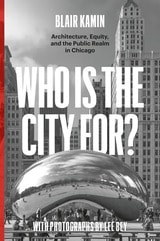
Who Is the City For?
Architecture, Equity, and the Public Realm in ChicagoBlair Kamin
University of Chicago Press, 2022
From his high-profile battles with Donald Trump to his insightful celebrations of Frank Lloyd Wright and front-page takedowns of Chicago mega-projects like Lincoln Yards, Pulitzer Prize–winning architecture critic Blair Kamin has long informed and delighted readers with his illuminating commentary. Kamin’s newest collection, Who Is the City For?, does more than gather fifty-five of his most notable Chicago Tribune columns from the past decade: it pairs his words with striking new images by photographer and architecture critic Lee Bey, Kamin’s former rival at the Chicago Sun-Times. Together, they paint a revealing portrait of Chicago that reaches beyond its glamorous downtown and dramatic buildings by renowned architects like Jeanne Gang to its culturally diverse neighborhoods, including modest structures associated with storied figures from the city’s Black history, such as Emmett Till.
At the book’s heart is its expansive approach to a central concept in contemporary political and architectural discourse: equity. Kamin argues for a broad understanding of the term, one that prioritizes both the shared spaces of the public realm and the urgent need to rebuild Black and brown neighborhoods devastated by decades of discrimination and disinvestment. “At best,” he writes in the book’s introduction, “the public realm can serve as an equalizing force, a democratizing force. It can spread life’s pleasures and confer dignity, irrespective of a person’s race, income, creed, or gender. In doing so, the public realm can promote the social contract — the notion that we are more than our individual selves, that our common humanity is made manifest in common ground.” Yet the reality in Chicago, as Who Is the City For? powerfully demonstrates, often falls painfully short of that ideal.
Why Architecture Matters
Lessons from ChicagoBlair Kamin
University of Chicago Press, 2001
Working the Boundaries
Race, Space, and "Illegality" in Mexican ChicagoNicholas De Genova
Duke University Press, 2005
De Genova worked for two and a half years as a teacher of English in ten industrial workplaces (primarily metal-fabricating factories) throughout Chicago and its suburbs. In Working the Boundaries he draws on fieldwork conducted in these factories, in community centers, and in the homes and neighborhoods of Mexican migrants. He describes how the meaning of “Mexican” is refigured and racialized in relation to a U.S. social order dominated by a black-white binary. Delving into immigration law, he contends that immigration policies have worked over time to produce Mexicans as the U.S. nation-state’s iconic “illegal aliens.” He explains how the constant threat of deportation is used to keep Mexican workers in line. Working the Boundaries is a major contribution to theories of race and transnationalism and a scathing indictment of U.S. labor and citizenship policies.
Writers of the Black Chicago Renaissance
Edited by Steven C. Tracy
University of Illinois Press, 2011
The volume covers a vast collection of subjects, including many important writers such as Richard Wright, Gwendolyn Brooks, and Lorraine Hansberry as well as cultural products such as black newspapers, music, and theater. The book includes individual entries by experts on each subject; a discography and filmography that highlight important writers, musicians, films, and cultural presentations; and an introduction that relates the Harlem Renaissance, the White Chicago Renaissance, the Black Chicago Renaissance, and the Black Arts Movement.
Contributors are Robert Butler, Robert H. Cataliotti, Maryemma Graham, James C. Hall, James L. Hill, Michael Hill, Lovalerie King, Lawrence Jackson, Angelene Jamison-Hall, Keith Leonard, Lisbeth Lipari, Bill V. Mullen, Patrick Naick, William R. Nash, Charlene Regester, Kimberly Ruffin, Elizabeth Schultz, Joyce Hope Scott, James Smethurst, Kimberly M. Stanley, Kathryn Waddell Takara, Steven C. Tracy, Zoe Trodd, Alan Wald, Jamal Eric Watson, Donyel Hobbs Williams, Stephen Caldwell Wright, and Richard Yarborough.